CT Is a Top Ten State - In A Good Way

Awash in a sea of negativity amidst yet another state budget deficit and intensifying concern about the prospects of additional fees, taxes, and service reductions, state residents now have an opportunity to accentuate the positive, courtesy of the 2017 Connecticut Economic Review. Noting that Connecticut is “at the epicenter of the Northeast” and “at the forefront of innovation,” the publication highlights an array of statistics that produce a “dynamic blend of advantages that make Connecticut a great place to start or grow a business.”

Among the key stats:

  • Connecticut ranks #3 in the country for the percentage of employees with advanced degrees - more than 400,000 employees have advanced degrees. And Hartford was identified as one of the 19 global Knowledge Capitals by the Brookings Institution.
  • Connecticut ranks #4 among the top states for private R&D investment per capita, at $2,227. Massachusetts, Delaware and California are the only states that rank higher. That’s also more than twice the national average.
  • Connecticut ranks #5 among the states for productivity per person, and #6 on the State Technology and Science Index, which benchmarks states on their science and technology capabilities and broader commercialization ecosystems that contribute to company growth, high value-added job creation and overall economic growth.

The state’s growing bioscience industry is responsible for more than 35,000 bioscience employees in over 2,000 companies. Connecticut also ranks #6 for academic R&D growth and #7 for state R&D investment.  Overall, the state ranks 5th in patents per capita and has 39 percent more patents than the U.S. average. Two Connecticut companies, Alexion and priceline.com, have been named by Forbes as among the nation’s most innovative companies.

In his introduction to the economic report, Governor Dannel Malloy points out that “Connecticut has grown to become a global hub in bioscience, digital media and green technology. We enjoy a combination of a real entrepreneurial spirit, remarkable experience and one of the most educated and productive workforces in the world.”

The New Economy Index, which measures how states are positioned to drive economic evolution in today’s changing society, ranks Connecticut #8 in the U.S., indicating that the state “offers the kind of environment that is particularly conducive to growth for companies that are capitalizing on the latest global economic trends.  (The top seven are Massachusetts, Delaware, California, Washington, Maryland, Colorado and Virginia.)  The ranking is based on measures in five key areas:  Knowledge jobs, Globalization, Economic dynamism, digital economy, and innovation capacity.

Produced by the Connecticut Economic Resource Center, the publication was sponsored by Eversource.

North Stonington Entrepreneur Is CT's Small Business Person of the Year

Carla Bartolucci, President & CEO of Euro-USA Trading/Jovial Foods of North Stonington, has been named the U.S. Small Business Administration’s 2017 Connecticut Small Business Person of the Year, SBA’s top annual award. According to the company’s website, Jovial Foods, Inc. was founded by a husband and wife team who have always been passionate about food, farming and traditions. Carla and Rodolfo met in the 1980’s in Bologna, where she was spending a year abroad studying Italian and he was studying agriculture. Both were born into family of talented home cooks, he in Italy and she in New England, and food was at the center of their childhoods.

She began her work in the organic food industry by creating the bionaturae brand of organic foods from Italy in 1996, after losing both of her parents to cancer by her mid-twenties, her website biography says.

“As soon as I set foot into an organic food store, I knew I wanted to get involved in organic farming and food manufacturing,” Carla Bartolucci explains. “After losing my parents, I couldn’t help but feel compassion for anyone suffering from disease or hardship, and creating good food, true and pure, was my way of caring for others.”

“We are extremely excited to honor a truly amazing line up of small business owners and champions this year, said Anne Hunt, SBA’s Connecticut District Director.  It is important to recognize these outstanding small businesses in the state as they are the job creators, innovators and the fabric of our local communities!”  “We hope the small business community will join the SBA and our host, SCORE for an inspiring awards luncheon on May 2nd in New Haven, CT.”

2017 Connecticut SBA Honorees:

  • Woman-Owned Small Business - Elizabeth Florian, Grassroots Ice Cream
  • Family-Owned Small Business - Beverlee Dacey, Amodex Products Inc.
  • CT Microenterprise Award - Katalina Riegelmann, Katalina’s Bakery
  • Minority-Owned Small Business - Miguel Tomassio, Taco Loco
  • Young Entrepreneur Small Business of the Year - Ashley Stone, Beauty Entourage
  • Financial Services Champion - Kim Rodney, Connecticut Community Bank
  • Entrepreneurial Success - Flavia Naslausky & Camilla Gazal, Zaniac Greenwich
  • Exporter of the Year - Monica Goldstein, Recovery Planner
  • Home-Based Business of the Year - Mary Goehring, Transcription Plus

The slate of leading small businesses owners in Connecticut will be honored at the Annual Small Business Week Awards Luncheon at Gateway Community College in New Haven on May 2.

“Your hard work, innovative ideas, and dedication to your employees and community have helped you build an outstanding business that has strengthened your state’s economy. The SBA is pleased to celebrate your achievements and recognize your personal role in driving our nation’s economic growth,” said Linda McMahon, administrator of the Small Business Association and a longtime Connecticut resident. The 2017 National Small Business Person of the Year will be announced at the ceremonies, along with three runner-ups.

Every year since 1963, the President of the United States has issued a proclamation announcing National Small Business Week, which recognizes the critical contributions of America’s entrepreneurs and small business owners.  This year, the dates are April 30 - May 7, 2017, with national events planned in Washington, D.C., New York City, Indianapolis, Dallas, and Fresno, California.

For more information and a complete list of Small Business Week events during the week of April 30 - May 7, 2017, visit www.sba.gov/ct.

https://youtu.be/50DcZn-9ce0

World’s Most Ethical Business: Three Headquartered in CT

Three Connecticut-based companies are among the world’s most ethical businesses. Norwalk-based Xerox Corp, Danbury’s Praxair Inc., and The Hartford, located in the Capital City are on the 2017 list developed by Ethisphere Institute, a Scottsdale, Arizona organization that measures corporate ethical standards.  The annual list has been published since 2007.

The Ethisphere Institute announced 124 companies spanning five continents, 19 countries and 52 industry sectors as the 2017 World’s Most Ethical Companies® honorees.

Ethisphere honors companies that “recognize their role in society to influence and drive positive change in the business community and societies around the world,” a news release announced the list stated. “These companies also consider the impact of their actions on their employees, investors, customers and other key stakeholders and leverage values and a culture of integrity as the underpinnings to the decisions they make each day.”

Xerox is one of only 13 honorees that have been named to the list for all 11 years, underscoring the company’s commitment to leading ethical business standards and practices.  The Hartford earned a spot on the list for the ninth time.

“At Xerox, we take great pride in our name being synonymous with innovation, quality and integrity,” said Jeff Jacobson, chief executive officer of Xerox. “We are committed to doing business the right way, with the highest degree of ethics and in compliance with laws worldwide.”

Among the 2017 list of companies are 13 eleven-time honorees and 8 first-time honorees. 2017 also marks the first-time appearance of a Mexico-based company.

The methodology is weighted into five key categories: ethics and compliance program (35%), corporate citizenship and responsibility (20%), culture of ethics (20%), governance (15%) and leadership, innovation and reputation (10%).  Non-profit colleges and universities, governments, governmental agencies, and NGOs are not considered for inclusion on the list.

“At Praxair, ensuring a culture of ethics and compliance is paramount to doing business the right way and is top of mind for all of our global employees,” said Steve Angel, Praxair chairman and chief executive officer. “It is a great honor to be recognized as a World’s Most Ethical Company and I thank all of our employees for their dedication to our core values and making this accomplishment possible.”

“Over the last eleven years we have seen an impressive shift in societal expectations, aggressive emergence of new laws and regulation and geopolitical swings that can further disrupt the balance. We have also seen how companies honored as the World’s Most Ethical respond to these challenges. They invest in their local communities around the world, embrace strategies of diversity and inclusion and focus on long term-ism as a sustainable business advantage. In short, these companies are transformative, not just out of need, but because they recognize that integrity is the key to their advancement,” explained Ethisphere CEO, Timothy Erblich.

Xeorx is one of 13 companies have made the list every year, including: Aflac, Deere & Company, Ecolab, Fluor, GE, International Paper, Kao Corporation, Milliken and Company, PepsiCo, Starbucks, Texas Instruments, and UPS.



The World’s Most Ethical Company assessment is based upon the Ethisphere Institute’s Ethics Quotient® (EQ) framework which offers a quantitative way to assess a company’s performance in an objective, consistent and standardized way, according to the Institute. The information collected provides a comprehensive sampling of definitive criteria of core competencies, rather than all aspects of corporate governance, risk, sustainability, compliance and ethics.

Municipal Finance to be Focus of Conference, State Leaders

State aid to municipalities will be the focus of attention Wednesday at the State Treasury’s Public Finance Outlook Conference, when Office of Policy and Management Secretary Ben Barnes is joined on a panel by House Minority Leader Themis Klarides and House Speaker Joe Aresimowicz before an audience of finance officials and municipal leaders from communities across the state. Proposed reductions and revisions to municipal aid, a by-product of the state’s anticipated deficit, have been the source of much conversation and contention in recent weeks, with leaders of the state’s cities and towns raising concerns about plans that would have them pay more for resident state troopers, teacher retirements, K-12 education and other programs.

The Connecticut Conference of Municipalities (CCM) recently pointed out that while the state economy grew by 17 percent between 2006 and 2015, state expenditures grew by 48.9 percent during the same period. The organization also reported that excluding K-12 education, local general government expenditures in Connecticut rank 50th out of all states and the District of Columbia as a percentage of the U.S. Treasury’s measure of total taxable resources.

In a report recommending changes in the state’s fiscal relationship with cities and towns, CCM observed that “for over a decade prior to the Great Recession, governments in the state benefited from a strong economy and stable revenue. But this stability depended on reliable, adequate state aid and the local property tax. The lack of diversity in revenue sources and uncertainty at the state level are now eroding the capacity of local governments to meet their obligations to the public.”

State Rep. J.P. Sredzinski (R-112) wrote last month that “Monroe ranks among the top ten ‘biggest losers’ in terms of how much municipal aid was cut compared to their town budgets. For Monroe, the costs that the governor’s budget proposal will shift onto taxpayers clock in at a whopping $6.5 million for this year alone – nearly 10% of our revenue. This unprecedented transfer of costs is neither predictable, nor sustainable.”

The day-long conference on March 29 will also include a panel discussion with the U.S. Head of Government Regulations and Regulatory Policy, Bret Hester, and a review of methods to protect municipal governments from cyber hacking and theft, featuring David Geick, Director, IT Security Services, Bureau of Enterprise Systems and Technology, State Department of Administrative Services; Christopher Hauser, 2nd Vice President, Cyber Risk, The Travelers Companies, Inc.; Jack McCoy, Chief Information Officer, Town of Manchester.

An economic update, highlighting current and anticipated trends, will be provided by the state Department of Labor’s Patrick Flaherty, Assistant Director of Research and Information, and the Treasury’s Short-Term Investment fund and Municipal Employees Retirement Fund will provide updates.

The Treasurer’s Short-Term Investment Fund (STIF) is a Standard & Poor’s AAAm rated investment pool of “high-quality, short term money market instruments,” the Treasury website explains. STIF serves as an investment vehicle for the operating cash of the State Treasury, state agencies and authorities, municipalities, and other political subdivisions of the State. As of June 30, 2015, the fund administered 939 active accounts for 67 state agencies and authorities and 222 municipalities and local entities in Connecticut.

The conference will be held at Rentschler Field in East Hartford.

Connecticut Main Street Center Award Winners Reflect Excellence, Community Involvement

A downtown management organization engaging the community in envisioning two underutilized parks as places that downtown residents, visitors, workers and families can mingle with artists and creatives, and a regional planning organization that created a program focused on supporting local businesses, creating jobs and filling vacant spaces in eight village centers are just two of this year's Awards of Excellence winners being recognized by the Connecticut Main Street Center (CMSC). In total, eight recipients have been selected to receive the prestigious awards, including organizations and initiatives from Bridgeport, Unionville Village in Farmington, Hartford, Meriden, New Britain, New Haven, and the Northwest Corner.  The awards will be presented at CMSC's Vibrant Main Streets event in the atrium of the Legislative Office Building on May 18 in Hartford.

The other winning entries include:

  • a 14-acre flood control project that created a public park and mixed-use economic development in downtown Meriden;
  • a comprehensive and complete overhaul of the City of Hartford's zoning language and process;
  • an interpretive wayfinding/signage program that connects Walnut Hill Park, Little Poland and Downtown New Britain;
  • the restoration of a historic ball bearing mill on the banks of the Farmington River into a mixed-use campus in the heart of Unionville Village;
  • a Twilight Bike Race & Street Festival that celebrates biking, food, culture and entertainment in Downtown New Haven; and
  • the redevelopment of a 1903 factory building into 72 units of market rate housing within easy walking distance of jobs and transit in downtown Hartford.

"This year's winners represent both catalytic and keystone initiatives that ignite and support significant positive change in Main Street communities," said CMSC Associate Director Kimberley Parsons-Whitaker. "From engaging the community in playing a proactive role in local economic development and envisioning new life for their historic public places, to the complex redevelopment of historic mills and factories for modern residential and commercial uses, our 2017 award recipients are leaders in re-imagining Main Streets."

In addition to its Awards of Excellence, CMSC also named the recipient of its 2017 Founder's Award, presented by Eversource Energy. CMSC founding President & CEO John Simone, who will retire in August, was selected to receive the Founder's Award for his more than 17 years of leading the organization's evolution as the voice of downtown, and for championing the tools, resources and political will needed for Connecticut's Main Streets to thrive.

Connecticut Main Street Center's mission is to be "the catalyst that ignites Connecticut’s Main Streets as the cornerstone of thriving communities."  CMSC works at both the local and State level to create and implement successful downtowns that meet the needs of residents and visitors. The organization describes a successful downtown as "one that incorporates housing, retail, social and business opportunities with transportation options for all users – walkers, cyclists, motorists and more."   Created in 2003 to recognize outstanding projects, individuals and community efforts to bring traditional downtowns and neighborhood commercial districts back to life, socially and economically, the Awards of Excellence are presented annually.


2017 Connecticut Main Street Center Awards of Excellence

CT Main Street Catalyst Awards

  •  Meriden Green - Recipient: City of Meriden. Partners: State of CT (DECD, DEEP, DOT); U.S. EPA; FEMA; Army Corps of Engineers; Meriden Flood Control Implementation Agency; Milone and MacBroom; AECOM; and La Rosa Construction.
  • Downtown Bridgeport Placemaking Program & Downtown Farmers Market at McLevy Green - Recipient: Bridgeport Downtown Special Services District. Partners: Project for Public Spaces; New Venture Advisors LLC.
  • ZoneHartford: Form-Based Code Zoning Regulations - Recipient: City of Hartford. Partners: Fitzgerald & Halliday, Inc.

CT Main Street Keystone Awards

  • Collaborative Shared Economic Development Services Project - Recipient: NW Hills Council of Governments. Partners: Goman+York; One Eleven Group; State of CT (OPM); Towns of Canaan/ Falls Village, Cornwall, Goshen, Kent, North Canaan, Norfolk, Salisbury/Lakeville and Sharon
  • New Britain Historic Trails & Signage Program - Recipients: City of New Britain; TO Design LLC. Partners: National Parks Service
  • Upson Market Place, Unionville - Recipient: Brian Lyman of Parker Benjamin Real Estate Services LLC. Partners: Town of Farmington.
  • New Haven Grand Prix: a Twilight Bicycle Race & Street Festival - Recipients: CT Cycling Advancement Program; Town Green District (New Haven). Partners: City of New Haven; Taste of New Haven.
  • Capewell Lofts, Hartford - Recipient: CIL. Partners: Capital Regional Development Authority; State of CT (DECD); InsurBanc; Guilford Savings Bank; Crosskey Architects; TO Design

CT Has Nation’s Highest Average Rate of Student Debt, Topping $35,000 Per Borrower

In 2017, more than 44 million Americans are working to repay student debt.  Nowhere in the nation is the challenge and burden of student debt more acute than in Connecticut, which has the highest student-debt-per-borrower average in the United States. At $35,947, Connecticut’s average student loan debt outpaced the nation, where, on average, borrowers are working to repay more than $28,000 after graduation.  That’s according to student loan and refinancing marketplace website LendEDU.com’s recently released study and analysis.  LendEDU has pointed out that 59 percent of college graduates in the state have student loan debt. 

In addition to having the highest student-debt-per-borrower average, according to LendEDU’s analysis, Connecticut has the:

  • 12th highest percentage of graduates with debt (68%)
  • 29th highest default rate (5.66%)
  • 31st highest college enrollment (133,999)

Student loan debt is the second highest form of debt in the U.S., second only to mortgages, according to LendEDU.  In addition, nationwide:

  • Over 40% of borrowers have delayed starting a family because of their debt
  • Over 60% of borrowers have delayed buying a car because of their debt
  • Over 70% of borrowers have delayed saving for retirement because of their debt
  • Around 75% of borrowers have delayed buying a home because of their debt

In terms of average student debt, among the states with the highest levels, after Connecticut, are New Hampshire (#49), Pennsylvania (#48), Rhode Island (#47), Delaware (#46),  Massachusetts (#45), New Jersey (#44), Minnesota (#43), Iowa (#42), South Carolina (#41), and New York (#40).

At $42,912, the average student debt per borrower in Connecticut’s 4th Congressional District, is not only higher than the state average, but is the highest among Connecticut’s five congressional districts.

In the 1st Congressional District (Rep. John B. Larson) it’s $32,003; in the 2nd (Rep. Joe Courtney), $28,900 the 3rd (Rep. Rosa L. DeLauro), $38,255; and the 5th District (Rep. Elizabeth Esty), $20,246.

The portion of graduates with student debt in 4th District is 70% — tying with the 3rd District for second highest in the state. At 84 percent, the 5th Congressional District has the highest portion of graduates with debt in the state, while the 1st District has the lowest, at 52 percent.

While the student loan default rate in U.S. Rep. Jim Himes’s district (4.99%) is lower than the state average, it is the second highest in the state. The 5th District has the highest student loan default rate, at 11.84 percent, while the 3rd District has the lowest, at 3.73 percent.

The largest college going population is in the New Haven-centered 3rd Congressional district, with enrollment of 46,440 students, according to the website.  The 4th Congressional District has a total college enrollment of 21,537, just behind the 3rd District (46,440) and 5th District (22,451). The 2nd Congressional District has the smallest enrollment total in the state, at 11,605.

Among the state’s public colleges, the average student debt ranged from UConn’s $25,000 to Central Connecticut State University’s $27,920.  Among all the state’s colleges and universities, among those with the highest average debt levels are Quinnipiac University, Sacred Heart University, and University of New Haven, all in the top 10 nationally with average student debt exceeding $40,000.


Higher Ed Panel on Innovation and Entrepreneurship Seeks to Map Statewide Plan

The charge of the state's Higher Education Innovation and Entrepreneurship Initiative is to strengthen innovation and entrepreneurship within Connecticut’s public and private higher education institutions while fostering collaboration and providing economic value to Connecticut. The Higher Education Innovation & Entrepreneurship Working Group, in accordance with Public Act 16-3, met in December, and again in mid-February, and aims to complete its work in May to develop a plan to support innovation and entrepreneurship.  Joanne Berger-Sweeney, Trinity College president and professor of neuroscience, and Mark E. Ojakian, president of the Connecticut State Colleges and Universities system (CSCU), were selected in December to co-chair the working group that includes public and independent institutions of higher education from throughout the state.

The group, which is staffed by CTNext, will send its strategic roadmap to CTNext’s board of directors for approval. Once the plan is approved, the board will elect an advisory committee made up of public and private school officials and student representatives. This new committee will advise the CTNext board of directors as it deploys $2 million each year for the next five years to projects and initiatives that fit the priorities identified in the strategic road map, according to the CTNext website.

The working group is tasked with developing a master plan for fostering innovation and entrepreneurship at in-state public and independent colleges and universities. The master plan will:

  1. address opportunities and risks to innovation and entrepreneurship resulting from existing and emergent conditions affecting entrepreneurial programs and initiatives at institutions of higher education;
  2. assess the scope and scale of existing entrepreneurial programs and initiatives at such institutions in the context of best practices at state and national institutions of higher education that are leaders in innovation and entrepreneurship;
  3. recommend initiatives that facilitate collaboration and cooperation among institutions of higher education on projects that address and strengthen innovation and entrepreneurship at such institutions;
  4. provide for the establishment of a state-wide intercollegiate business plan competition; and
  5. identify funding priorities for higher education entrepreneurship grants-in-aid pursuant for projects that expand and enhance entrepreneurial programs and initiatives or projects involving partnerships among institutions of higher education.

“As co-chair, I look forward to working closely with colleagues from across Connecticut,” said Berger-Sweeney. “Our strategic planning to support entrepreneurship and innovation is critical to the economic vitality and future of the state.”

“I’m excited to work with all our presidents, both public and private, to find ways to nurture innovation and entrepreneurship at our institutions,” said CSCU President Ojakian. “Our mission is help our students turn their creative ideas into businesses that will grow and thrive in Connecticut.”

During the working group’s December meeting, which ran just over an hour, participants from 27 colleges and universities, including the presidents of most of the institutions, discussed the challenges and opportunities to advance innovation and entrepreneurship on their campuses and in the state.
According to the meeting minutes, there was discussion on how best to allocate $10 million ($2 million/year for 5 years), centered on determining a strategy to leverage the funds.  Participants suggested a focus on partnerships, and urged efforts to “think from the beginning about how to connect people (broadly) to the jobs that will be created,” along with a “commitment to creating a whole that is greater than the sum of the parts.”  Education leaders also noted that Connecticut “is relatively more highly regulated than other states in public education,” which could make the effort “more difficult.”

The college and university leaders also listed an array of assets that exist in Connecticut which could spur their efforts.  Among those cited were:

  • Strong medical/bio-science institutions
  • Long standing leader in advanced manufacturing
  • Lower cost of real estate relative to Cambridge and Silicon Valley
  • Leadership in aerospace
  • International linkages/partnerships
  • Prime location between NYC and Boston

Also mentioned was the fact that Connecticut has “a lot of empty buildings” in “legacy cities ripe for redevelopment.”  Connecticut’s status as a financial capital, and the potential collective political force of higher education leadership were also noted as potential pluses.

Late last year, CTNext issued an RFP for “qualified independent higher education institutions, policy institutes, or research organizations to conduct certain analyses of innovation and entrepreneurship in the state.”  The assignment proposed included: “a baseline assessment of the state’s innovation and entrepreneurship based on certain program measures,” including:

  1. the increase or decrease in the state’s (a) start-up businesses, including growth stage start-ups; (b) software developers; and (c) serial entrepreneurs (i.e. those having brought at least one start-up business to venture capital funding by an institutional investor);
  2.  job growth within growth-stage businesses;
  3. the amount of private venture capital invested in start-up and growth-stage businesses;
  4. employee turnover at start-up and growth-stage businesses;
  5. the amount of entrepreneurship and innovation research funded by higher education institutions in the state;
  6.  the rate at which businesses enter and leave the state; and
  7. the degree to which the state’s (a) hiring rate exceeds its job creation rate and (b) employment separation rate exceeds its job loss rate.

CTNext is Connecticut’s innovation ecosystem designed to build a more robust community of entrepreneurs and to accelerate early-stage growth by providing access to talent, space, industry expertise, services, skill development, and capital to foster innovation and create jobs in Connecticut.  CTNext is a wholly-owned subsidiary of Connecticut Innovations.


Photos:  Trinity College President  Joanne Berger-Sweeney, CSCU President Mark Ojakian; February meeting of working group.  

Disparities Evident As Fairfield County Considers Its Community Wellbeing

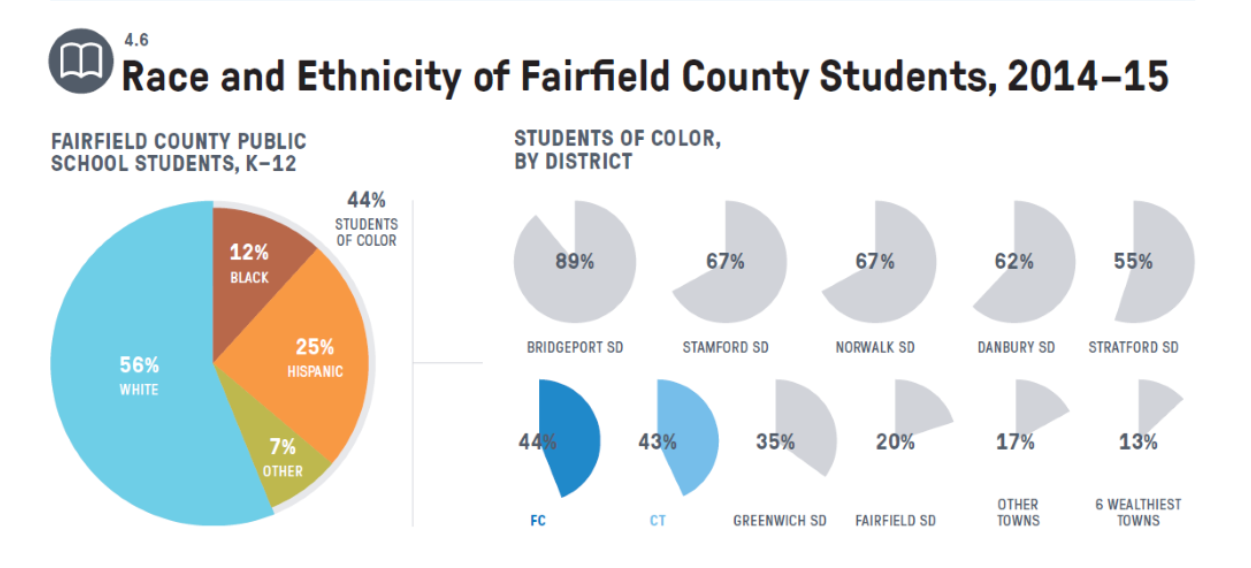
Fairfield County’s sizeable immigrant population - twenty percent of Connecticut’s most populous county - grew 89 percent from 1990 to 2014. In some municipalities, foreign-born residents make up as much as a third of the population. That is among the findings in the Fairfield County Community Wellbeing Index 2016, which examined regional demographics, economic opportunity, education, health, quality of life, and happiness.  The report includes analysis of the communities, populations, and neighborhoods of Fairfield County, as well as opportunities available and issues facing the area.

Since 1980, the size of the population living in neighborhoods that are considered most affluent – defined as those with an average family income more than 2.5 times higher than the state level - has tripled within Fairfield County. Meanwhile, the number of people living in poor neighborhoods is 3.5 times its 1980 size. The number of people in middle-income neighborhoods has decreased by sixteen percent.

Fairfield County’s Community Foundation, a major funder of the report, partnered with DataHaven, area hospitals, and government agencies to help launch a more robust and comprehensive resource that could serve as a part of the hospitals’ and health departments’ Community Health Needs Assessments as well as a broader county-wide indicators program.

“Fairfield County’s Community Foundation is committed to addressing the most pressing issues facing Fairfield County, but to do that we first need to be able to identify and understand those issues,” stated Nancy M. von Euler, Vice President, Programs, Fairfield County’s Community Foundation. “The data in the Fairfield County Community Wellbeing Index 2016 will help us to develop priorities for collective action to build a stronger, healthier Fairfield County where everyone has the opportunity to thrive, regardless of their zip code.”

The report states that "Despite its overall affluence, Fairfield County is among the nation’s most unequal metropolitan areas. Inequities in well-being appear when evidence is stratified by income, age, race, gender, and zip code. These differences are often most apparent after considering data that were collected specifically for the age groups and neighborhoods that are most impacted."

Among the findings, between 2014 and 2025, adults ages 65 and over are Fairfield County’s only age group projected to grow significantly, with a thirty-seven percent increase. Disparities in the County were also evident:

  • High and rising childcare costs are often prohibitively expensive for low and middle-income families. While Fairfield County has nearly enough spaces for all 3- to 4-year-olds to attend preschool, there are only enough regulated childcare slots for fifteen percent of the county’s children ages 0 to 2, and enough subsidized slots to cover only twenty-two percent of these youngest children in low-income households.

  • The issue of dental care arose as an indicator of well-being, particularly among younger adults and families. The Index shows that for every 10,000 residents living in Fairfield County, 12 residents visit an emergency room to receive treatment for preventable dental conditions in any given year, whereas on the East Side of Bridgeport, 178 residents do.
  • Fairfield County residents are healthy when compared to national benchmarks. However, many conditions and risk factors—such as asthma, food insecurity, exposure to community violence, and the early onset of diabetes—are disproportionately prevalent in lower-income neighborhoods and communities of color. Sections of Bridgeport in particular fall very far behind the surrounding area in many of these measures.
  • Disparities in access to reliable transportation persist between racial and income groups. A majority of Fairfield County workers, regardless of income, commute to another town for work. Many low-income (annual wages under $40,000) workers leave Bridgeport for work, while large shares of high-income workers commute to New York City.

“The process of developing this report allowed local partners and community members to identify links between the well-being of residents and the places where they live. Looking beyond typical measures like income levels or unemployment rates, the Community Wellbeing Index reveals a much more uneven distribution of opportunities in areas such as neighborhood walkability, economic development, public health, and education,” said Mark Abraham, Executive Director of DataHaven and a lead author of the report. “The impact that these barriers to opportunity have on overall well-being and happiness will serve as a call to action for many groups working to improve Fairfield County’s diverse neighborhoods and towns.”

The Fairfield County Community Wellbeing Index 2016 was based on a variety of federal and statewide data sources. Partners of DataHaven’s Fairfield County Community Wellbeing Index 2016 include Fairfield County’s Community Foundation; Bridgeport Hospital; Danbury Hospital; Greenwich Hospital; Norwalk Hospital; St. Vincent’s Medical Center; and Stamford Hospital.

10 CT Companies Are Finalists at Entrepreneur Innovation Awards, Three Receive Funds to Boost Growth

Fledgling entrepreneurial businesses in West Hartford, New Haven and Marlborough will be getting a financial boost in their efforts to gain a foothold in their respective industries. CTNext, Connecticut’s go-to resource for entrepreneurial support, announced the three winners of the most recent Entrepreneur Innovation Awards (EIA), held this month at the Connecticut Historical Society in Hartford.

The finalists, Connecticut-based companies and entrepreneurs, presented their innovative project ideas to a panel of entrepreneurial experts for an opportunity to secure $10,000 awards to help support business growth. The top winners, to receive $10,000 awards, were:

  • GinzVelo Hybrid Electric Cycles (West Hartford): A personal transportation solution powered by pedaling or the electric motor to effortlessly travel up to 100 miles to and from your destination.
  • Sweetflexx (Marlborough): Resistance technology active wear enables muscles to work more efficiently, resulting in a higher rate of calorie burn.  McCullough Shriver founded Sweetflexx. (see video below)
  • Verb Energy Manufacturing (New Haven): A healthy, caffeinated, energy bar that combines your cup of coffee and an energy bar for less cost. Verb Energy  was founded in 2016 by four Yale students.

The “judges’ favorite” went to Sweetflexx, and the “crowd favorite” was awarded to Verb Energy.  Each business will receive an additional $2,000.

The other finalists included:

  • Global Hydro Pneumatic High Tech Inventions (Shelton) Developing an all-wheel hydraulic power jack system that is safer and less damaging to cars.
  • Loki (Woodbridge) Creating an app that gives users control over their own multi-perspective visual experience.
  • Mobile Sense Technologies (Farmington) Engineering an “off-the-chest” ECG monitor for 24/7 management of cardiac arrhythmias.
  • Obvia (West Hartford) Creating a lightweight, dual-winglet blade for small to mid-sized wind turbines that is both energy- and cost-efficient.
  • Olie Robotics (Manchester) Building a professional robotic vacuum that cleans offices at a third of the cost with no labor hassles.
  • PennSMART (North Branford) Producing a universal retrofit for lighting fixtures that allows surveillance and sends alert notifications.
  • Trekeffect (Niantic) Creating an app that allows individuals to sell their travel itineraries.

“The Entrepreneur Innovation Awards seek to give new and growing companies the support they need to thrive,” said Glendowlyn Thames, executive director of CTNext. “Through these events, we have seen a number of incredible companies that are changing their respective industries and creating a positive economic impact in our state. These grants continue to support companies at the earliest stages of growth and to drive them to the next level of development.”

To be eligible for an EIA, startups must be Connecticut-based, registered as CTNext members, and looking to conduct growth-related activities to help advance their business. Project examples include but are not limited to prototyping, performance testing, compliance testing, product or service development, market research, licensing and more.

A full list of criteria can be found on the application page. For more information on the program or to apply, please visit: http://ctnext.com/entrepreneur-innovation-awards/.  CTNext launched in 2012 and has more than 1,500 members in its network, since initiating the awards program in February 2014 CTNext has awarded $544,000 to 52 companies.

The goal of CTNext is to build a more robust community of entrepreneurs and to accelerate startup growth by providing access to talent, space, industry expertise, services, skill development and capital to foster innovation and create jobs for people in Connecticut.


https://youtu.be/f7AxJz-KsUA

Bridgeport, Stamford, New Haven, Hartford, New Britain Among Most Culturally Diverse Cities in USA

Five Connecticut cities are among the nation’s most culturally diverse, according to a new analysis.  Bridgeport is the 15th most culturally diverse city in the U.S., according to the analysis by the financial website WalletHub, which also ranked Stamford at number 22.   New Haven, Hartford and New Britain were back-to-back-to-back, ranking  at number 30, 31 and 32 on the list of more than 500 cities across the country. Bridgeport’s cultural diversity score was 86.34, and the city ranked 28th in ethno-racial diversity, 17th in linguistic diversity and at number 150 in birthplace diversity.  Stamford’s cultural diversity score was 84.29, and the city ranked 63th in ethno-racial diversity, 20th in linguistic diversity and at number 103 in birthplace diversity.

New Haven’s scores and rankings were similar, with a 83.02 cultural diversity score, and ranking at number 76 in linguistic diversity and number 132 in birthplace diversity.  New Haven was the only Connecticut city to rank in the top 10 in any category, finishing ranked at number 10 in ethno-racial diversity.

When the analysis broke metropolitan areas down by size, among medium sized cities Bridgeport, Stamford, New Haven and Hartford all ranked in the top 15 most culturally diverse.  Waterbury ranked at number 19.  Among small cities, New Britain ranked 8th, Danbury 10th, Norwalk 15th and West Hartford 76th.  Large cities in the analysis were those with more than 300,000 people; midsize cities with 100,000 to 300,000 people, and small cities with fewer than 100,000 people.

The most culturally diverse city in the U.S. is Jersey City, New Jersey, with a score of 95.88.  New York City ranked sixth; Providence was at number 12.

“The country as a whole is becoming increasingly ethnically diverse, and living in an ethically diverse city today is good exposure to the opportunities and challenges all cities will be facing sooner or later,” said Mario Luis Small, Grafstein Family Professor of Sociology at Harvard University.  “Ethnic diversity in neighborhoods is associated with a strong preponderance of businesses and local organizations that generate economic activity and sustain community.  Children exposed to ethnic and language diversity early on, develop a broader and more sophisticated understanding of the diversity of the world.”

In determining the cultural diversity scores, the three categories were weighted, with racial and ethnic diversity making up 50 percent of the score, language diversity 33 percent and U.S. region of birth diversity consisting of 17 percent of the score.  The regions were in-state, Northeast, Midwest, South, West, U.S. territories, and foreign-born.