Matchmaker Event Seeks to Boost Local Small Businesses

Putting entrepreneurial, start-up and small businesses in the same place at the same time with business decision makers seeking suppliers, subcontractors and project partners is the concept that drives the CT Business Matchmaker, among Connecticut's largest events designed to bring together small, established businesses with “primes”—large and medium-sized companies, government agencies, educational institutions, and municipalities who are actively interested in increasing and diversifying their supplier lists. “The Matchmaker program is a premier event offering significant new opportunities for Connecticut-based small businesses,” said Fred Wergeles, director of the University of Hartford’s Entrepreneurial Center, which manages and hosts the event. “Bringing together large companies and agencies with small businesses in the fast-paced Matchmaker environment creates the spark for emerging relationships that will fuel the state’s economy. The Entrepreneurial Center provides pre-event training for both the large and small businesses to maximize the value of their participation in the program.”

The eighth annual event will be held on June 1, 7:00 AM to 2:30 PM on the university campus.  CT Business Matchmaker 2017 will offer an opportunity for small business owners to expand their contracting relationships. During the event, small businesses will present their products and services to potential customers in a series of ten- minute, one-on-one interviews with Primes. All Prime participants, including state and federal agencies, large corporations, municipalities, and educational institutions, come to the event with business needs they are seeking to fill.

“At Viking Construction, we are always looking for qualified subcontractors. We need to find the right company for the job in order to create a successful project, so relationships are very important to us. We know we’ll meet the quality we are seeking at CT Business Matchmaker,” said Michele Yeager, project administrator at Viking Construction.

“Through the CT Business Matchmaker, we accomplished our goal of reaching out to new subcontractors and providing economic opportunities to local businesses. They help get the small businesses ready for the opportunities we put out to bid,” said Michael Jefferson at the Metropolitan District (MDC). “I like to network with those agencies as well so I know what resources are available to support the success of our vendors. The MDC is committed to this process that helps build opportunities for small businesses.”

Wergeles also emphasized his organization’s effort to reach out to businesses run by women and minorities. “Through our Women’s Business Center, we also focus on recruiting women-owned and minority-owned businesses. These businesses traditionally receive fewer contracts, so we strive to provide more opportunities for them through this event.”

Additional organizing partners for CT Business Matchmaker include the University of Hartford’s Construction Institute, U.S. Small Business Administration, state Department of Administrative Services, CT Procurement Technical Assistance Program, state Commission on Human Rights and Opportunities, and the U.S. General Services Administration.

Participants include: Boston Scientific, Canberra Industries, Cianbro Corporation, City of Hartford, City of New Britain, Charter Oak Environmental Services, Inc., Colt's Manufacturing Company LLC, CT Airport Authority, Connecticut Lottery Corporation, CSCU, Dimeo Construction Company, Elbit Systems of America, Kollsman Inc., Enfield Enterprises Inc., Enterprise Builders, Inc., General Dynamics Electric Boat, Great Lakes Dredge & Dock Company, LLC, Greater Hartford Transit District, Harvard Pilgrim, Kaman Composite Structures, Manafort Brothers Incorporated, Methuen Construction Co., Inc., Pioneer Valley Transit Authority, Pitney Bowes, Sikorsky a Lockheed Martin Company, Skanska USA, Staples Business Advantage, Supervisor of Ship Building, The Hartford, The Metropolitan District, The Whiting-Turner Contracting Company, Triumph Integrated Systems, UCONN Health, UCONN Purchasing Dept., UConn Supplier Diversity Program, United States Navy, US Environmental Protection Agency, US General Services Administration – FAS, US General Services Administration – PBS, United Technology Aerospace Systems, Viking Construction, and Western CT State University.

New Ventures Impress, Receive Funds to Advance Entrepreneurial Efforts

reSET, the Social Enterprise Trust (www.reSETCo.org), whose mission is advancing the social enterprise sector and supporting entrepreneurs of all stripes, revealed the winners of its 2017 Venture Showcase last night at The Mark Twain House and Museum to a sellout crowd of 200. The annual event recognizes the talented entrepreneurs and innovative businesses that have just graduated from reSET’s nationally recognized accelerator. 17 early stage enterprises graduated from the recent cohort, and last night, seven finalists competed for $30,000 in unrestricted funding.

The entrepreneurs pitched their business models to an audience of founders, investors, and community and corporate stakeholders. An esteemed panel of judges, including Tony Vengrove of Miles Finch Innovation, Michael Nicastro of Continuity, and Lalitha Shivaswamy of Helios Management Corporation, selected the ultimate winners.

Recipients of the competition’s three “reSET Impact Awards” are listed below, as is the winner of the “Tech Impact Award,” which was given by reSET’s Founding Partner and the evening’s Presenting Platinum Sponsor The Walker Group.

reSET Impact Awards:

$10,000 - Career Path  http://www.careerpathmobile.com

$6,000- Pelletric  http://www.pelletric.com

$4,000 - Phood  http://phoodsolutions.com

The Walker Group’s Tech Impact Award:

$10,000 - Phood http://phoodsolutions.com

Other finalists included:  Almasuite http://www.almasuite.com, Eureeka BI http://www.eureekabi.com, Optima Sports System http://optimasports.es,

and Sweetflexx http://sweetflexx.com/en.

The Showcase’s prize purse was made possible by a handful of reSET’s community partners: The Walker Group (Presenting Platinum Sponsor), The Hartford (Platinum Sponsor), Eversource (Gold Sponsor), AT&T (Gold Sponsor), Accounting Resources, Inc. (Silver Sponsor), Qualidigm (Silver Sponsor), CT by the Numbers (Silver Sponsor), and Aeton Law Partners (Silver Sponsor). The David Alan Hospitality Group and Capture provided in-kind services.

CareerPath is a platform that enables career planning teams to "effectively connect and communicate with students." Using a series of milestones, tasks, and events as drivers, CareerPath allows students to "tackle their career planning objectives in an organized and manageable way."

reSET also receives generous support from its Strategic Partners: The Walker Group, Connecticut Innovations, MetroHartford Alliance, and the Connecticut Department of Economic and Community Development.  reSET, the Social Enterprise Trust is a non-profit organization whose mission is to advance the social enterprise sector. Its strategic goals are threefold: to be the “go-to” place for impact entrepreneurs, to make Hartford the Impact City, and Connecticut the social enterprise state.  Since its inception, reSET has awarded more than a quarter of a million dollars to scaling ventures. Graduates of the organization’s accelerator have generated $4.4 million in revenue and have taken on $5.5 million in investment.

https://youtu.be/EAC6W3Dn_k8

CT Ranked #4 in US in Education, Economic, Civic Opportunity

Including Connecticut, ranked #4 nationally, the New England states grabbed five of the top 10 slots in the Opportunity Index, an analysis of “how opportunities measure up” in communities across the country.  The Opportunity Index is an annual composite measure at the state and county levels of economic, educational and civic factors that expand opportunity. Leading the opportunity rankings are Vermont, Massachusetts, New Hampshire, Connecticut, New Jersey, Maryland, North Dakota, Nebraska, Maine and Minnesota.  Connecticut exceeded the national average in all three components – Jobs and Local Economy, Education, and Community Health and Civic Life.
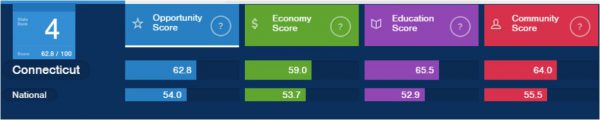
In the Education component of the Opportunity Index, Connecticut ranked second.  The state ranked sixth in the Community aspect of the index, but 20th in the Economy scorecard.  The Economy rankings included data on jobs, wages, poverty, inequality, access to banking, affordable housing and internet access.

Connecticut’s overall score was 62.8, compared with the national average of 54.0.  Among Connecticut’s eight counties, the best overall opportunities are in Middlesex County, which earned a 63.1 score.  Next were Tolland County, 62.3; Fairfield County,62.1; Litchfield County, 60.6; Hartford County 59.5; New Haven County, 56.8; New London County, 54.3; and Windham County 51.2.

The index was jointly developed by Measure of America and Opportunity Nation.

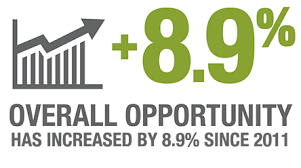
Nationally, overall opportunity has increased by 8.9 percent since 2011, as unemployment has dropped and violent crime has been reduced, the data indicated.  In addition, the rate of young adults from age 16 to 24 who are neither working nor in school has fallen 9.1% since 2011, but remains above pre-recession levels. This number has decreased slightly since 2015.

Opportunity Nation is a bipartisan, national coalition of more than 350 businesses, nonprofits, educational institutions and community leaders working to expand economic opportunity. Opportunity Nation seeks to close the opportunity gap by amplifying the work of its coalition members, advocating policy and private sector actions and releasing the annual Opportunity Index.  Measure of America provides easy-to-use yet methodologically sound tools for understanding well-being and opportunity in America.

The data, according to survey sponsors, comes from the U.S. Census Bureau, the Bureau of Labor and Statistics, the Federal Communications Commission, the National Center for Education Statistics, the Center for Disease Control and Prevention and the U.S. Department of Justice.

Waterbury, Hartford, Simsbury Receive National Recognition for Main Street Initiatives; Eight Local Efforts to Receive Awards

Three Connecticut communities in the Connecticut Main Street network have achieved accreditation for meeting the commercial district revitalization performance standards set by Main Street America, a subsidiary of the National Trust for Historic Preservation. The Connecticut Main Street programs that earned accreditation for their 2016 performance are Simsbury Main Street Partnership, Upper Albany Main Street (Hartford), and Main Street Waterbury.

The accreditation was announced at the 2017 Main Street Now Conference in Pittsburgh. Each year, Main Street America and its partners announce the list of accredited Main Street programs, which have demonstrated exemplary commitment to historic preservation and community revitalization through the Main Street Four Point Approach.

"Connecticut's Main Street America Accredited programs, Simsbury Main Street Partnership, Upper Albany Main Street (Hartford), and Main Street Waterbury, are well-established Main Street management organizations with histories of strong and dynamic leadership. Each has developed and maintained outstanding programs that increase the economic value of their districts while improving the quality of life for area residents," said Kimberley Parsons-Whitaker, Associate Director of Connecticut Main Street Center.

"Main Street revitalization is sustainable when the professional management organization is committed to engaging local stakeholders (business and property owners, anchor institutions, local government, and local residents) in envisioning a vibrant Main Street, and developing strong partnerships that result in action-oriented steps that bring the Main Street neighborhood back to life."

Working in partnership with Main Street America, Connecticut Main Street Center evaluates each of the state's Designated Main Street Programs annually to identify those programs that meet ten performance standards. Evaluation criteria determine the communities that are building comprehensive and sustainable revitalization efforts and include standards such as fostering strong public-private partnerships, securing an operating budget, tracking programmatic progress and actively preserving historic buildings.

The recognition doesn’t stop there.  Connecticut Main Street Center will be presenting its annual Awards of Excellence on Thursday, May 18 at the Legislative Office Building in Hartford.

Among the recipients: a downtown management organization engaging the community in envisioning two underutilized parks as places that downtown residents, visitors, workers and families can mingle with artists and creatives, and a regional planning organization that created a program focused on supporting local businesses, creating jobs and filling vacant spaces in eight village.

In total, eight recipients have been selected to receive the prestigious awards, including organizations and initiatives from Bridgeport, Unionville Village in Farmington, Hartford, Meriden, New Britain, New Haven, and the Northwest Corner.

Among the winning entries: a 14-acre flood control project that created a public park and mixed-use economic development in downtown Meriden; a comprehensive and complete overhaul of the City of Hartford’s zoning language and process; an interpretive wayfinding/signage program that connects Walnut Hill Park, Little Poland and Downtown New Britain; the restoration of a historic ball bearing mill on the banks of the Farmington River into a mixed-use campus in the heart of Unionville Village; a Twilight Bike Race & Street Festival that celebrates biking, food, culture and entertainment in Downtown New Haven; and the redevelopment of a 1903 factory building into 72 units of market rate housing within easy walking distance of jobs and transit in downtown Hartford.

Created in 2003 to recognize outstanding projects, individuals and community efforts to bring traditional downtowns and neighborhood commercial districts back to life, socially and economically, the Awards of Excellence are presented annually. CMSC’s mission is to be the catalyst that ignites Connecticut’s Main Streets as the cornerstone of thriving communities. CMSC is dedicated to community and economic development within the context of historic preservation, and is committed to bringing Connecticut’s commercial districts back to life socially and economically. CMSC is supported by its Founding Sponsors, the CT Department of Economic & Community Development (DECD) and Eversource Energy. CMSC is also supported by its Growth Sponsors, UIL Holdings Corp. and the State Historic Preservation Office.


Carolina Attendance Plummets; Proposal for Hartford Region to Buy Back Whalers, Bring 'Em Home

In a press conference on May 6, 1997, team owner Peter Karmanos Jr. said he was moving his hockey team, the Hartford Whalers, to Raleigh and renaming it the Carolina Hurricanes. It has been 20 years, and now there is an effort – voiced by Hartford City Councilman John Gale – to go back to the future, and bring the franchise to Hartford's XL Center.  It is a long-shot, wistful effort that has yet to capture the public imagination in Connecticut, or any apparent interest from Karmanos, despite near constant rumors, and some intimation, that the franchise could be bought, for the right price.  There has been consistent resistance from the NHL to moving the franchise from Raleigh, but no new comment since the latest idea became public.

“This is a market where the people have a good feeling about themselves, have a good feeling about the future,” Karmanos said two decades ago of the Carolina market to which he was redirecting the soon-to-be former Whalers. “I think they want a sports team here as a quality-of-life issue, something they can identify with.”

Now, Gale suggests in an op-ed published by the Hartford Courant, the team ought to return for much the same reason. “What if we could provide the region with an identity, a rallying point; what if there were a way to bring back the Whale and give it a built-in metro area base of support; and we did it all by regionally cooperating,” Gale wrote.

It has been two decades of highs and lows as the Carolina Hurricanes – two Stanley Cup appearances, and one win of the Cup in the early years, and the worst attendance in the National Hockey League, or near the bottom, more recently.  In Hartford, the Whalers remain very much a part of the city's consciousness.
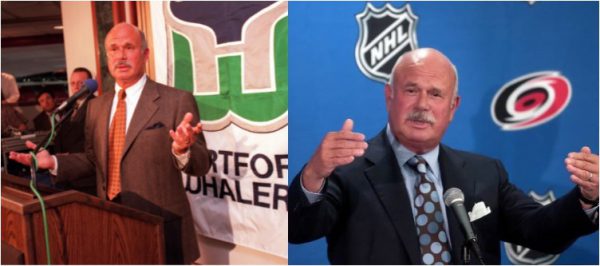
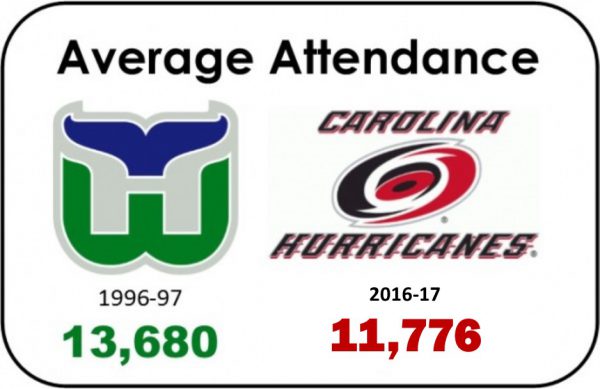
The Hurricanes have had the NHL’s worst home attendance in each of the past two years, and attendance at home games has dropped for five consecutive years, averaging 11,776 this season for 41 home games.

In January, NBC Sports reported that team President Don Waddell said Karmanos was not actively looking to sell the team, but that “If someone came along and wanted to buy it, I’m sure we’d talk about it but we’re not actively out there trying to find investors. If someone calls and says, ‘Hey, I want to buy the team,’ we’re taking that call.”  A year ago, there were rumors of a sale and move to Quebec City.

Today, the Hurricanes Executive Vice President and General Manager is Hall of Famer Ron Francis.  The former standout – in Hartford and Carolina – was the first player to have his number retired by the Hurricanes, on Jan. 28, 2006. Francis, captain dubbed “Ronnie Franchise,” saw his No. 10 – the jersey number in Connecticut and Carolina – raised high above the arena.

Earlier this year, NHL Commissioner Gary Bettman was quoted by USA Today as saying "Peter may sell, he may not sell.  He may sell all of it. He may sell some of it. He may sell none of it. There's no formal sale process going on. There's no imperative for the franchise to be sold on any immediate basis, and the franchise is not moving.”

Within weeks of those comments, Gov. Malloy and Hartford Mayor Luke Bronin made a play for the Brooklyn-based New York Islanders, rumored to be seeking a new home due to spotty attendance at the home they share with the Brooklyn Nets.  Those hopes were dashed last month when the team announced they planned to stay in New York, and are considering plans for a new hockey arena on Long Island or in Queens near Shea Stadium.

That effort caught the interest of data-guru Nate Silver, founder and editor of FiveThirtyEight.com, who revived his 2013 study that noted the Hartford-New Haven media market is the largest in the U.S. without a “big four” sports franchise.  He estimated that about 175,000 avid NHL fans live in the Hartford-New Haven metro area. “That sounds bad, though it’s comparable to or slightly better than some of the lower-tier American NHL markets, including Columbus, Raleigh-Durham, Miami and Nashville (and better than Las Vegas, where the NHL is expanding). Furthermore, there’s potentially room for growth. According to our estimates, 7 percent of adults in the Hartford metro area were avid NHL fans in 2013. But the percentage is 13 percent in the New York metro area and 17 percent in the Boston metro area.”  Sliver added that “If the Islanders or another team were to relocate to Hartford, the numbers would probably improve.”

Gale’s proposal: “What if all 38 towns in the Capitol Region Council of Governments banded together to buy the franchise and brought it back to Hartford? Grand lists are representative of the respective wealth of each town. So, the 38 towns would each pay a portion of the purchase price of the Whalers hockey team based on their percentage of the total grand list of all 38 towns. The average per capita cost for all 38 towns is $274 per person.”

In the Whalers’ final season in Hartford, 1996-97, attendance at the Hartford Civic Center had grown to 87 percent of capacity, with an average attendance of 13,680 per game.  Published reports suggest that the average attendance was, in reality, higher than 14,000 per game by 1996-97, but Whalers ownership did not count the skyboxes and coliseum club seating because the revenue streams went to the state, rather than the team.  Attendance increased for four consecutive years before management moved the team from Hartford. (To 10,407 in 1993-94, 11,835 in 1994-95, 11,983 in 1995-96 and 13,680 in 1996-97.)

Carolina’s average home attendance during the just-concluded 2016-17 season was 11,776– the worst in the 30 team league. That was a drop from the 2015-16 average of 12,203, which was lowest in the NHL that year as well.

ESPN reported last year that the Whalers Booster Club remains visible, and Whalers gear continues to sell briskly, in and beyond the Hartford region.

"We always march in Hartford's St. Patrick's Day parade," said Joanne Cortesa, the club's president.  "And every time we hear people chanting, 'Bring 'em back, bring 'em back!' Every place we go, it's 'Bring 'em back!'"

"It's probably not going to happen next week or next month," Bronin told ESPN. "But we'd certainly welcome having the NHL return to Hartford."

Edible Arrangements, Subway Take Steps Forward and Back in Roller-Coaster Economy

Two of Connecticut’s leading food franchise success stories - Edible Arrangements and Subway – have both been in the news in recent days, seemingly moving in opposite directions.  Subway, for the first time in memory, is reducing the number of franchises across the country, while Edible Arrangements is in the midst of extending its brand, as its founder has taken back control of the equity in the business. Subway dropped 359 U.S. locations in 2016, the first time that Subway has had a net reduction. The store count dropped 1.3 percent to 26,744 from 27,103, but Subway remains the nation’s most ubiquitous eatery. (Behind only McDonald’s in sales.) Sales at Subway franchises fell 1.7 percent last year to about $11.3 billion, according to published reports. Subway is still growing internationally, with sales outside the U.S. increasing 3.7 percent to $5.8 billion last year, as the company continued to open locations.

Subway was founded about 52 years ago by Fred DeLuca and Peter Buck in Bridgeport. DeLuca died in 2015, leaving the company in the hands of his younger sister, Suzanne Greco, who became chief executive officer. The chain’s restaurants are entirely owned by franchisees.

Since its founding in 1999 in East Haven, Edible Arrangements has grown to more than 1,300 locations worldwide. Tariq Farid developed a "healthy obsession with fruit," and used his experience in the floral industry insight to develop a new business concept: fruit bouquets. Edible Arrangements began franchising in 2001, according to the company website.

Farid has completed a buyback of equity of the company which had been held by Greenwich private equity firm L Catterton.  The company has entered into a strategic partnership with L Catterton in June of 2012. Farid said the relationship provided assistance during a key growth phase for the brand, a time in which Edible Arrangements expanded into offering fresh fruit smoothies, froyo fruit blends, chocolates and more.

“The timing was right to take back full ownership so that I could be more fully engaged in building the future of the brand with our franchisees," Farid said, adding that "Edible Arrangements finds itself well-positioned for a future that includes exciting new opportunities for our franchises and the brand.”

Edible Arrangements has launched a system-wide conversion of traditional stores to a "whole-store" experience in the Edible To Go platform, featuring fresh fruit smoothies, froyo fruit blends and other fresh fruit treats. The company is coming off a year in which it registered a 27 percent increase over the previous year in both the number of new store openings and signings of new franchise agreements. It was named in Entrepreneur's Top 40 of "Fastest Growing Franchises" and "America's Top Global Franchises" as well as being included among the "Inc. 5000" list of the fastest growing privately-held companies.

"This is an exciting time to be a part of Edible Arrangements," Farid said. "At heart we are really a family of small businesses that have enjoyed incredible growth through a shared passion and willingness to work together towards common goals. Now we can focus all our energy on working together on the next evolution of the Edible Arrangements brand."

Edible Arrangements is headquartered in Wallingford; Subway is headquartered in Milford.

Some of Most Valuable Global Brands Are Connecticut-Based Businesses

Connecticut remains ranked among the top 10 states for corporate brands, according to a new study.  London-based Brand Finance has calculated Connecticut as being home to 20 of the 500 most valuable brands in the nation.  Connecticut ranked seventh. The state also was strongly represented among the 500 most valuable brands in the world, with a half-dozen earning a slot in the global rankings.

The Spectrum brand of Stamford-based Charter Communications is now the most valuable among Connecticut-based companies, at number 83 in the rankings of most valuable global brands, and number 43 among U.S. companies.

Health insurance giant Aetna, which has flirted with merger and departure in the past year but remains headquartered in Hartford, is number 166 on the list of most valuable global brands, moving up from number 188 on last year’s list.  Among U.S.-based brands, Aetna ranked at number 70.

Booking.com, part of The Priceline Group, came in at number 274 on the global rankings, down from number 201 a year ago.

Bloomfield-based CIGNA, which also had a merger thwarted in recent months, was ranked number 305, jumping more than 100 positions on the list, from number 439 last year.

ESPN, with world headquarters in Bristol, is at number 381 on the global list, down from 356 a year ago.

Norwalk-based Priceline was ranked number 386, down from 357 last year.  Xerox, also based in Norwalk, was just behind at number 389, up from number 396 a year ago.

Subway, which recently announced the closure of more than 300 U.S. restaurants in 2016, was ranked number 464 on the list, down from number 417 in the previous annual ranking.

The top ranked global brands were Google, Apple (which switched places from a year ago), Amazon.com, AT&T, Microsoft, Verizon, Walmart, Facebook, Wells Fargo, McDonalds, IBM and Boston-based GE. Six years after it last held the title in 2011, Google is now the world’s most valuable brand with a value of US $109 billion, according to Brand Finance.

NBC, which is not headquartered in Connecticut but has operations in Stamford, was ranked number 93 on the list of the top global brands.  Xfinity, also part of the Philadelphia-based Comcast corporate family, is ranked number 37.

Also earning a spot on the U.S.-based top 500 list are Sheraton (part of Stamford-based Starwood), Carrier (United Technologies), Frontier, United Technologies, Otis (United Technologies), The Hartford, Pratt & Whitney, Praxair, Harman International, and Pitney Bowes.

On the industry-specific list of the most valuable global toy brands, topping the list is Lego.  The company, based in Denmark, has operations in Connecticut.  Lego was also named the world’s most powerful brand, along with google, Nike, VISA, Disney, NBC, PWC, Johnson & Johnson and McKinsey & Company. Lego scores highly on a wide variety of metrics including familiarity, loyalty, promotion, marketing investment, staff satisfaction and corporate reputation.

Financial accounting and reporting standards requires a clear definition of what intellectual property is included in the definition of ‘brand’, Brand Finance points out.  The website defines brand as the “Trademark and associated IP including the word mark and trademark iconography”.

Most Valuable Brands of Connecticut Based Companies (Ranking on list of US Companies) – Spectrum (43), Aetna (70), Booking.com (108), CIGNA (126), ESPN (162), priceline.com (164), Xerox (166), Sheraton (189), Subway (196), Carrier (203), Frontier (208), United Technologies (232), Otis (292), The Hartford (332), Pratt & Whitney (340), Praxair (351), Harman International (372), Pitney Bowes (471), and United Rentals (475).

CT's Economic Performance Ranks 49th in US; Economic Outlook Ranks 46th

Connecticut ranks 49th in economic performance during the past decade and the state’s economic outlook ranks 46th among the nation’s 50 states in the latest “Rich States, Poor States” analysis by the American Legislative Exchange Council. The look-back at the decade 2005-2015 shows Connecticut ranking near the bottom in the three components that make up the ALEC-Laffer State Economic Competitiveness Index performance numbers.  The state ranked 47th in state gross domestic product and 44th in non-farm payroll employment, both below the national average, and 43rd in absolute domestic migration, which increased for the third consecutive year.

Connecticut’s overall economic outlook ranking, 49th in the nation, represents a drop from 47th in each of the past two years, and 44th and 34rd in the two previous years.  Back in 20120, Connecticut ranked 36th.  The economic outlook includes more than a dozen categories.  Among them, Connecticut ranks highest in sales tax burden (12th), remaining tax burden (16th), and debt service as a share of tax revenue (20th).

“Each of these factors is influenced directly by state lawmakers through the legislative process,” the report points out. The policy variables “have a proven impact on the migration of capital—both investment and human—into and out of states.”

In the 10th annual edition of the competitive outlook index, the lead states in the ranking are Utah, Indiana, North Carolina, North Dakota, Tennessee, Florida, Wyoming, Arizona, Texas and Idaho.  The highest ranking New England states are New Hampshire (number 18) and Massachusetts (number 25).  Joining Connecticut towards the bottom of the list are Rhode Island (number 36) and Vermont (number 49).

The Economic Performance Rankings (2005-2015) placed Texas, North Dakota and Washington State atop the list, followed by Utah, Colorado, Oklahoma, Oregon, South Dakota, North Carolina, and Montana.  Massachusetts was the highest ranked New England state, at number 18.

“Generally speaking,” the report indicated, “states that spend less—especially on income transfer programs, and states that tax less—particularly on productive activities such as working or investing—experience higher growth rates than states that tax and spend more.”

Home Ownership in CT: Not Best, But Not Worst

When it comes to home ownership, Connecticut is in the middle of the pack among the nation’s 50 states.  A new report ranks the state at number 30, in the lower echelons of the states.  And when the report, by financial website ValuePenguin, identified optimal factors when considering homeownership, Connecticut faired more poorly in some key factors. Connecticut ranked 48th in affordability, followed only by California (49) and Florida (50).  New Jersey and Massachusetts were just ahead of Connecticut.  The best states for affordability were South Dakota, Wyoming and Idaho.

Ten factors, organized into three key categories were used to measure and rank the states. The three key categories of focus were: Housing Market Strength, Residual Costs, and Living Factors.

Factors that weakened a state’s position included propensity for crime, weak housing markets, and heavy burdens of costs to maintain a home – for instance the likelihood of property damage caused by storms and other calamities. Attributes that strengthened a state’s position included homeownership affordability, low mortgage rates, and low risk of calamities.

The 10 worst states to be a homeowner, according to the report, are Louisiana, Mississippi, Tennessee, New Mexico, and Alabama.  The best states, according to the analysis, are Iowa, South Dakota, Wyoming, Nebraska, Maine and Minnesota.

In terms of livability, the top states in the nation are the New England states of New Hampshire, Maine, and Vermont.


Best Small Cities to Start A Business? CT Has Only One - Danbury - Among Top 700 in USA

Only one Connecticut community is ranked in the top 700 “best small cities to start a business” in a new survey of 1,260 cities across the nation.  Danbury, ranked at number 170, was the sole Connecticut city to earn a slot among the nation’s business-friendly small cities.  The next Connecticut municipalities on the list were Torrington, ranked at number 749, and East Hartford, at number 775. To determine the best small cities in which to start a business, the financial website WalletHub’s analysts compared across three key dimensions: 1) business environment, 2) access to resources and 3) business costs. Included were cities with a population of between 25,000 and 100,000 residents.

Among Connecticut municipalities, also reaching the top 1,000 nationwide were East Hartford (775), Bristol (836), Westport (861), West Hartford (876), and Shelton (919).

The Danbury city website highlights that “assets and resources include a pro-business climate, a creative, educated and talented workforce, an excellent education system, transportation advantages, a superior quality of life and much more.”  The website highlights a Danbury business each week.

"We analyzed 21 Connecticut cities and out of these, Danbury ranked the highest at 170," said WalletHub analyst Jill Gonzalez. "Although it offers a strong business environment, the city has high business costs overall. Most of the cities (14 of them) ranked below the 1,000 rank because these fail to offer a thriving business environment, with little access to the resources needed to start a business as well as restrictive labor costs."

business-600x568.jpg

The analysis evaluated each of the three key dimensions using 16 relevant metrics. Each metric was graded on a 100-point scale, with a score of 100 representing the most favorable conditions for launching a business. “ A city with a smaller population can offer a greater chance of success, depending on an entrepreneur’s type of business and personal preferences,” WalletHub points out.

The business environment category (50 points) includes average length of work week, average growth in number of small businesses, number of startups per capita, average revenue per business, average growth of business revenues and industry variety.  The access to resources category (25 points) includes financing accessibility, human resource availability, higher education assets, working age population growth and workforce educational attainment.  The business costs category includes office space affordability, labor costs, corporate taxes, and cost of living.

open-600x381.jpg

Also earning a slot on the “Best Small Cities to Start a Business” list were East Haven (1,004), Norwich (1,014), New London (1,015), New Britain (1,022), West Haven (1,026), Wethersfield (1,028), Newington (1,032), Milford (1,053), Stratford (1,060), Norwalk (1,063), Meriden (1,079), Middletown (1,117), Naugatuck (1,185) and Trumbull (1,239).

Data used to create the ranking were collected from the U.S. Census Bureau, Bureau of Labor Statistics, Federal Deposit Insurance Corporation, AreaVibes, Yelp, Indeed, U.S. News & World Report, Tax Foundation and LoopNet, according to WalletHub.

The top small cities for business in the U.S., according to the analysis, were Holland, MI; Carbondale, IL; Springville, UT; East Chicago, IN; Jefferson City, MO; Wilson, NC; Enid, OK, Rio Rancho, NM; Clearfield, UT and Cheyenne, WY.  The top ranked city in New England was East Providence, RI, ranked at number 38.