Public Transit Commutes Double, Triple Driving Time in CT Cities

People who take public transportation to get to work in the Bridgeport-Stamford-Norwalk area will have a commute nearly three times longer than those who drive to work.  In New Haven, the commute via public transportation is twice as long. Data compiled by Governing magazine indicate that across the nation’s largest metropolitan areas, public transportation riders spend significantly longer traveling to work than those who drive.  Data was compiled for the 25 largest metro areas, including New Haven-Milford and Bridgeport-Stamford-Norwalk.

Bridgeport-Stamford-Norwalk area public transportation commuters spend an average of 69.2 minutes traveling to work. By comparison, it takes those who drive 24.9 minutes.  The 44,742 estimated public transportation commuters account for 10 percent of commuters, according to the data.

New Haven-Milford area public transportation commuters spend an average of 48.4 minutes traveling to work. By comparison, it takes those who drive alone 23.9 minutes.  The 17,504 estimated public transportation commuters account for 4 percent of all commuters.

In nearly every metro area, driving to work remains far quicker than using a bus or train, taking less than half as long in some places.  Across the country, Governing reports, transit systems are seeking to attract new customers as the latest national statistics show stagnant ridership. Cutting down on commute times represents an opportunity to serve more riders who otherwise have a choice in how to get to work.

“Operating speed is going to be important for customers, so if they want to compete in that market, they need to be more competitive,” says Steven Polzin of the Center for Urban Transportation Research. “Time is important to folks across the full economic spectrum.”

Governing compiled the most recent Census survey data measuring total commute times, including travel to stations and the time spent waiting for buses or trains. In the 25 metro areas where public transportation accounts for the largest share of all commuting, riders reported commute times an average of 1.9 times greater than those who drove alone. Similar gaps exist in regions where public transportation isn’t as prevalent.

A metro area’s overall commute times partly reflect its different types of transit. Commuter rail passengers spend an average of 69 minutes traveling to work, far longer than those taking bus or light rail. Accordingly, areas relying more on heavy rail, like Bridgeport-Stamford-Norwalk, report lengthier commutes overall, Governing points out.

On average, the latest Census suggest Americans who drive alone spend an average of nearly 25 minutes traveling to work. The national average for bus commuters is 45 minutes, while those who ride subways or streetcars spend an average of 47 minutes traveling to work. For those who primarily walk to work, commute times average only 12 minutes.

College towns are about the only areas where public transportation commute times mirror those for auto commuters, according to the data compiled by Governing.


Financial Woes Aside, Dunkin' Donuts Park is Nation's Best Double-A Ballpark

With almost 49,000 voters weighing in on the top Double-A facilities, Dunkin’ Donuts Park, home of the Hartford Yard Goats, was the winner in the third-annual Best of the Ballparks fan vote from Ballpark Digest. It is the first time a new facility has won a Best of the Ballparks vote. Fans selected Dunkin’ Donuts Park over Peoples Natural Gas Field, home of the Altoona Curve, in a bracketed online competition at ballparkdigest.com that saw over 178,000 fans vote on their favorite minor league ballparks.

“We are extremely proud to hear that fans voted Dunkin’ Donuts Park as the best Double-A ballpark in the country,” Yard Goats General Manager Tim Restall said. “We want to thank all the fans for taking time to vote over the past few weeks and for Ballpark Digest for having this contest to help showcase Dunkin’ Donuts Park on a national level. This is such a wonderful honor and we have been completely overjoyed by the outstanding fan support at our games in Hartford this season.”

The Yard Goats have played in front of capacity crowds 15 times. This past weekend, 19,956 fans watched the Yard Goats in Hartford. Dunkin’ Donuts Park has been sold out completely in each of the last three weekends (Friday through Sunday) and filled to capacity in 11 of the past 17 home games.

Voters were asked to choose among Eastern, Southern and Texas League ballparks in five rounds of voting. Last year’s top vote-getter among Double A stadiums was Pensacola Bayfront Stadium, home of the Pensacola Blue Wahoos.  In this year’s voting, Dunkin’ Donuts Park was seeded sixth when the voting began.

Dunkin’ Donuts Park is the first brand new venue to open in the Eastern League since Northeast Delta Dental Stadium—home of the New Hampshire Fisher Cats—opened its doors in 2005, and it is seen as the biggest change to the league’s facility landscape since the extensive multi-phase renovation to the Harrisburg Senators’ FNB Field was completed prior to the 2010 season.
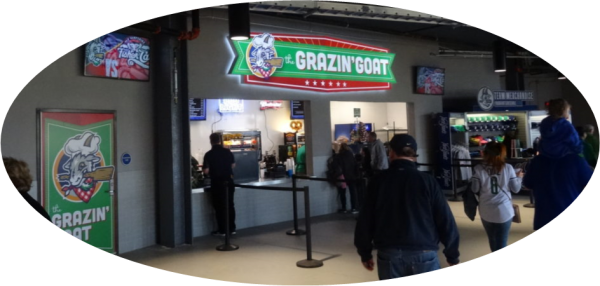
“Dunkin’ Donuts Park is one of the great stories in Minor League Baseball in 2017,” said Ballpark Digest publisher Kevin Reichard. “The Yard Goats front office persevered during a rough 2016 season and never wavered from a commitment to creating the best possible fan experience. That commitment to fans helped Dunkin’ Donuts Park snare a great honor in a highly competitive field.”

The stadium includes 18 luxury suites and two other suites adjacent to the dugouts, a kids “fun zone” just beyond the center field fence with an inflatable slide and bounce house and a glassed-in batting cage, which will allow fans with premium tickets to watch the players practice.

The Yard Goats are in their second year after moving 15 miles north from New Britain, where the team played through the 2015 season as the Rock Cats.  The club was forced to play its games on the road last year when construction delays caused the opening of Dunkin’ Donuts Park to be pushed back numerous times, ultimately to this season.

The team, an affiliate of the Colorado Rockies, is the first professional baseball club to call Hartford home since the Hartford Chiefs in 1952.  The team’s home opener earlier this year was played on the 20th anniversary of the home finale for the NHL’s Hartford Whalers.

Florida vs. Connecticut - Mixed Bag of Growth and Opportunity

Florida Governor Rick Scott spent much of Monday in Connecticut, urging businesses here to relocate to the Sunshine State. There’s no question that Florida has attracted some Connecticut residents and created jobs in recent years, but recent published reports highlight more of a mixed bag that appearances may suggest at first glance.

Chris McCarty, the director of the University of Florida's Bureau of Economic and Business Research, said in a PolitiFact.com article earlier this year that the state has yet to regain the construction jobs that were lost in the recession. McCarty said these jobs are important to note because they are high-paying. Prior to the recession (2006), there were about 668,700 construction jobs and in November 2016 there were only 461,800.

Scott, elected at the start of this decade, pledged to create 700,000 jobs (on top of what the state would have created anyway) in seven years, according to PolitiFact, has “more work to do before Scott hits the jobs total that he promised,” McCarty noted.

PolitiFact Florida is a partnership of the Tampa Bay Times and the Miami Herald, “to help you find the truth in politics.”

Scott’s office announced last month that Florida tied Georgia for the fastest private-sector job growth rate of the 10 largest states in the nation during the past year, when Florida added 233,800 new private-sector jobs, the second-most in the nation.

Scott is a former resident of Stamford.  He has made similar trips to California, Illinois, Kentucky, Maryland and Minnesota, according to the Miami Herald.  The paper reported that Scott brought chief of staff Jackie Schutz Zeckman to Connecticut, but none of his economic development experts joined him. Scott has previously urged GE and Yale University to relocate to Florida.

The Connecticut foray comes a week after he gained legislative approval of a “growth fund” for infrastructure and job training meant to create new jobs, the Orlando Sentinel reported.

The new fund cannot be used for direct payments to businesses, according to published reports, but can be tapped to build roads or other infrastructure and improve job skills to benefit citizens at large, rather than just one company. Local governments and state colleges can apply for money for specific projects from the fund.  It was the result of a compromise with legislative leaders in Florida, who had been critical of what was described as “corporate welfare.”

Job-poaching trips to other states had been routine for Scott, the Sentinel reported, but were cut back last year when lawmakers eliminated funding for direct incentive payments to businesses. Florida legislators have set aside $1.6 billion for business incentives over the past seven years but have become increasingly wary of their effectiveness in light of high-profile projects such as the Orlando biotech firm Sanford Burnham, which is leaving the state after failing to meet its job creation goal, set more than a decade ago. The company had been approved for $350 million in incentives.

A recent United Way report in Florida shows that nearly 70 percent of jobs in the state pay less than $20 an hour, the state’s public radio station, WFSU, recently reported. The most common job in Florida is a retail sales position paying an average of $10 an hour. Next are food preparers and cashiers, according to the report.  An economic analysis compiled for the Miami Herald/Tampa Bay Times Tallahassee Bureau by Florida International University Metropolitan Center last fall showed that although many jobs have returned since the Great Recession, the new jobs are paying workers significantly less than the jobs they replaced, and the rebound has been dramatically uneven across the state.

Last month, Scott announced the unemployment rate in Florida stood at 4.5 percent in April, the lowest it had been since September 2017 and just above the national unemployment rate of 4.4 percent. Connecticut’s unemployment rate rose from 4.8 to 4.9 percent in April as the state lost 1,500 non-farm jobs, according to the state Department of Labor.  The jobless rate was 0.5 percentage points lower than a one year ago and the state added 5,500 jobs during the previous 12 months, with private sector employment increasing by 9,900 positions during the previous year.

Earlier this month, Scott signed a state worker pay raise into law, marking the first time in over a decade that Florida state employees will receive an across-the-board raise. All employees who earn $40,000 a year or less will get a $1,400 raise, and employees who earn more than $40,000 a year will get a $1,000 raise. Most state law enforcement officers will get a 5 percent raise and most correctional officers will get a $2,500 raise, and judges, elected state attorneys and public defenders will get 10 percent pay hikes, the Tampa Bay Times reported.  In addition, state group health insurance will begin moving toward a four tier system, and most public sector employees will default into a 401-k style retirement program.

Subway Looks to Technology to Spur Growth, Reinvigorate Brand

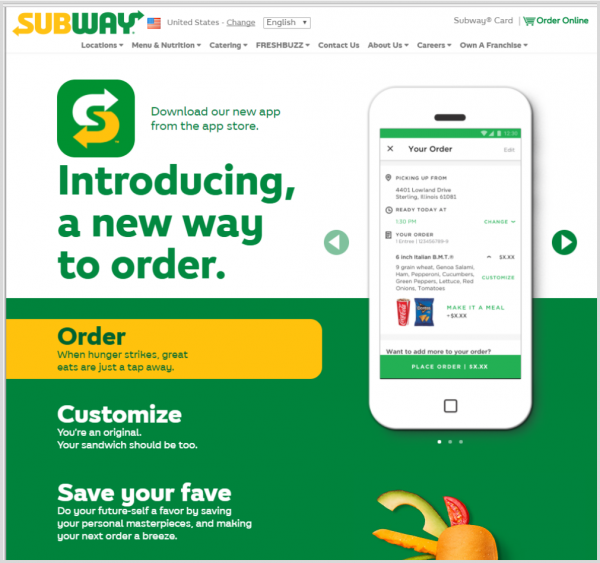
If it seems like Subway restaurants have stepped up the use of technology to combat the company’s first dip in growth in memory, you’re right.  Low-tech is out and high-tech is increasingly in at the Connecticut-based sandwich franchise mega-chain. Subway is aggresively introducing touch-screen ordering kiosks and a new mobile app – an effort to close the gap with competitors that have credited technology with helping boost sales. Subway is also testing dedicated pickup areas for mobile orders, a first for the company.

“It’s really a vision and strategy in how we want to evolve,” Carman Wenkoff, Subway’s chief information and digital officer, said in an interview with Bloomberg. “Customers are demanding a more complete experience.”

Subway launched a “bot” for Facebook Messenger in April that allows guests to order sandwiches and salads. The first-of-its-kind sandwich ordering bot was announced at the F8 Facebook Developer Conference with Agilitee, one of Subway’s digital partners, and is an innovation driven by the company's year-old Subway Digital division.

Customers can use the bot to order a sandwich or salad, customize it with their favorite bread; cheese; vegetables; and sauce, and pay on any device that supports Messenger. The bot for Messenger is described by the company as the latest addition to the brand’s mobile order systems that includes web ordering and app ordering. The new mobile app is available in about 26,500 of the chain’s 27,000 U.S. stores, which the company says is the largest deployments of a Messenger bot in the restaurant industry.

Subway has a presence in 112 countries, with more than 44,600 franchised locations. The company reports 7.5 million sandwiches a day served around the world.  Subway has more locations than any other restaurant chain U.S., but sales fell 1.7 percent last year to $11.3 billion, marking the third straight annual decline, according to research firm Technomic. Industry analysts point out that traditional fast-food chains are upgrading their equipment and embracing more natural ingredients, cutting into Subway’s decades-long edge in the healthy-eating arena.

The company, based in Milford, Connecticut, was founded almost 52 years ago by Fred DeLuca and Peter Buck. It remains a family-owned business. The company now operates about 26,744 stores in the U.S., a decline of 359 locations in 2016, the first annual decline the company has experienced.

A year ago, Subway announced the launch of Subway Digital, a new division centered on tech initiatives. The division’s focus was to be on evaluating all of the chain’s technology, ranging from its app to its loyalty program, with the ultimate aim of enhancing guest engagement, according to published reports in June 2016.

“With the creation of Subway Digital, we are committed to making the guest experience as meaningful, convenient and contemporary as possible, across all channels,” Suzanne Greco, Subway president and CEO, said in a statement at the time.

Subway is currently testing about 50 of the new self-ordering kiosks, Bloomberg reported. The technology allows customers to walk in and tailor their meals with more accuracy. Digital menus, meanwhile, are available in hundreds of stores. They can be changed instantly without having to print new signs and replace them. The chain also is testing out remodeled restaurants in eight areas in the U.S., Canada and England, according to published reports.

The upgrades require buy-in from franchisees, which own all of Subway’s locations. Though the company is helping pay for the changes, independent owners will bear much of the cost.

“We are investing heavily,” Wenkoff said in the Bloomberg interview. “Our franchisees are with us 100 percent.  Mobile devices are attached at the hip to pretty much all our customers these days.  It’s all about convenience.” The company also noted that Subway Digital, established last year, is in the midst of hiring more than 150 people for jobs supporting the brand’s “omnichannel approach.”

Broadway Awards Point Spotlight at Connecticut Connections

Westport native Justin Paul is having a big year.  The 2003 Staples High School graduate  added two Tony Awards this week to an Oscar won just months ago. And he is not the only Connecticut connection to the Tony Awards, announced on Sunday night. Paul won in the Best Original Score category for his work on Broadway’s “Dear Evan Hansen,” along with writing partner Benj Pasek. Before the night was out, the writers were back on the Radio City Music Hall stage to share another Tony for Best Musical for “Dear Evan Hansen.” In all, the play won six Tonys. Paul was the show's co-composer, co-lyricist and co-creator.

Rebecca Taichman won for directing "Indecent," the klezmer-scored historical drama about the Yiddish Theater that she co-created with playwright Paula Vogel. "Indecent" had its world premiere at the Yale Repertory Theatre in New Haven in 2015. The play began as Taichman's thesis project for the Yale School of Drama in 2001. "Indecent" also won for best lighting for a play.

The 9/11-themed musical "Come From Away" won for best direction of a musical, Yale University graduate Christopher Ashley. It had a significant early reading at Goodspeed Musicals' Festival of New Artists in 2013. One of the show's producers spoke about "Come From Away" at this year's Goodspeed festival, just prior to the Broadway production opening.
Paul won an Oscar Award in February for Best Original Song during the Academy Awards for “City of Stars” from “La La Land.” At that ceremony, he thanked Westport's education and arts communities in his speech: "I was educated in public schools where arts and culture were valued and recognized and a resource," said Paul. "I am so grateful to all my teachers who taught so much and gave so much to us."  Paul shared the award for the song "City of Stars," from the film "La La Land," with fellow lyricist Benj Pasek and composer Justin Hurwitz, and Hurwitz's score from the film also won an Oscar.

Additional Connecticut connections at the Tony Awards:  the revival of "Hello, Dolly!" won awards for best revival of a musical, actress, featured actor and costumes. The show is based on a play by Thornton Wilder, who lived a large part of his life in the New Haven area. And the late August Wilson's "Jitney" won a Tony for best revival of a play. The majority of the 10 plays in Wilson's "Century Cycle" (though not "Jitney") were developed at the Eugene O'Neill Theater Center in Waterford and the Yale Repertory Theatre.

Connecticut and TESLA: The Battle Lines Expand

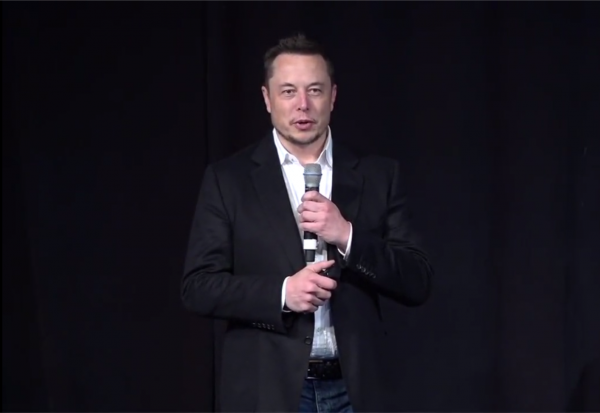
It was a one-two punch from Connecticut aimed at Tesla, in the marketplace and in the boardroom. On Tuesday, at the company’s annual shareholder meeting at the Computer History Museum in Mountain view, CA, a shareholder resolution advocated by the Office of State Treasurer Denise Nappier was on the agenda.

And on Wednesday, the Connecticut legislature concluded the 2017 regular session, leaving behind a proposal that would have enabled Tesla to sell cars directly to Connecticut consumers, as is done in many other states.  It was the third consecutive year that the plan did not receive approval from legislators, in the face of strong opposition from the Connecticut Automotive Trades Association.

The Tesla proposal was approved by two legislative committees - Transportation and Finance, Revenue, and Bonding - but was never voted on by House or Senate members in their respective chambers.  The bill pitted the state’s longstanding car dealers against the new model that Tesla prefers.

The Connecticut Retirement Plans and Trust Funds shareholder resolution called for the declassification of Tesla’s board and for the annual election of all of Tesla’s directors.  The $32 billion Connecticut Retirement Plans and Trust Funds (“CRPTF”), of which Treasurer Nappier is principal fiduciary, owned 32,837 shares of Tesla, Inc. common stock with a market value of $11.6 million as of June 6, 2017.

Tesla’s board currently is classified, which means that each year only a portion of the directors are elected by shareholders.  This year shareholders had the opportunity to vote on three of Tesla’s seven directors. The company’s board recommended that “our stockholders vote against this proposal.”

“Independent shareholders gave Tesla a clear message: it's time to sharpen the company's governance profile and strengthen board member accountability to shareholders, whose interests they are elected to represent,” Nappier said after the shareholder vote.

Connecticut’s resolution, the first ever filed to declassify Tesla’s board, received an estimated 47 percent of the votes not controlled by directors and officers, indicating strong support for the annual election of directors, according to the Treasurer’s Office.  Representing the Connecticut Treasurer’s Office at the annual meeting, and presenting the proposal, was Aeisha Mastagni, a Portfolio Manager in the Corporate Governance Unit of the California State Teachers’ Retirement System. Overall, according to a U.S. Securities & Exchange Commission filing, 74.7 million shareholders voted against the proposal, with 32.7 million voting in favor.


“And now that Tesla has joined the ranks of the Fortune 500, we encourage the company to take particular heed of the recent vote,” Nappier added, “given that most of its largest U.S. company peers have already embraced annual election of directors.  It should reconsider its opposition to this fundamental provision of good governance.”

“At the end of the day, Tesla has and will continue to develop and deploy new technologies and products that will be an important part of the global economy’s clean energy future.   The company’s corporate structure should likewise evolve toward a more accountable governance framework that will fortify its bottom line and sustainable value,” said Nappier, a veteran shareholder activist.

In the aftermath of the Connecticut legislative session, a spokesman for Tesla told CT NewsJunkie that the company wasn’t quite ready to give up on the state. Tesla is allowed to sell direct to consumers in most jurisdictions in the U.S. and around the world. They are prohibited from selling directly in Connecticut, Michigan, Texas, and West Virginia, according to the company.

“The residents of Connecticut overwhelmingly want Tesla to be able to freely operate in the state, and despite inaction during this session,” a company spokesman said.  There are approximately 1,300 Tesla vehicles registered in Connecticut.

Innovative Start-Up Companies Seek State Funds to Propel Growth

CTNext will bring together start-up businesses seeking the financing to move forward, providing the opportunity for them  to pitch at the next Entrepreneur Innovation Awards (EIA) event scheduled for Thursday, June 15 at the LOFT at Chelsea Piers in Stamford. Connecticut's "innovation ecosystem" will be highlighted as the nine companies, from all across the state, will be competing for $10,000 grants.  The competitors include:

  • Deo2go (Fairfield): Creating a topical delivery device that can be filled with a variety of products including, but not limited to deodorant, lip balms, and sunscreen
  • Egghead (Danbury): Developing a new way to package and sell ice cream that brings new revenue to a mature market
  • FallCall Solutions (Trumbull): Creating a tele-monitoring system for the Apple watch and other mobile systems for elders and caregivers
  • Fjord Weather Systems (Wilton): Developing a way to turn every boat on the water into a weather-monitoring system
  • LiquidSphere (New Haven): Creating an interactive app that will connect people who struggle with stress, anxiety, depression and addiction with therapists via text and video sessions
  • Lucca Ventures (Southington): Developing a Bluetooth-enabled microphone attachment to a full-face oxygen mask, letting patients communicate clearly while wearing it
  • Obvia (West Hartford): Manufacturing dual-winglet blades and semi-shroud power upgrade for Sunforce Wind Turbines that will improve efficiency and scalability for the turbines
  • Sweet Equations (East Hartford): Making custom candy cakes, edible cupcake displays and other desserts through the development of an on-demand decorating device
  • Trekeffect (Lyme): Developing a system to let individual travel planners buy and sell their itineraries.

To determine the finalist pool, each company’s application was vetted by a separate and independent team of reviewers who deemed their products, services and/or business ideas worthy of consideration for an EIA. Each finalist will have an opportunity to compete for a $10,000 grant as well as the judges’ and crowd favorite awards, each in the amount of $2,000 each.

The judges who will hear the company pitches and determine the winners include:

  • Elena Cahill: Senior Lecturer, University of Bridgeport, Entrepreneurship Department
  • Jim Kern: Co-founder, COMRADITY
  • Greg Kivenzor: Associate Professor of Marketing, Director of Experiential Learning Collaborative, UCONN- Stamford
  • Mark Lasoff: Founder, LearnToProgram
  • Mike Roer: President, The Entrepreneurship Foundation

Throughout the year, CTNext hosts the EIA, a Shark Tank–style pitch event where Connecticut-based startups and entrepreneurs compete for grants that can be applied toward a specific project that will help accelerate growth.

CT Next support the success of companies and entrepreneurs by providing guidance, resources, and networks to accelerate their growth. CT Next is a wholly-owned subsidiary of Connecticut Innovations, described as "a network of passionate people who offer services to busy entrepreneurs." Launched in 2012, there are now more than 1,500 members. Since its inception in 2014, CTNext has held 11 total events in cities and towns all over Connecticut, awarding $544,000 to 52 unique companies.

https://youtu.be/Au4ULyo5L1g

More Daughters Mean More Venture Capital Investment, More Success, Study Shows

As the growing number of Connecticut start-up firms seek to attract venture capital funds to propel their growth, a newly published study may suggest some surprising influences on the investment decisions – and ultimately the success of venture capital investments. A National Bureau of Economic Research (NBER) working paper by Paul A. Gompers and Sophie Q. Wang from Harvard University says that gender diversity may boost performance of venture capital firms.  But it is not the gender diversity of the start-up firms leaders, or the gender diversity of the venture capitalists, who tend to predominantly be white males.

It is the gender diversity of the children of venture capitalists that appears to make the difference.

The paper, “And the Children Shall Lead: Gender Diversity and Performance in Venture Capital,” is based on a study of a dataset of gender of venture capital partners’ children. It finds that partners with more daughters than sons were more likely to hire female partners. But that’s not all.

The study also finds that having more girl children had a positive effect on deal and fund performance of these partners.  The authors indicate that the effects concentrate overwhelmingly on the daughters of senior partners than junior partners.

“Taken together, our findings have profound implications on how the capital markets could function better with improved diversity,” they say in the paper’s abstract.

Venture capital firms are typically deep-pocketed, small companies that bet on startup success by investing millions in exchange for an ownership interest and hopes of high returns.  Published reports indicate that according to the study, firms that increased their gender diversity by hiring more women saw their deal success rate increase by nearly 3 percent. Their profitability, as measured by internal rates of return, rose by more than 3 percent.

Venture capital in Connecticut is available from a range of private and quasi-public sources, including Connecticut Innovations.

The 62-page paper was posted last week; Paul Gompers is Professor of Business Administration and Director of research for the Harvard Business School Finance Unit.  Sophie Q. Wang is a PhD student in the Department of Economics at Harvard University. They based their results on some 12,000 venture-capital investments made between 1990 and 2016, primarily by U.S.-based firms.  They also studied personal information obtained from some 1,400 investing partners.

The NBER is a private, non-profit, non-partisan organization dedicated to conducting economic research and to disseminating research findings among academics, public policy makers, and business professionals.

Good News, Bad News in State Health-Related Data, Analysis Finds

Connecticut is 11th best among states in the number of people who had no trouble finding a doctor in 2015, according to State Health Compare. The top 10 states were Minnesota, Kansas, Vermont, Utah, North Dakota, Montana, Maine, Nebraska, Hawaii and Tennessee.  That's the good news. But Connecticut is also 17th worst among states in the percent of residents with high medical cost burdens, at 23.1 percent. Utah has the highest percentage at 27.5 percent; Maryland the lowest at 15.3 percent, among the 50 states.

According to the data, 70.7 percent of state residents had a general doctor or provider visit during the year, a lower percentage than the national average of 73 percent, and ranking the state 38th in the nation.  The data also reveal that Connecticut is 19th lowest among states in the percent of state budget devoted to Medicaid, and 28th lowest in state public health spending per person.

Nearly one in ten Connecticut residents (9.1 percent) spent the night in a hospital during the year, 15th highest in the nation.

Created by SHADAC, State Health Compare is a new online comparison tool with state-level estimates across 46 measures of health and health care from six federal agency sources. SHADAC is a multidisciplinary health policy research center with a focus on state health policy, supported by the Robert Wood Johnson Foundation and affiliated with the Health Policy and Management Division of the School of Public Health at the University of Minnesota.

Categories in the database include health insurance coverage, cost of care, health behaviors, outcomes, access, utilization, quality of care, public health, and social and economic factors. Metrics include costs of potentially preventable hospitalizations, percent of residents who needed but did not get care due to cost, chronic disease prevalence, weight assessment in schools, and adult cancer screening rates.

Data for most measures is available for multiple years, allowing trend analysis. Within most of the 46 measures, the tool allows visitors to dive deeper into the data by subpopulations such as by age, race/ethnicity, and education level. The tool provides a map, state rank and trend display for each metric. The data can be downloaded and exported.

The data was recently featured in CT Health Notes, a biweekly informational newsletter of the Connecticut Health Policy Project. It includes research summaries, news, event notices, policy proposals and other issues important to Connecticut’s health policy.

Start-up Entrepreneurial Activity Boosts CT's Ranking from 22 to 18 Among Nation's 25 Smaller States

In a state-by-state analysis of start-up business activities, Connecticut moved from ranking 22nd among the smallest 25 states a year ago to 18th this year – the largest forward progress of any of the nation’s 25 smallest states.  Vermont also moved up four positions, from 13th to 9th.  And Kansas advanced three positions, from 18th to 15th. This year among the 25 smaller states, Nevada was top in startup activity, followed by Oklahoma, Wyoming, Montana, and Idaho. Among smaller states, eleven ranked higher than they did last year, five experienced no changes in rankings, and another nine ranked lower.

The analysis was included in the 2017 Kauffman Index Startup Activity State Report, issued this month by the Ewing Marion Kauffman Foundation, based in Kansas City.

Among the twenty-five largest states, the five states with the highest startup activity in the 2017 Index were California, Texas, Florida, Arizona, and Colorado. Seventeen out of the twenty-five largest states had higher levels of startup activity in 2017 compared to last year.  Among the twenty-five largest states, the four that experienced the biggest increase in ranks in 2017 were Massachusetts, Tennessee, Washington, and Minnesota. The three that experienced the biggest negative shifts in rank in 2017 compared to 2016 were Louisiana, Maryland, and Virginia.

After two years of large increases, startup activity rose slightly in 2016, continuing an upward trend started in 2014, the report indicated. Only three years ago, the Startup Activity Index was at its lowest point in the last twenty years. Today it has gone up three years in a row, reaching close to the peak before the Great Recession drop, the report pointed out.

Among the twenty-five smallest states, the three that experienced the biggest increase in ranks in 2017 were Connecticut, Vermont, and Kansas. The three that experienced the biggest negative shifts in rank in 2017 compared to 2016 were Hawaii, Rhode Island, and Delaware.  In the twenty-five smallest states, the five states with the highest startup activity in the 2017 Index were Nevada, Oklahoma, Wyoming, Montana, and Idaho. Eleven smaller states had higher Startup Activity Index measures this year.

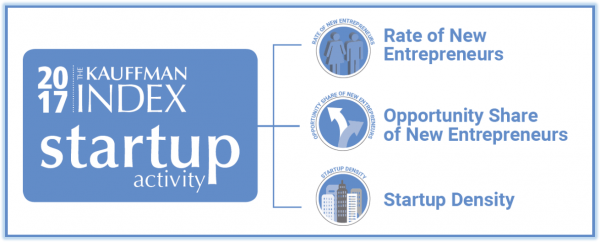
The Startup Activity Index is an index measure of a broad range of startup activity in the United States across national, state, and metropolitan-area levels. The Startup Activity Index captures startup activity along three dimensions:

  • The Rate of New Entrepreneurs in the economy— the percentage of adults becoming entrepreneurs in a given month.
  • The Opportunity Share of New Entrepreneurs—the percentage of new entrepreneurs driven primarily by “opportunity” as opposed to “necessity.”
  • Startup Density—the rate at which businesses with employees are created in the economy.