Enfield, Backed by Western Mass., Goes After Amazon HQ2

The State of Connecticut is throwing its muscle behind Hartford and Stamford in their bids to become the home of Amazon’s second headquarters.  The Economic Development Council of Western Massachusetts, however, has issued a letter supporting a bid by the town of Enfield. In addition to Enfield, the cities and towns of Bridgeport, Fairfield, New Haven and Stratford submitted a joint proposal; Danbury also applied.

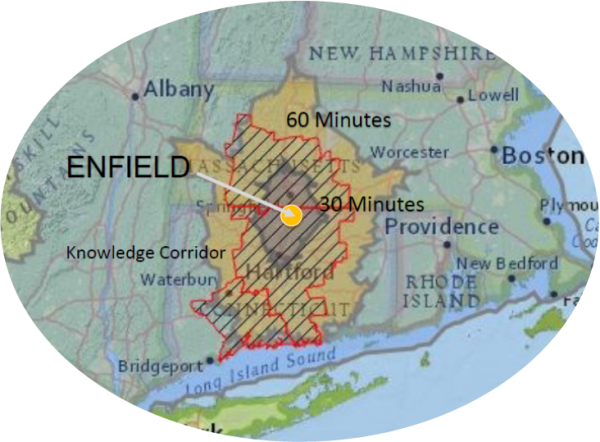
The bid by Enfield is perhaps the most ironic, as the Boston Globe pointed out in a front page article .  The central location being proposed is currently the Enfield Square Mall, which has seen its anchor stores – Macy’s, JC Penney’s and Sears – leave in recent years, followed by numerous smaller retailers.  The proposal is on the agenda of the next town Economic Development Commission, scheduled for Wednesday morning.  The Enfield proposal suggests Hartford, West Hartford, Windsor, Meriden and New Haven and Springfield as "potential satellite campuses" and stresses Enfield's place at the center of the Knowledge Corridor, which runs from Springfield to New Haven.

“It’s a scene repeating itself in dying suburban malls around the country,” the Globe reported, “a sweeping economic disruption known as the Amazon effect.”  Industry analysts have predicted that 20 percent of the 1,200 shopping malls in the U.S. will “meet their demise,” the Globe indicated.

Amazon.com has received 238 proposals from cities and regions across North America.  Amazon said Monday that 54 states, provinces, districts and territories in the United States, Canada and Mexico were represented in the bids. The number of applicants underscores the interest in the contest, which Amazon announced last month. The world’s largest online retailer said it would invest more than $5 billion and create up to 50,000 jobs for “Amazon HQ2”. The deadline for submitting proposals was last Thursday.

"There are no state boundaries for our region's workforce, company supply chains and students," Rick Sullivan, president and CEO of the Economic Development Council, wrote in a letter supporting Enfield.  The town is along the so-called "Knowledge Corridor," the economic region that includes Springfield as well as Hartford and New Haven, and follows the Interstate 91 corridor in Massachusetts and Connecticut.  The corridor is expected to benefit from the introduction of regular commuter rail service, being introduced next year; the Enfield proposal provides Amazon with a map of the new Hartford Line rail route.

The Enfield bid touts its proximity to higher education, Bradley International Airport and major highways, as well as arts and culture. Also highlighted are major businesses located in the community, including Lego, MassMutual, Brooks Brothers, and Eppendorf, according to published reports. The Enfield proposal opens with a stylized newsletter of the future, including facts about Enfield and the region, led by the headline “Internet Retail Giant Pumps Life Back into Dying Mall!”

"With a population of nearly 50,000, Enfield’s 33 square miles are at the center of the New England Knowledge Corridor, Enfield provides quick and easy access to several US Highways, airports and rail systems," the 12-page Enfield proposal explained.  "Tax Increment Financing (TIF) districts are being created in Enfield and surrounding towns to support new development and growth. Abatements and Regional Revenue Sharing are all available to sweeten the deal. Connecticut has the lowest corporate tax rate in the North East."
After having received more than a dozen potential bids, state economic development officials opted to promote Hartford and Stamford as its leading candidates to land the headquarters, developing a website to promote the two regions, under the headline “The Talent You Need.  The Lifestyle They Want.”  The submission noted that "if Connecticut were a country, we’d be the sixth most productive in the world—ahead of Germany, Japan and Hong Kong."

A letter of support jointly signed by the state’s seven-member Congressional delegation and included with the state’s submission did not indicate a preferred location in the state, advocating “full support of Connecticut as the home of your second headquarters.”  A similar letter was signed by legislative leaders of both political parties, along with the co-chairs of the state’s Commission on Economic Competitiveness.  That letter noted that “Connecticut has already made a major commitment to Amazon, with facilities in Windsor and Wallingford, and another planned for North Haven.”

The Hartford bid was supported by the Mayors of Hartford, East Hartford, and West Hartford, along with Chip Beckett of Glastonbury, Chair of the Capital Region Council of Governments.  A joint letter was included in the state’s overall package.  A similar letter supporting Stamford came from that city’s Mayor.

An additional letter of support for the state’s bid was signed by 57 business leaders from throughout the state, accompanied by another from nearly three dozen higher education leaders from public and private institutions.

It was, some have suggested, a show of unity that has been generally lacking during the four months that the state has operated without an approved state budget, the longest such period in the state’s history.

Some communities, most notably the joint proposal by the cities of Bridgeport and New Haven, along with their immediate suburban neighbors, didn’t make the state cut, but submitted proposals nonetheless.  The Enfield proposal touts the entire region, along the I-91 corridor.  Locations in Enfield, including the mall, are suggested, as are other communities north and south of the state line that could host various divisions of an Amazon headquarters, according to reports on the proposal.

Portions of artists renderings included in State of Connecticut proposal advocating for Stamford and Hartford.

Attracting International Start-Up Ventures to CT Takes State's Money and Business' Commitment

Connecticut’s efforts to attract innovative, early stage, start-up companies from around the world will be front and center on Friday at VentureClash, the state’s $5 million global investment challenge.  The mission is simple:  to provide early-stage companies worldwide with an opportunity to grow their business in Connecticut. Connecticut Innovations (CI), the leading source of financing and ongoing support for Connecticut’s innovative, growing companies, is the driving force behind VentureClash, which has attracted companies in digital health, financial technology, insurance technology and the Internet of Things.

The nine finalists, from seven countries, will present in front of a panel of expert judges, at the competition to be held at the Yale School of Management.  The challenge will provide one top winner with a $1.5 million investment. Up to two second-place winners will each receive a $1 million investment, and up to three third-place winners will receive awards worth $500,000 each.

Applications opened in March.  To be eligible, companies must have been in business for at least 12 months, have paying customers or customers who are actively testing the applicant’s product, and be focused in digital health, financial technology (Fintech), insurance technology (InsureTech) or Internet of Things (IoT).

Companies seeking the VentureClash funding must also “be willing to establish a Connecticut presence, which applies to domestic and international applicants,” according to the competition’s criteria.

Tim Armstrong, CEO of Oath, will be the keynote speaker at the event. Oath is a global digital and mobile company that reaches more than one billion global consumers and partners with the world’s leading global brands. Oath owns close to 50 mobile and internet brands, including Yahoo, AOL, HuffPost, TechCrunch, Tumblr and other leading brands as well as global commerce and advertising platforms that support thousands of partners across the globe.

The VentureClash finalists are:

  • Bought By Many – A U.K.-based interactive members-only service, Bought By Many offers targeted insurance opportunities designed to help individuals find the right insurance efficiently and customized to their needs.
  • Buzzmove – Buzzmove is the United Kingdom’s only price-comparison and instant-booking platform for all services related to moving and the right level of insurance needed to cover moving-related services.
  • Davra Networks – Based in Ireland, Davra Networks provides a complete Internet of Things (IoT) platform that allows customers to define, build and bring to market vertical-specific IoT applications while collecting and easily sharing data.
  • EAVE – U.K.-based EAVE is developing the next generation of hearing protection and communication technology utilizing noise cancellation and speech enhancement to eliminate noise-induced hearing loss.
  • FRISS – Based in the Netherlands, Friss uses proprietary analytics software to provide state-of-the-art solutions in the fields of fraud, risk and compliance for the insurance industry.
  • Peek Health, S.A. – Based in Portugal, Peek Health offers powerful three-dimensional preoperative planning software for orthopedic surgery that aims to help the surgeon better treat the patient while reducing costs and surgical times.
  • SCADAfence – Based in Israel, SCADAfence is a pioneer in securing mission-critical industrial networks from cyber threats, reducing the risk of connecting multiple devices in industries like manufacturing, utilities, oil and gas.
  • Tellspec – Headquartered in Toronto, Canada, Tellspec is a data company with the ability to scan food, offering non-destructive real-time food testing for quality control, authentication, safety and nutritional value.
  • Vouchr – Based in Canada, Vouchr is a secure, payment-agnostic tool that allows users to bundle transfers of funds with photos, videos, social networking and gamification.

“VentureClash again attracted an impressive list of innovative, early-stage companies poised for growth,” said Matt McCooe, CEO of Connecticut Innovations. “The fundamental improvement in this year’s competition is the deep involvement of so many corporate partners. Many of Connecticut’s flagship companies engaged in the process to learn about, meet and help us select the competitors in VentureClash. The Connecticut-based companies are looking to CI to act as a tech scout, and to help identify fantastic talent and innovation from across the globe.”

Recognizing that it takes more than money to succeed, officials point out, the $5 million global business competition also includes access to a critical network of customers, investors, mentors and talent.

VentureClash 2017 has partnered with the following organizations for this year’s competition: Aetna; Bank of Ireland’s Startlab; Boehringer Ingelheim; Dream Payments; Fiondella, Milone & LaSaracina LLP; General Dynamics Electric Boat; Health Venture; ISG (Information Services Group); Magellan Health; Medtronic; Microsoft BizSpark Assets; Navigators; Pitney Bowes; RBS/NatWest; Shipman & Goodwin; Sikorsky & Lockheed-Martin; Stanley, Black & Decker; Stanley Ventures; Synchrony Financial; The Hartford; The Jackson Laboratory; Travelers; Updike, Kelly & Spellacy; Webster Bank; Yale University; Yale New Haven Health; and Yale Office of Cooperative Research (OCR).

A year ago, in the inaugural VentureClash, ten companies were selected as finalists from an initial field of 200.  The top prize winner, DreamPayments, was a financial technology company that provides a cloud-based mobile payment platform for merchants and financial institutions.  Based in Canada, the company was looking to expand its operations to the U.S.  In receiving the $1.5 million in funds from CT Innovations, they stated plans to hire up to 10 employee positions in Connecticut and add a business development professional to help assist with its U.S. growth plans.  The company is headquartered in Toronto, with operations also now in Stamford.  The company hired its first U.S. employee in March.

Connecticut Innovations is Connecticut’s strategic venture capital arm, providing funding and strategic support to early-stage technology companies. In addition to equity investments, CI provides grants that support innovation and collaboration through CTNext, and connections to its well-established network of partners and professionals.

To register to attend the 2017 VentureClash finals event, visit: www.ventureclash.com/event.


Forum on Bankruptcy Planned as Budget Eludes State, Hartford Nears Decision

If the state legislature remains deadlocked on approval of a state budget and the level of municipal aid that would be sent to the City of Hartford, a public forum planned for next Thursday, October 19, may offer a sneak preview of what will come in the days after the headline “Hartford Declares Bankruptcy.” In a program organized by the City of Hartford with support from the Hartford Foundation for Public Giving, the front-burner topic will be “What Does Municipal Bankruptcy Mean and What Can We Learn From Other Cities.”  Insight will be offered by Kevyn Orr, former Emergency Manager for the City of Detroit; Don Graves, former Deputy Assistant to President Obama and Counselor to Vice President Biden; and Mayor James Diossa of Central Falls, Rhode Island.  Moderator for the forum will be Jay Williams, recently installed as President of the Hartford Foundation for Public Giving, and a former U.S. Assistant Secretary of Commerce for Economic Development, and Mayor of Youngstown, Ohio.

The purpose of filing Chapter 9 bankruptcy is to provide a financially distressed government body protection from its creditors while it reorganizes to make itself more fiscally stable.  Opinions differ on its impact and effectiveness.  In Connecticut history, the city of Bridgeport filed for bankruptcy in 1991, but the filing was withdrawn by a new administration after the incumbent Mayor was defeated.  Years later, action by the state legislature to take over fiscal management of Waterbury prevented a possible bankruptcy declaration.

The 90-minute program on October 19 will be held beginning at 8 a.m. at The Society Room on Pratt Street in downtown Hartford.  The conversation continues at a late-afternoon public forum, with the same panelists, at Hartford Public High School.  

Central Falls, the first city in Rhode Island history to declare bankruptcy, in 2011, came out of bankruptcy in a relatively short 13 months.  Described as one of the hardest hit communities in the great recession, with unemployment reaching 16 percent between 2010 and 2012, Central Falls was considered by 2015 as among communities in the state that, although still struggling, were on the rise.

On July 18, 2013, Detroit, Michigan, became the largest municipality in United States history to file for Chapter 9 bankruptcy.  Detroit’s highly visible bankruptcy is today credited by some observers as a key element in the city’s ability to rebound in more recent years, attracting new investment after shedding considerable liabilities through bankruptcy court.  It is even using its bankruptcy as a plus as it goes after Amazon’s second headquarters – a competition that Hartford also looks forward to entering.

Out of nearly 89,500 municipalities in the country, there were just 239 municipal bankruptcy filings between 1980 and 2010, according to the American Legislative Exchange Council.  That number picked up considerably in the aftermath of the recession, including Detroit, Central Falls, San Bernardino and Stockton, CA; and Jefferson County, AL.

Hartford Mayor Luke Bronin said earlier this month that Hartford would seek Chapter 9 protection if additional state aid was not forthcoming by November. The city is seeking at least $40 million more this year — on top of the $260 million the city is already due to receive -also now in doubt due to the state's budget stalemate.  The city, facing a $65 million deficit, is expected to run into cash-flow problems this fall, with shortfalls of $7 million in November and $39.2 million in December, according to published reports.

A week ago, in a newsletter to bond holders and other investors, Municipal Market Analytics noted some of the issues that a Chapter 9 petition could pose not only to Hartford, but to jurisdictions beyond the city’s borders, including steeper interest rates when towns in the region borrow for infrastructure projects, and a possible adverse impact on the state’s bond rating.  The report was speculative, but could have an impact on decisions made at the State Capitol in the coming weeks.

Traffic is for Women, Weather is for Men (Mostly) on Connecticut TV

Rachel Frank is an Emmy award-winning meteorologist, seen regularly throughout FOX61 evening newscasts.  Kaitlyn McGrath is a meteorologist for NBC Connecticut.  As women, they are the exception in Connecticut, where 16 men routinely provide the weather updates on Connecticut television stations. Traffic reporting, however, is a women’s domain in the state.  The news teams at all four television stations in the market – WFSB, WTNH, NBC and FOX - have women handling the traffic reporting responsibilities on their morning newscasts, and observers are hard-pressed to recall a man doing that job.

The latest shake-up of the weather reporting team at WTNH, NewsChannel 8, brought the disparity into sharper focus with half-page newspaper ads and television promos trumpeting the new all-male team of meteorologists, highlighted by the addition of veteran meteorologist Joe Furey, who moved to the station last month from FOX61.  Furey, named co-chief meteorologist, joins Sam Kantrow, Fred Campagna, Gil Simons and Kevin Arnone.

Also starkly absent from the meteorology and traffic reporting ranks in Connecticut – ethnic and racial diversity.

First, the traffic.  Morning newscast viewers see Rachel Lutzger on FOX, Nicole Nalepa on WFSB, Teresa Dufour on WTNH and Hanna Mordoh on NBC.

Nalepa wears many hats at channel 3, also serving as a health reporter and fill-in-anchor for the station.  Before joining the station, she was weekday morning anchor and reporter at WWLP-TV/22News in Springfield, MA, after having graduated Magna Cum Laude with a degree in Communications from Westfield State University. Mordoh earned a bachelor’s degree in Journalism and Criminal Justice from Indiana University and was a news reporter in Indiana and Kentucky before joining NBC Connecticut.

Lutzger also handles traffic reporting each morning for Kiss 95.7, Country 92.5, The River 105.9, WELI and KC101, and afternoons on The River 105.9. A native New Yorker, she first came to Connecticut to attend the University of Hartford. In addition to traffic reporting, Dufour is co-host for CT Style, a daily lifestyle program on WTNH.  She graduated from the University of Connecticut in 2001 with a bachelor’s degree in broadcast journalism, and handled traffic reporting for WFSB before moving over to WTNH.

Connecticut briefly lost its most visible female meteorologist when Frank, an honors graduate of Pennsylvania State University with a bachelor’s degree in meteorology and a native New Yorker, left the station briefly in 2014 for New York City’s WPIX.  She returned to Connecticut and FOX61 later that year.  McGrath’s most memorable career moments, according to the station’s website, were covering everything from severe thunderstorms and flooding, to life threatening heat and an EF2 tornado in Charleston, South Carolina. She earned her degree in Telecommunications/News Broadcasting at the University of Florida, and, earlier this year, a Certificate of Science in Geoscience; Broadcast Meteorology Concentration, from Mississippi State University.

At FOX, Frank is joined on-air by Matt Scott, Dan Amarante and Sam Sampieri. The NBC “First Alert” team includes Bob Maxon, Ryan Hanrahan, Darren Sweeney, and Josh Cingranelli, along with McGrath.  The full-time meteorologists at WFSB are Bruce DePrest, Mark Dixon, Mike Cameron and Scot Haney. At WFSB, the all-male ranks are occasionally joined by reporter Melissa Cole, who serves as a “fill-in meteorologist, lending a hand during major weather events,” according to the station’s website. She studied Meteorology at Villanova University, and initially joined WFSB as a weekend newscast meteorologist.

A national study published this month in the Bulletin of the American Meteorology Society, found that although “the overall percentage of females in the field increased and females were more represented in larger markets, females held fewer influential and desired positions in 2016 compared with previous studies. Females made up 8% of chief meteorologist positions and less than 11% of evening shifts, which was lower than numbers in previous studies.”

According to the American Meteorological Society (AMS), in 2005 about 20 percent of meteorologists nationally were women, up from 10 percent in 1995. In 2010, the Boston Globe reported that “for the first time, all five of the meteorologists on Boston’s early-morning and midday newscasts are women.”  Among them was Dylan Dreyer, now with NBC News and the network’s Today Show.  Commenting on a WeatherChannel program earlier this year with leading female meteorologists now working at national television networks, including ABC News Chief Meteorologist Ginger Zee, the program host observed in a blog post, “Check the numbers on female chief meteorologists around the nation. It’s pretty pathetic.”

In a 2015 article published by Medium, it was reported that an AMS membership survey of its 14,000 members indicated that 2 percent were African-American.

Photos:  Traffic reporters (above, clockwise)  Hanna Mordoh, Nicole Nalepa, Rachel Lutzger, and Teresa Dufour;  Weather reporting teams at NBC Connecticut, FOX61 and WFSB.

New Area Codes Becoming More Prevalent in Connecticut; 475 and 959 Grow in Usage

Do the numbers 475 and 959 sound familiar?  If they don’t yet, they likely will in the relatively near future. There was a time, long ago but not far away, when residents in the entire state of Connecticut shared one Numbering Plan Area, better known as an area code.  All across Connecticut, it was 203.  Then, after about 50 years, it became more complicated.

First, with advances in technology and the exponential growth of communications devices, the state was split into two area codes in 1995, with Fairfield and New Haven counties retaining 203, and the other six counties shifting to the new 860. 

But that quickly proved to be insufficient.  Within the past decade, two “overlay” area codes were added.  Beginning in December 2009, residents or businesses in the 203 area code could be assigned a 475 area code.  And telephone customers in the 860 area could be assigned the 959 area codes as of August, 2014.

Commonly known as an area code, an NPA is the first three digits of a 10-digit North American phone number. In areas that have run out of phone numbers and a new area code has been introduced, some – including Connecticut - have chosen to overlay the new area code over the same area as the old one, instead of splitting the area in half. This avoids anyone having to change area codes, but does require that everyone in that region dial all ten digits for each call.

According to the North American Numbering Plan Administration (NANPA), which has jurisdiction for assigning area codes (Numbering Plan Areas) in Connecticut and beyond, as of June 30, 2017 telephone carriers reported approximately 57,000 numbers have been assigned using the 959 area codes, and nearly ten times that number, 523,000, have been assigned the 475 area code in Fairfield and New Haven counties.  The numbers are assigned to carriers, who then dole them out to customers. 

One of them is the Odyssey Early Learning and Enrichment Program in Norwalk, assigned a 475 number.  The New Haven Public Schools Office of Choice & Enrollment also was provided a 475 number, in the midst of all the 203’s across the city.  In Bridgeport, St. Vincent’s Medical Center Federal Credit Union has introduced customers to their 475 area code phone number.  The Hartford Correction Center began using a 959 area codes in January, and the UConn School of Social Work received a 959 number when they relocated to Hartford this year.

So, don’t be surprised if a new neighbor or a local businesses shares a phone number with an unfamiliar prefix.  It’s the wave of the future, and it’s here now.

It is still possible for the “old” 203 and 860 prefixes to be assigned to new customers by the carriers.  NANPA reports that there remain 200 blocks of one thousand numbers that may still be provided to various carriers for them to assign to customers.

Of course as reliance on land lines continues to diminish and people tend to keep their cellular phone numbers as the relocate across the country, the connection between where a person lives and the telephone area code becomes less meaningful. But for land lines in Connecticut what was once one area code is now four.  At least for the immediate future.


More CT Employers Expect Hiring to Increase for Remainder of Year; Hartford Region Lags State

Employers in Connecticut expect to hire at a modest pace during the fourth quarter of this year, which began on October 1, according to the ManpowerGroup Employment Outlook Survey. From October to December, 18 percent of Connecticut companies interviewed plan to hire more employees, while 7 percent expect to reduce their payrolls. Another 73 percent expect to maintain their current workforce levels and 2 percent are not certain of their hiring plans. This yields a Net Employment Outlook of 11%, which is below the national outlook projection.

“Hiring intentions are stronger compared to Q3 2017 when the Net Employment Outlook was 8%,” said ManpowerGroup spokesperson Betty Gooding. “The hiring pace is expected to remain stable compared to one year ago when the Net Employment Outlook was 12%.”

For the coming quarter, job prospects in the state appear best in Construction, Durable Goods Manufacturing, Nondurable Goods Manufacturing, Wholesale & Retail Trade, Information, Financial Activities, Professional & Business Services, Education & Health Services, Leisure & Hospitality and Other Services. Employers in Government plan to reduce staffing levels, while hiring in Transportation & Utilities is expected to remain unchanged, the survey found.

In an analysis of the largest metropolitan regions in the nation, three in Connecticut brought differing projections, with one slightly higher and the others slightly lower than overall expectations statewide.

In the Bridgeport-Stamford-Norwalk metropolitan statistical area (MSA), employers expect to hire at what is described as a “respectable pace” during this quarter, according to the Survey.  Twenty percent plan to hire more employees, which is offset by the 6 percent that plan to reduce payrolls, while 72 percent of employers expect to maintain current staff levels. Two percent indicate they are not sure of their hiring plans, which yields a Net Employment Outlook of 14% - higher than the expectation statewide.

In the New Haven-Milford MSA, 16 percent plan to hire more employees from October through December and 6 percent that plan to reduce payrolls. The Net Employment Outlook is 10%, just under the state outlook.  And in Hartford-West Hartford-East Hartford, 17 percent of employers plan to hire more employees, 8 percent that plan to reduce payrolls, while 70 percent expect to maintain current staff levels and 5 percent are not sure of their hiring plans. This yields a Net Employment Outlook of 9%.

Nationwide, of the more than 11,500 employers surveyed, 21 percent expect to add to their workforces, and 6 percent expect a decline in their payrolls during the final quarter of the calendar year. Seventy-one percent of employers anticipate making no change to staff levels, and the remaining 2 percent of employers are undecided about their hiring plans. When seasonal variations are removed from the data, the Net Employment Outlook is 17% nationwide.

This marks the 13th consecutive quarter with an Outlook of +15% or stronger, according to Manpower Group.  Compared with this time one year ago, hiring prospects are slightly stronger in the Northeast and remain relatively stable in the other three regions.  The Northeast Region includes Connecticut, Maine, Massachusetts, New Hampshire, New Jersey, New York, Pennsylvania, Rhode Island, and Vermont.  Employers across all sectors report favorable hiring intentions, with those in durable goods manufacturing reporting the strongest intentions in the past 10 years.

For the final quarter of the year, employers in Delaware, North Carolina, Wisconsin, Minnesota, Montana, Oregon, South Carolina and Utah report the strongest Net Employment Outlooks. Among the 100 largest metropolitan statistical areas, the strongest job prospects are expected in Cape Coral, Fla.; Oxnard, Calif.; Charlotte, N.C.; Stockton, Calif.; Deltona, Fla.; Grand Rapids, Mich.; Madison, Wis. and McAllen, Texas.  The Net Employment Outlook is derived by taking the percentage of employers anticipating an increase in hiring activity and subtracting from this the percentage of employers expecting a decrease in hiring activity, taking into account seasonal adjustments.

Bradley Ranks Last in Passengers’ Satisfaction Rating of 21 Mid-Sized U.S. Airports

Air travelers ranked Connecticut’s Bradley International Airport last among 21 medium-sized airports in a passenger satisfaction survey.  The airport fell from a second-to-last ranking in a similar analysis done at the end of last year, to the bottom rung of the latest ratings. Sacramento International Airport ranks highest among medium airports, with a score of 810. Indianapolis International Airport (807) ranks second, and Ted Stevens Anchorage International Airport (806) ranks third, in the survey by J.D. Power.

Bradley’s score of 742 was an improvement from 724 last year, but did not prevent the drop to the bottom of the category.  Just ahead of Bradley were Cleveland Hopkins International Airport (754) Kahului Airport (758), and San Antonio International Airport (761).  In last year’s survey, Bradley was tied for second-to-last with Kahului; Cleveland finished last.  Both passed Bradley in the latest rankings.  The medium airport average score was 781 in the survey released this month.

Connecticut Airport Authority Executive Director Kevin Dillon told the Hartford Business Journal, "We're pleased that our score has increased from last year and that our score is the highest among competing airports in the region."  He added that “we know that there are areas that need to be addressed, such as enhancing our concessions and terminal facilities. We have already introduced a number of new concessions over the last year and have made major updates to our terminal, and we have an ambitious plan for further upgrades over the coming months and years."

Nationally, overall traveler satisfaction scored a 749 out of 1,000 points, an 18-point increase from last year’s survey.  Among the nation’s largest airports, Orlando International Airport received a score of 778 out of 1,000, beating out the runner up, Detroit Metropolitan Wayne County Airport, which received a 767 score.

Newark Liberty International Airport in New Jersey received the lowest ranking among “Mega” airports, earning a score of 686. LaGuardia Airport, in New York City, ranked worst among “Large” airports, with a score of 654.

The survey ranked airports across the U.S. based on several key factors: accessibility, check-in and baggage check process, security screening, shopping, terminal facilities and baggage claim.

Airports were broken down into three categories based on size. “Mega” airports were defined as those handling more than 32.5 million annual passengers. The “large” category included airports with 10 million to 32.4 million passengers and “medium” airports, including Bradley, are those with between 3 million and 9.9 million passengers.

The J.D. Power analysis indicated that “with nearly every airport in the country dealing with challenges of high passenger capacity and ongoing construction projects to address increased demand, technology is helping to directly address these issues.”

“The trifecta of a steadily improving economy, record passenger volume and billion-dollar renovation projects unfolding in airports across the country has created a challenging environment for customer satisfaction,” added Michael Taylor, Travel Practice Lead at J.D. Power.

Now in its 12th year, the study is based on responses from 34,695 North American travelers who traveled through at least one domestic airport with both departure and arrival experiences (including connecting airports) during the past three months. Travelers evaluated either a departing or arriving airport from their round-trip experience. The study was conducted from January through August 2017.

New Haven Chamber Recognizes Business Success Stories, Starting with "Juice"

The annual Greater New Haven Chamber of Commerce awards luncheon on Thursday, September 28  will celebrate the diverse accomplishments of members of the region’s business community – including an entrepreneurial business with the “juice” to grow from a home-based start-up in Wallingford to employ more than 120 people in New Haven in less than a decade. The company - FreshBev LLC - produces two primary lines of beverages - RIPE Craft Juice and RIPE Craft Bar Juices, bringing real fresh juice to the market, and connecting local farmers to consumers by using only ingredients that could be traced back to the grower and region.
“We don’t heat our juice, we don’t pasteurize it. It’s cold-pressed,” founder Michel Boissy told NewsChannel 8 earlier this year. “We use an amazing new technology called high-pressure processing, which does everything that pasteurization does minus the heat. So we’re not heating the juice, we’re not killing the color, flavor, aroma, nutritional profile and all of what fresh juice is.”

The company’s website explains that “In the fall of 2008, tired of being subjected to the big ol’ bottle of day glow “margarita” mix, childhood friends and founders Michel Boissy and Ryan Guimond came to the conclusion that they had no choice but to create the first line of legit, handcrafted bar juices. With Mike's experience in high end kitchens and behind the bar, coupled with Ryan’s picky palate and a shared love of a good cocktail, these drink mix mercenaries set forth to create the nation's first pure squeezed, cold pressed, Bar Juice™.

The results are making local history, and spreading.  RIPE Craft Juices are available nationally through Whole Foods and select regional grocery chains.

The Chamber’s business leadership event is highlighted by the presentation of the Community Leadership Award to an individual who has made an outstanding contribution to the Greater New Haven Community.   That award will go to longtime Quinnipiac University President John Lahey, who has announced his retirement.  The other awards to be presented by the Greater New Haven Chamber of Commerce include:

Small Business Achievement Award  Four Flours Baking Company

Legislative Leadership Award   First Selectman Mike Freda, Town of North Haven

Achievement in Manufacturing Award  Cowles & Company

Leadership in Healthcare Award  Cornell Scott-Hill Center

Community Partnership Award  Easter Seals Goodwill Industries

Developer Investment Award  Randy Salvatore, RMS Companies

Alumnus of the Leadership Center Award  Paul Bartosic, Harvard Pilgrim Health Care

Volunteer of the Year Award  Mary Grande, New Reach

The awards will be presented on September 28 at the Omni Hotel in New Haven.


https://youtu.be/X56KIS8TEd0

Personal Finance, Economic Education Curriculum Not Required in State's Schools

Connecticut has a curriculum for financial literacy for schools in the state.  But they’re not required to use it.  That’s true for economic education and personal finance education.  Despite having a 9-page state approved set of curriculum guidelines and expectations for student learning detailed on the website of the State Department of Education, there appears to be no indication as to where or whether courses are actually offered, taken and taught. Economic Education is included in the state’s K-12 standards in Connecticut, as it is in every state in the nation.  But Connecticut is one of only six states where the standards are not required to be implemented by districts, one of 27 states where a high school course is not required to be offered, one of 30 states where a high school course is not required to be taken, and one of 34 where standardized testing in the subject is not provided.

The numbers are similar for personal finance education.  Connecticut is one of 13 states that does not require standards to be implemented by local school districts, one of 28 states that does not require a high school course to be offered, and one of 28 that do not require a high school course in personal finance education to be taken. Connecticut, like most states (43) does not have standardized testing in personal finance.

That’s according to the Council for Economic Education’s “Survey of the States 2016,” a report on “Economic and Personal Finance Education in Our Nation’s Schools.”  Among the national findings:

  • While more states are implementing standards in personal finance, the number of states that require high school students to take a course in personal finance remains unchanged since 2014 – just 17 states.
  • Only 20 states require high school students to take a course in economics – that’s less than half the country and two fewer states than in 2014.
  • There has been no change in the number of states that require standardized testing of economic concepts – the number remains at 16.

Connecticut’s seven “content standards” in personal finance focus on personal decision making, earning and reporting income, managing finances and budgeting, savings and investing, buying goods and services, banking and financial institutions, and maintaining credit worthiness, borrowing at favorable terms and managing debt.  The “frameworks” outline skills that students are expected to master, and “learner expectations” at various levels, from beginning to advanced.

“Some states offer little guidance to school districts related to what personal finance content to offer in schools at each grade level; others have pushed ahead, requiring courses from elementary to high school aged students, supporting and training teachers, and in some cases even testing students on learning outcomes,” said J. Michael Collins, of the Center for Financial Security at the University of Wisconsin-Madison in the report.

“Rigorous state standards can facilitate local schools to implement well-designed programs, which in turn expose students to concepts they otherwise would not learn. Communities may also benefit from having more financially competent households; perhaps stronger economics and personal finance standards could even be viewed ultimately as an economic development strategy, equipping young people with an increased ability to manage credit and invest in their future,” Collins added.

Statistics were not available in Connecticut on the number of school districts requiring financial literacy coursework, or the number of students who take such classes.

"States that combine personal finance and economics, support teachers, and hold students accountable for learning objectives have the best chance of promoting the development of young people who are better financial managers and stewards of their credit—behaviors with which many, if not most, young people tend to struggle," Collins pointed out.

The Council for Economic Education (CEE) is a leading nonprofit organization in the United States that focuses on the economic and education of students from kindergarten through high school.  The 65 year-old organization is based in New York City.


CT Ranked 36th in Construction Jobs Added During Past Year

Connecticut ranked 36th in the nation in the number of construction jobs added between July 2016 and July 2017, one of 36 states (and the District of Columbia) that added construction jobs during the 12-month period. The analysis by the Associated General Contractors of America of Labor Department data found that firms in parts of the country that build infrastructure projects are seeing less demand for their services amid overall declines in public-sector spending. Only 100 construction jobs were added in Connecticut during the past year, moving the states employment level in construction industries from 58,800 to 58,900, reflecting growth of two-tenths of one percent.

“Despite growing private-sector demand, it appears that construction employment in some parts of the country is being brought down by declining public-sector investments,” said Ken Simonson, chief economist for the association.  “Some of these declines will be offset thanks to recently enacted state infrastructure funding increases, but stagnant federal investments are not helping.”

Among the New England states, Rhode Island ranked third in the nation, with a 12-month gain of 12.7 percent, New Hampshire ranked fourth with 11.8 percent growth in construction jobs, and Maine ranked sixth, with a 9.3 percent increase.

California added the most construction jobs (51,000 jobs, 6.6 percent) during the past year. Other states adding a high number of new construction jobs for the past 12 months include Florida (35,800 jobs, 7.5 percent); Louisiana (13,900 jobs, 9.8 percent); Oregon (11,900 jobs, 13.2 percent) and Texas (10,400 jobs, 1.5 percent). Oregon added the highest percentage of new construction jobs during the past year, followed by Nevada (12.8 percent, 9,700 jobs).

Thirteen states and the District of Columbia shed construction jobs between July 2016 and July 2017 while construction employment was unchanged in North Dakota. Iowa lost the highest number of construction jobs  (-4,400 jobs, -5.4 percent), followed by Illinois (-4,300 jobs, -2.0 percent) and North Carolina (-2,500 jobs, -1.2 percent).  South Dakota lost the highest percentage for the year (-5.6 percent, -1,400 jobs) followed by Iowa and Mississippi (-3.9 percent, -1,700 jobs).

Association officials have continued to urge Congress and the administration to make needed new investments in the country’s aging infrastructure to offset declining public-sector investments in construction. In particular, they urged officials to consider including new infrastructure investments as part of a tax reform measures expected this fall, the association indicated in a news release.