Institutional Investors, Including Connecticut, Seek to Influence Firearms Industry

A coalition of global institutional and private investors, including the $35-billion Connecticut Retirement Plans and Trust Funds (CRPTF), has announced plans to be guided by a newly developed set of principles developed to encourage a “responsible civilian firearms industry.”  The guidelines, established as part of their “fiduciary responsibility,” aim to encourage the firearms industry to address gun safety issues. Since the 2012 Sandy Hook tragedy, Connecticut State Treasurer Denise Nappier has engaged with companies in which the State invests that manufacture, distribute and sell guns and ammunition, raising the business case for reasonable regulation of firearms and ammunition sales in order to mitigate the potential long-term business risk posed by high rates of mortality that are attributed to the misuse of firearms, according to the Treasurer’s Office.

“The proliferation of gun violence is not only a public health issue but also a business risk issue, both of which are central to our fiduciary role as long-term institutional shareholders,” Treasurer Nappier said.

The launch of the Principles for a Responsible Civilian Firearms Industry by investors with combined assets under management of more than $4.8 trillion builds on the Treasury’s engagement effort.  Among the institutional investors signing on to the new principles are funds in states that have seen headline-raising mass shootings, including Florida and California, in addition to Connecticut.

The principles would apply to public and private companies that are involved in the manufacture, sale and distribution of civilian firearms, officials said.  They are focused on reducing risk, which is a priority for institutional investors who have a fiduciary obligation to invest pension assets prudently and to monitor and manage risks.

Over the past decade, shootings involving multiple victims have been on the rise with 2017 being the worst year on record. It is estimated that in 2017 alone, excluding suicides, more than 15,000 people were killed by guns in the United States including students, teachers, and law enforcement officers, according to Gun Violence Archive, a non-profit organization that tracks media and law enforcement reports of shootings.

This year there have been several shootings resulting in multiple fatalities at schools, bars, religious institutions and other places where large numbers of people congregate.

“We must do better,” Treasurer Nappier said.  “We must continue to speak out, contribute constructively to the public debate over this important issue, and achieve the outcome for which we all strive: the safety of our communities and of all our citizens.”

The five principles serve as a conversation starter for investors to use when engaging companies to be active participants in protecting and enhancing long-term portfolio values by ensuring risks are being appropriately monitored and addressed.  The five principles include:

  • Principle 1: Manufacturers should support, advance and integrate the development of technology designed to make civilian firearms safer, more secure, and easier to trace.
  • Principle 2: Manufacturers should adopt and follow responsible business practices that establish and enforce responsible dealer standards and promote training and education programs for owners designed around firearms safety.
  • Principle 3: Civilian firearms distributors, dealers, and retailers should establish, promote, and follow best practices to ensure that no firearm is sold without a completed background check in order to prevent sales to persons prohibited from buying firearms or those too dangerous to possess firearms.
  • Principle 4: Civilian firearms distributors, dealers, and retailers should educate and train their employees to better recognize and effectively monitor irregularities at the point of sale, to record all firearm sales, to audit firearms inventory on a regular basis, and to proactively assist law enforcement.
  • Principle 5: Participants in the civilian firearms industry should work collaboratively, communicate, and engage with the signatories of these Principles to design, adopt, and disclose measures and metrics demonstrating both best practices and their commitment to promoting these Principles.

“More companies are recognizing that we do not need to work through these issues as adversaries, because we are not.  We share a common interest in their future growth and success, and in promoting the sustainable health of the economic, social and environmental framework within which they exist,” Nappier said.  “Our investments and the future well-being of millions of American pension fund beneficiaries are dependent on responsible corporate governance and citizenship of the portfolio companies in which we invest, but we also can influence it.”

Signatories, besides the CRPTF, include: the California Public Employees Retirement System; the California State Teachers’ Retirement System; the Florida State Board of Administration; the Maine Public Employees Retirement System; the Maryland State Retirement and Pension System; Nuveen, the asset manager of TIAA; OIP Investment Trust; the Oregon Public Employees Retirement Fund; Rockefeller Asset Management; the San Francisco Employees’ Retirement System; State Street Global Advisors; and Wespath Investment Management.

The principles were conceived earlier this year when Harvard University Advanced Leadership Fellow Christianna Wood and Christopher J. Ailman, chief investment officer of the California State Teachers’ Retirement System (CalSTRS), convened a group of asset owners, asset managers, and financial institutions to design pragmatic principles for portfolio company engagement in the firearms industry that both gun manufacturers and retailers could embrace.

“The objective of the initiative was to mitigate reputational and financial risk in the investment portfolio. We believe these principles will help to ensure the long-term financial health of the civilian firearms industry and where possible, allow for continued investment/funding of companies within the industry,” the coalition said.

“These principles are an engagement solution to divestment and meant to stimulate productive dialog within the industry. Working together, we can build and leverage solid relationships as we make progress toward mitigating risks, not only to the civilian firearms industry, but also on behalf of our investments,” Ailman said.

Treasurer Nappier said that the Treasury will use the principles as a foundation for conversation and collaboration with the companies in the gun industry in which the CRPTF has investments.  Nappier will conclude 20 years as State Treasurer in January.  She did not seek re-election, and will be succeeded in office by Shawn Wooden, who was elected by Connecticut voters earlier this month.

Credit Card Balance? CT Residents Have Nation's Second Highest, on Average

With the holiday gift-giving season on the horizon, the sound of credit cards are being pulled from wallets and numbers being typed into online sites is also upon us. Before those bills even come due, Connecticut residents have a head start in building credit card balances. Connecticut residents have the highest average credit card balance, at $7,258, in the continental United States.  Alaska, at $8,515, is the only state where residents have a higher average balance in the U.S.

Rounding out the top ten are Virginia ($7,161), New Jersey ($7,151), Maryland ($7,043), Hawaii ($6,981), D.C. ($6,963), Texas ($6,902), Colorado ($6,718), and Georgia (6,675).  New York is next at $6,671.

The states with the lowest credit card balances overall are Iowa and Wisconsin, with an average of $5,155 and $5,363, respectively.

Connecticut average credit card balance - $7,258, - is not only second highest in the nation, but the average number of credit cards owned by Connecticut residents is 3.23, which ranks fifth among the states.  The states where people opened the most credit cards were New Jersey and New York, with an average number of 3.49 and 3.34 cards per person, respectively.

On the state’s average income of $70,121, which is second highest in the U.S., the average credit card balance is 10.35 percent of income.  Because of Connecticut’s high average income, the percent of income average is fourth lowest among the states.

The analysis, by the financial website Upgraded Points, used data of average credit card balances from Experian’s State of Credit: 2017, and data of average annual income by state in 2017 from research by the Federal Reserve Bank of St. Louis.

The analysis notes that “for the 58.8 percent of American households that pay off their balances in full, credit card debt is not a problem. But the other 41.2 percent carry some amount of debt every month and must pay interest fees.” In 2017, overall American credit card debt, according to Upgraded Points, broke through the $1 trillion mark and set an all-time high. The last time credit card debt was over $1 trillion was right before the Great Recession in 2008. In 2017, a survey by Pew Research found that only 46 percent of Americans made more than they spent.

The data indicates that states near the coasts tend to have the highest absolute credit card balances. “The only two states in the top 10 that aren’t by the ocean are Texas and Colorado.  States in the Midwest tend to have the lowest average credit card balances. Only three states in the bottom 10 were not in the Midwest: West Virginia, Arkansas, and Mississippi.”


Danbury Leads CT in 5-Year Job Growth; 41st in Ranking of 50 States’ Leaders

When job growth is measured over the past five years, Danbury leads the way in Connecticut. An analysis of changes in employment figures between 2013 and 2018 from the 381 metropolitan areas defined by the U.S. Census Bureau focused on the leading city in each state, and ranked them. The analysis, by the website howmuch.net, found that Danbury - which saw job growth of 6.6 percent - outpaced Connecticut’s largest cities, but that the leading city in 40 of the 50 states had a stronger track-record.

The leading cities in five-year job growth were Lake Charles, LA: 28.3%; Bend-Redmond, OR: 26.6%; Elkhart, IN: 24.0%: St. George, UT: 23.4%; Greeley, CO: 21.1%; Gainesville, GA: 20.9%; Fayetteville, AR: 20%; Boise City, ID: 18.6%; Austin, TX: 18.4%; and Reno, NV: 18.0%.  The analysis notes that the top cities “are truly remarkable job markets at the center of the recovery, perhaps because they were hardest hit by the recession.”

The standing of Austin, Charlottesville and Nashville are noted for “a reputation as fun destinations with music and tech scenes. They are mid-sized cities with universities, hospitals, and large well-known employers. These are the ingredients for long-term economic growth and positive employment numbers.”

“In many ways, Danbury is the forgotten city in Fairfield County up north here,” P.J. Prunty, executive director of the Greater Danbury Chamber of Commerce, told the Danbury News-Times earlier this year. “These statistics show that people are attracted to a city that has opportunity and good employment. It’s growing, and that’s a good thing. People are voting with their feet by moving here.”  Back in April, the Danbury Labor Market Area had the lowest unemployment rate of the nine LMAs in the state. The Danbury LMA outpaced the state and national unemployment rates, the News-Times reported.

Leading the way in the five-year analysis, released this month, are Barnstable in Massachusetts, at 13.7 percent employment growth; in New Hampshire it is Portsmouth at 10.1 percent, in Rhode Island, Providence/Warwick at 7.7 percent; Maine the greatest job growth has been in Portland/South Portland at 7.1 percent.  Vermont is the only New England state with a leading city growing jobs at lower rate than Connecticut’s – Burlington/South Burlington at .8 percent.  Only Alaska and Wyoming are lower, rounding out the 50 states.

Also noted:  “Some places are factory towns with unsustainable growth rates. Others are truly remarkable places to live with thriving, growth-oriented economies, and still others are barely seeing any benefits from the economic recovery.”


Will 2019 Legislature Ban Pet Leases? CT Would Be 4th State to Approve Ban

New York became the third state earlier this year, following Nevada and California, to enact a law restricting or prohibiting pet leasing, apparently a growing trend – and concern - across the country.  The law was approved last month and takes effect in December. Connecticut considered a ban on pet leasing during the 2018 legislative session.  A proposal was approved in the Senate, but was not considered by the House of Representatives, according to a report released this month by the state Office of Legislative Research (OLR). 

The Federal Trade Commission explains that “pet leasing is a relatively new industry. It relies on a financial product – a consumer lease – that is commonly associated with cars, furniture, and heavy equipment, not with puppies, parrots, and other pets. As a result, most people considering buying a pet are not expecting to be handed a lease.”

“There can be complications,” the FTC points out. “If the customer misses a monthly payment, the leasing company can repossess Fluffy, Fido, or Cookie the Cockatoo. And, if the animal gets lost, stolen, or dies, or if the customer can no longer keep the pet, the customer can still be required to make payments through the end of the lease period or pay a hefty early termination fee.”

These concerns, and others, are leading an increasing number of states to consider laws to govern – or ban – the practice.  Last month, published reports indicate that the American Society for the Prevention of Cruelty to Animals filed a lawsuit in New Jersey Superior Court on behalf of residents of Hopatcong, New Jersey, against a local pet store and another in Virginia. The lawsuit challenges the lease agreement.

Earlier this year, CBS News published a story about the practice, citing a Connecticut pet store’s practice that irked a local resident.

“Here's how it works: pet stores lure customers in with a cute but expensive pet. Then the customers sign what they believe is a loan that will allow them to make low monthly payments for the pet,” the CBS News report explained.  “But it's not really a loan; it's a lease. And customers often don't realize it until it's too late.”

The Connecticut law proposed earlier this year “generally would have voided any pet lease entered into on or after October 1, 2018,” according to OLR.  It stated that “Anyone taking possession of a dog or cat under such a contract would have been (1) deemed to be the animal’s owner and (2) entitled to the return of all amounts paid under the contract.”

Nevada law prohibits a person from offering to lease any living animal or goods intended for personal, family, or household use, including pets, according to the research published by OLR. California law, effective on January 1 this year, applies to dogs and cats and points out that the consumer taking possession of the dog or cat under such a contract is deemed the animal’s owner, voiding any lease agreements.  The New York law prohibits a contract for buying or financing a dog or cat that includes any provisions that authorize using the dog or cat as security and allow the lender or seller to repossess the animal if the buyer fails to make payments under the contract.  The law does not prohibit buying a dog or cat through an unsecured personal loan.

CT Utility Costs Are 4th Highest in the Nation, Analysis Shows

Connecticut residents pay an average of $496.07 for utilities per month, the fourth most expensive average utility bill in the nation, according to a new analysis.  Hawaii tops the list with the highest average utility cost, $730.86 per month, followed by Alaska, at $527.96.  On the other end of the spectrum is Idaho, which has the lowest average cost at $343.71. Electricity costs are significantly higher on the East Coast, according to the study by move.org, released this week. Seven of the top ten states with the most expensive utilities are on the Atlantic Seaboard.  In addition to Connecticut, those states are Rhode Island, ranking third at $521.98; New York ($477.31); New Hampshire ($477.02); Massachusetts ($469.13); Vermont ($468.30) and Maine ($464.45).  The only other non-Atlantic coast state to land in the top 10 is South Carolina ($473.78).
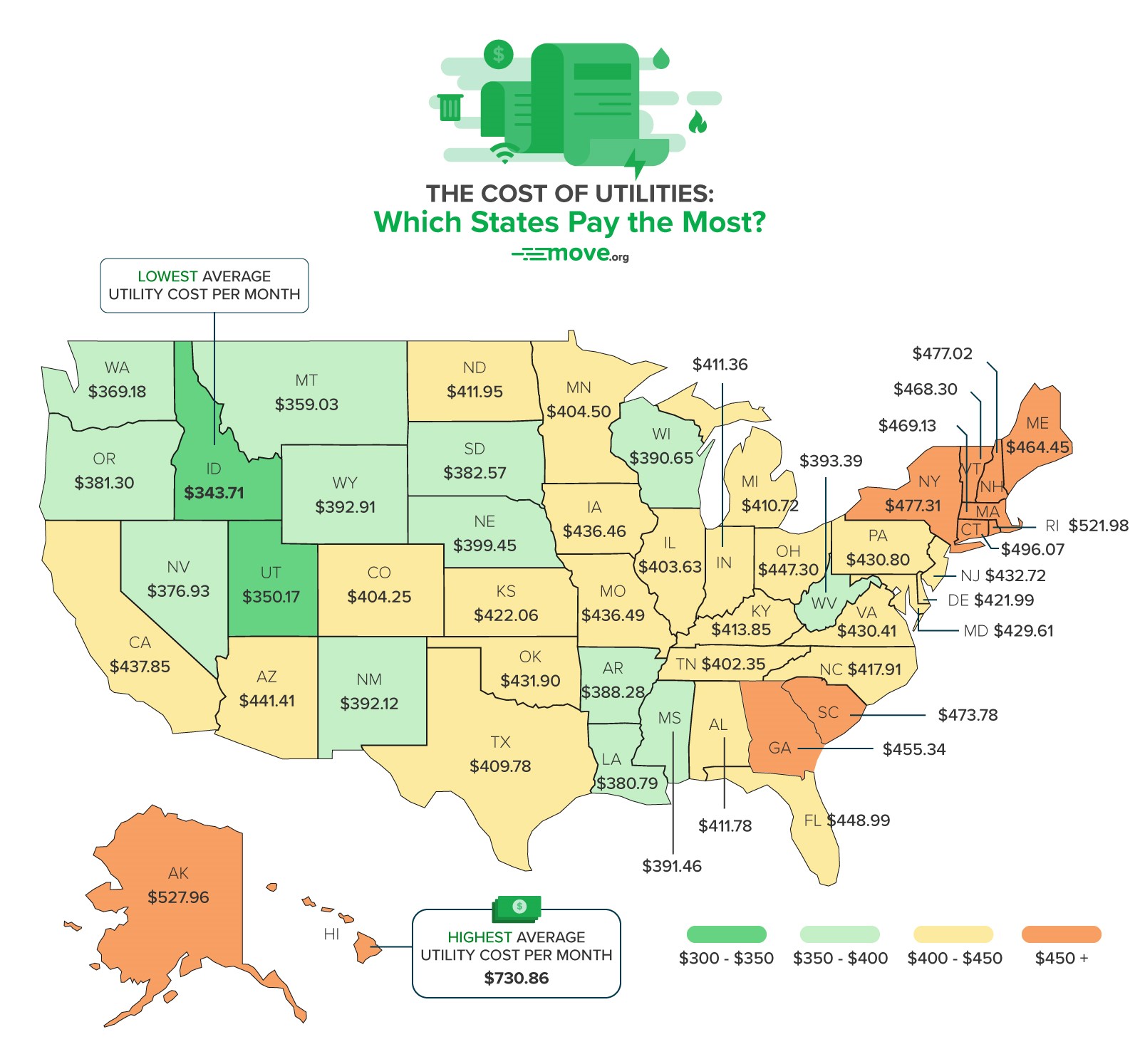
The analysis noted that “electricity costs are mostly to blame for Connecticut’s high overall utility bill, but its natural gas costs are much higher than most as well at an average of $114.11 per month.”  In two key categories, Connecticut had the third highest electricity rates and the 14th highest natural gas rates.

The survey broke down each state’s utility costs into a handful of distinct categories: Electricity, Natural gas, Internet, Cable and Water. [State-by-state information was unavailable for cable and water, so the analysis used the national averages to supply those figures for each state.]

The average cost of cable is $100, but that may change as more people cut their cable cords and switch to streaming services, the analysis noted.

In addition to Idaho, the least expensive utility costs can be found in Utah, Montana, Washington (State), Nevada, Louisiana and Oregon, according to the move.org analysis.

National Startup Analysis Sees Potential, Standout Efforts Underway in Hartford

A new analysis of the status of the business startup community in six American cities – including Hartford – has found that Connecticut’s Capitol City has “strong startup potential,” and in some ways is already standing out among peers and competitors. Startup Genome, with support from the Kauffman Foundation, selected six U.S. metropolitan areas that are not in the top 40 most populous and which have been faring less well economically than the country as a whole for a deeper analysis.  In addition to Hartford, the analysis includes Albuquerque, Fresno, New Orleans, Reno and Springfield, MA.

“In each of these metros, efforts are underway to support entrepreneurs, create more startups, and generate stronger economic trajectories. Like many other American cities (and elsewhere), they’ve been through economic ups and downs and now see startups as their next best hope for sustainable and broadly-shared growth,” the report, released this week, points out.  Startup Genome works to increase the success rate of startups and improve the performance of startups across more than 30 countries.

“Every startup ecosystem shows room for growth and improvement, and Hartford has key strengths to build on. The city's strong heritage in insurance is already being leveraged by many stakeholders and the ecosystem is clearly attracting experienced talent to start and join companies,” Dane Stangler, president & chief policy officer of Startup Genome told CT by the Numbers.

In Hartford, reSET, which specializes in encouraging and assisting entrepreneurship and social enterprise, was among several local partners with whom Startup Genome worked to gather data from more than 300 respondents.  Additional partners were the MetroHartford Alliance, Wesleyan University, UConn’s Connecticut Center for Entrepreneurship and Innovation, Upward Hartford,  as well as Launch EZ, the West Hartford Chamber of Commerce and others.

“More broadly, Hartford shows greater diversity than peer ecosystems and already has a few hundred startups operating. By continuing to strengthen the local culture and focusing on startup success in key areas, the Hartford economy will enjoy higher levels of job creation and growth,” Stangler added.

Hartford and the other cities were determined to be in the Early Activation phase of the Ecosystem Lifecycle, with a mix of prominent attributes and areas with potential yet to be realized.  In its analysis, the report indicates that “just in the span of a few years the startup scene has exploded,” in Hartford, noting that:

  • investors and experts in Hartford provide more hours of help to founders than in the other cities, and more than the global average. (Experts include university faculty, corporate employees, mentors, and others.)
  • nearly four in 10 founders in Hartford are women, which is twice the global average across all ecosystems in the Startup Genome database.
  • 11 percent of startup founders in Hartford are immigrants, the second-highest in the sample.

“We’re so grateful that Startup Genome was able to include Hartford in its recent analysis of early-stage ecosystems, thanks to support from the Kauffman Foundation,” said reSET Managing Director Ojala Naeem.  “Our great city is too often overlooked, and with local and state funding being what they are, national attention on all of the amazing businesses making an impact here is more important than ever. We have so many smart and motivated entrepreneurs who are worthy of investment consideration. They just need a spotlight.”

The comprehensive assessment of Hartford’s ecosystem also noted that “Hartford’s [startup] founders claim to have the right ambition to go global,” concluding that “Hartford’s startups have more potential to strengthen Global Market Reach and Global Connectedness.” In a number of areas analyzed in the assessment, Hartford is seen as having potential to strengthen the local startup community, its reach beyond Hartford, and the demographic of startup teams.

During the past seven years Startup Genome has provided a way for entrepreneurs everywhere to “tell us about their journeys and their regions - giving their local expertise a voice at the policy-making table.” The organization’s primary research with founders, supplemented with secondary research and data from global and local partners, helps create the world’s most comprehensive research on startups. Approximately 10,000 startup founders fill out global survey providing direct input each year.

“Hartford has some record of successes – generating more will help ecosystem size and performance,” Startup Genome observed in its assessment of Hartford.

Israeli Speech Communication Firm Earns $1.5 Million Investment at State's VentureClash

An Israeli company developing “a revolutionary mobile application that translates indistinguishable speech into understandable language” won praise and the top investment award of $1.5 million in VentureClash, Connecticut's $5 million global investment challenge for early-stage companies in digital health, financial technology, insurance technology and the Internet of Things. Connecticut Innovations (CI), the leading source of financing and ongoing support for Connecticut’s innovative, growing companies, runs the annual competition. In all, nine companies from six different countries participated in the final pitch event. VentureClash judges awarded six companies with investments, mentoring and customer introductions to help them grow and succeed.  The winning companies are required to establish a presence in Connecticut.

The top placing company, Voiceitt, points out that the market for their product, in the U.S. and worldwide, is vast.  In the US and Europe, a combined 10.4 million people suffer from speech disabilities, and 8 percent of all children suffer from a consistent or temporary communications disorder. (see video, below)

Voiceitt’s core mission is to “make voice recognition technology truly accessible to everyone. Our principal aims are inclusion and independence, and we are committed to helping children and adults around the world communicate freely, spontaneously, and naturally by voice.”

Through a hybrid of unique statistical modeling and machine learning, Voiceitt is working to enable “tens of millions of people to overcome communication barriers and help them connect with the world.”

Two second-place winners were each awarded a $1 million investment:

  • DOZR: A Canadian company that has developed a marketplace for the online rental of heavy equipment, enabling business owners to earn additional revenue from their idle equipment and allowing contractors to rent equipment at lower rates than traditional rental companies.
  • IronYun: A Stamford-based next-generation, AI deep-learning, big-data video search business-to-business software company providing enterprise customers with hyper-converged, private cloud computing and big-data video software products.

Three additional finalists were selected to each receive a $500,000 investment award:

  • CloudKPI: An Irish company developing an insight engine that enables SaaS businesses to predict likely outcomes.
  • Invixium: A Canadian manufacturer of modern biometric solutions for markets needing strong user authentication, convenience and data analytics.
  • Paygilant: An Israeli technology company working to prevent mobile payments fraud on mobile devices in the preauthorization phase.

The finalists pitched their ideas in front of a live audience and a panel of judges at the Yale School of Management in New Haven on October 18. The other finalists were:

  • Kasko: A London-based digital insurance intermediary bridging the gap between the digital and insurance economies.
  • Panoply: An Israeli startup developing a smart data warehouse, using machine learning and natural language processing to automate data integration, data management and query optimization.
  • SnapSwap: A Luxembourg-based company offering white-label end-to-end know-your-customer (KYC) services for financial institutions and businesses.

“The VentureClash competition continues to introduce some of the world’s most innovative and promising early-stage companies to all that Connecticut has to offer,” said Matt McCooe, CEO of CI. “From the initial application period through to the finals, we were so impressed with the caliber of leadership and the depth of innovation represented by the companies involved in the competition. We thank them for their efforts and commitment and look forward to working with the companies to help them make Connecticut a center point of their growth strategy.”

The VentureClash competition started with applications from 300 companies from more than 15 countries. After two rounds of judging, nine finalists were named, and they then went on to compete at the live pitch event.  The judges included investors and subject-matter experts from Greycroft Partners, Oak HC/FT, Real Ventures, Stanley Ventures, Teamworthy Ventures, Travelers and the Royal Bank of Scotland.

Event partners and sponsors included Aetna; aventri; Bernstein; Boehringer Ingelheim; Diameter Health; Disruptive Technologies; Elm Street Ventures; FML; Harman; Hartford Healthcare; Magellan Health; MasterCard; Medtronic; Nassau Re; NatWest Markets; Payflex; Pitney Bowes; Health Venture; ISG; Stanley, Black & Decker; startlab powered by Bank of Ireland; The Hartford; Shipman & Goodwin; Sikorsky Innovations; Synchrony Financial; Teamworthy Ventures; Travelers; Updike, Kelly & Spellacy; Voya Financial; Webster Bank; Yale University; and Yale University’s Office of Cooperative Research.


https://youtu.be/6-rng3rGYws


CT Minimum Wage Tied for 10th Highest in USA

Connecticut's state minimum wage rate is $10.10 per hour, greater than the federal minimum wage of $7.25 but not nearly the highest in the nation. The top five states are District of Columbia: $12.50 per hour; Washington: $11.50 per hour; California: $11.00 per hour; Massachusetts: $11.00 per hour and Oregon: $10.75 per hour, according to U.S. Department of Labor data analyzed by the website howmuch.com.  Arizona and Vermont are just behind the leaders at $10.50, followed by New York at $10.40 and Colorado at $10.20.  Maryland, Hawaii and Rhode Island join Connecticut at $10.10 in a four-way tie.

The Connecticut minimum wage was last changed in 2008, when it was raised $2.45 from $7.65 to $10.10. A proposal considered by the Connecticut legislature in 2018 – but not approved - would have raised the state minimum hourly wage from $10.10 to $12 on Jan. 1, 2019; from $12 to $13.50 on Jan. 1, 2020; and from $13.50 to $15 on Jan. 1, 2021. After reaching $15 in 2022, it would have indexed any future increases to annual increases in the consumer price index.  A similar proposal is expected to be considered when the legislature next convenes in January.

The federal minimum wage is $7.25 an hour, a rate used by 20 states. That includes five states – Alabama, Louisiana, Mississippi, South Carolina and Tennessee – that have no state minimum wage laws and therefore the federal minimum wage is the default.  And two states – Georgia and Wyoming – have minimum wages below the federal level, so the federal minimum is in effect. 

The Massachusetts minimum wage will rise to $15 an hour over five years under legislation approved earlier this year, becoming the third state – after California (effective 2022) and New York – to approve legislation putting the state on a path to a $15 minimum wage in the years ahead.  In New York, the current rate of $10.40 will increase incrementally in the coming years, to $12.50 as of January 1, 2020. Thereafter, it will be adjusted annually for inflation until it reaches $15.00.

Delaware enacted a two-step increase in 2018. The rate rises from $8.25 to $8.75 effective January 1, 2019, and will increase again to $9.25 effective October 1, 2019.

Eighteen states began 2018 with higher minimum wages than the previous year, according to the National Conference of State Legislatures. Eight states (Alaska, Florida, Minnesota, Missouri, Montana, New Jersey, Ohio, and South Dakota) automatically increased their rates based on the cost of living, while eleven states (Arizona, California, Colorado, Hawaii, Maine, Michigan, New York, Rhode Island, Vermont and Washington) increased their rates due to previously approved legislation or ballot initiatives.

Seattle, Washington’s largest city and half of the state’s population, has moved toward a local minimum wage of $15 per hour, based on a city law passed in 2014 that incrementally increased the local minimum over several years.


New Haven, Bridgeport at Bottom of Ranking for Disability-Friendly Cities

Connecticut’s two largest cities are not particularly hospitable for individuals with disabilities, according to a new national analysis.  New Haven and Bridgeport are at the bottom of a list of 182 cities that were included in the review, released this month to coincide with National Disability Employment Awareness Month The personal-finance website WalletHub compared the largest U.S. cities – including at least two from each state - across 31 key indicators of disability-friendliness. The data set ranges from wheelchair-accessible facilities per capita to rate of workers with disabilities to quality of public hospital system. The 31 indicators were grouped into three categories:  Economy, Quality of Life and Health Care.


The report on 2018’s Best & Worst Cities for People with Disabilities placed New Haven at the bottom of the list, and Bridgeport just two positions higher.  They were the only Connecticut cities evaluated in the analysis.

According to the Centers for Disease Control and Prevention, one in four U.S. adults, or 61 million total, have a disability that impacts their major activities. And among Americans age 65 and older, that number rises to two in five. In 2017, nearly 5.7 million people with disabilities were employed.

New Haven, which ranked number 182 overall, ranked 180 in Economy, 134 in Quality of Life and 173 in Health Care.  Bridgeport, just above New Haven at number 179 in the overall ranking, placed 164 in Economy, 128 in Quality of Life and 163 in Health Care.

WalletHub analyst Jill Gonzalez explained that among the metrics dragging down New Haven's overall ranking was the second lowest employment rate for people with disabilities, at 71.03 percent. This refers to the civilian non-institutionalized population aged 18-64 in the labor force. Other areas where New Haven ranked poorly, Gonzalez pointed out, were the share of people with disabilities living in poverty, which is almost 37 percent, and the relatively low number of family doctors and general practitioners per capita.

Bridgeport ranked as the fourth worst city for people with disabilities. One of the issues driving the ranking, Gonzalez said, was similar to New Haven's - a low employment rate for people with disabilities, at 74.28 percent. The other issues are mostly related to the quality of life.

“Bridgeport has one of the lowest number of wheelchair accessible art, entertainment and recreational establishments per capita, and a large number of older buildings with little to no access for disabled residents," Gonzalez said.

The analysis found that only Detroit had a lower employment rate for individuals with disabilities that New Haven.  On the overall list, Providence, RI was just one notch above New Haven, at the bottom of the rankings.

The cities ranked at the top of the list were Overland Park, KS; South Burlington, VT; Sioux Falls, SD; Scottsdale, AZ; Columbia, MD; San Francisco; Rapid City, SD; St. Louis, MO; Bismarck, ND; and Grand Rapids, MI.

Data used to create this ranking, according to WalletHub, were collected from the U.S. Census Bureau, Bureau of Labor Statistics, Department of Housing and Urban Development, Council for Community and Economic Research, Centers for Disease Control and Prevention, National Center for Education Statistics, Centers for Medicare & Medicaid Services, Trust For Public Land, Genworth Financial, United Cerebral Palsy, WalkScore, Yelp, Rails-to-Trails Conservancy, Affordable Housing Online, Kaiser Family Foundation, Eligibility.com, Redfin and WalletHub research.

CT Office of Early Childhood Receives Global Recognition for Effective Communication

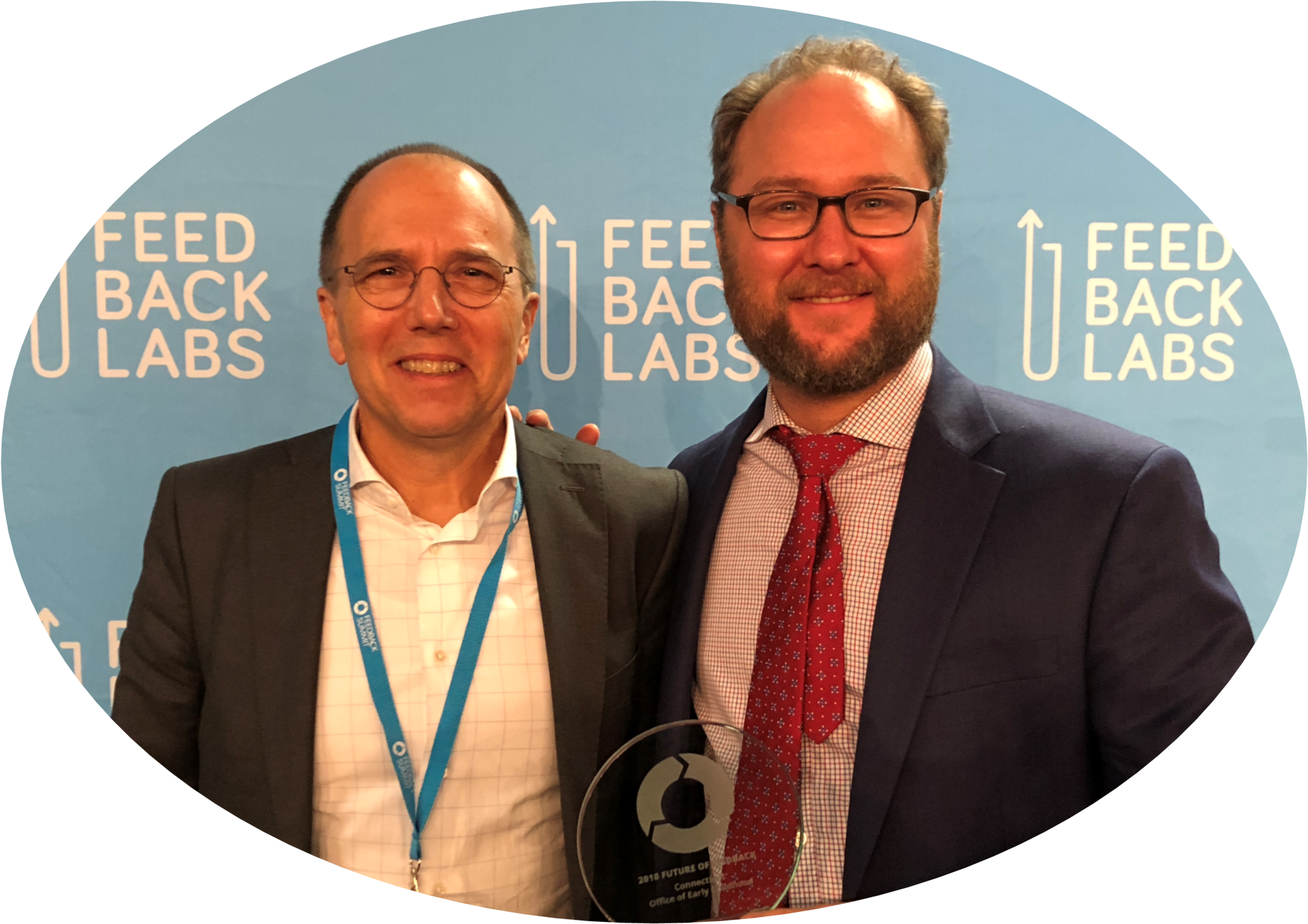
The Connecticut Office of Early Childhood (OEC) – a state agency that didn’t exist just over five years ago - has earned global recognition for success and innovation in serving the state’s youngest children and their families. The agency was chosen to receive the “Future of Feedback Award” at the annual Feedback Summit in Washington, D.C.   The award was presented last week to OEC Commissioner David Wilkinson for his agency’s efforts at effective listening to the people it serves and the nonprofit providers who serve them.

“The Office of Early Childhood is honored to be recognized for its efforts in communicating effectively with Connecticut’s families and providers, and for finding strategies to meet their needs,” said Commissioner Wilkinson. “The parents we serve and the community providers we support are the best experts in what they need to succeed, but too often they don’t have a seat at the table.  OEC is trying a new approach to put parents and our hardworking providers at the center of our policymaking.  We’re saying, ‘nothing we plan for you should be done without you.’’

"Connecticut’s Office of Early Childhood is pioneering innovative ways of both listening and acting.  OEC’s outreach to families – and frontline service providers – is creating conversations about what matters most, and what they can all do together," said Dennis Whittle, Co-Founder of Feedback Labs and GlobalGiving.

Feedback Labs, the organizer of the Summit, is a global network of over 400 leading aid, philanthropy, and governance organizations around the world.  Feedback Labs was conceived in 2013 and launched in connection with the Obama White House. Whittle also co-founded GlobalGiving, a leading marketplace connecting social, environmental, and economic development projects to individual and corporate donors. Since its inception GlobalGiving has facilitated $335 million in funding to over 20,000 projects in 170 countries.

Established in 2014 through a bipartisan effort of Gov. Dannel Malloy and the legislature, OEC oversees and funds Connecticut’s early childhood programming – including child care, pre-K, early intervention for children with developmental delays, and family support services for at risk families – components that once were housed in five disparate state agencies.

Among the 10 largest state agencies in Connecticut, OEC’s goal is to keep the state’s children safe, healthy, learning and thriving. Through its innovative feedback efforts, the agency is acting on evidence that engaging providers and parents in policymaking yields better results.  Officials said that the agency combined data from 1,700 family surveys, another survey shared with all providers in the state, and 400 community and provider meetings in order to build a draft plan to transform the ECE system in the state, which serves 200,000 children.


Wilkinson added that “An award like this is an encouraging validation of our efforts to listen to families and providers, and then do all we can to act on their advice.  We believe that by listening and responding, we will provide better, more effective services for Connecticut families with young children – and in so doing help create a brighter future for the state.”

"OEC’s approach contains key ingredients of more responsive, innovative, and effective government.  OEC’s leadership in asking for and responding to feedback has the potential to spread widely through the public sector,” Whittle added.

“Child care centers work hard every day for children,” Said Dr. Monette Ferguson, Executive Director of ABCD, Inc., a nonprofit operating several leading child care centers in and around Bridgeport. “Usually the state tells us what to do and by the time we share any concerns, it’s too late.  I am not used to a state agency asking what I think before it acts.  It’s good to feel heard and to see OEC acting on our advice.”

David Wilkinson was named Commissioner by Gov. Malloy in April 2017 to serve as the second Commissioner of the state’s Office of Early Childhood (OEC). He previously served as Director of the White House Office of Social Innovation and Civic Participation under President Barack Obama. While at the White House, Wilkinson worked closely with the Malloy Administration on signature early childhood efforts, including a first-of-its-kind initiative – scaling a program proven to reduce parental substance use and child welfare interaction – for which the administration has achieved national acclaim.  He has also served as an advisor to the Yale Child Study Center, a leading collaborator with the state and its early childhood service providers.

Christine Johnson-Staub is the Interim Director of Child Care and Early Education at CLASP, a 50-year-old national nonprofit based in Washington, D.C., that focuses on shaping policy to support families living in poverty. She said, “OEC’s approach to setting its policy direction was unique because not only did it build on input from the community and existing research and data, but it went back to a wide range of impacted people, including parents, providers and other stakeholders, to make sure they got it right.”

“Parents and child care providers know the challenges facing the early care system better than anyone but rarely does anyone from state government ask our opinion,” said Merrill Gay, Executive Director of the nonprofit Early Childhood Alliance, a state consortium of providers and advocates. “That's why it was so refreshing to have the Office of Early Childhood ask us: ‘What are the pain points?  How do we make this system work better for you?’  I'm really excited to see OEC now turning that agenda for improvement into concrete action to better serve children and families.”

The strategy of communicating successfully with a target audience, and then acting upon that communication, is known as a “feedback loop” – an approach widely studied and increasingly appreciated by thought leaders, initially gaining traction in international development, but seen to have powerful implications for advancing more responsive, cost-effective and impactful government services in the US. The 2018 Feedback Summit was attended by over 150 feedback pioneers and leaders from around the U.S. and the world.

“They speak. We listen. We make change. It’s about being responsive to the needs of the young children in our state and, of course, their parents and caregivers,” Wilkinson said.  To contact the Office of Early Childhood, visit www.ct.gov/oec or call (860) 500-4412.