CT Insurance Department Recovers $7.8 Million for Policyholders, Taxpayers in 2018, Up $1 Million
/The Connecticut Insurance Department recovered $7.8 million for policyholders and taxpayers in 2018, helping individuals, families and employers with their claims and complaints, according to department officials.
The Department’s Consumer Affairs Unit (CAU) fielded 6,350 complaints and inquiries in 2018 and helped policyholders recoup more than $5.5 million during the calendar year. In addition, the Department’s Market Conduct Division levied approximately $2.3 million in fines against carriers and returned that money to the state’s General Fund. Both financial results are up from a year ago.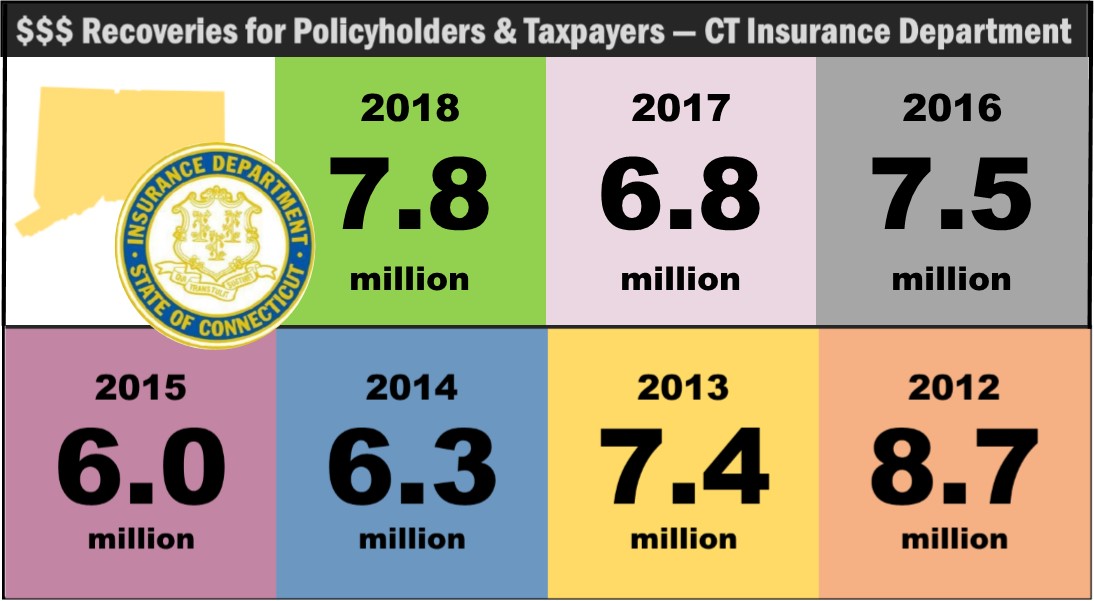
“The Department’s Consumer Affairs staff helps thousands of consumers each year with their questions and concerns about their insurance and makes certain that companies are compliant with all state insurance laws and regulations,” Acting Commissioner Paul Lombardo said.
In comparison, during 2017 CAU fielded 5,800 complaints and inquiries and helped policyholders recoup nearly $4.8 million. The Department’s Market Conduct Division levied approximately $2 million in fines. The Department’s fines result from a variety of violations and settlements ranging from untimely claim payments to improper licensing. The Market Conduct enforcement actions are posted on the Department’s Web site at www.ct.gov/cid
The majority of the funds recovered during 2018 for policyholders stemmed from complaints over health, accident, homeowners and life and annuities policies. The breakdown of funds recovered:
- Accident, Health - $2.3 million
- Auto - $1.5 million
- General Liability - $30,000
- Homeowners and Commercial Property - $1.13 million
- Life, Annuities - $523,000
- Miscellaneous - $37,000
Recoveries in the area of Homeowners and Commercial Property more than tripled, going from $344,600 in 2017 to $1.13 million in 2018.
The Department calculates its consumer recoveries based on what the policyholder received as a result of the Department’s intervention. The inquiries and complaints also help the Department identify industry trends that may adversely affect consumers and trigger investigation by the Market Conduct division.
In 2017, the state Insurance Department recovered $6.8 million for policyholders and taxpayers. That was a slight drop from the previous year, when it recouped $7.5 million in 2016. and approximately $6 million in 2015. In previous years, the department recaptured $6 million in 2015, reached a recent high of $8.7 million in 2012, $7.4 million in 2013 and $6.3 million in 2014.
Complaint data also help determine topics for consumer education and serve as tools to help the Department monitor the industry, officials noted.
The mission of the Connecticut Insurance Department is to protect consumers through regulation of the industry, outreach, education and advocacy. The Department’s annual budget is funded through assessments from the insurance industry.

 “We strive to help advisers understand and anticipate stock market and economic changes to be able to provide the best guidance for their clients,” said Juliana Dalton, CFA, president of CFA Society Hartford. Members include CFA® charterholders employed by leading financial services companies and those who are private wealth managers. While many have been in the field for decades – providing much-needed expertise to a range of clients, particularly in turbulent economic times – CFA Society Hartford also continues to reach out to young professionals, as well as college students considering careers in the financial services industry.
 “For the past nine years, analysts have predicted apocalypse for the U.S. economy around every corner, but the strong market and economic recovery are both the longest ever,” commented Dalton. The program will look ahead at what might be next.
 The forecast dinner’s lead speakers will also provide insight. Brian Wesbury is Chief Economist at First Trust Advisors L.P., a financial services firm based in Wheaton, Illinois. He has been a member of the Academic Advisory Council of the Federal Reserve Bank of Chicago since 1999. In 2012, he was named a Fellow of the George W. Bush Presidential Center. In 1995 and 1996, he served as Chief Economist for the Joint Economic Committee of the U.S. Congress, and has been ranked by the Wall Street Journal as the nation’s #1 U.S. economic forecaster (2001), and by USA Today as one of the nation’s top 10 forecasters (2004). Denise Merrill was re-elected in 2018 to her third term as Secretary of the State of Connecticut, and is past president of the National Association of Secretaries of the State. She previously served in the Connecticut House of Representatives. Her office oversees elections and business data, among its responsibilities.
 Current pricing for roundtrip flights in May: from $78 to Raleigh/Durham and Orlando, from $118 to Denver, depending upon length of stay and day of the week of selected flights.
 DEI is a national, transparent, annual benchmarking tool that offers businesses an opportunity to receive an objective score, on a scale of zero (0) to 100, on their disability inclusion policies and practices. The

 In addition, “the unemployment rate in [metro] Hartford for adults with at least a bachelor's degree is the lowest in all the metropolitan areas analyzed, whereas last year, it was in the middle of the pack.”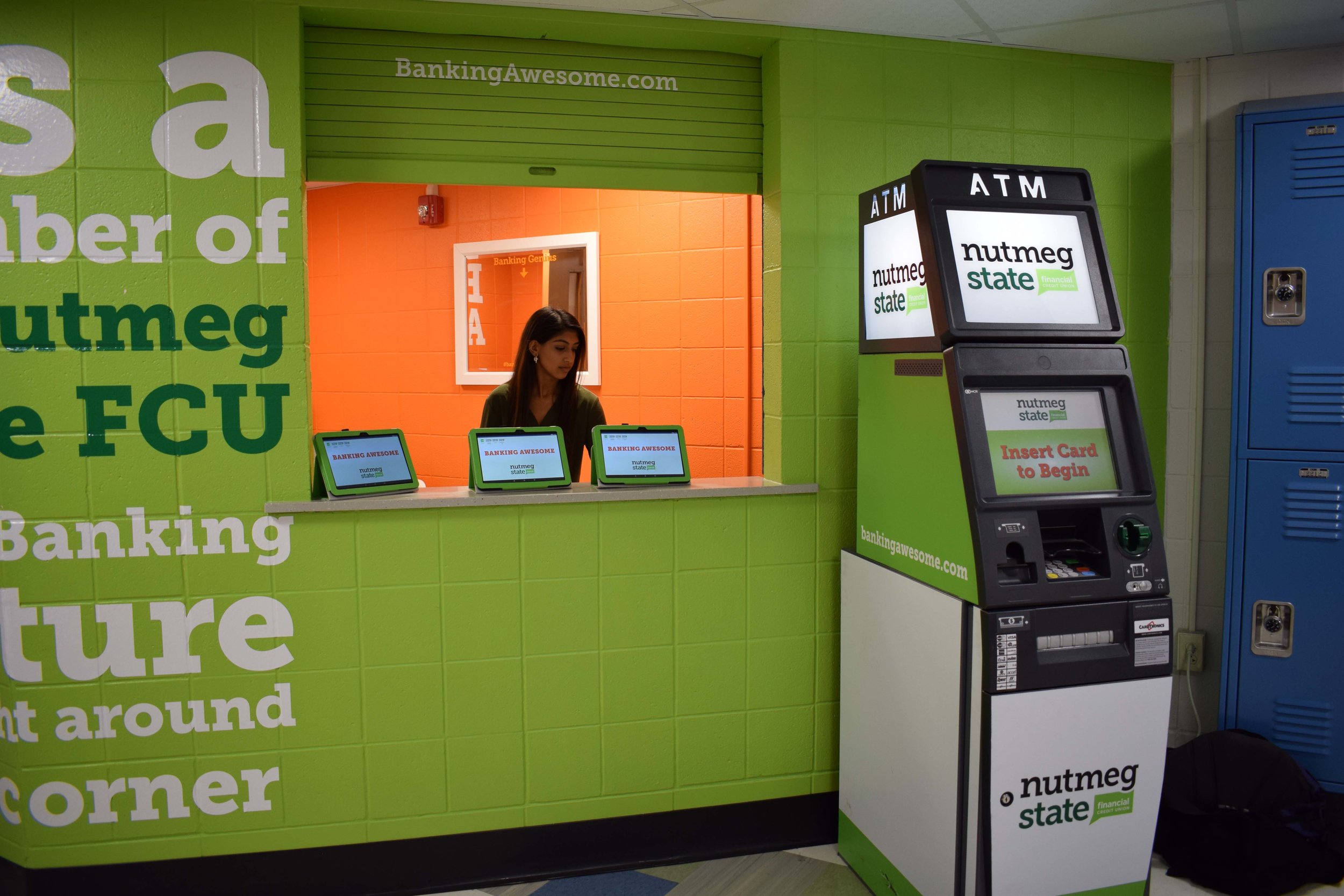
 Because the technology is intuitive for most students, their transaction time can be used to talk about subjects they may be less familiar with – such as balancing a checkbook, how debit cards and account balances relate to each other, loans and interest rates, and what a credit score is all about. Not the typical teen conversation, but Holt indicates that students have been quite interested in learning more.

 The new center at Sacred Heart University will further Verizon’s commitment to cultivate strong relationships with academic institutions with emerging technology curricula, officials stressed. The coworking spaces allow Verizon to tap into local startup and innovation networks, build relationships with potential partners and open new doors for ideas and technology. With Verizon, Alley is bridging the gap between startup and corporation by helping the community workspace build next-level ecosystems for entrepreneurs. Verizon provides entrepreneurs and start-up companies working on new products with the technology and services they need for growth.