Noah and Sophia Were CT's Most Popular Newborn Names in 2015

Connecticut’s most frequent names for newborns in 2015 were Noah and Sophia, according to the Social Security Administration.  Nationwide, Noah topped the list for boys, but Emma was number one for girls. Among the baby girls, Connecticut’s top three names selected were Sophia, Emma and Olivia.  Nationwide, the names were the same but the order was different – Emma, Olivia and Sophia.usa baby
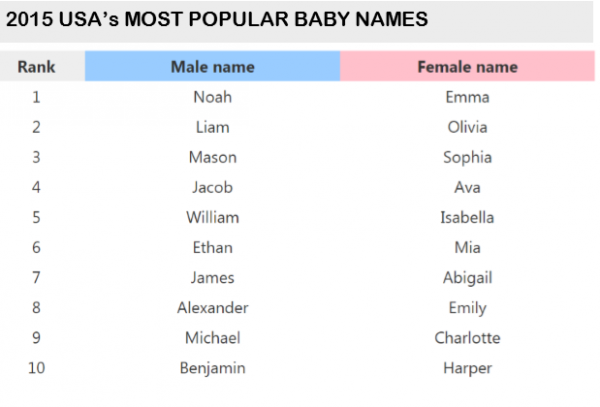
Among the boys, Mason was number 2 in Connecticut and number 3 nationwide. Alexander, Connecticut’s third most popular name for boys, placed eighth nationally.

In 2014, Mason and Olivia topped the list of most popular baby names in Connecticut, with Noah, Alexander, Emma and Sophia not far behind.  In 2013, Olivia again was atop the girls list, but William ranked first among the baby boys.

The source of the data is a 100 percent sample based on Social Security card application data.

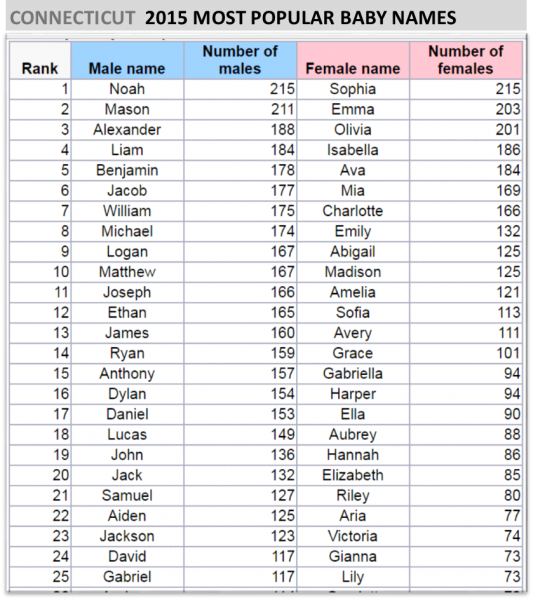
The top 10 names for boys in Connecticut in 2015 were Noah, Mason, Alexander, Liam, Benjamin, Jacob, William, Michael, Logan and Matthew.  For girls, Connecticut’s top 10 were Sophia, Emma, Olivia, Isabella, Ava, Mia, Charlotte, Emily, Abigail, and Madison.CT most popular
Since the beginning of this decade, as most elementary school teachers can likely attest, the most popular boys names in the U.S. are Jacob, Noah, Mason, William and Ethan; for girls, the leaders have been Sophia, Emma, Isabella, Olivia and Ava.  In the first decade of this century, the top names were Jacob, Michael, Joshua, Matthew and Daniel for boys; Emily, Madison, Emma, Olivia, and Hannah for girls.

A century ago, the list was very different.

The top girls names between 1900 and 1909 were Mary, Helen, Margaret, Anna, Ruth, Elizabeth, Dorothy, Marie, Florence, and Mildred: among the boys it was John, William, James, George, Charles, Robert, Joseph, Frank, Edward and Thomas.

baby booties

CT Ranked Third Best State for Working Moms

Despite ranking 37th in professional opportunities for women and 12th in child care, Connecticut has been ranked as the third best state for working moms on the strength of a number one ranking in “work-life balance," according to a new analysis from the financial website WalletHub. With Mother’s Day just days away, the WalletHub analysis revealed 2016’s Best & Worst States for Working Moms.mom at computer

The top five states were Vermont, Minnesota, Connecticut, North Dakota and Massachusetts.  Vermont also ranked first in child care, and was the top-ranked state (after D.C.) in professional opportunities.  At the bottom of the list, considered the worst states for working moms, were Alaska, Louisiana, South Carolina, Alabama and Nevada.top 10

The website also noted that “women still earn only $0.79 for every dollar that men make and have far less upward mobility, as evidenced by the fact that only 4 percent of S&P 500 companies’ chief executives are female.”

WalletHub’s analysts compared the attractiveness of each of the 50 states and the District of Columbia to a working mother, using 13 key metrics such as median women’s salary, female unemployment rate and day-care quality.

Connecticut’s ranking across the categories included in the survey ranked from second in parental leave policy to 24th in the ratio of female to male executives.  The state’s rankings by category, in the WalletHub analysis:working w

  • 2nd – Parental Leave Policy
  • 6th – % of Single-Mom Families in Poverty
  • 6th – Access to Pediatric Services
  • 8th – Length of Average Woman’s Workday
  • 9th – WalletHub’s “Best School Systems” Ranking
  • 24th – Ratio of Female Executives to Male Executives

3rdThe Child Care metrics included Day-Care Quality, Child-Care Costs, Access to Pediatric Services, and WalletHub’s “Best School Systems” Ranking.   The Professional Opportunities category included Gender Pay Gap, Ratio of Female Executives to Male Executives, Median Women’s Salary, Percentage of Families in Poverty, Female Unemployment Rate, and Gender-Representation Gap in Different Economic Sectors.   The Work-Life Balance category included Parental Leave Policy, Length of the Average Woman’s Work Week, and Women’s Average Commute Time.

Data used to create these rankings, according to WalletHub, were collected from the U.S. Census Bureau, Bureau of Labor Statistics, Child Care Aware® of America, Equal Employment Opportunity Commission, Council for Community and Economic Research, National Partnership for Women & Families and WalletHub research.


Link Literacy and Social-Emotional Skills to Improve Children’s Success in School, Report Urges

Experts agree that there is a deep connection between social-emotional development and literacy in children’s early school success including achieving reading proficiency in the early grades – and it turns out that the benefits of effectively making those connections sooner rather than later are significant, and can endure for a lifetime. A new report from the Child Health and Development Institute of Connecticut (CHDI), “Connecting Social and Emotional Health and Literacy: Critical for Early School Success,” explores the interplay between young children's social-emotional development and early literacy and language skills, and “elevates awareness of the connections between these essential competencies,” according to CHDI and the report’s researchers.report

The detailed 36-page report provides examples of linking strategies and outlines recommendations with the goal of accelerating actions by states and communities to advance children's readiness for school and successful educational achievement.

“Early cognitive and social-emotional skills are interactive and woven together - like strands of a rope,” notes Ann Rosewater, lead author of the report and co-leader of the Connecticut Peer Learning Pilot on Social-Emotional Development and Early Literacy. “The strategies and tools in this report will help communities implement approaches to align children’s literacy and social emotional health.”

The report urges a series of coordinated state actions to advance the linkage and integration of supports for children’s social-emotional health and learning:

  • Align systems that address social-emotional development and literacy
  • Increase support and education for parents
  • Invest in professional development for those working with young children
  • Institute universal and routine screening for social-emotional development and
  • appropriate follow-up
  • Expand the reach of evidence-based practices and programs
  • Focus attention on special populations

mom-baby-readingThe recommendations are drawn from the experiences of nine communities in Connecticut that explored researched-based strategies over the past year, to link supports for social-emotional and literacy skills. The effort was part of the Connecticut Peer Learning Pilot on Social-Emotional Development and Early Literacy, developed and led by the Campaign for Grade-Level Reading, in partnership with the National Center for Children in Poverty and with support from the Irving Harris Foundation and others.

Participating community teams represented Campaign for Grade-Level Reading and William Caspar Graustein Memorial Fund Discovery Initiative coalitions from Bridgeport, Colchester, Danbury, Enfield, Norwalk, Torrington, Vernon, West Hartford, and Winchester.  Their involvement, according to the report, “catalyzed notable progress in most participating communities, building on significant efforts their collaboratives had undertaken before engaging in the initiative.”  The communities “found reinforcement, inspiration and impetus to pursue as vigorously as their circumstances allowed strategies that recognized and promoted the relationship between children’s social-emotional health and literacy and language skills,” the report concluded.

In addition to urging state action, based on these experiences the report highlighted steps that can be taken at the community level to promote school success by reflecting the understanding that literacy and social-emotional development build on and reinforce each other.children

Promising strategies used by communities include the following:

  • Raise community awareness and reinforce community efforts to integrate social emotional and literacy skills fundamental to success in school and life
  • Promote nurturing parent-child relationships, which are essential to children’s social-emotional development and can simultaneously stimulate literacy learning
  • Screen for social-emotional competencies, with appropriate follow up and intervention
  • Enhance home visiting and book distribution programs
  • Incorporate professional development related to the connections between social-emotional development and literacy for those working with young children
  • Promote attendance in early education programs and the early grades
  • Support special populations, particularly children living in poverty, dual language learners or those faced with potentially unstable environments (foster care or homelessness)

chartThe report indicates that “Far too many children are at a disadvantage in their development because they lack the language and literacy competencies they need to enter kindergarten, significantly hobbling their success in reading proficiently by the end of third grade. Disparities begin as early as infancy and become more pronounced in the toddler years, with children from families below 200 percent of poverty scoring lower than children from higher income families on measures of cognitive development.”

The report goes on to state that “At kindergarten entry age, only 48 percent of poor children are ready for school, compared to 75 percent of children from families with moderate or high income.”

The Child Health and Development Institute of Connecticut (CHDI), a subsidiary of the Children’s Fund of Connecticut, is a not-for-profit organization established to promote and maximize the healthy physical, behavioral, emotional, cognitive and social development of children throughout Connecticut.  CHDI works to ensure that children in Connecticut, particularly those who are disadvantaged, will have access to and make use of a comprehensive, effective, community-based health and mental health care system.