National Recognition for Charter Oak, Quinnipiac, Fairfield As State Stand-outs

Charter Oak State College, Connecticut’s public online college, has been ranked #2 of 100 colleges scored in the recently compiled Best College for Returning Adults. The national rank was awarded by College Factual and reported on the Forbes.com website. “We are very proud of this ranking. It speaks to the flexibility of and demand for our online workforce relevant programs, such as our new Master of Science in Organizational Effectiveness and Leadership, and the intense and successful focus on our mission of helping adults complete college degrees,” said Ed Klonoski, President, Charter Oak State College.

College Factual’s rankings specifically address “non-traditional students who actually make up the majority of degree-seekers” and include the following categories: students returning to college after dropping out or transferring; working adults seeking flexible options; students seeking distance learning options; and professional who want to utilize life experience to earn college credit.

Of Charter Oak, the website indicated “about 80% of the public school’s students are part-timers, and its online courses in liberal arts studies are among its most popular for returning adults.”  Factors deemed as “high importance” by College Factual were accreditation and early career salary boost.

Founded in 1973, Charter Oak State College is Connecticut’s only public online college, offering associate and bachelor’s degree completion programs in high-demand fields including Health Information Management, Health Care Administration, Cyber Security and Business Administration.

school logosAnother Connecticut school has received national recognition, as Military Times ranked the School of Business at Quinnipiac University as the best business school for veterans in Connecticut and the 24th best in the nation, according to its Best for Vets: Business Schools 2016 rankings.

The organization, made up of Army Times, Navy Times, Air Force Times and Marine Corps Times, focused on culture and curriculum that cater to military veterans when conducting and scoring the fourth annual Best for Vets: Business Schools survey, a highly respected analysis of a graduate business school's complete offerings for veterans. As with all of the Best for Vets rankings, Best for Vets: Business Schools is an editorially independent news project that evaluates the many factors that make an institution a good fit for military veterans.

"Veterans have told us they were attracted to a business degree because it wouldn't tie them down to a certain industry," said Amanda Miller, editor of Best for Vets. "The survey lets us recognize the graduate business schools with close military connections that truly take vets' success to heart."Forbes

Matthew O'Connor, dean of the School of Business, said, "The School of Business is proud to be selected as a 2016 Best for Vets Business School by the Military Times. As an AACSB-accredited business school, we offer a wide variety of high-quality business programs and student services”

He added, “Our excellent internship program and enviable track record for helping graduates secure full-time employment is particularly attractive to veterans. Quinnipiac is proud of the service of military personnel and veterans and celebrates the contributions they make to our University."

The rankings were published in full in the issues of Army Times, Navy Times, Air Force Times and Marine Corps Times and online.

Quinnipiac University also recently announced that the Hamden-based university will be adding a School of Engineering in the fall, breaking off from what has been the School of Business and Engineering, which offered engineering courses to students during the past four years.  The School of Engineering becomes that university’s ninth school leading to a bachelor of science degrees. It will of offer engineering degrees in civil, industrial, mechanical, software engineering and computer science.

Dr. Justin Kile has been appointed the founding dean of the new school after previously serving as Quinnipiac’s associate dean of engineering since 2013. He will guide the school through the Accreditation Board for Engineering and Technology’s yearlong approval process.

Regarding business schools in the state, Bloomberg recently concuded a study of the best U.S. undergraduate business schools, ranking Fairfield No. 1 in Connecticut with an overall national ranking of 43rd.The school jumped 15 spots from last year's rankings.

The other Connecticut business schools on the list were University of Connecticut, ranked 72nd; Quinnipiac University, 91st; Sacred Heart University, 92nd; University of Hartford, 101st; and the U.S. Coast Guard Academy, ranked at number 104. The elements that contributed to the rankings included an employer survey, student survey, starting salaries of graduates and internships available as part of the curriculum.

Another distinction for Fairfield University: the school is among nine universities nationwide to receive accreditation from the International Dyslexia Association (IDA) and its affiliate, the Center for Effective Reading Instruction, for having met the standards outlined in IDA’s Knowledge and Practice Standards for Teachers of Reading.dyslexia

The Certificate of Advanced Study (6th year), Reading and Language Development program in GSEAP received the designation.

The IDA Standards provide a framework for course content in university and other teacher preparation programs, offering research-supported documentation of what teachers ought to know and be able to demonstrate when teaching dyslexic students.  The standards also apply to the teaching of other struggling readers or the general student population.

The goal of the standards initiative is to promote consistent and high-quality teacher preparation to improve outcomes for those who struggle with written language. Fairfield’s Sixth Year Professional Certificate in Reading and Language Development is open to those who have received their master’s in education degree.

"We are very excited about this national recognition from IDA. Elementary teachers and even Reading Specialists are not prepared with the tools and training to diagnose and intervene with children with dyslexia; this program addresses that," said Robert Hannafin, Phd., Dean of GSEAP. "We are committed to helping all students read and particularly struggling readers."

Number of Special Education Students in CT Schools Continues to Increase, Data Shows

The number of Connecticut students in kindergarten through 12th grade with disabilities eligible for special education and related services has increased by nearly 6,000 between the 2008-09 school year and the current school year, as the overall student population has dropped by more than 32,500 students in that time. Data included in a new website developed by the Connecticut State Department of Education indicates that the prevalence of special education in Connecticut schools has increased from 11.6 percent of students to 13.4 percent of students over the past seven years.stat

The prevalence of autism has doubled in the overall school population, from eight-tenths of one percent in 2008-09 to 1.6 percent in the current year.  The percentage of students with learning disability has also increased, while the percentage with speech or language impairment has dropped, as a percentage of the overall student population.

Overall, the Special Education K-12 count in 2008-09 was 64,187 students.  In the 2015-16 school year, the number has climbed to 70,055, an eight percent increase, even as the total student count has gone from 555,411 to 522,906.

The website points out that “Prevalence rate is a statistic about the identification of students with disabilities eligible for special education and related services,” adding that “Connecticut has seen increases in the number and percent of students with disabilities statewide over the last five years.”

The site also notes that the overall decreasing public school enrollment causes the prevalence rate to appear to grow at a must faster rate than one would perceive from actual special education count data.web FT

Connecticut State Department of Education Commissioner Dianna R. Wentzell launched the new website, www.edsight.ct.gov, in late April.  It is designed to strengthen transparency and streamline online access to important school and district information.  The site integrates information from over 30 different sources – some reported by districts and others from external sources.

“The launch of our new data portal is a critical step in our mission to ensure all Connecticut students have access to the kind of high-quality education that prepares them for success in college, career and civic life,” Commissioner Wentzell said.

Over the coming months, additional information and reports will be made accessible to the public through this portal. The site is the culmination of more than two years of work and development by the Department with support from important partners, including the state Department of Administrative Services.

The Department also joined the world of social media last week with the launch of an official Facebook page and Twitter account. The Department’s Facebook page address is http://www.facebook.com/ctdepartmentofeducation. On Twitter, the Department is @EducateCT.

SpedTable_Prev


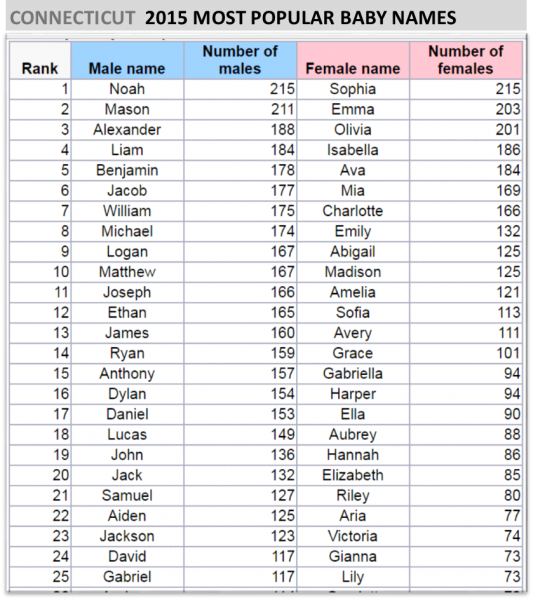
Noah and Sophia Were CT's Most Popular Newborn Names in 2015

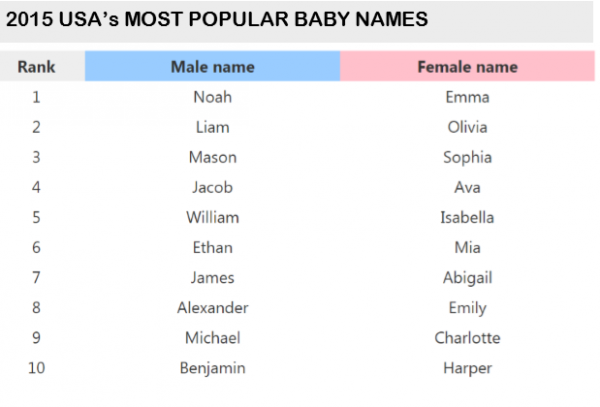
Connecticut’s most frequent names for newborns in 2015 were Noah and Sophia, according to the Social Security Administration.  Nationwide, Noah topped the list for boys, but Emma was number one for girls. Among the baby girls, Connecticut’s top three names selected were Sophia, Emma and Olivia.  Nationwide, the names were the same but the order was different – Emma, Olivia and Sophia.usa baby

Among the boys, Mason was number 2 in Connecticut and number 3 nationwide. Alexander, Connecticut’s third most popular name for boys, placed eighth nationally.

In 2014, Mason and Olivia topped the list of most popular baby names in Connecticut, with Noah, Alexander, Emma and Sophia not far behind.  In 2013, Olivia again was atop the girls list, but William ranked first among the baby boys.

The source of the data is a 100 percent sample based on Social Security card application data.

The top 10 names for boys in Connecticut in 2015 were Noah, Mason, Alexander, Liam, Benjamin, Jacob, William, Michael, Logan and Matthew.  For girls, Connecticut’s top 10 were Sophia, Emma, Olivia, Isabella, Ava, Mia, Charlotte, Emily, Abigail, and Madison.CT most popular

Since the beginning of this decade, as most elementary school teachers can likely attest, the most popular boys names in the U.S. are Jacob, Noah, Mason, William and Ethan; for girls, the leaders have been Sophia, Emma, Isabella, Olivia and Ava.  In the first decade of this century, the top names were Jacob, Michael, Joshua, Matthew and Daniel for boys; Emily, Madison, Emma, Olivia, and Hannah for girls.

A century ago, the list was very different.

The top girls names between 1900 and 1909 were Mary, Helen, Margaret, Anna, Ruth, Elizabeth, Dorothy, Marie, Florence, and Mildred: among the boys it was John, William, James, George, Charles, Robert, Joseph, Frank, Edward and Thomas.

baby booties

CT Ranked Third Best State for Working Moms

Despite ranking 37th in professional opportunities for women and 12th in child care, Connecticut has been ranked as the third best state for working moms on the strength of a number one ranking in “work-life balance," according to a new analysis from the financial website WalletHub. With Mother’s Day just days away, the WalletHub analysis revealed 2016’s Best & Worst States for Working Moms.mom at computer

The top five states were Vermont, Minnesota, Connecticut, North Dakota and Massachusetts.  Vermont also ranked first in child care, and was the top-ranked state (after D.C.) in professional opportunities.  At the bottom of the list, considered the worst states for working moms, were Alaska, Louisiana, South Carolina, Alabama and Nevada.top 10

The website also noted that “women still earn only $0.79 for every dollar that men make and have far less upward mobility, as evidenced by the fact that only 4 percent of S&P 500 companies’ chief executives are female.”

WalletHub’s analysts compared the attractiveness of each of the 50 states and the District of Columbia to a working mother, using 13 key metrics such as median women’s salary, female unemployment rate and day-care quality.

Connecticut’s ranking across the categories included in the survey ranked from second in parental leave policy to 24th in the ratio of female to male executives.  The state’s rankings by category, in the WalletHub analysis:working w

  • 2nd – Parental Leave Policy
  • 6th – % of Single-Mom Families in Poverty
  • 6th – Access to Pediatric Services
  • 8th – Length of Average Woman’s Workday
  • 9th – WalletHub’s “Best School Systems” Ranking
  • 24th – Ratio of Female Executives to Male Executives

3rdThe Child Care metrics included Day-Care Quality, Child-Care Costs, Access to Pediatric Services, and WalletHub’s “Best School Systems” Ranking.   The Professional Opportunities category included Gender Pay Gap, Ratio of Female Executives to Male Executives, Median Women’s Salary, Percentage of Families in Poverty, Female Unemployment Rate, and Gender-Representation Gap in Different Economic Sectors.   The Work-Life Balance category included Parental Leave Policy, Length of the Average Woman’s Work Week, and Women’s Average Commute Time.

Data used to create these rankings, according to WalletHub, were collected from the U.S. Census Bureau, Bureau of Labor Statistics, Child Care Aware® of America, Equal Employment Opportunity Commission, Council for Community and Economic Research, National Partnership for Women & Families and WalletHub research.


Link Literacy and Social-Emotional Skills to Improve Children’s Success in School, Report Urges

Experts agree that there is a deep connection between social-emotional development and literacy in children’s early school success including achieving reading proficiency in the early grades – and it turns out that the benefits of effectively making those connections sooner rather than later are significant, and can endure for a lifetime. A new report from the Child Health and Development Institute of Connecticut (CHDI), “Connecting Social and Emotional Health and Literacy: Critical for Early School Success,” explores the interplay between young children's social-emotional development and early literacy and language skills, and “elevates awareness of the connections between these essential competencies,” according to CHDI and the report’s researchers.report

The detailed 36-page report provides examples of linking strategies and outlines recommendations with the goal of accelerating actions by states and communities to advance children's readiness for school and successful educational achievement.

“Early cognitive and social-emotional skills are interactive and woven together - like strands of a rope,” notes Ann Rosewater, lead author of the report and co-leader of the Connecticut Peer Learning Pilot on Social-Emotional Development and Early Literacy. “The strategies and tools in this report will help communities implement approaches to align children’s literacy and social emotional health.”

The report urges a series of coordinated state actions to advance the linkage and integration of supports for children’s social-emotional health and learning:

  • Align systems that address social-emotional development and literacy
  • Increase support and education for parents
  • Invest in professional development for those working with young children
  • Institute universal and routine screening for social-emotional development and
  • appropriate follow-up
  • Expand the reach of evidence-based practices and programs
  • Focus attention on special populations

mom-baby-readingThe recommendations are drawn from the experiences of nine communities in Connecticut that explored researched-based strategies over the past year, to link supports for social-emotional and literacy skills. The effort was part of the Connecticut Peer Learning Pilot on Social-Emotional Development and Early Literacy, developed and led by the Campaign for Grade-Level Reading, in partnership with the National Center for Children in Poverty and with support from the Irving Harris Foundation and others.

Participating community teams represented Campaign for Grade-Level Reading and William Caspar Graustein Memorial Fund Discovery Initiative coalitions from Bridgeport, Colchester, Danbury, Enfield, Norwalk, Torrington, Vernon, West Hartford, and Winchester.  Their involvement, according to the report, “catalyzed notable progress in most participating communities, building on significant efforts their collaboratives had undertaken before engaging in the initiative.”  The communities “found reinforcement, inspiration and impetus to pursue as vigorously as their circumstances allowed strategies that recognized and promoted the relationship between children’s social-emotional health and literacy and language skills,” the report concluded.

In addition to urging state action, based on these experiences the report highlighted steps that can be taken at the community level to promote school success by reflecting the understanding that literacy and social-emotional development build on and reinforce each other.children

Promising strategies used by communities include the following:

  • Raise community awareness and reinforce community efforts to integrate social emotional and literacy skills fundamental to success in school and life
  • Promote nurturing parent-child relationships, which are essential to children’s social-emotional development and can simultaneously stimulate literacy learning
  • Screen for social-emotional competencies, with appropriate follow up and intervention
  • Enhance home visiting and book distribution programs
  • Incorporate professional development related to the connections between social-emotional development and literacy for those working with young children
  • Promote attendance in early education programs and the early grades
  • Support special populations, particularly children living in poverty, dual language learners or those faced with potentially unstable environments (foster care or homelessness)

chartThe report indicates that “Far too many children are at a disadvantage in their development because they lack the language and literacy competencies they need to enter kindergarten, significantly hobbling their success in reading proficiently by the end of third grade. Disparities begin as early as infancy and become more pronounced in the toddler years, with children from families below 200 percent of poverty scoring lower than children from higher income families on measures of cognitive development.”

The report goes on to state that “At kindergarten entry age, only 48 percent of poor children are ready for school, compared to 75 percent of children from families with moderate or high income.”

The Child Health and Development Institute of Connecticut (CHDI), a subsidiary of the Children’s Fund of Connecticut, is a not-for-profit organization established to promote and maximize the healthy physical, behavioral, emotional, cognitive and social development of children throughout Connecticut.  CHDI works to ensure that children in Connecticut, particularly those who are disadvantaged, will have access to and make use of a comprehensive, effective, community-based health and mental health care system.