Private Schools in Connecticut Among Most Expensive in USA

If you’re considering sending a child to private elementary or high school, know that there’s virtually nowhere in the United States more expensive in Connecticut. The average cost of private high school tuition in Connecticut, $31,413, is the second most expensive in the nation, just behind Vermont ($31,532) and just ahead of Massachusetts ($30,186).  New Hampshire and Main round out the top five most expensive states for private high school tuition.

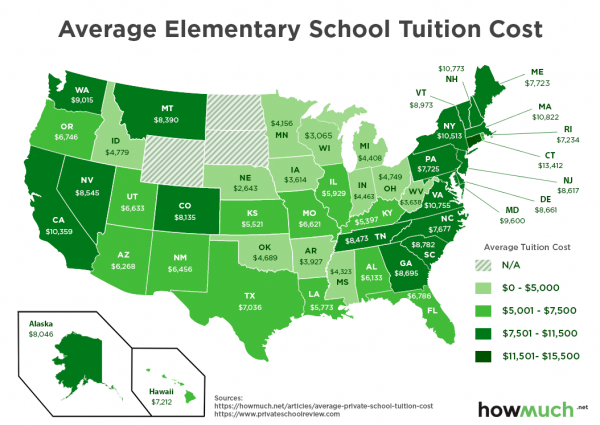
The most expensive average elementary school tuition cost is also on the East Coast, and Connecticut leads the way.  The average private elementary school tuition is $13,412, with Massachusetts ($10,822), New Hampshire ($10,773), Virginia ($10,755), and New York ($10,513) rounding out the top five.

The average cost of private school tuition has grown at a rate that is higher than inflation over the past 20 years, according to data analyzed by the website hommuch.net   The site indicates that administrative employee compensation has been the main catalyst for the increases in private school expenses, noting that the rise in the volume of employees who have a larger compensation package than a typical teacher has created the upward trajectory in private school tuition costs.

The website Private School Review indicates that the private elementary school average is $9,263 per year and the private high school average is $14,017 per year.

In a ranking of the best private schools in Connecticut this year, the website Niche listed Choate Rosemary Hall (Wallingford), The Hotchkiss School (Lakeville), Hopkins School (New Haven), Kent School (Kent), Greenwich Academy (Greenwich), The Taft School (Watertown), Loomis Chaffee School (Windsor), Brunswick School (Greenwich), Miss Porter’s School (Farmington) and Westminster School (Simsbury) as the top 10.
 

Report Reflects Good News, Continuing Challenges for Women, Girls in Eastern CT

Women and girls in Eastern Connecticut are progressing in many ways, but gender equity is elusive in many others, according to a new report.  The Community Foundation of Eastern Connecticut commissioned DataHaven to develop a report on the Status of Women and Girls in Eastern Connecticut, and the findings provide an insightful snapshot of disparities that persist, and challenges that remain and may increase, as well as diminish, in the years ahead. The purpose of the 26-page report, explains the Community Foundation’s President and Chief Executive Officer Maryam Elahi, is “to help inform and guide thoughtful conversations and inspire local ideas for social and policy advancements and investments.”   It is designed to be a “platform for action” to increase opportunity, access and equity for women and girls in Eastern Connecticut, officials indicated.  It is the first time that such a report was developed.

Among the key findings:

  • Young women are achieving in school, but greater educational attainment has yet to translate to economic equality.
  • Positive educational outcomes and economic equality are further out of reach for women of color.
  • Many occupations remain segregated by gender, and women make up a majority of part-time workers.
  • Women are at greater risk of financial insecurity, with single mothers at the greatest risk. 25% of all children in Eastern Connecticut live with a single mother, and 90% of single-parent households are headed by a mother.
  • Women in Eastern Connecticut are healthy, with a life expectancy of about 82 years—slightly above the national average, but below the state average.

The report also found that:

  • The opioid epidemic continues to ravage our communities, with deaths of women in 2016 more than double those of 2012.
  • Young women are at heightened risk for many mental health conditions. 35% of female students reported feeling hopeless or depressed vs. 19% of male students, and women are three times more likely to attempt suicide than men.
  • Violence against women continues to be a major public health problem. Almost 5,000 women in Windham and New London counties received services from domestic violence shelters.

The report defines Eastern Connecticut as the Community Foundation of Eastern Connecticut service area:  42 towns that include 453,000 people, 227,000 women.  The population of the region is 80% white, 9% Latina, 4% Black and 4% Asian.  Approximately 33,700 residents, or 7 percent, are foreign born.  Looking ahead, the report noted that the population of women ages 65 and up is projected to grow significantly over the next decade; estimated to increase 44 percent by 2025.

Continuing racial disparities are highlighted by the finding that among 90 percent of girls in the region’s class of 2016 graduated high school within four years, yet nearly 20 percent of women in New London and Windham/Willimantic lack a high school diploma.

The report noted that “a persistent gap” exists for women with degrees in STEM fields. Overall, 51 percent of men vs. 30 percent of women majored in science and engineering fields. Encouragingly, of 25-39 year-old women with degrees, 37 percent majored in the sciences. This is higher than previous generations.

Although women comprise 76 percent of educators, only 11 out of 41 superintendents in the region are women.  The report also found that 25 percent of businesses are women-owned.

“Women’s equality,” Elahi said, “is not just a women’s issue. It affects the wellbeing and prosperity of every family and community.”

The Community Foundation has organized public forums to discuss the report findings.  The first was held last week in Hampton, the next is February 15 in New London.

New Haven-based DataHaven’s mission is to improve quality of life by collecting, sharing, and interpreting public data for effective decision-making. The Community Foundation of Eastern Connecticut serves 42 towns and is comprised of over 490 charitable funds, putting “philanthropy into action to address the needs, rights and interests of the region.”

Number of World Language Students in Connecticut More Than Triples Over Past 25 Years

In 1991, 65,252 students were enrolled in world languages in Connecticut’s K-12 schools.  A dozen years later, in 2003, that number had climbed steadily, reaching 95,154.  By 2015, another 12 years later, the number of students taking language instruction had more than doubled, to 208,627 during the 2015-16 academic year. Data provided to CT by the Numbers by the state Department of Education also showed that nearly one-quarter of those students were taking Spanish.  Also, during those two and a half decades, the number of students taking Chinese language instruction has grown from less than 100 to more than 5,500.

Twenty-five years ago, in 1991, the most popular languages taught were Spanish, with 37,963 students; French, with 17,281; Latin, with 4,764; and Italian, with 2,989.  There was also a smattering of German (1,290 students), Russian (318), and Portuguese (193).  The number of students other languages was relatively tiny – 72 were learning Chinese, 67 were taking Japanese and 36 were in Polish language classes.   

By 2003, the most frequent world language choices for Connecticut students had not changed, but the numbers had jumped.  Spanish grew from just under 38,000 students to just over 62,000.  The number of French students was virtually unchanged, and would drop slightly in the years following, as the number of Latin students grew from just under 5,000 to just over 7,500 and the number of students taken Latin closed in on doubling from just under 3,000.

By 2015-16, there were 54,308 taking Spanish, plus another 2,142 taking Spanish for Native Speakers.  Just under 27,000 students were taking French, and 5,500 taking Chinese. The ratio of French students to Chinese students had dropped from more than 200 to 1 in 1991 to about 5 to 1 by the 2015-16 school year.

Slightly more than 7,000 students were learning Italian in 2015-16, more than double the number in 1991. Arabic, which barely registered in 1991, was being taken by 343 students and Russian was the language of choice for 86 students by 2015-16.

According to “The State of Languages in the U.S.: A Statistical Portrait,” Connecticut was one of seven states, along with New Jersey, Pennsylvania, Maryland, Vermont, New Hampshire and Wisconsin, where more than 30 percent of K-12 students were enrolled in language. As of 2014, only twelve states had more than one in four elementary- and secondary-school students studying languages other than English.

The report was published by the American Academy of Arts & Sciences in 2014, noting in the introduction that “While English continues to be the lingua franca for world trade and diplomacy, there is an emerging consensus among leaders in business and politics, teachers, scientists, and community members that proficiency in English is not sufficient to meet the nation’s needs in a shrinking world.”

“What a lot of Americans remember is language as an academic pursuit,” Marty Abbott, director of education for the American Council on the Teaching of Foreign Languages told the nonprofit organization Great Schools in 2016.  “They learned a lot about a language, how to conjugate every irregular verb. Today, the emphasis is on developing students’ communications skills — what they can do with a language. That’s a radical departure.”

There were approximately 191,000 students taking a world language in Connecticut in the 2013-14 and 2014-15 school years; that number jumped to more than 208,000 the following year, in the most recent data available from the state Department of Education.  Data for specific languages may vary, as course descriptions differ from district to district in Connecticut.

Michelle Obama Influences Children's Trick-or-Treat Choices, Yale Study Says

The conclusion is striking:  Michelle Obama’s initiative to reduce childhood obesity has influenced children’s dietary preferences. Researchers estimated that viewing a photograph of Michelle Obama’s face caused children to be 19 percent more likely to choose fruit over candy, on Halloween.  The experiment – Yale University researchers - was conducted on a New Haven porch over three consecutive Halloweens, and the results are published this month in a journal of the Public Library of Science (PLOS). The participants were 1,223 trick-or-treaters in New Haven over three years; on average, 8.5 years old and 53 percent male (among children whose gender was identifiable). To be eligible for inclusion in the study, trick-or-treaters had to be over the age of three.

The porch of a home had photographs clearly visible in front of the trick-or-treating children.  One was of Michelle Obama.  The other side, the “comparison” side in the study, “had a photo of Ann Romney (2012), a photo of Hillary Clinton (2014, 2015), or no photo (2014, 2015).”

At both sides of the porch, children were asked their age and whether they would prefer to receive fruit (a box of raisins) or candy (a more typical small packaged piece of name-brand chocolate such as Snickers or Milky Ways). Each child was given the option (fruit or candy) that they requested.

“The experimental set-up allows us to measure what proportion of children chose fruit instead of candy when in the presence of an image of Michelle Obama’s face, as well as the proportion of children who chose fruit instead of candy when not in the presence of an

image of Michelle Obama’s face,” the researchers pointed out.

Publishing the research are Peter M. Aronow, Dean Karlan, Lauren E. Pinson.  Peter Aronow is Assistant Professor of Political Science and in the Institute for Social and Policy Studies and of Public Health at Yale University; Dean Karlan is a Professor of Economics at Yale; Lauren Pinson is a Ph.D. candidate in Political Science at Yale University.

The experiment was conducted in the East Rock neighborhood of New Haven, which is about one mile from the Yale University campus, and contains many single family homes owned by Yale faculty, as well as some multi-family homes in which many graduate students live, the study explained. “There are also low income neighborhoods within a mile of this neighborhood,” and “due to the high level of activity during Halloween, many families drive from further away in order to trick-or-treat in this neighborhood.”

The study provides background, explaining that “During her tenure as First Lady of the United States, Michelle Obama has spearheaded one of the largest public health initiatives focused on childhood obesity. In 2010, Obama unveiled her Let’s Move Initiative, aimed at fostering a healthy lifestyle and reducing childhood obesity. As the public face of the campaign, Obama urged healthy eating and exercise in a variety of classic and social media venues accessible to minors and their parents, including appearances on Sesame Street and Oprah and posts of online videos.”

In regards to the results, the researchers caution that “we ran the experiment on a day where candy is readily available, the influence on children’s dietary preference for fruit instead of candy may differ from other days of the year; for instance, perhaps children are more willing to choose fruit since it is unique for the holiday, or children are less willing to choose fruit because they are under the influence of sugar consumption.”

PLOS was founded in 2001 as a nonprofit Open Access publisher, innovator and advocacy organization with a mission to accelerate progress in science and medicine by leading a transformation in research communication.

Climate Change, Children and Pollutants: Recipe for Health Concerns

The environmental damage caused by continuing to burn fossil fuels affects children most, with one study indicating that an estimated that about 88 percent of the disease from climate change afflicts children. In an article this month in the web-based science publication Massive, Renee Salas, an academic emergency medicine physician at Massachusetts General Hospital and Harvard University Medical School, says that while studies on climate change are still emerging, there has been enough research to result in a broad scientific agreement that climate change is negatively affecting children’s health.

The article points out that Frederica P. Perera, a professor of environmental health sciences and director of the Columbia Center for Children’s Environmental Health, recently released a review article “showing yet again how air pollution and climate change interact to multiply the negative health effects children face.”  The combination of air pollutants and warmer temperatures creates a perfect storm where chemicals emitted into the atmosphere interact to multiply the effects that each would have alone, the article states.

“People of all ages are exposed to this myriad of air pollutants in the changing climate, but children are more at risk of a wide spectrum of negative health effects because their developing bodies can suffer permanent damage from interference with their growth, Salas explains.

Investigators at the Yale Center for Perinatal, Pediatric and Environmental Epidemiology (CPPEE) at the Yale School of Public Health are engaged in a number of population-based studies in the U.S. and China intended to give us a better understanding of the health risks associated with exposure to relatively low and high levels of air pollution in childhood and during pregnancy.

The Center’s website points out that environmental factors are estimated to account for 24 percent of global diseases (WHO – Preventing Disease through Healthy Environments). In terms of the environmental contribution to disease, respiratory infections are ranked second, perinatal conditions seventh, and asthma fifteenth.  Air pollution is a major environmental risk factor in all three diseases.

Asthma is a major chronic disease in the US, accounting for more than two million emergency room visits and $14 billion in health care costs and lost productivity per year, the website indicates. Asthma is the most common chronic illness of childhood, accounting for more absenteeism (14 million missed school days per year) than any other chronic disease.  Absenteeism impacts academic performance, participation in extracurricular activities, and peer acceptance.

The Yale School of Public Health also points out that “underserved populations are especially affected by asthma.” In Connecticut, for example, asthma prevalence of 9.9 percent is among the highest in the U.S., they report. The rate among children enrolled in Connecticut’s HUSKY program (health insurance program for uninsured children) is 19.5 %. Increases in asthma and allergy are likely due to a combination of factors--genetic, environmental, socioeconomic, lack of access to care, and differential treatment.

The Massive article goes on explain that the potential harm starts early.  Once a child is born, the brain, lungs, and immune system aren’t fully formed until the age of six, the article states. “Even their air and food exposure in proportion to their size is much higher than adults – the amount they eat in relation to their body weight is three to four times greater than that of adults.”

She goes on to state the “Children also have an increased risk for being developmentally delayed, having lower intelligence scores, and less of a certain part of the brain called white matter, the stuff that helps you walk and talk. Their mental health is also at risk as children exposed to air pollution have higher rates of anxiety, depression, and difficulty paying attention.”

Salas notes that in addition to caring for patients who have negative health impacts from climate change, she uses her masters in Clinical Research and masters in Public Health in Environmental Health for research, education, and advocacy in this field. Says Salas, “I believe that climate change is the biggest public health issue facing our globe and am dedicating my career to making any positive difference I can.”

Health and Safety Among Top Concerns in Choosing Childcare, Survey Finds

When choosing a childcare or preschool, many parents try to gather information to make their decision. Yet only 54 percent of parents were very confident that they could tell if a childcare option would be safe and healthy for their child, according to a new national survey.  Beyond that challenge, 2 out of 3 parents said it’s hard to find childcare options with the characteristics they want. In selecting a childcare or preschool, parents consider a variety of health, safety, educational, or practical factors. Overall, 62 percent of parents agreed that it’s hard to find childcare options with the characteristics they want. The C.S. Mott Children’s Hospital National Poll on Children’s Health asked about these factors in a national sample of parents of children age 1-5 years who attend childcare or preschool.

Nearly half of parents reported their child currently attends preschool (48%), while the other half reported their child attends either a childcare center (25%) or in-home childcare (27%) for at least 5 hours per week.  Most parents (88%) felt that childcare centers and in-home childcare providers should have the same health and safety standards.  Parents selected up to 5 factors they would consider most important when choosing a childcare or preschool. The top 5 factors differed by the child’s current setting:

  • Preschool: staff background checks (45%), active play every day (40%), doors locked (38%), staff have early childhood training (30%), and safe outdoor play area (30%)
  • Childcare center: staff background checks (46%), staff have early childhood training (42%), doors locked (36%), cost (33%), and location/hours (32%)
  • Home childcare: healthy foods served (28%), active play every day (28%), books/educational toys (27%), kitchen area cleaned (26%), and staff background checks (24%)

Connecticut’s Office of Early Childhood provides information on its website, including a “Child Care Checklist for Parents,” to assist in choosing a child daycare program. It suggests asking if the program is licensed, ensuring that unannounced visits are permitted, that there is adequate staff and that the program is safe.  The website also includes an “online lookup tool” to determine licensing status for family child care home providers, group child care homes, child care centers, family child care home staff-substitutes and assistants and youth camps.

A report published last month by Connecticut Voices for Children indicated that for more than a decade, Connecticut has made expanding early care and education programs and wrap-around supports a priority. The state has increased funding for early childhood programs for low-income families and communities,"making a real, sustained effort to build a strong infrastructure to support the early childhood system. Increased spending has increased both the availability and the quality of care."  Those efforts, the study found, "have begun to pay off in terms of both access and quality of care." 

The 39-page report indicated that: • Almost four in every five four-year-olds enroll in preschool. As of 2016, nearly 80% of four-year-olds were enrolled in preschool, an increase of six percentage points since 2005. • Disparities in preschool access have narrowed. The gap in preschool experience rates between the large urban districts and the wealthiest suburban districts has narrowed from 40 percent in 2003 to just 26 percent in 2016. • State programs are serving more infants and toddlers. Head Start and Child Day Care Centers have shifted to address more of the state’s need for infant and toddler care. Combined, they serve almost 80% more infants and toddlers in 2016 than in 2005.

The report stressed, however, that as of 2016, center-based infant/toddler care is affordable to only 25 percent of Connecticut families with a young child. Child care for two young children is affordable to only seven percent of such families.  The need for infant/toddler care "continues to vastly outstrip statewide capacity,"  and community wealth "continues to predict both preschool access and later test scores."

In the national poll, parents identified deal-breakers in selecting childcare – characteristics that would eliminate a preschool or childcare from their consideration. Over half said location in a sketchy area or a gun on the premises would be a deal-breaker; others were: non-staff adults on the premises, unvaccinated children allowed to attend, and having a staff person who smoked.

Some factors rated as most important by the Mott Poll parents may be reflected in the policies of the facility. These include whether staff undergo background checks prior to hiring, whether staff have early childhood certification or training, and whether child and staff members must be vaccinated. For many preschools and childcare centers, this type of information can be found on the facility’s website; it may be more difficult to find such information for in-home childcare providers, the poll analysis pointed out.


Connecticut Among Leaders in Addressing Cyberbullying, Bullying Among Youth

Connecticut's anti-bullying laws and relatively low number of reported cyberbullying incidents have earned it a spot as one of the top three safest states from cyberbullying, according to a new national survey.   Nationwide at least 34 percent of kids have been cyberbullied, but the precise percentages vary from state to state. A new survey developed by Frontier Communications, marking Child Safety & Prevention Month, assesses the relative safety across the nation.  Based on an analysis of six weighted factors (including school sanctions for cyberbullying, existing state bullying laws, school discipline for off-campus behavior, and the percentage of students in grades 9–12 that have reported being cyberbullied), ten states are said to be addressing the issue head on: Florida, Arkansas, Tennessee, Michigan, Pennsylvania, New York, Vermont, Massachusetts, Connecticut, and Washington, DC.

In contrast, Washington, Oregon, Montana, Utah, Arizona, Colorado, Iowa, Wisconsin, and Ohio provide the fewest legal protections against cyberbullying. For example, most of these states don’t have a specific state statute that allows schools to discipline students for off-campus behavior, according to the survey analysis.

The U.S. Department of Health (DOH) defines bullying as repeated “unwanted, aggressive behavior among school children that involves a real or perceived imbalance.” Bullying can involve making threats, spreading rumors, physically attacking someone, or purposely excluding someone from an activity.

Bullying and cyberbullying are major problems - over 3 million students are bullied every year, which contributes to over 160,000 days of absences by students from school, according to Derek Peterson, CEO of Digital Fly, a technology company based on Long Island.

“This is bad for the student, schools, communities, states and our nation,” he said, emphasizing that states have the ability to lead, create policies for reporting, tracking, educating, preventing and punishing those involved in bullying and cyber bullying.

Connecticut’s “An Act Concerning the Strengthening of School Bullying Laws,” Senate Bill 1138 signed into law in 2011, defines "Cyberbullying" as any act of bullying through the use of the Internet, interactive and digital technologies, cellular mobile telephone or other mobile electronic devices or any electronic communications…” The law states that school policies must “include provisions addressing bullying outside of the school setting if such bullying (A) creates a hostile environment at school for the victim, (B) infringes on the rights of the victim at school, or (C) substantially disrupts the education process or the orderly operation of a school…”

Testifying in support of the Connecticut legislation, state Victim Advocate Michelle Cruz said “we now know the long lasting and devastating effects that bullying behavior can have on victims, bystanders and even bullies.”  She cited a study by the Family and Work Institute that reported one-third of children are bullied at least once a month, while six out of ten teens witnessed bullying at least once a day.

Attorney General George Jepsen noted that “Students no longer have the refuge of home.  Technology makes students easily accessible through cell phones, social networking sites, and online gaming systems long after school closes.”  In advocating for the legislation, he said efforts must aim to prevent school from being a “hostile environment for the student” that “impacts their ability to learn and thrive.”  And, he added, those efforts must continue when the student leaves the school building.

The DOH defines cyberbullying as “bullying that takes place over digital devices like cell phones, computers, and tablets” and can include any number of activities:

  • Spreading rumors online or through texts
  • Posting hurtful or threatening messages on social networking sites or web pages
  • Posting a mean or hurtful video or picture
  • Pretending to be someone else online to hurt another person
  • Taking unflattering pictures of a person and sharing them online
  • Sexting, or circulating sexually suggestive pictures or messages about a person

Recent statistics show that more than a third of children and teens have experienced cyberbullying, according to the Frontier analysis.  Data is available from the National Center for Education Statistics and the Cyberbullying Research Center.

Local Foundation Receives Major Grant to Expand Suicide-Prevention Program Nationally

The Hartford-based Jordan Porco Foundation has been selected as one of 13 non-profit organizations to receive a $100,000 grant from the Alkermes Inspiration Grants program. The grant will support Fresh Check Day, which is an uplifting mental health fair that builds a campus community around mental health and suicide prevention through engaging peer-to-peer education. Fresh Check Day, the foundation’s signature program, creates an approachable atmosphere where students are encouraged to engage in dialogues about mental health, and it helps to build a bridge between students and the mental health resources that exist on campus, in the community, and on a national level. Research supports that peer-to-peer education is one of the most effective ways to educate students, especially when the subject is suicide and mental health.

Since the first event in 2012, Fresh Check Day has grown exponentially, expanding throughout Connecticut, New England and nationwide.  There are now 26 colleges and universities in Connecticut that offer the program, and nearly 150 schools in 37 states.

“We are thankful to be awarded this grant in support of our signature program, Fresh Check Day. It helps in our national expansion and efforts to reach more young adults with our critical message of hope,” said Marisa Giarnella-Porco, President and CEO of the Jordan Porco Foundation.

The mission of the Jordan Porco Foundation, a 501(c) (3) public charity, is to prevent suicide, promote mental health, and create a message of hope for young adults. They accomplish this by providing engaging and uplifting peer-run programs. Their programs strive to start a conversation about mental health that reduces stigma while encouraging help-seeking and supportive behaviors.

“Addiction and mental illness affect millions of people and their families every day, and require an integrated approach to treatment that is scalable in communities across the country,” said Richard Pops, Chief Executive Officer of Alkermes. “Medicines play a role, but importantly, it is the innovative programs, like the Jordan Porco Foundation, designed to support people affected by these diseases and led by passionate leaders on the front lines that will ignite sustainable and meaningful change for patients.”

The primary goals of Fresh Check Day are to:

  • Increase awareness of mental health resources and services available to students
  • Challenge stigma and misconceptions around mental health and suicide that often deter individuals from seeking help
  • Empower peers to be gatekeepers by understanding warning signs and knowing what to do if a friend is exhibiting signs of suicide or a mental health concern
  • Increase willingness to ask for help if experiencing emotional distress

Now in its second year, Alkermes Inspiration Grants focuses on two key areas: improving or enhancing support or resources for people affected by mental health concerns or substance use disorder, and/or integrating the perspective of people affected by mental health concerns or addiction into drug development or care delivery. Alkermes is a global biopharmaceutical company with a “steadfast commitment” to developing innovative medicines for central nervous system (CNS) diseases.  The company has facilities in Ireland and the United States.

https://youtu.be/z_AQ5LJgVnQ

The Difference A Dollar Makes: UConn Research Finds Minimum Wage Increase Reduces Maltreatment of Children

It has been nearly a year since a study co-authored by UConn Assistant Professor of Public Policy Kerri M. Raissian appeared in the academic journal Children and Youth Services Review, but the interest hasn’t waned.  In fact, it now tops the list of downloaded articles in the past 90 days from the journal’s website. The article, which Raissian co-authored with Lindsey Rose Bullinger, asks – and answers – this question:  Does the minimum wage affect child maltreatment rates?

Short answer, according to their research:  yes. 

Raising the minimum wage by $1 per hour would result in a substantial decrease in the number of reported cases of child neglect, according to a study co-authored by Raissian and Bullinger.  They reviewed eleven years of records on child abuse and neglect and found that increases in the minimum wage correlate with declining child maltreatment rates.

A $1 increase would result in 9,700 (9.6 percent) fewer reported cases of child neglect annually as well as a likely decrease in cases of physical abuse, Bullinger explained on the website sciencedaily.com, where their study was featured earlier this year. This decline is concentrated among young children (ages 0–5) and school-aged children (ages 6–12); the effect diminishes among adolescents and is not significant, the study’s abstract points out.

“Our results suggest that policies that increase incomes of the working poor can improve children's welfare, especially younger children, quite substantially,” the authors conclude in their 70-page article on the study.

"Money matters," Bullinger noted on sciencedaily.com. "When caregivers have more disposable income, they're better able to provide a child's basic needs such as clothing, food, medical care and a safe home. Policies that increase the income of the working poor can improve children's welfare, especially younger children, quite substantially."

More than 30 states had minimum wages exceeding the federal requirement by an average of $1 during the study period, allowing the researchers to track changes in the number of reports to child protective service agencies with increases in the minimum wage.  Data from the National Child Abuse and Neglect Data System was used in the research.

The substantial decrease in child neglect cases is concentrated among toddlers and school-age children, but changes in the minimum wage had little impact on reports of neglect of teenagers. The researchers found no variation based on a child's race.

“Families with low incomes have a great ability to make a dollar go a long way. On average, the weekly SNAP (Supplemental Nutrition Assistance Program) food stamp benefit for a family of three is about $30. That’s about what a one dollar an hour minimum wage increase translates into for full-time workers. Other studies show that a $1,000 tax refund results in similar declines in child maltreatment – neglect, specifically. So for really low-income families that probably have pretty severe material deprivation or economic hardship, that extra dollar can make a really big difference,” Raissian told UConn Today.

Raissian’s research interests are linked by a common focus on child and family policy, according to the university’s website.  Her dissertation, “Assessing the Role and Impact of Public Policy on Child and Family Violence,” evaluated the efficacy of policies designed to reduce violence directed towards intimate partners, children, and other family members. Her professional background includes nearly 10 years of government and nonprofit sector experience, which focused on serving abused adults and children.

Bullinger is associate instructor in the school of public and environmental affairs at Indiana University at Bloomington.  Both attended Syracuse University’s Maxwell School of Citizenship and Public Affairs.

“Most of the states don’t have a minimum wage at or above $10; Connecticut does. It’s possible Connecticut may be at the threshold,” Raissian said in an interview featured in UConn Today. “It’s also really important to note that, while our study looks at the minimum wage, this could really be an income story – remember other studies find similar results when incomes are increased in other ways. Our very low-income families might be facing other reductions in their incomes that will be costly to us as a state. We should consider that, moving forward.”


Feds Urged to Complete Study Assessing Safety of Crumb Rubber Playing Fields, Playgrounds

If at first you don’t succeed, try, try again.  That’s not only a well-worn adage from youth, it is apparently the game plan for Connecticut U.S. Sen. Richard Blumenthal and his multi-year quest for a comprehensive federal study of the health risks of crumb rubber turf, a surface made of recycled tires that is widely used on playgrounds and athletics fields in Connecticut and nationwide. Blumenthal, along with colleagues in the Senate, are this week urging a federal task force to finish a long-overdue study into potential health risks.  The crumb rubber used in artificial turf fields is mainly composed of recycled tires, which contain man-made and natural rubber, according to the state Department of Public Health.  Chemicals called polycyclic aromatic hydrocarbons (PAHs) and volatile organic compounds (VOCs) can be found in the crumb rubber.  Crumb rubber can also contain heavy metals such as zinc and copper.

After a year and a half, WTNH-TV reported, the Senators are convinced progress on a comprehensive federal study has stalled.

It isn’t the first time that Blumenthal has been a lead voice to prompt action.  In November 2015 Blumenthal and Senate colleague Bill Nelson of Florida urged the Consumer Product Safety Commission to conduct a study.  In March 2016, Blumenthal was among those urging Congress and the President to allocate sufficient funds to conduct the study.  “Parents deserve to know if there is a danger to their children playing on these fields,” he said that month at a news conference held at Yale University.

A synthetic turf study was undertaken in 2016 by four United States agencies  — EPA, Consumer Products Safety Commission, the Centers for Disease Control and Prevention/Agency for Toxic Substances and Disease Registry — which has yet to be finalized.

With it’s completion in doubt, Blumenthal is highlighting the imperative to get scientific answers to guide communities that are considering how best to replace natural grass or other types of field surfaces.  It is estimated that there are more than 10,000 artificial-turf surfaces in use across the country.

Earlier this year, plans for a crumb rubber synthetic turf field in North Haven brought local opposition. The town decided to go forward with the less controversial encapsulated crumb-rubber infill over the traditional crumb rubber option, according to an article on the controversy published this month in The Atlantic.

Last year, Hamden opted not to go ahead with plans for crumb rubber, switching to a mix of cork shavings and coconut husk, called “GeoFill,” along with a “shock pad” in response to safety concerns. Bloomfield High School installed a synthetic turf field, South Windsor decided to use acrylic-coated sand instead of crumb rubber.  Madison and Guilford are also among the communities with crumb rubber surfaces for fields or playgrounds, according to published reports.

Testifying at the Connecticut State Capitol earlier this year, medical staff from the Children’s Environmental Health Center at the Icahn School of Medicine at Mount Sinai in New York City, urged that “Until the findings of these studies are available and conclusively demonstrate the safety of recycled rubber playground surfaces, we recommend a ban on the use of these materials where children play.”

Legislation that would have prohibited the installation of ground cover that contains shredded or ground rubber recycled from motor vehicle tires in municipal and public school playgrounds in Connecticut was approved by two legislative committees (Committee on Children, Committee on Planning & Development) in March, but the proposal was not considered by the full legislature in the session that concluded in June.

Blumenthal first became concerned about the artificial surface when his children were playing on the crumb-rubber athletic fields.  “I became concerned as a parent, as much as a public official, ten years ago, and at first was somewhat skeptical, but now very firmly believe that we need an authoritative, real study about what’s in these fields,” Blumenthal told ABC News two years ago.

The state Department of Public Health (DPH) website points out that “the advantages of these fields include less maintenance costs, ability to withstand intense use and no need for pesticides.”  To address public safety concerns, four Connecticut state agencies collaborated in 2010 to evaluate the potential exposures and risks from athletic use of artificial turf fields, the DPH website explains.

A two year investigation of releases from five fields during active play was conducted by the Connecticut departments of Public Health, Energy and Environmental Protection, University of Connecticut Health Center, and The Connecticut Agricultural Experiment Station. The study was peer-reviewed by the Connecticut Academy of Science and Engineering.

The overall conclusion of the report, according to the DPH website, is that “use of outdoor artificial turf fields does not represent a significant health risk.”  A news release issued by the department did note “higher contaminant levels at one indoor field indicate that ventilation of indoor fields should be considered.  Storm water run off findings indicate that proper management of this run off is prudent to address possible environmental effects.”