State Residents Express Confidence in Public Schools; CT Ranks 12th in Poll

North Dakota residents (89%) are more likely than those living in any other U.S. state to rate the K-12 education provided in their state as excellent or good, followed closely by those living in Minnesota and Nebraska (82%). Connecticut ranked at number 12 in the nation, for residents’ assessment of their state’s public schools, with 71 percent viewing the caliber of education provided as good or excellent. In stark contrast to the top states, about half as many Nevada and New Mexico residents, 42% in each state, rate their public edCHDIucation systems positively, the lowest percentages in the country, in a new poll released by Gallup.  Joining the two southwest states at the bottom of the list are Hawaii (47%), Louisiana (49%), Arizona (50%), California and Alabama (52%), Mississippi (53%) and  Oregon and Rhode Island (54%).

71State residents were asked “how would you rate the quality of public education provided in grades K-12” on a scale including excellent, good, fair and poor.  The top 10 states after North Dakota, Minnesota and Nebraska are Iowa, New Hampshire and Massachusetts (80%), Wyoming (79%), South Dakota (78%) and Vermont and Virginia (75%).

These results are based on a Gallup poll conducted from March through December 2015, and released this week, with approximately 500 interviews in every state.

Residents in states where a large share of residents rate the quality of education as excellent or good are also more likely to believe their public school system prepares students for success in the workplace, according to Gallup.230px-Gallup_Corporate_logo

When asked “Do you believe your state public school system prepares students for success in the workplace?” North Dakota and Nebraska again topped the list, at 89 percent and 81 percent, respectively.  Connecticut ranked 18th at 68 percent.


Focus Shifts from Veterans to Children in Efforts to Combat Homelessness

As progress is being made in Connecticut and across the country to end homelessness among veterans, greater attention appears to be turning next to homelessness among families with children. Families with children under age 6 are the fastest growing segment of the homeless population in the United States, Myra Jones-Taylor, Commissioner of Connecticut’s Office of Early Childhood, told state legislators recently.

In Connecticut, an estimated 3,000 to 9,000 families with young children are homeless, Jones-Taylor said. Of that estimate, approximately 1,125 families experienced homelessness in 2015 with 2,022 children impacted. Of those children, 43 percent were under the age of 5 and 42 percent were between the ages of 5 and 12.quote

Governor Malloy announced last month that the federal government has certified Connecticut as having effectively ended homelessness among veterans.  Just the second state in the nation to accomplish the milestone, Connecticut has implemented a comprehensive, unprecedented system to target homelessness among veterans.  Connecticut was one of the first states to join a national initiative that sought to secure commitments from communities across the country to end veteran homelessness by the end of 2015.

Nationally, between 2009 and 2015, there has been a 35 percent reduction in the number of homeless veterans, according to a Governing magazine’s review of data from the Department of Housing and Urban Development, published this month.  In addition to Connecticut, major cities including New Orleans, Houston and Las Vegas have indicated that “they’ve effectively eliminated homelessness among veterans.”

“But most people who are homeless are not veterans.  And in many of the nation’s large cities, homelessness among the general population appears to be getting worse,” the magazine points out.  Between 2014 and 2015, overall homelessness in the nation’s 50 largest urban areas increased by 3 percent.  The numbeyouth hr of unsheltered individuals in those cities went up 10.5 percent and the number of unsheltered people in homeless families grew by 18.8 percent, Governing revealed.

Many attribute the success in reducing the veteran homeless population to an aggressive well-planned effort initiated at the federal level, and are looking for similar efforts focused on homeless youth.

In President Obama’s budget plan submitted to Congress this year, he requested $10.967 billion for the purpose of reaching and maintaining the goal of ending family homelessness by 2020. The National Alliance to End Homelessness emphasizes that “should this request be enacted by Congress, it would give communities what they need to end homelessness for families with children.”

Connecticut Child Advocate Sarah Healy Eagan has said that “research has shown that homelessness puts children at increased risk of health problems, developmental delays, academic underachievement, and mental health problems.”

According to the National Low Income Housing Coalition (NLIHC), the federal Department of Housing and Urban Development (HUD) is asking Congress to provide sufficient funding for 10,000 new housing choice vouchers for homeless families with children, funding for 25,000 new permanent supportive housing units, and funds to provide 8,000 families with rapid rehousing assistance.

In addition, HUD announced a legislative proposal where it will seek $11 billion in mandatory spending over the next 10 years to serve a total of 550,000 families with additional vouchers, permanent supportive housing, and rapid rehousing assistance.

At a February public hearing at the State Capitol focused on proposed Senate Bill 10, which focuses on child care for homeless families with children.  It would create a “protective services” category for children experiencing homelessness, making them “categorically eligible” for child care subsidies regardless of the parent’s work status; and, ensure immediate access to child care for all children by creating a 90-day grace period for providing documentation of health and immunization records when enrolling in a child care center, group children care home, or family child care home.youth

The executive director of the Partnership for Strong Communities, Alicia Woodsby, testifying in support of the legislation, expressed the hope that its passage would “assist providers in resolving each case of family homelessness more quickly,” noting that families experiencing homelessness lack employment and are struggling with extreme instability.  The lack of child care makes it even more challenging for them to participate in worker training or secure new employment.”

The coalition of organizations and agencies led 2016 Homelessness & Housing Advocacy Days on March 2 and 3 at the State Capitol, drawing attention to the issue of homelessness, including homelessness among children and families.

There are wide estimates of just how many young people are homeless nationwide, according to the Child Welfare League of America, ranging from half a million to 1.6 million with estimates that up to 40 percent are gay, lesbian, questioning or transgender. Many of these young people have been kicked out of their own homes and are responsible for their own survival and are frequent targets of exploitation, trafficking and abuse while living on the streets CWLA points out.

The White House has pointed out that three years ago, in February 2013, the U.S. Interagency Council on Homelessness (USICH) issued a  Framework to End Youth Homelessness detailing the steps necessary to achieve the goal of ending youth homelessness by 2020, and strategies to improve outcomes for children and youth experiencing homelessness.

Officials noted that “the framework articulates the need for government, non-profit, civic, and faith community partners to focus together on the overall well-being of youth experiencing homelessness — addressing not just their need for stable housing, but also their educational and employment goals, and the importance of permanent adult connections in their lives.”

The conclusion of that report stated flatly that “we can end youth homelessness in America by 2020.”  The report emphasized that “Reaching this goal will require more resources at all levels and sectors, but resources are not enough. At all levels of policy and programming, we have to continuously challenge ourselves to gather and use better data, to leverage existing resources available to us, to implement more deliberate service strategies informed by good data and stakeholder input, and to coordinate systems and services around those strategies.”

“Access to high quality early care and education is extremely important for all children, but especially for children in vulnerable circumstances,” Rachel Leventhal-Weiner, Education Policy Fellow at Connecticut Voices for Children, told legislators.  “We consider homeless children to be among the most vulnerable.”

Plans for Expanded State Civic Network Gains Support of Open Government Advocates

Advocates for government transparency are lining up in support of legislation that would establish a “state civic network” for Connecticut, similar in structure to the national C‐SPAN model. The independently financed, non-profit network would expand access to the workings of the three branches of state government by building on the present CT-N system, which has been funded directly by the General Assembly since 1999. ctnThe new network would dramatically extend televised and online coverage and “on-demand access” to all legislative hearings and debates, as well as public policy conferences, regulatory hearings, executive agency meetings, and state Supreme Court and Appellate judicial proceedings.

The result would be searchable, shareable library of state government deliberations, decisions and activities – and the tools to make it understandable and useful – available to every citizen through cable TV, online and mobile devices.

“Access to government information is the key way for the public to know what its government is doing,” according to the Connecticut Commission on Freedom of Information. Calling the proposal “pro‐ transparency and cost‐saving,” Executive Director Colleen Murphy underscored the Commission’s commitment to encouraging citizen engagement. The State Civic Network “will bring the workings of government into people’s homes...in a most productive, timely, and professional manner.”

The Board Chair of the Connecticut Public Affairs Network, which operates CT-N under contract to the state legislature, indicated that the network “was never intended to be a service OF government, but rather ABOUT government – as are the national and municipal services that welcome citizens to unbiased channels that provide access and context," said veteran Connecticut television news anchor Pat Sheehan. "Technology now allows the coverage of all government activities, archived and searchable files, and presentations that appeal not-only to government insiders, but to the general public as well.”

The public’s expectation of coverage has changed over the past seventeen years,” said Paul Giguere, the founder of the network and CEO of the independent non‐profit Connecticut Public Affairs Network (CPAN). “Technological innovations have changed how and when citizens access information, and a state civic network will use emerging technologies to allow greater public engagement with the development of policies and legislation that affect us all.”

1932481_10152248599276937_845195084824203420_nGiguere pointed out that “there are 10 hearing rooms, but CT¬N’s physical plant limits us to covering only two events concurrently. That means up to 80% of the Legislative committee process at any given time goes unseen. Our capacity to cover the Executive and Judicial Branches is even more limited.”

The Connecticut Council on Freedom of Information, the Society of Professional Journalists, and the Connecticut Conference of Municipalities (CCM) have endorsed the proposed legislation to expand coverage throughout state government, as have advocacy groups such as the American Association of Retired Persons (AARP), CT Community Non‐Profit Alliance, the League of Women Voters, the Connecticut Education Association, Common Cause, and the Connecticut Citizens Action Group (CCAG).

The proposed State Civic Network is now being considered by the legislature’s Joint Committee on Government Administration and Elections. Under the plan, management and operational funding would be provided through a process that already exists for local community access stations, regulated by PURA, the state’s Public Utility Regulatory Authority. PURA has an extensive history of selecting non‐profit managers for government‐use channels that provide local public, educational, and government programs within cable television franchise areas. These channels are likewise supported through programming fees charged by cable companies, rather than by taxpayer funds, CT-N officials pointed out.

The plan drew opposition from AT&T, with the cable provider warning in legislative testimony that it would "have a real impact on consumers’ ability and willingness to continue to buy video service."   CT-N "should be required to annually justify its budget to the General Assembly like any other proposed expenditure,"AT&T said in a prepared statement.

CFOG, the Connecticut Foundation for Open Government, noted dramatic changes in the way citizens access news, with increased reliance on social media and mobile devices. Funded by a subscriber fee similar to how C‐SPAN and community access stations arestate civic network currently funded, CFOG notes, “the new entity would be monitored and accountable to the public, but independent from government itself.”

The State’s Office of Consumer Counsel, created in 1975 by the legislature to act as the advocate for consumer interests in all matters and “fight for the most reasonable rates,” endorsed the State Civic Network proposal after “carefully analyzing” a monthly fee of less than $0.50 per subscriber. Consumer Counsel Elin Katz said “a thriving democracy requires citizen access to information relating to their government, access that is ideally broad and unfettered.”

“Best of all,” she added, “this proposal will create a permanent and searchable online library of public documents and visual recordings of state government events that would be of great use both to the public and to the elected officials who serve them.”

CPAN launched the CT-N network for the Connecticut General Assembly in 1999 as a 24‐hour media service providing gavel‐to‐gavel coverage of state government and public policy on both television and internet platforms. In the intervening years, CPAN has extended the scope of its CT-N programming, adding coverage of electoral politics, news conferences, and a weekly review program, Capitol Report.


Remarkable Tenacity, Inspiring Music Distinguish CT’s New State Troubadour

It is a singular distinction.  Singer-songwriter Kate Callahan, a native of West Hartford and current  Hartford resident, has been selected as State Troubadour, to serve a two-year term beginning this month. Connecticut is the only state in the nation that honors a singer-songwriter with a formal position. The State Troubadour serves as an ambassador of music and song and promotes cultural literacy among Connecticut citizens.

IMG_0652Callahan’s extensive touring, public speaking, and teaching make her a natural fit for the position. “Connecticut Roads,” her original composition, tells a story of Connecticut people and places, and is a joyous, melodious remembrance of growing up in the Nutmeg State.   “This is where I’ve gotten my start and I see friends on the road of life… we do it here in this place we call home.”

With the new statewide platform, she plans to bring therapeutic music to Connecticut inmates, perform at State and local ceremonies, start her own grassroots record label, and share her experiences with the healing power of music.

At the age of nineteen, she sustained traumatic brain injury in a skiing accident. She had to withdraw from college and rehabilitate five days a week for a year until her insurance ran out. Her doctors told her she had plateaued. Callahan knew she had more desire to heal than the doctors could see, so she took up acoustic guitar lessons.

Her short-term memory was so impaired that she couldn’t remember that she was taking lessons from week to week. Over time, however, she began to remember and saw improvements in her coordination, eyesight, and guitar playing. She began writing songs soon after that and felt compelled to share them with small audiences at open mics. Open mics turned into features, opening sets, and headlining appearances at venues throughout New England.

In the years since her tenacious recovery, the 16th Connecticut State Troubadour has earned many accolades in her home-state, having been named Best Singer-Songwriter by the Connecticut Music Awards, Featured Artist of the Year by the Greater Hartford Arts Council, and Best Solo Performer by the Hartford Advocate. She was also awarded the Hartford Courant's "Woman of Character Award” for her involvement in schools and on stages.troubadour

Callahan began her two-year tenure as Connecticut State Troubadour at the State Capitol on Wednesday March 2.  Her performance of the original song, Connecticut Roads, concludde Connecticut Arts Day, the first of its kind in over ten years. The event brought together a broad cross section of policy makers, arts, cultural and creative industry organizations and individuals from across Connecticut.

The day-long event was sponsored by the Connecticut Office of the Arts in partnership with the Designated Regional Service Organizations, Connecticut Arts Alliance, Connecticut Arts Council, Culture & Tourism Advisory Committee and the Connecticut Arts Foundation.  The day included panel discussions, guest speakers, and a range of performances from individuals, groups and organizations from throughout the state.

The honorary position of Connecticut State Troubadour was established in 1991 by the State of Connecticut.  The Connecticut Office of the Arts (COA) appoints an individual resident singer-songwriter as State Troubadour based on the recommendation of a review panel.

Recent State Troubadors include Kristen Graves, a singer/songwriter and activist from Fairfield (2013-2015), Charles (better known as Chuck) Costa of Madison (2011-2012), Lara Herscovitch of North Guilford (2009-2010), and Pierce Campbell (2007-2008).

Callahan’s music has been described as soulful, inspirational, lyrical and mystical at times, and Callahan has been described as “unapologetically optimistic” in concert. The Boston Globe calls Callahan "an award-winning singer who rose from a calamitous injury to claim her creative life.”

During April, Callahan will be performing in Manchester, Hamden and Wethersfield as her tenure as State Troubadour, the 16th in state history, gets underway.   To learn more about Kate Callahan, visit her website www.Kate-Callahan.com

CT Residents Believe Economy, Business Conditions Have Improved, But Uncertain About Future

Connecticut residents are somewhat more upbeat about the state of the state’s economy, but less than convinced that good economic news will keep coming, according to the results of the Connecticut Consumer Confidence Survey for the fourth quarter of 2015, released this week.  The quarterly survey,  by InformCT, a public-private partnership that provides independent, non-partisan research, analysis, and public outreach to help create fact-based dialogue and action in Connecticut, is designed to generate an ongoing measure of consumer confidence in the Connecticut economy.CTConsumConfSurveyLOGO When asked to think about overall business conditions in Connecticut versus 6 months ago, respondents – for the first time in three quarters – said conditions are better now than 6 months ago.  The margin was narrow - with 27 percent saying “better” and 25 percent saying “worse”, but that’s a reversal from the past two quarters, when more people were of the view that business conditions has worsened (22%-24% and 24%-28% in the two previous quarters).

The percentage of respondents who feel that the Connecticut economy is improving increased from 23 percent in the 3rd quarter to 27 percent in the most recent survey, and the percentage expressing concern that their job, or their spouses’ job, is in jeopardy, has declined in each of the four quarterly surveys, from 38 percent in the first quarter of 2015, to 36 percent, 35 percent and now 33 percent.SURVEY-RESULTS-v2

Administered for InformCT by the Connecticut Economic Resource Center, Inc. and Smith & Company, the analysis is based on the responses of residents across Connecticut and addresses key economic issues.  The most recent consumer confidence survey also saw an uptick in key indicators, as the percentage who believe:

  • there are “plenty of jobs for anyone who wants to work (as compared with 6 months ago)” increased from 10 percent to 13 percent
  • the employment situation will be better still in 6 months increased from 15 percent in the 3rd quarter to 17 percent in the 4th quarter
  • their personal financial situation is better now than 6 months ago increased from 63 percent in the third quarter to 65 percent in the 4th quarter survey.

Even though Connecticut residents feel conditions are improved, they are increasingly divided when asked if they expect that will continue.

When asked to look ahead six months, respondents have consistently believed business conditions will improve, but by a narrowing margin in each of the past four quarters.  In the beginning of the year, 30 percent thought business conditions would improve, as compared with 19 percent who thought conditions would worsen – an 11 point differential.  In the following three quarters, that differential narrowed to 9 points, then 5, and now 4.

There were other positive outcomes in the final quarterly survey of 2015, as the percentage who anticipate:

  • making a major consumer expenditure for furniture or some other product in the next 6 months jumped from 26 percent to 34 percent, reversing a slide from 36 percent in the year’s first quarterly survey.
  • buying a new car also increased, from 22 percent in Q3 to 25 percent in Q4, the highest percentage of any of the quarterly surveys on that question.
  • taking a vacation outside Connecticut in the next 6 months also rebounded, from 51 percent to 56 percent, reversing a diminishing percentage in each of the past two quarters.

There remain some troubling signs amidst the generally upbeat news.

The percentage who agree that Connecticut is a good place to live and raise a family and dropped slightly, and is under 50 percent for the first time in the quarterly surveys, at 47 percent.   The percentage of respondents who say they are likely to move out of the state in the next five years has increased in three consecutive quarters, from 32 percent to 34 percent to 37 percent, but remains lower than in the first quarterly survey, when it stood at 39 percent.

InformCT is a public-private partnership that currently includes staff from the Connecticut Economic Resource Center and the Connecticut Data Collaborative.  More information about subscribing can be found at informct.org.  Based in Rocky Hill, the Connecticut Economic Resource Center, Inc. is a nonprofit corporation and public-private partnership that provides economic development services consistent with state strategies, leveraging Connecticut’s unique advantages as a premier business location.  Smith & Company LLC, is a Shelton, Connecticut-based market research firm.


Confidence in State Government Plummets in CT; Third Lowest in USA

In 2013, a majority of Connecticut residents expressed confidence in their state government.  Two years later, 6 in 10 residents, when asked if they had confidence in their state’s government, said no.no confidence In a survey of states nationwide, Illinois was at the bottom of the list, with only one in four Illinois residents indicating confidence in their state government, the lowest among the 50 states by a significant margin. Rhode Island (33%) and Connecticut (39%) join Illinois as states with less than 40 percent government confidence, according to data compiled by Gallup. North Dakota residents are the most trusting; 81 percent say they are confident in their state government.

Connecticut is joined among the states where residents expressed the least confidence in their government by New Jersey, Louisiana, Kansas, Pennsylvania, and New York.  Along with residents of North Dakota, people living in Wyoming, Nebraska, Montana, South Dakota, Utah and Minnesota expressed the most confidence in their state government.

In the Gallup survey in Connecticut, 39 percent of residents expressed confidence in state government, while 60 percent said they did not have confidence in state government.  The "no confidence" percentage has increased by 14 percentage points in two years.  The Gallup analysis noted that there is a strong relationship between residents' ratings of their state's economy and their confidence in state government. In addition to Illinois, Rhode Island, Connecticut, New Jersey and Kansas all rank among the states in which residents are the least positive about their state's economy.

The resul230px-Gallup_Corporate_logots are based on Gallup's 50-state poll, conducted March through December 2015. Gallup asked respondents whether they do or do not have confidence in their state's "government in general."

A similar poll by Gallup in 2013 brought very different results for Connecticut.  In that survey, a majority (52%) expressed a great deal or fair amount of confidence in state government.  That year, 46 percent expressed not very much confidence or none at all.

least confidence


Survey Says Hartford Residents Want Healthier Foods and Beverages, Action Steps Suggested

Two-thirds of Hartford residents believe that fresh, healthy foods are too expensive, and 4 in 5 believe that it is very important for local childcare programs to offer healthy food options. In a survey commissioned by the American Heart Association's Hartford Accelerating National Community Health Outcomes through Reinforcing (ANCHOR) Partnerships Program, a majority of women, parents and young adults in the city see healthy foods as too expensive.aha

"Making healthier food more accessible to all will greatly improve health outcomes and move us closer to our goal of reducing deaths from cardiovascular disease and stroke," said Dr. Seth Lapuk, pediatric cardiologist and American Heart Association of CT/Western Massachusetts board president. "Healthy food access is especially critical for our children. Obese children as young as 3 years old show indicators for developing heart disease later in life. These survey findings show the community wants the healthy choice to be the easy choice."

The survey was part of an overall initiative to improve access to healthy foods in underserved communities. It was conducted in September 2015 and included 400 Hartford residents.  The survey also revealed that 70 percent strongly support matching a portion of SNAP (Supplemental Nutrition Assistance Program) so people can spend more on healthy foods. Respondents would also like to see an increase in the number of farmers' markets and wider acceptance of SNAP at farmers' markets and mobile markets.      healthy-food

Based on the findings of this survey, the organization highlighted recommendations to address residents' concerns:

  • Encourage local community, government and business leaders to increase access to healthy foods
  • Present child care programs as an example of a key setting that has important influence on family nutrition and healthy food policy
  • Promote farmers' markets as a way to increase competition and drive down price

Hartford Mayor Luke Bronin said "As a mayor and as a parent of three young kids, I'm proud to say that our schools and our Department of Children & Families have been making great efforts to promote healthy foods. To keep Hartford healthy and strong, we need to continue working hard to make sure that healthy food and beverage options are available wherever our residents live, work, play and learn."

65Just over the city line in West Hartford, ShopRite supermarket (corner of Kane and Prospect Streets) is offering a series of free courses with a registered dietician to help individuals know “where to start on your path to becoming healthier.”  The “Eat Well Be Happy” Weight Management Series begins on February 24, and will be held every Wednesday from 6-7:30 p.m., for six weeks. Each class focuses on a different topic including: meal planning, portion control, importance of fiber, protein and hydration and controlling sugar cravings, among others.  Individual consultation is also available, and all nutritional services are available to customers free of charge.   (Interested individuals can contact shana.griffin@wakefern.com)

"Healthy food does not have to be out of reach on the basis of cost," said Martha Page, executive director of Hartford Food System and chair of the Hartford Advisory Commission on Food Policy.

"Based on the findings of this survey, I am glad to see that our residents view early childhood programs as a key opportunity to provide a positive influence on family health," said Jane Crowell, Assistant Director, Hartford Department of Families, Children, Youth and Recreation, Division for Young Children. "Hartford's Little City Sprouts program does exactly that by providing healthy foods and beverages to the children, encouraging community gardening, offering caregiver support and information to promote healthy food preparation through recipes and snack ideas."

The ANCHOR Project is a federally funded collaboration between the American Heart Association and the Centers for Disease Control and Prevention (CDC). The focus of the ANCHOR project is to improve access to healthy foods through the promotion of healthy food financing initiatives with grocery stores, healthful food and beverage contract arrangements among organizations and institutions, and farmers' markets. For more information on the American Heart Association's ANCHOR Partnerships Program, go to www.heart.org/ANCHOR .

Connecticut Among Five States with Highest Percentage of Foster Children in Group Homes, Report Says

The percentage of children in foster care in Connecticut who have not been placed with a foster family is among the highest in the nation, according to a report issued in 2015.  The report, from the Annie E. Casey Foundation, highlights the differing policies and practices among states, stressing that “kids should live with relatives or foster families when they have been removed from their own families, but one in seven nationally lies in a group placement.” In Connecticut there are 4,071 children in foster care, with 74 percent in family placement and 24 percent in non-family placement, exceeding the national average, according to the report.  That compares with 84 percent in family placement and 14 percent in non-family placement, nationally.  Only Colorado (35%), Rhode Island (28%) and West Virginia and Wyoming (27%), had a higher percentage of foster children than Connecticut in a non-family placement. states comparison

The state-by-state data from 2013, the most recent year available, shows use of group placements varies widely by state, ranging from 4 percent to 35 percent of children under the system’s care.  In Oregon, Kansas, Maine and Washington, only 4 to 5 percent of young people in out-of-home care are in group placements, the report points out.

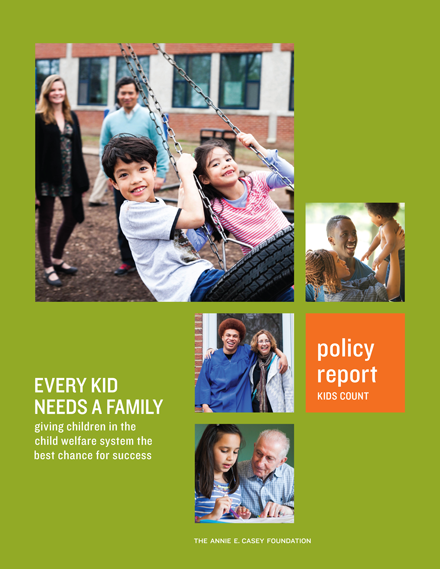
The Foundation’s policy report, Every Kid Needs A Family, highlights “the urgent need to ensure, through sound policies and proven practices, that everything possible is being done to find loving, nurturing and supported families to children in foster care.” The report highlights the promising ways that state and local government leaders as well as policymakers, judges and private providers can work together as they strive to help these 57,000 children who are living in group placements – and overall, the more than 400,000 children in the care of child welfare systems.

The report goes on to recommend how communities can widen the array of services available to help parents and children under stress within their own homes, so that children have a better chance of reuniting with their birth families and retaining bonds important to their development. And it shows ways in which residential treatment — a vital option for the small percentage of young people who cannot safely live in any family during treatment — can help those young people return to families more quickly and prepare them to thrive there.7 to 10 times

“We have an obligation to help all of our kids succeed,” said Patrick McCarthy, president and CEO of the Casey Foundation. “If our children couldn’t live with us, we would want them to live with someone close to us - and if that couldn’t happen, with a caring foster family who could provide them with as normal a life as possible during a turbulent time. This report shows more kids can live safely in families and get the nurturing they need while under the care and protection of our child welfare systems.”

Among the report’s findings across the United States:

  • One in 7 children under the care of child welfare systems live in group placements, even though federal law requires that they live in families whenever possible.
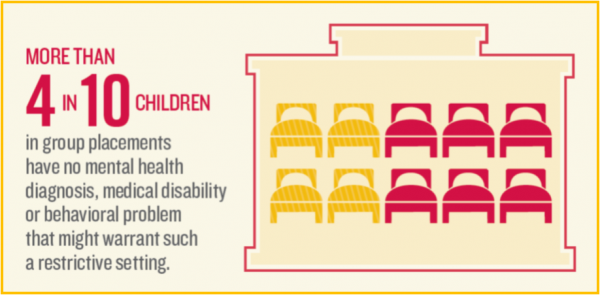
  • Fortaecf-everykidneedsafamily-cover-2015y percent of the children in group placements have no documented behavioral or medical need that would warrant placement in such a restrictive setting.
  • While research shows children who need residential treatment likely need to stay no longer than three to six months, young people are staying in group placements an average of eight months.
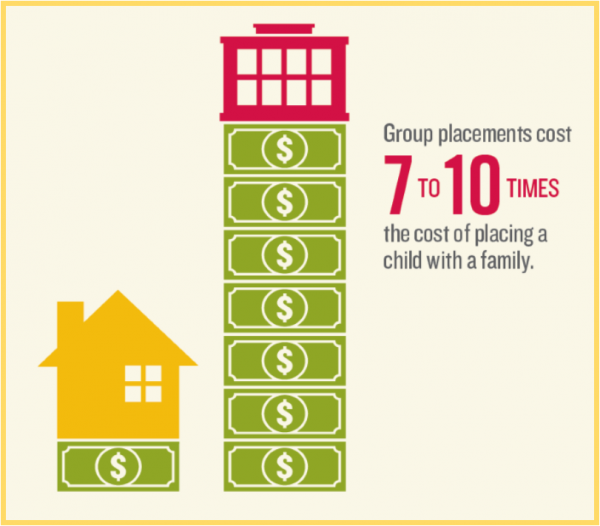
  • Group placements cost 7 to 10 times the cost of placing a child with a family.

The report also indicates that African American and Latino youth are more likely than white youth to be placed in group settings, and boys are more likely than girls to be in group placements.  Nationally, African American youth are 18 percent more likely than their white counterparts to be sent to group placements, and boys are 29 percent more likely than girls, according to data cited in the report.

4 in 10


Motor Vehicle Deaths Up 14 Percent in CT in 2015, Exceeding National Average

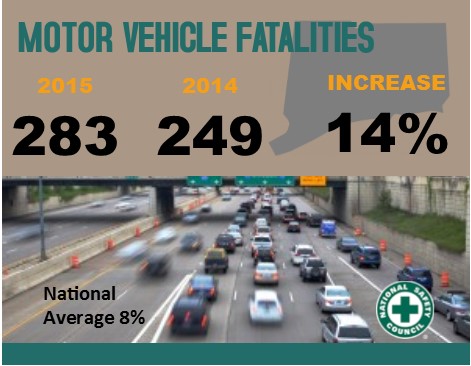
The death toll in Connecticut from motor vehicle accidents increased 14 percent in 2015 from the previous year, consistent with a nationwide increase but higher than the national average.  The increase in Connecticut ranked the state tied for 14th in the percentage increase in motor vehicle deaths from 2014 to 2015. fatalities CTNationally, 2015 saw the largest single-year percent increase in motor vehicle deaths since 1966. Estimates from the National Safety Council (NSC) show an 8 percent increase in 2015 compared with 2014 – with substantial changes in some states, including Connecticut.  There were 283 motor-vehicle related deaths in Connecticut last year, compared with 249 in 2014 and 276 in 2013.


While many factors likely contributed to the fatality increase, a stronger economy and lower unemployment rates are likely at the core of the trend.  The National Safety Council estimates 38,300 people were killed on U.S. roads, and 4.4 million were seriously injured, meaning 2015 likely was the deadliest driving year since 2008. The annual total of motor vehicle fatalities for 2014 was 35,398.

Over the last year at the state level, the National Safety Council estimates Vermont (30 percent), Oregon (27 percent), New Hampshire (24 percent), Georgia (22 percent), Washington (21 percent) and Florida (18 percent) experienced the largest percentage increase in fatalities, while only 13 states showed improvement. Among them were New Mexico (-20 percent), Kansas (-7 percent) and New Jersey (-2 percent).

Increases were also in Arizona (15%), Colorado (17%), Idaho (17%), Montana (17%), Maine (16%), Maryland (16%), and South Carolina (16%).  Also seeing 14 percent increases along with Connecticut were Arkansas, Minnesota, Missouri, and Nevada.  nsc_logo

“These numbers are serving notice: Americans take their safety on the roadways for granted,” said Deborah A.P. Hersman, president and CEO of the National Safety Council. “Driving a car is one of the riskiest activities any of us undertake in spite of decades of vehicle design improvements and traffic safety advancements. Engage your defensive driving skills and stay alert so we can reverse this trend in 2016.”

From 2013 and 2015, Connecticut had a 3 percent increase in traffic fatalities, according to the data.

The estimated cost of motor-vehicle deaths, injuries, and property damage in 2015 was $412.1 billion, according to NSC.  The costs include wage and productivity losses, medical expenses, administrative expenses, employer costs, and property damage.

The estimate is subject to slight increases or decreases as data mature, according to the National Safety Council. NSC has issued annual traffic fatality estimates since 1921. Over the last three years, preliminary estimates have fallen within 1 percent of final counts.

Average gas prices were 28 percent lower in 2015 than in 2014 and are projected to continue dropping this year, making driving more affordable for many Americans, NSC pointed out, noting that the U.S. Department of Transportation estimates a 3.5 percent increase in the number of miles driven in 2015 compared to 2014.

To help ensure motor vehicle accidentsafety, the National Safety Council recommends drivers:

  • Make sure every passenger buckles up on every trip
  • Designate an alcohol and drug-free driver or arrange alternate transportation
  • Get plenty of sleep and take regular breaks to avoid fatigue
  • Never use a cell phone behind the wheel, even hands-free
  • Stay engaged in teens’ driving habits, as teens are three times as likely to crash as more experienced drivers
  • Learn about vehicle safety systems and how to use them, including features such as adaptive cruise control, blind spot warning systems and backup cameras.

Founded in 1913 and chartered by Congress, the National Safety Council, nsc.org, is a nonprofit organization whose mission is to save lives by preventing injuries and deaths at work, in homes and communities, and on the road through leadership, research, education and advocacy.

Connecticut is Most Religious State in New England

Connecticut is the most religious state New England, ranked number 38 in the nation, according to a new Gallup poll.  The other New England states are all in the bottom ten, according to the survey, which covered the year 2015. New Hampshire is the least religious state in the nation, with 20 percent of residents considering themselves to be “very religious,” 24 percent “moderately religious” and 55 percent “non-religious.”  Just ahead of New Hampshire at the bottom of the list, are Vermont (22 percent very religious), Maine (26 percent very religious) and Massachusetts (27 percent very religious).  Rhode Island is ranked 43, with 32 percent of residents considering themselves to be very religious.CT religion

Connecticut, the only New England state ranked higher than the bottom ten, broke down this way:  33 percent very religious, 28 percent moderately religious, and 39 percent non-religious.

In the annual survey, Mississippi (63 percent) has extended its eight-year streak as the most religious state, followed closely by neighboring Alabama (57 percent), according to Gallup.  Rounding out the top ten “very religious” states were Utah, Louisiana, Tennessee, Arkansas, Georgia, South Carolina, North Carolina, Kentucky and Texas.

The state-by-state results are based on over 174,000 interviews conducted as part of Gallup Daily tracking in 2015, including more than 480 interviews in every state and more than 1,000 interviews in most states.  In Connecticut 1,919 interviews were conducted, according to Gallup.framed church Lee, MA

Gallup classifies Americans into three religious groups based on their responses to a question measuring religious service attendance and how important religion is in their daily life. Very religious Americans are those who say religion is important to them and who attend services every week or almost every week. Nonreligious Americans are those for whom religion is not important and who seldom or never attend religious services. Moderately religious Americans meet just one of the criteria, either saying religion is important or that they attend services almost every week or more.

Nationwide, the percentage classified as very religious on the basis of their attendance and view on the importance of religion has stayed remarkably stable since the survey began seven years ago. In 2008, 41% of Americans were very religious, 29% moderately religious and 30% nonreligious. In 2015, those same percentages are almost identical: 40%, 29% and 31%, respectively.

religion USA