Project Undertakes Mapping CT With Precision From the Air
/Unbeknownst to most of us, there is a world of difference between an aerial photograph and an orthophotography. In fact, enough of a difference for the State of Connecticut to get behind an initiative to photograph the entire state.
The results are to be made publicly available through the state’s Open Data Initiative. The orthoimaging of Connecticut, now complete, was undertaken by the Sanborn Map Company, under a contract with the Capitol Region Council of Governments made possible by a grant from the state's Office of Policy and Management. It will provide Connecticut with its first statewide acquisition of datasets at this high level of accuracy, according to those involved with the project.
The Sanborn flight team overcame challenging spring weather conditions to successfully collect high-resolution imagery of the entire state of Connecticut and its coastline in just five weeks, according to the company. Altogether, the firm collected more than 42,500 4-band, 3-inch resolution images during March and April, including more than 6,000 coastline images during low-tide conditions.
The Sanborn team, which included subcontractors, also collected more than 5,200 square miles of high-density light detection and ranging (LiDAR) data covering the entire state during the same time period. All of the data were collected during snow-free, cloud-free and leaf-off conditions, which makes them ideal for a host of products and applications.
A conventional perspective aerial photograph contains image displacements caused by the tilting of the camera and terrain relief, or topography. It does not have a uniform scale and one cannot measure distances on an aerial photograph as if it were a map.
In orthophotography, the effects of tilt and relief are removed from the aerial photograph by a computer rectification process to create an orthophoto, which then becomes a uniform-scale photograph. Since an orthophoto has a uniform scale, it is possible to measure directly on it, as with traditional maps.
The product combines the image characteristics of a photograph with the geometric qualities of a map; thus, it is possible to get direct measurements of distances, areas, angles, and positions.
That distinction can make a big difference for governments and businesses seeking such images. Brad Arshat, Sanborn director of strategic accounts in the Northeastern United States, estimates that statewide collaboration on the project will result in several million dollars in tax dollar savings, as opposed to each of the state's 169 municipalities acquiring its own data.
Sanborn is now creating mapping products from the data, which will be delivered later this year. These include 3-inch ground sample distance (GSD) orthoimagery; U.S. Geological Survey (USGS) QL2 LiDAR data; bare Earth digital elevation models (DEMs); and 1-foot contour maps.
 Individual municipalities and state agencies also have options to purchase additional products as needed, such as 3-D building footprints, planimetrics, landcover maps, impervious surface maps and more, according to company officials.
"We need to support our communities by giving them the tools to do their jobs in a modern, efficient and effective way," Gov. Dannel Malloy pointed out in a Sanborn news release. "As a former mayor, I know how valuable this information is to municipalities. In addition, this information is critical to our state agencies."
Sanborn is a preeminent innovator in the geospatial industry, the company website indicates, delivering state-of-the-art mapping, visualization, Web GIS™ and 3-D solutions to customers worldwide. The firm, which marked its 150th anniversary in 2016, operates a fleet of 14 aircraft located strategically across the United States.
 "Our flight team did an exceptional job of outmaneuvering the unusual weather present during the collection period (in Connecticut)," says Shawn Benham, Sanborn project manager. "The savings truly are astronomical when you merge many smaller project areas into a single large project because of the fixed costs associated with each mobilization," added Arshat in statement released by the company.


 The Connecticut Interscholastic Athletic Conference

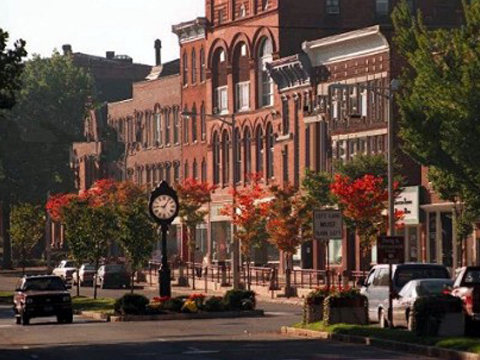

 The
 In lower Fairfield County, the city of Norwalk launched a rebranding initiative earlier this year. Using the new slogan “The Sound of Connecticut,” the campaign, according to Mayor Harry Rilling “was necessary to help reposition Norwalk. Our visual brand and identity system will become a recognized symbol of Norwalk’s progressive and connected vibe. We understand and live the brand’s values, goals and promises on a daily basis.” The Mayor


 Connecticut Voices for Children Executive Director Ellen Shemitz said the poll results indicate that there are potentially great rewards for leaders to work on this issue, and not many penalties. In addition, the results show the public’s willingness to devote money to this issue, and that people are looking to their elected leaders to make these investments, Shemitz pointed out.
 The site pointed out that “unless we pay attention to attendance even among young children, we are missing the opportunity to use early educational experiences to build an essential skill: showing up on time, every day to school. A growing body of research and practitioner experience shows that paying attention to attendance for our youngest children is essential.




 The site said of
 s, including:
 Funding for the competition prize awards will be provided both by the State of Connecticut, which has committed $1 million, and an additional $2 million commitment from private partners. The Doris Duke Charitable Foundation, The Kresge Foundation, Living Cities, NeighborWorks America, The United Illuminating Company, Stanley Black & Decker, Boehringer Ingelheim, Travelers Companies, Inc., The Hartford Foundation for Public Giving, Webster Bank, Eversource Energy, Liberty Bank Foundation, Hartford HealthCare, Barnes Group, Hoffman BMW of Watertown/Hoffman Auto Group, United Technologies Corp., Charter Communications, and Fairfield County’s Community Foundation have all committed to participating in the challenge.
 “We are pleased to bring the Working Cities Challenge to Connecticut and are thankful to Governor Malloy for his support of the effort, as well as the Hartford Foundation, the Doris Duke Foundation, Living Cities, The Kresge Foundation, and many others,” Boston Fed President Eric Rosengren said. “The partners have come together to make it possible to bring the competition to Connecticut – precisely the model of cross-sector collaboration that forms the basis of the Working Cities Challenge. This competition focuses on the residents of the state’s postindustrial cities – places with unique assets that taken together can help to build civic leadership infrastructure, which our research shows is a key component of economic resurgence.”
 “It’s gratifying to see the strong support from Connecticut companies, foundations, and the Malloy administration for the Working Cities Challenge under the thoughtful leadership of the Boston Fed,” James C. Smith, Chairman and CEO of Webster Bank, said. “By encouraging the development of civic infrastructure as a prerequisite to physical infrastructure, the Working Cities Challenge promises to revitalize Connecticut’s smaller cities economically and transform the lives of inner city residents.”

 A recent report in Business Insider indicated that one in three new businesses in the U.S. were started by an entrepreneur age 50 or older. Describing “running a business as the new retirement,” the news report cited an infographic in easylifecover that highlighted those aged 55-64 in the U.S. have actually had the highest rate of entrepreneurial activity in the last 10 years, noting that the founders of McDonald's, Coca Cola, and Kentucky Fried Chicken – among others - were all over 50 when they established their businesses.
 The interactive “Boot Camp” event at reSET – open to people of all ages with a special focus on the 50 and over –included short presentations from local resource organizations, networking opportunities and valuable information on the programs and tools available to potential business owners. Attendees were updated on the necessary steps and tools to launch a business, and had opportunities to talk one-on-one with local mentoring organizations, lenders, small business advisors and community leaders for advice and assistance.
 hand at the reSET event in mid-June were representatives of the Office of Secretary of State (where new businesses are registered),
 reSET serves all entrepreneurs, but specializes in social enterprise ― impact driven business with a double and sometimes triple bottom line. In addition to providing co-working space and accelerator and mentoring programs, reSET aims to inspire innovation and community collaboration, and to support entrepreneurs in creating market-based solutions to community challenges. The organization’s goal is to “meet entrepreneurs wherever they are in their trajectory and to help them take their businesses to the next level.”