CT’s Local Government Workforce Shrinks 7.4% in Past Decade; 10th Largest Reduction in US from Employment Peak

Connecticut’s local municipal workforce has been shrinking for the past decade, and had been reduced 7.4 percent by 2015 when compared with the peak employment year of 2005, according to a new analysis by Governing magazine.  The drop in local government employment is the 10th largest in the country by percentage of workforce, when peak employment levels were compared with 2015 numbers. “Going on nearly a decade since the start of the recession, localities in many parts of the country have since restored public payrolls to prior levels. But some still employ far fewer workers than they did before the downturn,” Governing reported.

Governing compared each state's pre-2010 peak aggregate totals to the latest 2015 data, excluding the education sector.  In all, the magazine reported, local governments in 26 states had yet to see payroll expenditures return to prior levels when adjusted for inflation. Similarly, local public employment remains below previous highs in most states and is down 3.5 percent nationally from 2008.

The steepest declines in local government payrolls, when 2015 data was compared with the peak pre-recession year, came in Delaware (-20.5% from 2007), Michigan (-18.2% from 2003), Arizona (-17.1% from 2008), Rhode Island (-16.5% from 2003), Massachusetts (-14.4% from 2008), Nevada (-14.1% from 2009), Florida (-11.0% from 2008), Indiana (-8.8% from 2008), New Jersey (-8.3% from 2009) and Connecticut (-7.4% from 2005).

Where localities chose to make payroll cuts has varied, according to the analysis, but a number of patterns were pointed out, based on Census data.  When national employment estimates were compared with 2008 levels, non-sworn police employees sustained the single largest reduction of any major category of workers, the analysis indicated. Governing suggested the reductions were likely a result of police departments trimming civilian staff to maintain the size of police forces on the streets. Nationally, the number of police and firefighters were down 2.6 percent from 2008 while all other areas of local government, excluding education and hospitals, experienced a larger 4.5 percent decline.

At the opposite end of the spectrum, North Dakota, South Dakota, Wyoming, Montana and New Mexico recorded the biggest increases in noneducation payrolls since the recession began in 2008-2009.  Half the states showed an increase in local government payrolls, and despite the generally slow recovery across many regions of the country, U.S. local government payroll spending overall showed a slight three  percent nationwide uptick between 2014 and 2015, according to the analysis.

National Effort to "Revive Civility" is Underway, Looking Ahead to Next Elections

The National Institute for Civil Discourse (NICD), launched in the aftermath of the shooting targeting Congresswoman Gabby Giffords in Arizona in 2011, has launched a new initiative – Revive Civility. “Incivility in America has reached epidemic proportions,” organizers point out. “Every day rudeness, disrespect and hostility sideline collaboration and compromise. Sound bites replace sound journalism. Extremes on both ends of the political spectrum stymie productive dialogue. The public, initially worn and weary, is increasingly enraged about how the lack of civility has left government helpless in the face of our nation's most pressing problems.”

The initiative includes proposed Standards of Conduct, toolkits for citizens, and suggested text messages  that emphasize how ”civility strengthens our democracy.”

Pointing out that “research found that most people think mocking or making fun of a political opponent, making disrespectful or demeaning statements, refusing to listen to arguments of different points of view, or making exaggerated statements that misrepresent the truth are all uncivil behaviors.”

In 2017, “reviving civility is more important than ever” and NICD plans to continue to champion “respectful interactions” in media, legislatures, and the public.  The organization will also educate “the next generation on the importance of civility and ways in which respectful dialogue and interaction between a variety of viewpoints can be created in your own life.”

The 2016 campaign, NICD points out, “brought political incivility directly into living rooms across America,” pointing out that candidates used “disrespectful remarks, name calling,” insulted various members of minority groups, and “the tone of the campaigns has also led to physical violence. Uncivil words have led to uncivil actions and are the direct result of the nature of the rhetoric expressed by those competing to lead in public office.”

NICD points out that:

  • 2 in 3 voters say the 2016 election has been less civil than other elections.
  • 6 in 10 agree with the statement "The 2016 election will go down as one of the most negative elections."
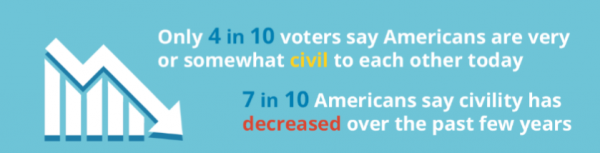
  • 4 in 10 voters say Americans are very or somewhat civil to each other today.
  • 7 in 10 Americans say civility has decreased over the past few years.

The honorary chairs of NICD, a nonprofit organization, are former presidents George H.W. Bush and Bill Clinton.  Among the honorary co-chairs is former U.S. Supreme Court Justice Sandra Day O’Connor.


Financial Cost to Connecticut Smokers Among Highest in the Nation

The financial cost of smoking in Connecticut is higher than just about anywhere in the United States.  The total cost over a lifetime per smoker is $2,183,204, the third highest in the nation, and the annual cost per year per smoker of $42,808, is also third highest in the nation, just behind New York and Massachusetts. The lifetime health care cost per smoker, $274,272 in Connecticut, is higher than every state but one, (Massachusetts), and the out-of-pocket cost per smoking individual of $170,513 for smokers living in Connecticut is third highest in the nation.

The data was compiled by the financial website WalletHub, where analysts calculated the potential monetary losses — including the cumulative cost of a cigarette pack per day over several decades, health-care expenditures, income losses and other costs — brought on by smoking and exposure to secondhand smoke. 

Emphasizing that “the negative physical and financial effects of smoking can be significant,” WalletHub noted that Connecticut’s rankings placed it as among the most costly in every category.

Over a lifetime, the financial opportunity cost for smokers living in Connecticut was $1.436,335 and the income loss per smoker was calculated at $286,950.  Other costs per smoker, such as not being able to qualify for homeowner’s insurance discounts for non-smokers, were $15,133.  In each instance, the costs in Connecticut were among the three highest among the 50 states and District of Columbia.

Annual income loss for Connecticut smokers is calculated at $5,626.  Only Maryland, Alaska, New Jersey and D.C. were higher, according to the analysis. Attributable factors included absenteeism, workplace bias or lower productivity due to smoking-induced health problems.  The website also noted that according to a recent study from the Federal Reserve Bank of Atlanta, smokers earn 20 percent less than nonsmokers, 8 percent of which is attributed to smoking and 12 percent to other factors.

For the calculations, WalletHub assumed an adult who smokes one pack of cigarettes per day beginning at age 18, when a person can legally purchase tobacco products in the U.S., and a lifespan thereafter of 51 years, taking into account that 69 is the average age at which a smoker dies. Data used in developing the ranking were collected from the U.S. Census Bureau, Bureau of Labor Statistics, Centers for Disease Control and Prevention, Insurance Information Institute, NYsmokefree.com, Federal Reserve Economic Data (FRED), Kaiser Family Foundation and the Independent Insurance Agents & Brokers of America.

In 2016, the American Lung Association gave Connecticut an “F” grade in its spending of tobacco prevention and control funds.  The ALA points out that 40 states and Washington D.C. spend less than half of what the Centers for Disease Control and Prevention recommends on their state tobacco prevention programs.  Overall, states spend less than two cents of every dollar they get from tobacco settlement payments and tobacco taxes to fight tobacco use.  Each day, more than 2,600 kids under 18 try their first cigarette and about 600 kids become new, regular smokers, according to nationwide data from ALA.

A report on Connecticut's spending on tobacco prevention just over a year ago found that the state was being outspent over 67 times by tobacco companies' marketing efforts - due in large part to the state spending only a small portion of tobacco settlement funds on anti-smoking efforts.

The report, “Broken Promises to our Children: A State-by-State Look at the 1998 State Tobacco Settlement 17 Years Later," said the state was spending $1.2 million in FY 2016 to fight tobacco use. That's compared to an estimated marketing investment of $80.4 million by tobacco companies in Connecticut that year. The national average shows a margin of 20.1 to 1.  At that time, Connecticut ranked 38th in spending on a percentage basis.  The state has consistently spend less than the CDC has recommended.

The annual report was developed by the Campaign for Tobacco-Free Kids (CTFK), a coalition that includes the American Heart Association, the American Cancer Society Cancer Action Network, the American Lung Association, the Robert Wood Johnson Foundation, Americans for Nonsmokers’ Rights, and the Truth Initiative.

A year later, the next report ranked Connecticut last, as Connecticut’s projected spending on smoke cessation and tobacco prevention efforts for FY 2017 dropped to zero.  The report found that 13.5 percent of adult state residents are smokers, and 10.3 percent of high school students smoke.  Just under 5,000 deaths each year are caused by smoking in Connecticut, and 27 percent of cancer deaths are attributable to smoking.  Connecticut’s cigarette excise tax, $3.90 per pack, is the second highest in the nation. It was estimated that the state would collect $519.7 million in revenue this year from the 1998 state tobacco settlement and tobacco taxes, but will spend none of it on tobacco prevention programs.


Was Holocaust News in Connecticut As It Happened? Historians Seek to Find Out

What could Americans have known – in Connecticut and across the country - about the Nazi threat from reading their local newspapers in the 1930s and 1940s? The Connecticut League of History Organizations (CLHO) is looking for some research help to find out. CLHO is participating in History Unfolded, a project of the United States Holocaust Memorial Museum in Washington, DC. It asks students, teachers, and history buffs throughout the United States what was possible for Americans to have known about the Holocaust as it was happening and how Americans responded. “

Participants look in local newspapers for news and opinion about 31 different Holocaust-era events that took place in the United States and Europe, and submit articles they find to a national database, as well as information about newspapers that did not cover events. History Unfolded raises questions for scholars and will inform the Museum’s initiative on Americans and the Holocaust.

CLHO and Connecticuthistory.org are teaming up to introduce this project to Connecticut. On January 26, 2017, (the day before the United Nations Holocaust Remembrance Day) “citizen historians like you can register to join ‘Team Connecticut’ as we explore Holocaust history.”  Research volunteers will learn how to use primary sources in historical research, and challenge assumptions about American knowledge of, and responses to, the Holocaust.

Officials stress that no experience is needed to participate. Individuals may get involved on their own using online newspaper archives, at local libraries or participating museums, or in groups working as members of a research team.

Data from History Unfolded: U.S. Newspapers and the Holocaust will be used for two main purposes: to inform the upcoming exhibition on Americans and the Holocaust at the United States Holocaust Memorial Museum, and to enhance scholarly research about the American press and the Holocaust. Information captured in the general database will be available as a research source for generations to come.

As of January 9, 2017, 920 participants from across the country had submitted more than 6,300 articles from their local newspapers. The articles were published in newspapers located in all 50 states and the District of Columbia, and represent news articles, editorials, letters to the editor, political cartoons, and advertisements. Individuals are urged to check with their local museum, historical society, or library to see if they will be hosting a research group. A classroom or school, a temple or church, a museum or library, or other community organizations can participate. Individuals can also participate.  Organizations can email Liz Shapiro at liz@clho.org or Gregg Mangan, at gmangan@cthumanities.org for additional information.  For more about the national project, visit the project at https://newspapers.ushmm.org/
State’s First Law Incubators Set to Launch in Hartford, Bridgeport

Connecticut’s first law incubators are due to open early this year at the Center for Family Justice, a Bridgeport-based nonprofit, and at UConn School of Law,  being established to provide affordable legal services to people who need them and help lawyers establish solo practices. The Connecticut Community Law Center, an initiative of the law school and the Hartford County Bar Association, aims to help people who have traditionally been underserved by the justice system: low- and moderate-income clients who don’t qualify for legal aid but can’t afford standard legal fees, the UConn School of Law announced this month.

“Too many people face legal problems concerning essential human needs without proper representation because they fall into the growing access-to-justice gap, between the very poor who qualify for legal aid and those with the financial means to pay a private lawyer,” said attorney Mark Schreier, who was appointed director of the Connecticut Community Law Center. “Standing alone and without professional guidance, those individuals enter our justice system at a tremendous disadvantage.”

The incubator is set to open in February in William F. Starr Hall on the UConn Law campus in Hartford. In addition to the services of the director, the law school will provide office space and support – including training, guidance, and legal research resources – for up to six solo practitioners. The Hartford County Bar Association and the law school faculty will provide mentors, and Greater Hartford Legal Aid will help with training and referrals.

The subsidized working environment will allow participating lawyers to provide legal services at a modest cost that is lower than standard legal fees, with each lawyer setting the fee on a case by case basis. Schreier said he expects cases to involve a wide range of legal problems, including family, consumer, probate, housing, bankruptcy, employment, immigration, and other general civil matters.

In Bridgeport, the Center for Family Justice, a Bridgeport-based nonprofit that provides services to trauma survivors affected by domestic violence, sexual assault or child abuse, will house the incubator.

The Center is working with Connecticut law schools to help build the center’s legal apparatus, Fairfield County Business Journal reported, with several professors from Quinnipiac University on the steering committee to help develop the parameters of the program.  Four attorneys are being sought.

Lawyers in the incubator program at the Center will provide the legal advices services and representation needed by victims of domestic violence, including restraining orders, divorce proceedings, child custody and support, housing and immigration issues.  An Open House was held in September to interest local attorneys in participating.

“A legal incubator is like a business incubator,” Jennifer Ferrante, who joined the Center for Family Justice staff as the coordinator for the new service, told the Journal.  At the center’s office at 753 Fairfield Ave., “We are going to be housing four attorneys here on site,” she said. Two of the first attorneys who applied and were accepted in the program are recent law school graduates.

The American Bar Association counts more than 60 lawyer incubators around the country, three-fourths of them established since 2014. The Connecticut Community Law Center and the Justice Legal Center at the Center for Family Justice in Bridgeport, will be the first in Connecticut.

Participating lawyers will spend 18 to 24 months at the Connecticut Community Law Center before moving on with their practices. The training and experience they receive will not only help them jump-start their practices, it will spread seeds of innovation in the delivery of legal services at an affordable cost, UConn Law Dean Timothy Fisher said.

Clients who qualify for services at the Hartford incubator will be those whose incomes exceed the limits for legal aid but fall within three times the federal poverty level. For a family of four, this would mean a maximum household income of $72,900. Clients wishing to apply for services may do so beginning in February, when information will be available at the center’s website: cclc.law.uconn.edu.

“I think it will give the low- and moderate-income community a real chance in getting their legal needs met and ending their cycles in abuse and poverty,” Ferrante said of the new Bridgeport center.

Planning for the legal incubator has been ongoing since 2009. Although the Center for Family Justice is focused on serving six Fairfield County municipalities – Bridgeport, Easton, Fairfield, Monroe, Stratford and Trumbull – it also welcomes those seeking help from elsewhere in the state, officials said.

CT Council Urges Change in Focus to Combat Human Trafficking in State

Recognizing that the sex industry – especially when it involves underage children – is a form of human trafficking, the Connecticut Trafficking in Persons Council (TIP) is making several legislative recommendations aimed at shifting the onus for the crime of prostitution from the prostitute to “the demand side” – the buyers of sex. On National Human Trafficking Awareness Day, the TIP Council released its Annual Report and recommendations for the state legislature, and launched a new initiative and website, www.enddemandct.org.

“Conversations about sex trafficking almost exclusively disregard the role of the individual buying sex—the ‘john,’” says Jillian Gilchrest, chair of Connecticut’s Trafficking in Persons Council and Director of Health Professional Outreach at the Connecticut Coalition Against Domestic Violence. “The sex trafficking of Connecticut’s women, men, and children is driven by demand for the commercial sex acts they perform. Put simply, without ‘buyers’ to purchase sex there would be no sex-for-pay industry. So, we are embarking on an ‘End Demand’ campaign to bring much needed attention to those buying sex who create the demand that fuels sex trafficking.”

The TIP report questions why, since Connecticut enacted the felony crime of patronizing sex from a minor in 2013, there have been no arrests or convictions for the felony. Significantly, DCF has seen an increase in the trafficking of children; currently, there are 456 referrals for children at high risk of trafficking.

The report also calls on Connecticut lawmakers, state agencies, and advocates to work together to better understand the demand side of sex trafficking in order to effectively prevent this crime from happening. This begins, the report explains, with creating awareness, since more often than not, those buying sex are left out of conversations about human trafficking. With the use of social media, traditional media, and advertising, the TIP Council indicated it aims to raise public awareness about the individuals in our state who choose to pay to sexually abuse children and exploited individuals.

The report indicates that law enforcement and State’s prosecutors argue that those buying sex with children and exploited adults can be charged with other crimes, such as sexual assault in the second degree or risk of injury. The Council will be looking into this, the report notes, to better understand if buyers of sex are being arrested, and if not, why.

In addition, the report outlined that with over 100 members, the Department of Children and Families (DCF) Human Anti-trafficking Response Team (HART) comprises multi-department, multiagency partners, various levels of law enforcement, the provider community, faith-based network, among others. In 2015, DCF received 133 referrals of youth who were at risk or confirmed victims of human trafficking. As of September 2016, DCF has received 151 referrals of youth who were at risk or confirmed victims of human trafficking, the report indicated.

Tammy Sneed, Director of Gender Responsive Adolescent Services at Department of Children and Families and co-chair of DCF’s Human Anti-Trafficking Response Team, said: “Reports of children suspected to be victims of domestic minor sex trafficking are increasing every year -- and, in 2016, there were just under 200 such referrals. For every child victim, the number of buyers on a given day in Connecticut is unfathomable. Some children report 10 to 15 buyers per night, which leads us to estimate that a minimum of 2,000 buyers in Connecticut bought sex from children last year.”

In the report, the Council recommends:

  • the Connecticut Sentencing Commission, Special Committee on Sex Offender, Subcommittee on Sex Offender Sentencing consider whether to include 53a-192a. Trafficking in persons and 53a-83(c), Patronizing a prostitute when such other person is under the age of 18, to the Registration of Sex Offender statutes;
  • further discussion and inquiry on why there have not been any convictions under Sec. 53a-83(c), Patronizing a prostitute under the age of 18, effective 2013;
  • further discussion on increasing the penalty for Sec. 53a-83(c), patronizing a prostitute under the age of 18, to align with similar sexual crimes against children; and
  • further discussion on revising Sec. 53a-192a, Trafficking in persons, to include recruitment, harboring, transportation, provision, obtaining, patronizing, or soliciting of a person for the purpose of a commercial sex act and increasing penalties to recognize the severity of the crime.

The Trafficking in Persons (TIP) Council is convened by the Commission on Women, Children and Seniors and chaired by the Connecticut Coalition Against Domestic Violence (CCADV). The Council was formerly run by the Permanent Commission on the Status of Women. The council consists of members from a diversity of backgrounds, including representatives from state agencies, the judicial branch, law enforcement, motor transport and community based organizations that work with victims of sexual and domestic violence and immigrants and refugees, and address behavioral health needs and social justice and human rights.

“Demand keeps sexual exploitation and trafficking profitable,” says Beth Hamilton, associate director of the Alliance to End Sexual Violence (formerly CONNSACS). “We’ve started seeing the criminal justice system hold traffickers responsible, but we do not often see the people who purchase sex being held accountable for their role in keeping the industry thriving.  If we want to end commercial sexual exploitation, we need to focus on ending demand and creating survivor-centered services.”

In Connecticut, a person is guilty of trafficking in persons when such person compels or induces another person to engage in sexual contact or provide labor or services by means of force, threat of force, fraud or coercion. Anyone under the age of 18 engaged in commercial sexual exploitation is deemed a victim of domestic minor sex trafficking irrespective of the use of force, threat of force, fraud or coercion.

The report points out that “For many people, sex and labor trafficking bring visions of foreign places and people, but this idea is false. In reality, sex and labor trafficking are happening in the state, to Connecticut residents.”

Sandy Hook Shooting Among Top 10 Impactful Historic Events for Millennials

Among American millennials, the 2012 shooting of students and teachers at Sandy Hook Elementary School in Newtown is one of the 10 events during their lifetime with the greatest impact on the country. That’s according to a new survey conducted by Pew Research Center in association with A+E Networks’ HISTORY. For Millennials, the 9/11 terror attacks and the Obama election leads the list – and by a greater margin than for other generations.

The top 10 list for these young Americans also varies from the rankings of other generations. For example, the Columbine school shooting makes the top 10 list of Millennials and Gen Xers but not Boomers or the Silent Generation.

Millennials also are unique in that five of their top 10 events – the Sandy Hook and Orlando/Pulse nightclub shootings, the death of Osama bin Laden, the Boston Marathon bombing and the Great Recession – appear in no other generation’s top 10 list.

The perceived historic importance of the attacks on New York and the Pentagon, span virtually every traditional demographic divide, the survey found.

The top 12 among millennials were: Sept.11; Obama election; Iraq/Afghanistan wars; Gay marriage; the tech revolution; Orlando shooting; Hurricane Katrina; Columbine shooting; Bin Laden; Sandy Hook; Boston Marathon bombing; Great Recession.

When participants of all ages were asked to identify a time or event during their lifetime when “you felt most disappointed in America,” among the events mentioned most often were the school shootings at Sandy Hook and Columbine.

To measure how Americans view the importance of recent historic events, Pew Research Center conducted a national, probability-based survey with a representative sample of adults who are members of the GfK KnowledgePanel, a national, probability-based online panel. Pew Research Center received supplemental funding from HISTORY to conduct this survey.

Survey participants were asked to list the 10 historic events that occurred during their lifetimes that they thought “have had the greatest impact on the country.” Respondents were further told that they could name a specific event, a series of related events or any other historic development that had a major influence on American life.

Leading the list among Generation X were Sept. 11; Obama election; Fall of Berlin Wall/End of Cold War; The tech revolution; Iraq/Afghanistan wars; Gulf War; Challenger disaster; Gay marriage; Hurricane Katrina; Columbine shooting; Orlando shooting; Oklahoma City bombing.

For baby boomers, the top historic events were Sept. 11; JFK assassination; Vietnam War; Obama election; Moon landing; the tech revolution; Civil rights movement; Fall of Berlin Wall/end of Cold War; MLK assassination; Iraq/Afghanistan wars.

Millennials are those young adults born between 1981 and 1998.  Generation X were born 1965 to 1980; the Baby Boom generation were born between 1946 and 1964.

Charitable Giving in CT Not Keeping Pace with U.S., Report Finds

The latest report from the Connecticut Council of Philanthropy (CCP), which highlights philanthropic giving in Connecticut shows that as giving across the U.S. has increased, the opposite is true of Connecticut, even as individual giving – which makes up the lion’s share of giving – has increased. The report, which highlights calendar year 2014 and the years leading up to it, reveals that while total giving in the U.S. increased from 2013 to 2014, total giving in Connecticut dropped from $4.66 billion to $4.51 billion. Over the five years through 2014, individual giving by Connecticut taxpayers who itemized rose 14 percent, less than the increase nationally of 25 percent.  More than three-quarters of giving in Connecticut is by individuals.

In 2014, Connecticut was ranked number one in per capita income by state and 45th in charitable giving.  All six New England states rank at the bottom in per capita giving, while Southern states rank near the top.  Yet the proportion of tax returns reporting contributions in 2014 at 34.5 percent was considerably higher than the national average of 24.5 percent, the report indicated.

The annual report, Giving in Connecticut, looks at charitable giving by Connecticut grant makers and residents, including: individual giving through reported contributions, bequests made through estate giving, and foundation giving. Giving in Connecticut uses data from the IRS Statistics of income Division, the Foundation Center, and self-reported data gathered by CCP.

The report, published this month, found that:

  • Giving in Connecticut from all sources at $4.51 billion was down 3.2 percent from 2013, due primarily to a drop in bequests.
  • The giving breakdown: $3.39 billion from individuals; $1.02 billion from foundations; $.09 billion from bequests
  • Giving by individuals was up 2.8 percent.
  • Giving by all foundations was up 2.1 percent.
  • Giving via bequests was down 74 percent after being up the previous year by 76 percent.
  • Giving by individuals and bequests combined at $3.48 billion amounted to 77 percent of all giving.

The report indicated that giving by foundations saw most grants going to Education and Health. Giving by foundations is greatest in Fairfield County where 56 percent of Connecticut foundations are based. They gave $747 million to charities, representing 73 percent of total foundation grant making.

Religion is the largest single category of recipient type of charity across the U.S., at 33 percent.  Education ranks second at 15 percent.

The 20-page report also found that in 2012, individual giving in Connecticut spiked, apparently in response to Superstorm Sandy and the tragedy at the Sandy Hook elementary school in Newtown.

Connecticut has 1,425 Private Foundations, 79 of which are Operating Foundations, 59 are Corporate Foundations and 20 are Community Foundations, according to the report. Community Foundations assets showed strong growth of 41 percent from 2010 to 2014, from $1.37 billion to $1.92 billion. Connecticut Corporate Foundation giving remained steady during the five year period while private foundation giving climbed.  

The top five foundations, by giving, were the Boehringer Ingelheim Cares Foundation, Dalio Foundation, GE Foundation, The Zoom Foundation, and the Steven & Alexandra M. Cohen Foundation.  Rounding out the top 12 in 2014 were Hartford Foundation for Public Giving, Seedlings Foundation, Newman’s Own Foundation, The Community Foundation for Greater New Haven, Smith Richardson Foundation, Connecticut Bar Foundation and Aetna Foundation.

The Connecticut Council for Philanthropy is an association of grantmakers committed to promoting philanthropy for the public good.


CT’s Mortality Rate from Drug Poisoning is 11th Highest in US; Was 6th Lowest A Decade Ago

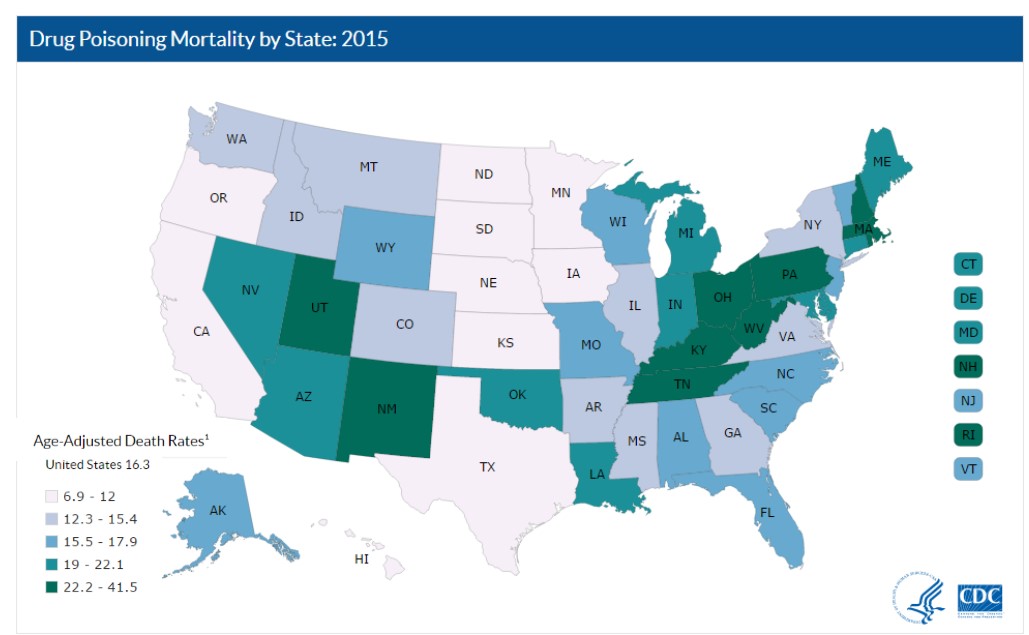
Connecticut’s mortality rate from firearms is less than half the national average, the state’s homicide rate is slightly above half the national average, but the rate of drug poisoning deaths exceeds the national average. Data from the Centers for Disease Control and Prevention (CDC) indicate that Connecticut’s mortality rate from drug poisoning was 17.6 per 100,000 population, with 623 deaths in the state in 2014, the 19th highest rate in the nation.  The U.S. rate that year was 14.7, with 47,055 fatalities.  Last year, Connecticut’s mortality rate from drug poisoning climbed to 22.1, which was the 11th highest rate in the nation, with 800 deaths. 

The states with the highest drug poisoning mortality rates in the nation in 2015 were West Virginia, New Hampshire, Kentucky, Ohio, Rhode Island, Pennsylvania, Massachusetts, New Mexico, Utah, Tennessee and Connecticut.  The lowest rates were in Nebraska, South Dakota, North Dakota, Texas and Iowa.

The CDC reported this month that opioids—prescription and illicit—are the main driver of drug overdose deaths. Opioids were involved in 33,091 deaths in 2015, and opioid overdoses have quadrupled since 1999.

In 2015, according to the CDC, significant increases in drug overdose death rates from 2014 to 2015 were primarily seen in the Northeast and South Census Regions. States with statistically significant increases in drug overdose death rates from 2014 to 2015 included Connecticut, Florida, Illinois, Kentucky, Louisiana, Maine, Maryland, Massachusetts, Michigan, New Hampshire, New Jersey, New York, North Carolina, Ohio, Pennsylvania, Rhode Island, Tennessee, Washington, and West Virginia.

The five states with the highest rates of death due to drug overdose were West Virginia (41.5 per 100,000), New Hampshire (34.3 per 100,000), Kentucky (29.9 per 100,000), Ohio (29.9 per 100,000), and Rhode Island (28.2 per 100,000).

The increase in drug overdose deaths in Connecticut from 2014 to 2015 was 25.2 percent, the fourth highest in the nation among states that had a statistically significant increase.  Only Massachusetts, New Hampshire and Maine had larger increases.

Among the 28 states meeting inclusion criteria for state-level analyses, 16 (57.1%) experienced increases in death rates involving synthetic opioids other than methadone, and 11 (39.3%) experienced increases in heroin death rates from 2014 to 2015, the CDC reported.

The largest absolute rate change in deaths from synthetic opioids other than methadone occurred in Massachusetts, New Hampshire, Ohio, Rhode Island and West Virginia. The largest percentage increases in rates occurred in New York (135.7%), Connecticut (125.9%) and Illinois (120%).

Connecticut, Massachusetts, Ohio, and West Virginia experienced the largest absolute rate changes in heroin deaths, while the largest percentage increases in rates occurred in South Carolina (57.1%), North Carolina (46.4%), and Tennessee (43.5).

Connecticut announced a detailed opiate response initiative this fall.  The Connecticut Opioid REsponse Initiative (CORE) is a strategic plan from Yale experts in response to the state’s opioid and overdose epidemics. It recommends: 1) expanding access to effective, medication-based treatment for substance use disorders; 2) improving transitions within the treatment domain; 3) increasing the availability of naloxone — the antidote to reverse an opioid overdose — and; 4) decreasing the over-prescribing of opioid at high doses or in combination with sedatives.

The CDC said “there is an urgent need for a multifaceted, collaborative public health and law enforcement approach to the opioid epidemic;” the Drug Enforcement Administration referred to prescription drugs, heroin, and fentanyl as the most significant drug-related threats to the United States, the CDC reported.


Connecticut Opioid REsponse Initiative (CORE) news conference, 10/6/16

https://youtu.be/fqw-AXvsL_8

Northeast Sees Relatively Strong International Migration Amidst Overall Weak Population Growth

New data from the U.S. Census indicates that population growth and domestic migration patterns have continued to move away from the East and the Midwest to the South and West, at accelerated rates, the website newgeography is reporting. Equally important, according to the site, pre-Great Recession interstate mobility rates have been restored.  The Census population estimates for the nation, states and the District of Columbia indicate a population increase for the South of 7.7 million between 2010 and 2016. The West gained 4.7 million. By contrast, the Midwest grew 1.1 million, while the East, including Connecticut, was even lower, at 900,000.

Combined, the South and West accounted for 87 percent of the national growth, the website’s analysis of the Census data indicated. In 2011, the South and West captured 82 percent of the national growth. By 2016, the South and West had risen to 94 percent of the national population increase. The South, alone had 57 percent of the growth, up from 52 percent in 2011. The West also had a strong gain, from 31 percent in 2011 to 36 percent in 2016.  The growth leaders:

  • Texas has led the nation in total population growth. Total population growth includes the natural change (births minus deaths), international migration and net domestic migration. Texas added 2.7 million residents, a 10.8 percent increase compared to its 2010 population. This is more than double the national rate of 4.7 percent.
  • California was well behind, with a gain of 2.0 million, despite having started the decade with a 50 percent higher population. California’s growth rate was 5.3 percent.
  • Florida added the third largest number of new residents, at 1.8 million, for a 9.6 percent growth rate from 2010.

Three states suffered population losses over the period. Illinois lost 30,000 residents and West Virginia lost 20,000. Vermont lost 1,000 and was joined by New England neighbors Maine, New Hampshire, Connecticut and Rhode Island in the bottom 10, with slim increases in overall population.

International migration was a bright spot for the Northeast, which along with the South were the two leading regions, followed by the West and Midwest.

The East and Midwest had a near monopoly on the bottom 10 in net domestic migration. New York lost 867,000 net domestic migrants, while Illinois lost 540,000. California’s loss was 383,000. New Jersey lost 336,000 and Michigan 216,000. Connecticut, Pennsylvania, and Ohio lost between 100,000 and 200,000, while Maryland and Massachusetts lost between 70,000 and 100,000.

In 2016, there were 825,000 interstate moves, according to the data outlined by newgeography, which is more than double the post-2000 low of 411,000 in 2011. The 2016 moves exceeded the 2001 to 2009 average by more than 10 percent