Opioid Epidemic Evident in CT Communities Large and Small; Data Show Rapidly Growing Health Crisis

In 2012-13, 111 of Connecticut’s 169 towns had at least one death attributable to opioids, and one city, Hartford, had more than 100 deaths that were caused by the drug.  Just four years later, in 2016-17, 138 towns saw at least one death during the two-year period, an increase of 24 percent, and the number of cities with more than 100 deaths had quadrupled, as Hartford, Bridgeport, New Haven and Waterbury each saw the death toll climb past 100. A review of data from the Connecticut Medical Examiner by the Connecticut Data Collaborative found that “opioid deaths have doubled and tripled in some towns in Connecticut in only six years.” The analysis found that although Bridgeport, New Haven, Waterbury, and Hartford have the highest rates per population, “many smaller towns have seen their rates of death triple as well.”

In comparing the average annual opioid-related death rates per 100,000 population in 2012-13, 2014-15, and 2016-17, the dramatic increases across communities statewide is quite evident. The data analysts point out that data are where deaths from 'any opioid' (meaning some type of opioid were found in the person) take place. Therefore, they explain, one would expect to see higher rates in places with large hospitals (hence high rates in cities). They add that one can also not discount that these places are also seeing higher rates among its residents.

In Danbury, for example, the rate of deaths nearly tripled from 2012-13 to 2016-17, from 6.88 to 18.20. In Enfield, it more than tripled, from 2.01 to 6.70.  In that northern Connecticut community, the rate translates to 9 opioid-related deaths during the two years of 2012-13 to 30 in 2016-17.

In Norwalk, the rate quadrupled from 2.57 in 2012-13 to 10.70 in 2016-17, when 25 people died from opioid-related causes.  The rate in New Britain more than tripled from 8.78 to 29.65 – from 24 deaths over a two-year period to 81 in the same period four years later.  In Hamden the number of deaths from opioid-related causes doubled from 8 to 16 in four years; in West Haven there were 7 deaths in 2012-13 and 29 in 2016-17.

The Connecticut Data Collaborative has posted on its website an interactive series of state maps that allows visitors to compare the number of opioid deaths in every town in Connecticut in each of the three years.  The maps indicate “the breadth of the problem” and “intensity of the issue.”

Earlier this year, Connecticut officials launched a statewide public awareness campaign aimed at reducing opioid misuse.  The "Change the Script" campaign provides information on prevention, treatment and recovery provided by local health departments, prevention councils, healthcare providers, pharmacists, and other community partners and stakeholders.

The state departments of Mental Health and Addiction Services (DMHAS), Consumer Protection (DCP) and Public Health (DPH) are working together on the campaign, which grew out of the Governor's Connecticut Opioid Response (CORE) Initiative, a three-year strategy to prevent addiction and overdoses.


https://youtu.be/Uy3IVFjUAjE
New Citizens Sworn In, Distinguished Immigrants Honored at State Capitol Ceremonies

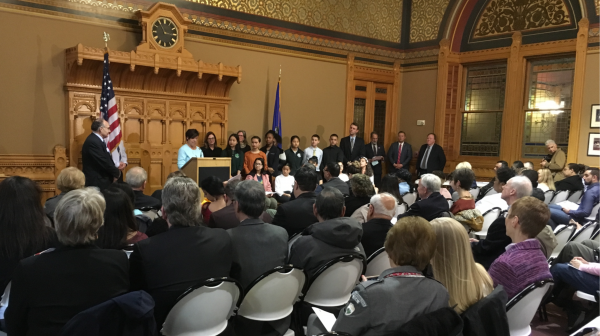
Fifteen recent immigrants living in Connecticut took the oath of allegiance as American citizens on Wednesday during a special court session to be held at the State Capitol.  Minutes after the new Americans were sworn in as citizens, the Connecticut Immigrant & Refugee Coalition (CIRC) honored eight longtime state residents who have made significant contributions to life in Connecticut. The individuals honored on the 21st Annual Connecticut Immigrant Day came to the United States from Belarus, Italy, Vietnam, Poland, Egypt, Pakistan, India and Taiwan.  The new Americans citizens came to the U.S. from Brazil, Canada, Ecuador, Guatemala, Iraq, Italy, Jamaica, Kenya, Mexico, Russia and Syria.

“Immigrants have always been – and continue to be – an abundant and enduring strength of our great nation,” said Robert Fishman, Executive Director of the Connecticut Immigrant & Refugee Coalition (CIRC), which sponsored the observance with the Office of Secretary of the State. “Connecticut is fortunate to have many remarkable individuals who have contributed tremendously to our state, and as we honor them we are also inspired by the newest group of proud and determined immigrants to take the oath of allegiance as Americans.”

The court session that administered the oath to 15 new Americans was presided over by The Honorable Donna F. Martinez, U.S. Magistrate Judge for the District of Connecticut.

Lieutenant Governor Nancy Wyman shared brief remarks at the ceremony, recalling her grandfather’s journey to America.  The CIRC award recipients at this year’s 21st annual ceremony included residents of Avon, Trumbull, Farmington, Norwich, Monroe and East Hartford, in addition to West Hartford.  The National Anthem was led by Chris Nelson, a native of Ghana and current Goodwin College student.  The Governor’s Foot Guard presented the colors at the start of the ceremony, which was led by Chris George of Integrated Refugee & Immigrant Services.

The mission of CIRC, a coalition of about a dozen organizations across Connecticut, is to promote the rights and opportunities of immigrants and refugees in Connecticut and to foster their civic participation.

The individuals honored are:

  • Bassam Gayed, born in Egypt, is Multicultural Services Coordinator at the Otis Library in Norwich.
  • Irena Rak Dzierzbinski, born in Belgium, teaches French and Spanish in middle school in Darien and is active in Girl Scouts. She hosts a Polish-English radio program at Fairfield University.
  • Naeem Khalid, born in Pakistan, started Sam’s Food stores and employs 1,000 in his businesses. He formed a charity, Sam’s Children, to assist needy children in Connecticut and is active with the Pakistan American Association of Connecticut.
  • Ruth Lazowski, born in Belarus, is a Holocaust survivor who speaks with school groups.
  • Cary Lakenbach, born in Italy, is the current Board Chair of the Jewish Federation of Greater Hartford and an actuary.
  • Bruce Tsan-Tang Liang, born in Taiwan, is the Dean of the University of Connecticut School of Medicine.
  • Vani Nidadavolu, born in India, operates an Indian Dance School and works part-time for Edward A. Jones. She holds an MA in Commerce and is a Philanthropist.
  • Trinh K. Duong, born in Vietnam, came to Connecticut as a refugee and now works with new refugees and immigrants, helping them to resettle. She received her degree in Accounting from UConn.

In addition, Alicia Kinsman, Director and Managing Attorney of Immigration Legal Services at the Connecticut Institute for Refugees and Immigrants received the Myra M. Oliver Memorial Award, and two student groups were presented with the Angela R. Andersen Memorial Award, created to honor students who demonstrate deep commitment to issues impacting refugees and immigrants.

Sixth-graders from the Interdistrict School for Arts and Communication in New London were recognized for their project, “Community Faces-Humanizing the Immigrant Label,” parts of which were on display at the Capitol.  The second group was Teens4Citizenship, a Hartford Public Library and Hartford Public Schools collaborative program. As "Citizenship Guides," these high school immigrant students support family and community members on the path to Citizenship and upon turning 18 pursue their own citizenship.


Member organizations in the Connecticut Immigrant & Refugee Coalition include: Milan Cultural India Association, Polish American Foundation of CT, The American Place at the Hartford Public Library, Catholic Charities Migration Services, Connecticut Coalition of Mutual Assistance, Connecticut Institute for Refugees and Immigrants, Integrated Refugee & Immigrant Services (IRIS), Jewish Family Services of Greater Hartford, Legal Assistance Resource Center, Center for Urban Research, Education and Training, Pakistani American Association of CT, Hellenic Society of Paideia and World Affairs Council of Connecticut.


CT's Firearm-Related Mortality Rate is 5th Lowest in U.S.; MA is Lowest, Seen as Model for Nation

The death rate from firearms in Connecticut is fifth lowest in the nation, according to data compiled by the Center for Disease Control and Prevention.  The state follows Massachusetts, Rhode Island, New York and Hawaii.  Connecticut’s 4.6 deaths per 100,000 residents, is slightly higher than Massachusetts’ nation-lowest 3.4 deaths.  And now Massachusetts U.S. Senator Ed Markley is urging other states to follow the Bay State’s lead, and seeking federal funds as incentive for the changes. Markey's newly introduced bill would allocate $20 million in Department of Justice grants each year for the next five years to states that adopt laws like those in Massachusetts, according to published reports.  Perhaps best known is the state's ban on assault weapons, signed in 2004 by Gov. Mitt Romney, now a candidate for U.S. Senate in Utah. The state also requires gun dealers to conduct background checks, mandates private sellers to verify that buyers have a valid gun license, bans “mentally defective” people from owning firearms, and requires weapons to be unloaded and locked away when not in use.

Last year, Massachusetts became the first state to ban rapid-firing bump stocks after the Las Vegas shooting. At least 15 states – including Connecticut - are currently considering similar bans, and several others have tightened up restrictions already in place, Governing magazine recently reported.

In Connecticut, Governor Malloy has repeatedly called for a ban on bump stocks in Connecticut, and the matter is currently before the state legislature.  The bill was subject of a lengthy public hearing last week at the State Capitol complex.

Connecticut is also one of only five states – including Massachusetts - that gives police chiefs the authority to deny, suspend or revoke licenses for handguns and long guns. This aspect of the law has been cited as being instrumental in keeping guns out of the hands of dangerous people. In addition to Connecticut and Massachusetts, the District of Columbia, California, Hawaii, Illinois and New Jersey have enacted a law allowing local law enforcement to approve or deny gun licenses.

The highest per capita firearm mortality rates in the nation are in Alaska (23.3), Alabama (21.5), Louisiana (21.3), Mississippi (19.9), Oklahoma (19.6) and Missouri (19.0).  The United States average is 11.8.  The statistics are based on 2016 data, the most recent available.

Goodbye Columbus? Indigenous Peoples Day Gains Another CT School District

West Hartford’s Board of Education voted this month to mark Indigenous People’s Day, rather than Columbus Day, in the town’s schools beginning next year.  Bridgeport schools made the change in 2015, and the New London school district replaced Columbus Day with Indigenous Peoples Day in 2016. There are no Connecticut municipalities that have voted to change the name of Columbus Day. In 2017, Rep. Josh Elliott of Hamden introduced legislation at the state level to make the change, but the proposal died in a legislative committee and was not voted on by either the House or Senate.

Instead of honoring Christopher Columbus, the Indigenous Peoples’ Day recognizes Native Americans, who were the first inhabitants of the land that later became the United States of America. Advocates for the switch to Indigenous Peoples Day argue that Columbus did not “discover” America in 1492 but instead began the colonization of it.

The states of Minnesota, Alaska and South Dakota celebrate Indigenous People’s Day or Native Americans Day, instead of Columbus Day.

TIME magazine has reported that with the exception of Santa Cruz, Calif., and the state of South Dakota, which adopted the similar Native American Day in place of Columbus Day in 1990, the jurisdictions that have chosen to celebrate Indigenous Peoples Day have done so relatively recently, with cities like Minneapolis and Seattle voting to celebrate Indigenous Peoples Day instead in 2014, and Los Angeles doing so last year, with the observance to begin in 2019.  In 2016, the state of Vermont (by gubernatorial proclamation) and city of Phoenix, AZ celebrated Indigenous Peoples Day. When the city of Austin adopted Indigenous Peoples’ Day in October 2017, the resolution stated that the city wanted to encourage schools to teach this history.

For decades, Native American activists have advocated abolishing Columbus Day, which became a federal holiday in 1937.  On the 300th anniversary of Columbus’ landing, the Society of St. Tammany, or the Columbian Order, organized the first celebration of Columbus Day on Oct. 12, 1792, according to the Library of Congress. In 1934, President Franklin D. Roosevelt designated Oct. 12 as the national holiday called Columbus Day. It became a federal holiday honored annually on the second Monday in October in 1971.

Tracey Wilson, a former social studies teacher at Conard who is also town historian, told we-ha.com that it’s important to “help our students distinguish between nostalgia and history.” Today’s world is different than it was when Columbus Day was first celebrated in 1892 and when the day became a national holiday in 1934, she said.


Land of Steady Habits is 4th Most Unpredictable State, Analysis Shows

Connecticut, long seen as the quintessential Land of Steady Habits, is surprisingly ranked as the nation’s fourth most unpredictable state in an analysis that appeared recently in the Orange County (CA) Record. The analysis brought together three recent surveys: Best State to Raise a Family, by WalletHub; Best Livability from Gallup; and “Best state” by U.S. News & World Report. The analysis included each state’s overall rankings plus the subcategory scores that helped produce the three scorecards, the newspaper reported.

The goal was to use “standard deviation” on the factors in the three studies to see if there were any patterns of predictability.  And some were, more than others.  Predictability was not necessarily reflective of high regard.  West Virginia, for example, finished near the bottom of two of the three surveys, and thus was “predictable,” finishing high in predictability because of finishing predictably low in the various surveys.

The most unpredictable state was New Jersey, followed by New Mexico and Idaho.  After fourth-ranking Connecticut were California, Florida, Rhode Island, Alaska, Arizona, Massachusetts and Hawaii.

On the other end of the spectrum, the most predictable state was Minnesota, followed by West Virginia, Nebraska, Louisiana, Michigan, Virginia, Colorado and Pennsylvania.

In the three surveys studied, Connecticut ranked 11th, 24th and 20th.  The composite of the three scores ranked the state 17th in the U.S. on the three rankings combined.  Its’ range in the subcategories was from third to forty-third – hence the unpredictability.

CT Arts Organizations to Participate in Make Music Day on June 21, Joining 800 Communities in 120 Countries

A year ago, over 800 cities around the world threw citywide music celebrations on June 21. Three decades after the concept was born in France, the Make Music celebrations has spread throughout the world and is now marked in more than 120 countries.  Later this spring, it arrives in Connecticut for the first time.

Make Music Connecticut will feature an eclectic mix of over 250 free outdoor musical events, and is part of Make Music Day, a global music celebration that takes place on the summer solstice each year and brings people of all ages and skill levels together to make music.

In addition to Connecticut, more than 70 U.S. cities will collectively host thousands of Make Music performances. The event is not a concert, or series of concerts, organizers point out.  Any musician, amateur or professional, young or old, is invited to take part by signing up at MakeMusicCT.org. Registration closes on May 21, 2018.

In addition, Connecticut businesses, buildings, schools, churches, and other institutions can visit the website to offer their outdoor spaces as concert locations.  It is the world’s largest annual music event.

The event was held for the first time in North America 11 years ago.  The numbers continue to grow.  On June 21, 2017, 53 North American cities organized 4,138 free concerts at 1,179 locations.

Each Make Music city is independently organized. Often it’s a local community group, media outlet, arts presenter, government agency, or civic leader who champions the musical holiday in their hometown.

Make Music Day Connecticut is being administered in partnership with the Connecticut Office of the Arts and the following organizations: Greater Hartford Arts Council, Southeastern Connecticut Cultural Coalition, The Arts Council of Greater New Haven, Windham Arts, Stamford Downtown, Middletown Commission on the Arts, Northwest Connecticut Arts Council, Fairfield Theatre Company, Waterbury Symphony Orchestra, the City of Waterbury and City Lights Gallery in Bridgeport.

The plan at the  Greater Hartford Arts Council is for “sidewalks, parks, front porches, and public spaces throughout the city” to become “stages for local musicians to perform and for all to enjoy.” Registration has opened, with  matchmaking software in place for musicians to register, create profiles and find a match for their Make Music Hartford performance.  Similar initiatives are being launched by the other participating Connecticut organizations.  Circle June 21 on the calendar!  Wherever you are in Connecticut, music won't be too far away.

Firm Inspecting New London's Gold Star Bridge Project Also Designed Collapsed Florida Pedestrian Bridge

Project inspection and oversite for the rehabilitation of the southbound Gold Star Bridge structure on I-95 in New London and Groton, due to be completed later this year, is being conducted by the Connecticut Department of Transportation and FIGG Bridge Inspection.  FIGG, whose logo appears prominently on the website devoted to providing the public with project information, is the firm that designed the pedestrian bridge that collapsed at Florida International University on Thursday. The Gold Star Memorial Bridge, described as “Connecticut’s most iconic structure,” is the largest bridge in the State of Connecticut. It is 6,000 feet long and over 150 feet tall at the center span. The bridge is actually a pair of steel truss bridges that span over the Thames River, between New London and Groton, according to the project website.


The project was awarded to Mohawk Northeast in December 2016 and onsite activities began a year ago, in April 2017. Project inspection and oversight, conducted by the state Department of Transportation and FIGG Bridge Inspection, is anticipated to be completed by late Fall this year.

UPDATE:  The Miami Herald is reporting that an engineer from FIGG working on the Florida project notified the state two days before the collapse of cracking on the bridge.  

FIGG has its headquarters in Tallahassee with offices in Pennsylvania, Minnesota, Texas and Colorado, the Miami Herald reported. The company specializes in all types of bridge design and focuses solely on bridge design and engineering both in the U.S. and abroad, according to the company's website. The FIU-Sweetwater UniversityCity Bridge is the largest pedestrian bridge moved via Self-Propelled Modular Transportation in U.S. history, the University's website noted prior to the collapse.

The newspaper also reported that FIGG, which provides design, engineering and construction services, was cited by the Virginia Department of Labor for four violations in 2012 after a 90-ton piece of concrete fell from a bridge under construction near Norfolk, Virginia.

At the Gold Star Bridge, plans call for the structure’s expansion joints to be replaced, as well as overhead sign structures, according to the project website. In total, the bridge has more than 1,000,000 square feet of deck surface area spread over 11 vehicle traffic lanes and a pedestrian sidewalk. The average daily traffic count is 117,000 vehicles.

“Repairs and maintenance of the bridge’s structural steel includes steel girder end repairs, bolt replacements, and bearing replacement and maintenance.  Repairs to the substructure include concrete repairs and crack sealing,” the website explains.

The site notes that “During off peak hours the number of lanes may be reduced to accommodate repairs and improvements,” and there will be periodic closures of the sidewalk.

The company’s website touts “FIGG's exclusive focus on bridge design and construction engineering inspection enables us to provide state of the art technology, innovative aesthetics and materials, and a unique capacity to partner for research.”

After the 2007 collapse of the Highway 35 West bridge in Minneapolis, Minnesota, FIGG built a $233.8 million 10-lane replacement bridge, the Tallahassee Democrat reported.  It was heralded for its state-of-the-art safety systems, including sensors designed to monitor bridge stress and corrosion.

FIGG focuses solely on bridge design and engineering both in the U.S. and abroad. Since 1978, the company has built, studied and designed $10 billion in bridges in 39 states and six countries, according to its website.

The Northbound Gold Star Bridge was built 30 years prior to its sister Southbound Gold Star Bridge.  Repairs on the Northbound bridge are due to begin later this year, the project website indicated. “In the end,” the website predicts, “the service life of the iconic Gold Star Bridges will be extended for decades.”


https://www.youtube.com/watch?v=xYLrBQv3t4o

CT School Administrators Oppose Arming Educators

As students at schools across Connecticut held local observances in memory of the 17 students killed one month ago at Marjory Stoneman Douglas High School in Parkland, Florida, the Connecticut Association of School Administrators released the results of a survey of its members on proposals to arm teachers and administrators as a means of combating the growing problem of gun violence in school settings. When asked “Do you support providing teachers and administrators with firearms?” 84 percent of respondents said no, and 16 percent were supportive.  Asked if schools “will be safer if teachers and administrators are armed,” 85 percent said they would not; 15 percent thought they would.

“The recent proposal to combat school shootings by allowing armed teachers and administrators has little support. Millions of students attend schools throughout the nation for one purpose, to get an education,” said Anthony Ditrio, Chair of the Connecticut Association of School Administrators and a retired administrator who was a Norwalk School Principal for three decades.

“While we agree students should feel safe in every learning environment, arming school teachers and administrators is not the right course of action,” Ditrio added. “The results of our survey don’t surprise me or our organization at all.”

The Connecticut Association of School Administrators is a non‐profit membership organization aimed at advocating to protect the status and welfare of Connecticut school administrators, below the rank of assistant superintendent, in elementary, middle, and secondary schools or working in their board's central office. The Association includes approximately a thousand members from urban, suburban and rural school districts.

More than 160 members participated in the brief survey.

Public Access to State Government Data Would be Strengthened by Proposed Law

“If we want better government, we need better data.”  That succinct observation by Michelle Riordan-Nold, Executive Director of the Connecticut Data Collaborative, summed up the push for legislation that would codify in state law an “expectation of increased access to state government public data.” The proposal, House Bill 5172, supports the ongoing work of the State’s Open Data Initiative, which is currently maintained by the state Office of Policy and Management.  Riordan-Nold, in supportive testimony last week, said passage of the bill would be “an important step in institutionalizing the state’s commitment to public open data sharing.”  She noted that Connecticut has been a national leader in its commitment to open data, adding that passage of the bill was necessary to “continue the momentum.”

The Connecticut Data Collaborative works with state agency staff, nonprofit staff and community organizations.  Riordan-Nold said that “data users from all sectors across the state are hungry for unbiased, high quality public data,” pointing out that “the increased availability of public data from state agencies will not only aid many individuals, organizations and researchers in their daily work, it will also drive programming decisions, support funding opportunities and illuminate the health and well-being of our residents and municipalities.”

State Comptroller Kevin Lembo told the Government Administration Committee that “Making raw data regarding state agency performance and operations available to the public increases accountability. Access to data allows third parties in the public, including journalists and academics, to review and critique government performance, resulting in a more efficient and responsive government.”

Lembo added that passage of the bill would “affirm Connecticut’s commitment to open government. It allows existing transparency efforts to evolve and grow, providing easy access to public data while increasing government accountability and responsiveness.”  The Comptroller’s Office has a number of initiatives on its website that provide easy public access to data, and Lembo said passage of the bill would ensure that the data necessary for the sites would continue to be available to the public.

State Consumer Counsel Elin Swanson Katz added that the bill “provides the confidence and volume of data that users require through the open access to the quality and unbiased public data that H.B. 5172 ensures.”  She said the bill “will allow for increased agency accountability and responsiveness in order to improve public knowledge of the state government and its operations, by safely providing timely data that the state makes easily accessible to the public.”

In his testimony before the committee, David Wilkinson, Commissioner of the Office of Early Childhood, said “by advancing better data systems, customer feedback mechanisms, and outcomes-driven contracting, we will get smarter and spend smarter, becoming more cost-effective as we achieve better results.”  A recent report by Connecticut Voices for Children pointed out that “integrated data would improve reporting and decision making within agencies, but public access to data is also vital.”  The report also noted that “the state needs more holistic and actionable data on health and social determinants of health in order to work towards health equity.”

The bill would codify Governor Malloy’s Executive Order 39, signed in 2014, which requires executive branch agencies to regularly publish data that is of high value to the public.

On behalf of the Hartford Foundation for Public Giving,  Research and Community Indicators Director Scott Gaul testified in support of the provisions in HB 5517  that would establish the Connecticut Data Analysis Technology Advisory Board and encouraged the state to involve philanthropy and nonprofits on the Board. In recent testimony before the Commission on Fiscal Stability and Economic Growth, the Foundation asked the Commission to prioritize the development and coordinate use of high-quality research and data to ensure that limited public and private resources support best practices and policies.


Increase in College Student Voting Rates in CT Among Largest in US in 2016 Election, Study Finds

Across all regions of the U.S., students voted at higher rates in 2016 than 2012, with students enrolled in New England and the Mid-East having the highest increases (5.1% and 5.0%), according to a comprehensive new student on student turnout by the Institute for Democracy and Higher Education at Tufts University.  Connecticut saw the 7th highest increases in voting rates among the states. The National Study of Learning, Voting, and Engagement (NSLVE), which included college and university students attending 1,023 higher education institutions in the U.S. across all 50 states, found that Connecticut college students voted in higher numbers in 2016.  Nearly two dozen colleges in the state were included, and according to the data, all saw increases in student voting from 2012 to 2016.

Compared to the rest of the country, institutional voting rates in New York, Pennsylvania, and Massachusetts tended to increase the most, followed by California, Texas, Illinois, Connecticut, Indiana and Florida.  Institutions in Georgia, Wisconsin, and Mississippi had the largest decline.

The demographics of the nearly 10 million students in NSLVE resemble those of the approximately 20 million college students in the U.S, according to the study, which is described as “a significant step forward in measuring students' political interest and engagement.”

By combining student enrollment records with publicly available voting records, the Institute has “created a one-of-a-kind database that provides the higher education community with its only objective measure of student voting,” according to the study authors.  Overall, NSLVE students voted at a higher rate in 2016 than 2012 by about three percentage points, rising from 45.1% to 48.3%, according to the report. Relative to the turnout of the general U.S. population of 18 to 24-year-olds, NSLVE student turnout was somewhat higher in both election years and increased slightly more between elections.

Among undergraduates, turnout increased from 2012 to 2016 across all class years—first-years, sophomores, juniors, and seniors. In both elections, seniors voted at the highest rate (47.0% in 2012 and 51.8% in 2016) and first-years' turnout was lowest (39.5% in 2012 and 42.8% in 2016). Individual data for the participating colleges, or specific state-by-state data was not released in the national study.

Across the country, nine institutions saw turnout increases of at least 15 percentage points between 2012 and 2016. The study also found that 60.4% of students enrolled at women’s colleges voted in 2016, compared to 53.1% in 2012, an increase of over seven percentage points.  In addition, the study found that “unlike voting rates, registration rates did not increase appreciably.”

In addition, the largest increase in voting rate was among private four-year institutions, where turnout increased by 4.1 percentage points from 2012 to 2016, although four-year public institutions still have the highest turnout rate overall, the report indicated. Women voted at rates nearly seven percentage points higher than men in both elections.

The study also found that voting rates increased from 2012 to 2016 in all academic fields of study. In both election years, students majoring in the social sciences voted at the highest rate, followed by those studying health professions, the humanities, and business. Students majoring in STEM fields (science, technology, engineering, and math) voted at the lowest rate in both election years. These differences could be due to many potential factors, including civically engaged students self-selecting into more civically oriented majors, the study analysis theorized.

The objective measure of student civic engagement that the data provides can be particularly insightful to the extent that voting can be seen as a proxy for student interest in public affairs.  The Institute is in the Jonathan M. Tisch College of Civic Life at Tufts University.