

Occupational Illnesses Remain High in Connecticut, Report Finds
/Occupational illnesses remain a serious and under-reported issue in Connecticut, with a rate 6 percent higher than the national average, according to a new report issued by UConn Health. The latest data shows a reporting of over 7,500 occupational illnesses, with up to an estimated 25,000 cases going unreported. The highest number of cases reported were in Farmington, Hartford and Cromwell. The newly published Occupational Disease in Connecticut, 2018 report examined the latest 1997-2016 data, based on reports of individuals filing for workers’ compensation, physician reports to the Occupational Injury and Illness Surveillance System, and the ConnOSHA/BLS survey of employers.
Connecticut’s illness rate ranked 15th highest out of 41 states with publishable data (fourteen states had higher rates and 26 had lower rates). Maine had the highest rate of 38.8 and Texas had the lowest at 9.8. Private sector rates for occupational illness were 15.0 in Connecticut and 14.1 nationally. Connecticut’s public sector rate was 35.7; the U.S. public sector rate was 31.6, according to the report.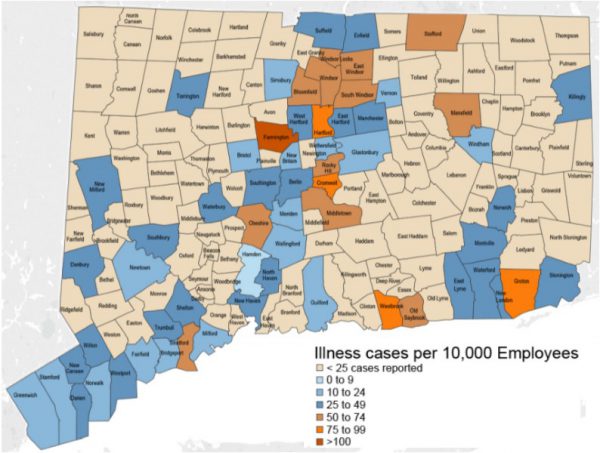
The Connecticut data revealed reports of 7,675 unique occupational illnesses. Most frequent were 3,430 musculoskeletal cases (such as sprains, Carpal Tunnel Syndrome, and tendonitis), and 2,408 infectious diseases (such as bloodborne diseases and exposures, meningitis, and Lyme Disease). In addition, the data indicated there were 431 respiratory illnesses (such as chemical exposures, asthma, and poisonings), 313 skin disorders (such as poison ivy and chemical dermatitis), 115 cases of hearing loss, and 978 “other illnesses” (such as heart conditions, stress, and dizziness).
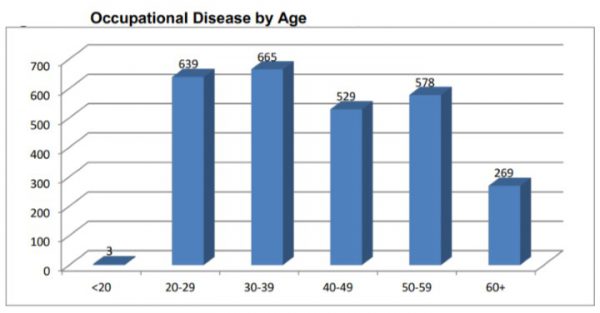
The OSHA/BLS survey shows a rate of 17.4 cases per 10,000 workers in Connecticut, 6 percent higher than the national rate of 16.4. The report focuses on chronic job-related illnesses, and does not include acute traumatic injuries. Overall, approximately 49% were for women, but this varied by type of case, with women accounting for 66% of infectious cases. Based on workers’ compensation reports of occupational illnesses, there were similar proportions (between 20%-25%) for workers in their 20’s, 30’s, 40’s and 50’s.
Rates of occupational illnesses varied widely across Connecticut towns and cities. Based on workers’ compensation reports from towns with at least 25 cases, the 10 highest rates were found in Farmington (126 cases per 10,000 workers - almost 4 times the rate as the state average), Hartford (89), Cromwell (89), Groton (85), Westbrook (84), Windsor Locks (73), East Windsor (63), Cheshire (61), Stratford (60), and Middletown (58). The town average across the state was 33 cases per 10,000 workers.
 These higher town rates often reflect the locations of large employers in higher hazard industries, and may also reflect better reporting of cases, since cases of occupational illness are often not reported, the study points out.
Based on workers’ compensation reports, the highest rates of occupational illnesses were found in the industries of beverage and tobacco product manufacturing (170 cases per 10,000 workers), computer and electronic product manufacturing (131), primary metal manufacturing (112), state government (103), local government (81), transportation equipment manufacturing (59), electrical equipment manufacturing (57), miscellaneous retail stores (51), fabricated metal product manufacturing (49), and hospitals (46).
The highest specific sector rate, according to the report, was State Government with 41.8, with the highest rates for skin conditions (17.7) and lung conditions (7.9). Local Government was second with 32.1, and Utilities third highest rate with 31.8.
Each year the report is prepared for the Connecticut Workers’ Compensation Commission by occupational and environmental health expert Tim Morse, professor emeritus at UConn Health. The 53-page report is part of the Occupational Injury and Illness Surveillance System, a cooperative effort of the Connecticut Workers’ Compensation Commission, the Connecticut Department of Public Health, and the Connecticut Labor Department.
The system is designed to track occurrences of work-related disease, with an eye to understanding patterns and developing approaches to prevent occupational illness.
“We must take stronger actions to improve the employee work safety experience and environment, with improvements in ergonomics, safe needle devices in health care, reducing mold and increasing fresh air flow in indoor environments, providing education on toxic chemicals, and increasing the recognition of such hazards as poison ivy,” Morse told UConn Today.
Morse and UConn Health researchers analyze survey responses and occupational illness reports from the State Labor Department/Bureau of Labor Statistics (BLS) survey; the first reports of injury to the Connecticut Workers Compensation Commission; and health provider reports to the Connecticut Departments of Labor and Public Health under the Occupational Illnesses and Injury Surveillance System.

 Trumbull First Selectman Vicki Tesoro has expressed reservations, encouraged public comment, and kept an open mind. In a public
 The Bridgeport-Stamford-Norwalk metropolitan area also ranked fifth in the nation in the percentage of bachelor’s degree holders and the percentages of graduate or professional degree holders. The regions with higher percentages in both categories are Ann Arbor, Washington D.C., and San Francisco, joined by San Jose for bachelor’s degrees and Durham-Chapel Hill, NC for graduate or professional degrees.
 That shift of political influence has ramification across the electoral system, and was the impetus for a lawsuit filed this summer against the state of Connecticut by the NAACP to force an end to the practice. It is the first of its kind, and being widely watched.

 Anti-media rhetoric from President Trump, which was a constant during his campaign and since, has spurred interest in the topic. The discussions in Avon, which are free, will be led by local educators and historians and continue into the fall.

 The Popularity of Alexander Hamilton - Thursday, September 13, 2018, 3:00 pm: An illustrated talk about the inspiring story of the Alexander Hamilton, and his contributions, struggles, and tragic death. After years of being perceived as having only a supporting role, Hamilton’s star has risen, confirming his belief that “Those who stand for nothing fall for anything.” The discussion will be led by Bev York, Education Director for the Windham Textile and History Museum.


 Her work at C-CHANGE is designed to accelerate and strengthen public education on climate change and pollution issues, bringing the science down to the individual level, highlighting the impacts on people, rather than the planet.

 Each of the six locations is highlighted on the site with information on attractions, events, restaurants, accommodations and shopping.
 ithin the past year. Bridgeport also received a walk score of 68, along with a bike score of 50. Stamford earned a walk score of 54, bike score of 39 and transit score of 38. Waterbury’s walk score was 49; bike score was 25. Danbury’s walk score was 38.




















