Report: Medicaid's Impact Goes Beyond Health Care to Economy

Medicaid is, at its core, a health insurance program that provides coverage to low-income Connecticut residents.  A new report in Connecticut finds that the program also plays a key role in the state’s economy, budget, and ability to weather economic challenges. The report was developed for, and released by, the Connecticut Health Foundation. In Connecticut, Medicaid is known as HUSKY and covers approximately one in five state residents – close to 800,000 people. HUSKY covers more than one third of Connecticut children, nearly 47 percent of non-elderly adults with disabilities, 15 percent of seniors, and 70 percent of nursing home residents.
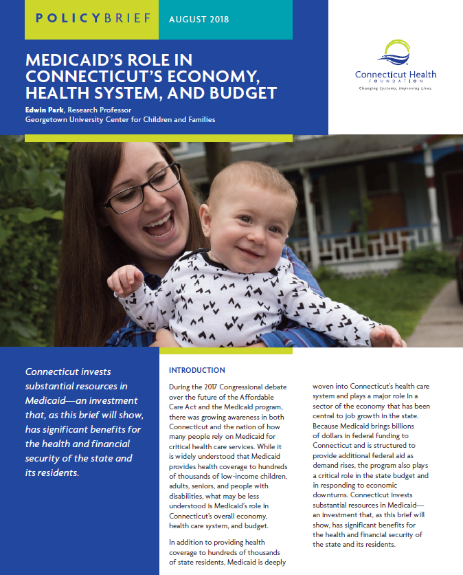
The report, developed by the Georgetown University Center for Children and Families, finds that the program is deeply woven into Connecticut’s health care system and plays a major role in a sector of the economy that has been central to job growth in the state. Health care makes up nearly 15 percent of the state’s gross domestic product. Medicaid finances about 20 percent of health care expenditures in Connecticut.

“It is important for policymakers to understand the full impact of Medicaid in the state, particularly as they face difficult budget decisions,” said the report’s author, Edwin Park, research professor at the Georgetown University Center for Children and Families. “Medicaid plays a key role in the state’s economy and is linked to long-term positive outcomes for children like better health, obtaining a college degree, and higher earnings.”
Among the report’s other key findings:

  • Research has linked Medicaid coverage of children and pregnant women to long-term health and economic benefits when children reach adulthood: better health outcomes, greater educational attainment such as completing high school and obtaining a college degree, and higher employment and earnings.
  • Medicaid can help states cope with recessions and economic downturns because it automatically increases federal funding in response to higher state costs, such as those resulting from enrollment increases as people lose their jobs and health insurance.
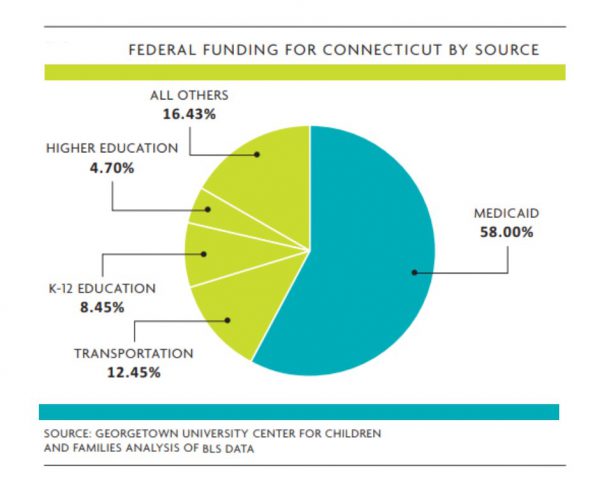
  • Medicaid contributes the majority of the federal funding spent through Connecticut’s state budget – 58 percent in the 2016 fiscal year. The federal government pays more than half of the state’s Medicaid costs. For every $10 spent on Medicaid in Connecticut, approximately $5.92 comes from the federal government.

“Connecticut invests significant resources in HUSKY and the findings of this report underscore the impact of this investment,” said Patricia Baker, president and CEO of the Connecticut Health Foundation.

The report also indicted that “research has found that Medicaid eligibility during childhood is tied to higher wages and cumulative higher tax payments made as young adults. It also increases employment and reduces the need for public assistance, especially assistance needed due to disability. According to the report, in 2016 Medicaid covered:

  • 4 percent of the nearly 400,000 hospital discharges and 12.9 percent of hospital payments.
  • 63 percent of the 373,200 patients who received care at community health centers.

The Connecticut Health Foundation is the state’s largest independent health philanthropy dedicated to improving health outcomes for people of color. Since its creation in 1999, the foundation has awarded more than $62 million to nonprofit organizations and public entities to expand health equity, reduce health disparities, expand health coverage, and improve the health of all Connecticut residents.
Occupational Illnesses Remain High in Connecticut, Report Finds

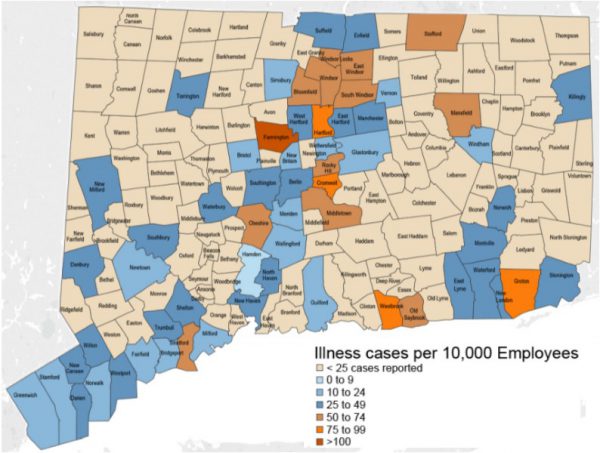
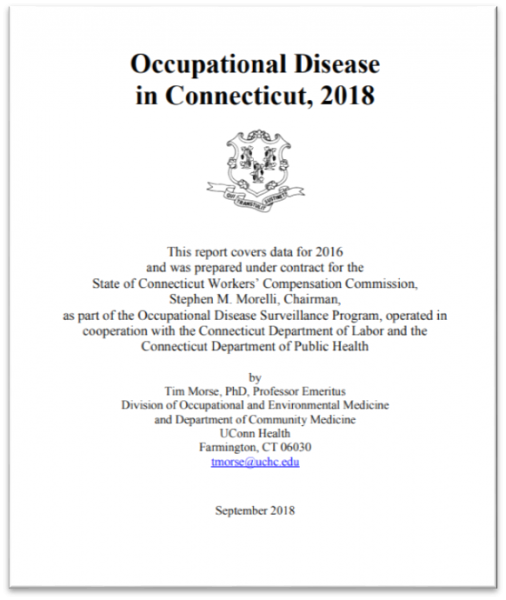
Occupational illnesses remain a serious and under-reported issue in Connecticut, with a rate 6 percent higher than the national average, according to a new report issued by UConn Health.  The latest data shows a reporting of over 7,500 occupational illnesses, with up to an estimated 25,000 cases going unreported. The highest number of cases reported were in Farmington, Hartford and Cromwell. The newly published Occupational Disease in Connecticut, 2018 report examined the latest 1997-2016 data, based on reports of individuals filing for workers’ compensation, physician reports to the Occupational Injury and Illness Surveillance System, and the ConnOSHA/BLS survey of employers.

Connecticut’s illness rate ranked 15th highest out of 41 states with publishable data (fourteen states had higher rates and 26 had lower rates). Maine had the highest rate of 38.8 and Texas had the lowest at 9.8. Private sector rates for occupational illness were 15.0 in Connecticut and 14.1 nationally. Connecticut’s public sector rate was 35.7; the U.S. public sector rate was 31.6, according to the report.

The Connecticut data revealed reports of 7,675 unique occupational illnesses.  Most frequent were 3,430 musculoskeletal cases (such as sprains, Carpal Tunnel Syndrome, and tendonitis), and 2,408 infectious diseases (such as bloodborne diseases and exposures, meningitis, and Lyme Disease).  In addition, the data indicated there were 431 respiratory illnesses (such as chemical exposures, asthma, and poisonings), 313 skin disorders (such as poison ivy and chemical dermatitis), 115 cases of hearing loss, and 978 “other illnesses” (such as heart conditions, stress, and dizziness).

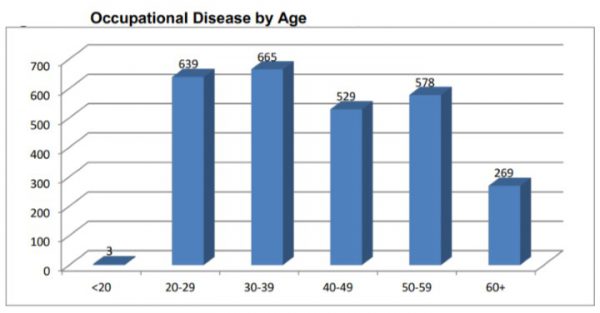
The OSHA/BLS survey shows a rate of 17.4 cases per 10,000 workers in Connecticut, 6 percent higher than the national rate of 16.4. The report focuses on chronic job-related illnesses, and does not include acute traumatic injuries. Overall, approximately 49% were for women, but this varied by type of case, with women accounting for 66% of infectious cases. Based on workers’ compensation reports of occupational illnesses, there were similar proportions (between 20%-25%) for workers in their 20’s, 30’s, 40’s and 50’s.

Rates of occupational illnesses varied widely across Connecticut towns and cities. Based on workers’ compensation reports from towns with at least 25 cases, the 10 highest rates were found in Farmington (126 cases per 10,000 workers - almost 4 times the rate as the state average), Hartford (89), Cromwell (89), Groton (85), Westbrook (84), Windsor Locks (73), East Windsor (63), Cheshire (61), Stratford (60), and Middletown (58). The town average across the state was 33 cases per 10,000 workers.

These higher town rates often reflect the locations of large employers in higher hazard industries, and may also reflect better reporting of cases, since cases of occupational illness are often not reported, the study points out.
Based on workers’ compensation reports, the highest rates of occupational illnesses were found in the industries of beverage and tobacco product manufacturing (170 cases per 10,000 workers), computer and electronic product manufacturing (131), primary metal manufacturing (112), state government (103), local government (81), transportation equipment manufacturing (59), electrical equipment manufacturing (57), miscellaneous retail stores (51), fabricated metal product manufacturing (49), and hospitals (46).

The highest specific sector rate, according to the report, was State Government with 41.8, with the highest rates for skin conditions (17.7) and lung conditions (7.9).  Local Government was second with 32.1, and Utilities third highest rate with 31.8.

Each year the report is prepared for the Connecticut Workers’ Compensation Commission by occupational and environmental health expert Tim Morse, professor emeritus at UConn Health. The 53-page report is part of the Occupational Injury and Illness Surveillance System, a cooperative effort of the Connecticut Workers’ Compensation Commission, the Connecticut Department of Public Health, and the Connecticut Labor Department.

The system is designed to track occurrences of work-related disease, with an eye to understanding patterns and developing approaches to prevent occupational illness.

“We must take stronger actions to improve the employee work safety experience and environment, with improvements in ergonomics, safe needle devices in health care, reducing mold and increasing fresh air flow in indoor environments, providing education on toxic chemicals, and increasing the recognition of such hazards as poison ivy,” Morse told UConn Today.

Morse and UConn Health researchers analyze survey responses and occupational illness reports from the State Labor Department/Bureau of Labor Statistics (BLS) survey; the first reports of injury to the Connecticut Workers Compensation Commission; and health provider reports to the Connecticut Departments of Labor and Public Health under the Occupational Illnesses and Injury Surveillance System.

Want to Live at the Mall? It Could Happen – in Trumbull

The Westfield Trumbull mall’s unusual request for a zoning change that would allow it to build 290 apartments on its 76-acre site may be the harbinger of things to come for suburban malls.  The plan was the subject last month of a Trumbull Planning & Zoning Commission hearing; a final decision is pending. The 290 units are planned to be one or two-bedroom apartments, with the opportunity to rent a garage and/or a storage space. The buildings will be on slabs, four stories high, with elevator access. Developers are hoping for a clubhouse, with a gym and common meeting room, and a pool.

The units would be marketed to professionals, young couples and older couples looking to stay in Trumbull, but not in a single-family home.  The plan is a trimmed down version of a proposal floated in the spring that would have developed 580 units.

Mall housing?  Nina Fuhrman, head of retail strategy at global design company IDEO, noted that “As we see the lines blurring between where you work and where you play and where you live, we’re going to see more residences and office spaces attached to malls.”

Trumbull may provide a glimpse into a trend gaining traction.  In a feature article last May in Business of Fashion, Westfield’s development of mall-adjacent residential properties was described as “a no-brainer because doing so will not only create a revenue stream from rent, but will also increase foot traffic to stores.” Already, Chief Operating Officer Bill Hecht told the publication, “the residential buildings in close proximity to our malls can charge slightly above market rent, because they have access to all our amenities close by.”

Trumbull First Selectman Vicki Tesoro has expressed reservations, encouraged public comment, and kept an open mind. In a public statement, she “expressed an understanding that malls throughout the country are reinventing themselves out of necessity. We, as a town, should work with them to the extent possible in that process. The mall is our largest taxpayer, and its success is a shared goal.”

In Bethesda, Maryland, Westfield plans to close a Sears store at the Westfield Montgomery Mall within the next year and is looking to launch a major mixed-use development on its piece of the property. The first phase, according to a report published by Bisnow, is expected to be completed by 2022, and would create 170K SF of new retail space with 350 to 360 apartments above, plus a health club. After that, Westfield would build an additional 300 units and 130K SF of retail and hotel space.

Jim Agliata, Westfield’s vice president of development, told Bethesda magazine earlier this year that the project represents the next phase of Westfield Montgomery’s emergence as a “lifestyle destination.”

Survey: Three CT Metro Areas Among Top 50 Most Educated in U.S.

In an analysis ranking America’s metropolitan areas to identify the most educated in the nation, one Connecticut region – the Bridgeport-Stamford-Norwalk area – was the 10th best in the nation, and two others earned spots in the top 50.   Hartford-West Hartford-East Hartford was ranked number 26 and New Haven-Milford placed at number 44. The Bridgeport-Stamford-Norwalk metropolitan area also ranked fifth in the nation in the percentage of bachelor’s degree holders and the percentages of graduate or professional degree holders.  The regions with higher percentages in both categories are Ann Arbor, Washington D.C., and San Francisco, joined by San Jose for bachelor’s degrees and Durham-Chapel Hill, NC for graduate or professional degrees.

Topping the overall list of “Most Educated Cities,” in an analysis from the financial services website WalletHub, were Ann Arbor, Washington DC, San Jose, Durham-Chapel Hill, San Francisco-Oakland, Madison, Boston-Cambridge-Newton, Austin, and Seattle-Tacoma.  The analysis was developed by the financial services website WalletHub.

On a substantially less positive note, the Bridgeport-Stamford-Norwalk metropolitan area had the largest racial education gap in the nation, of 140 metropolitan regions included in the analysis.

Data used to create this ranking were collected from the U.S. Census Bureau, GreatSchools.org, Education Cities.org, Yelp and WalletHub research.  A total of 11 relevant metrics were used, in the areas of Educational Attainment, Quality of Education and Attainment Gap.

In another recent survey, using different methodology, West Hartford was declared the "most educated city" in Connecticut by the financial insurance website Insurify.  The website noted that the  U.S. Census Bureau recently reported that for the first time in history, over one-third of American adults now have at least a Bachelor’s degree and high school completion rates are at an all-time peak.

To determine the most educated community in each U.S. state, Insurify analyzed over 1.4 million completed auto insurance applications in which individuals were asked about their city of residence and highest level of education. Using a proprietary scoring algorithm, Insurify's analysts calculated a score for each applicant based on educational achievement, and, for current high school students, likelihood of advancement to college based on reported GPA. The resulting data set was analyzed to determine the average scores for each city across all age ranges, and a composite score was created for each city.

West Hartford led the list in Connecticut.  In Massachusetts it was Cambridge; in Rhode Island, Providence led the way.

Legal Challenge Seeks to End Prison Gerrymandering in CT

In 2010, New York State enacted legislation to ensure that incarcerated persons are be counted as residents of their home communities when state and local legislative districts are redrawn in New York, in an initiative designed to end what has come to be called “prison gerrymandering.” Connecticut has repeatedly considered legislation during the past decade – in 2011, 2013, 2015 and 2016 - that would make the same policy change, but that legislation has failed to pass.  A 2013 report by the Prison Policy initiative and Common Cause found that almost half of the state's prison population comes from the state's five largest cities, but almost two-thirds of the state’s prison cells are located in just five small towns - Cheshire, East Lyme, Enfield, Somers, and Suffield.

Because prisons are disproportionately built in rural areas but most incarcerated people call urban areas home, counting prisoners where they are incarcerated rather than in their home municipality results in a “systematic transfer of population and political clout” from urban to rural areas, according to the Prison Policy Initiative.

That shift of political influence has ramification across the electoral system, and was the impetus for a lawsuit filed this summer against the state of Connecticut by the NAACP to force an end to the practice.  It is the first of its kind, and being widely watched.

The NAACP points out that Connecticut, like many states, disenfranchises prisoners and has concentrated its prisons primarily in rural areas. The effect is that white, rural voters in the districts where prisons are located have their electoral power unconstitutionally inflated, at the expense of voters of color in other, over-crowded districts.

The plaintiffs seek to compel the State of Connecticut to adopt a new redistricting map that counts incarcerated individuals in their home state legislative districts rather than in the districts where they are being incarcerated, thereby safeguarding the Fourteenth Amendment principle of “one person, one vote.”

Although a number of states continue to engage in this practice, the NAACP explains, Connecticut has some of the worst discrepancies in population numbers between its prison districts and most populated districts.

According to the complaint filed in U.S. District Court, when prisoners are reallocated to their home districts, the population of the 59th House District, which includes Enfield and East Windsor, where three state prisons are located, has an overall population that is more than 15% smaller than the most populated district in the state. The effect is that the vote of a person in that prison district counts for 15% more than each vote of a person in the largest district.

“This is about making sure everyone gets an equal voice,” said Germano Kimbro, a formerly incarcerated individual and plaintiff in the case. A resident of the 97th House District, located in New Haven, one of the most overcrowded state legislative districts in Connecticut, Kimbro argues “My vote shouldn’t count less than someone else’s just because they live near a state prison.”

The NAACP, together with the NAACP Connecticut State Conference and individual NAACP members who live in five of the most overcrowded Connecticut state legislative districts, filed the suit.  The plaintiffs in the lawsuit are represented by the Rule of Law Clinic at Yale Law School and the NAACP.

“Each person’s vote is to be equal to that of their fellow citizens,” explains Alden Pinkham, a student in Yale Law School’s Rule of Law Clinic. “Using prisoners to inflate the population of the districts where prisons are located violates this principle.”

Seven states (Colorado, Mississippi, New Jersey, Virginia, Maryland, Michigan, and New York) encourage or even require local governments to exclude prison populations during redistricting.  The next legal filings in the case are due just after Labor Day.  A conclusion is not anticipated prior to the 2018 November elections, but with an eye toward 2020.

Avon Library to Explore First Amendment, Freedom of the Press

Thomas Jefferson’s famous quote, “our liberty depends on the freedom of the press, and that cannot be limited without being lost,” is the centerpiece of a lecture series hosted by the Avon Public Library examining freedom of the press in America’s democracy. Anti-media rhetoric from President Trump, which was a constant during his campaign and since, has spurred interest in the topic.  The discussions in Avon, which are free, will be led by local educators and historians and continue into the fall.

Upcoming sessions are:

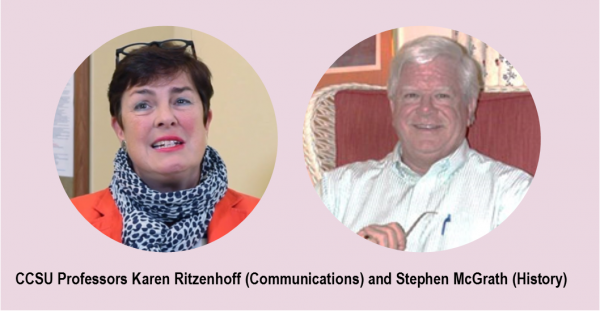
Discovering Katherine Graham  - Wednesday, August 15, 2018, 2:00 pm:  This program will consider relevant sections of Katherine Graham’s Pulitzer Prize winning biography, Personal History (1997) alongside the film adaptation, The Post . It will focus on Graham’s representations of the Newspaper Guild and the pressman’s strike, the Pentagon Papers, the Watergate Affair, and the Vietnam War in light how The Post depicts the struggle to uphold the principles of journalistic integrity when faced with adversity.   The literature discussion will be led by Aimee Pozorski, CCSU English Department; film discussion will be led by Dr. Karen Ritzenhoff, CCSU Communication Department.

“We Hold These Truths”: The Declaration of Independence; A Single Page that Changed the World - Tuesday, August 21, 2018, 2:00 pm:  An interactive and illustrated discussion about the events surrounding the adoption of the Declaration of Independence by the Second Continental Congress will be led by Bev York, Education Director for the Windham Textile and History Museum.  Attendees are asked to review the declaration of Independence prior to the session.

The Bill of Rights for High School Students - Wednesday, September 12, 2018, 3:00 pm:  What can students say and do to exercise the First Amendment right of free speech and freedom of religion in schools?  How has the Supreme Court ruled on these issues, and what avenues of redress are open to students if they think that their rights have been violated?  These and other questions will be explored in this session, led by Stephen McGrath, CCSU History Department.  It is geared for teens, but attendance is not limited.

The Popularity of Alexander Hamilton - Thursday, September 13, 2018, 3:00 pm: An illustrated talk about the inspiring story of the Alexander Hamilton, and his contributions, struggles, and tragic death.  After years of being perceived as having only a supporting role, Hamilton’s star has risen, confirming his belief that “Those who stand for nothing fall for anything.” The discussion will be led by Bev York, Education Director for the Windham Textile and History Museum.

Social Media, the Press, and Us - Monday, September 17, 2018, 6:30 pm:  The everyday reality of media use around the globe is changing rapidly due to the proliferation of smart phones, tablets and multiple screens that allow access to, and immediate dissemination of, the news. This talk will focus on the way social media is not only shaping our human relationships in a digital age but also our understanding of the world around us. How does user-generated content allow for new participatory energies to develop while also deeply affecting cultural identities and generating new types of intimacies. Lecture and discussion will be led by Dr. Karen Ritzenhoff, CCSU Communication Department.

A full description of the upcoming lectures is available, and the library also has resources available through their website, at www.avonctlibrary.info.


Study: Working-Class Candidates Less Likely to Run in Public Financing System

A new academic study has found that working-class first-time candidates for the Connecticut legislature became rarer after the state enacted public campaign financing, when compared with candidates in neighboring Massachusetts and Rhode Island. The study, by a Harvard University researcher, found that working-class candidates in Connecticut were less likely to qualify for the state’s public financing for candidates, apparently because of the requirement to raise a large number of small-dollar private contributions to qualify for public financing.

The findings demonstrate that when public financing is available, fewer low socio-economic status candidates run for state legislative office, and “those who do run are not more likely to win and are less likely to utilize public financing.”

The study’s author, Mitchell Kilborn, is a PhD candidate at Harvard University’s Department of Government concentrating in American Politics. His research focuses on inequality in political participation and the interaction between commercial activity and political behavior.  The study was published in the journal State Politics & Policy Quarterly last month.

Candidates running for the office of Governor, Lieutenant Governor, Attorney General, Secretary of the State, State Comptroller, State Treasurer, State Senator or State Representative can participate in the state’s Citizens Election Program. To participate, candidates must agree to abide by certain requirements, including strict contribution and expenditure limits and mandatory financial disclosures.

Candidates must raise an aggregate amount of small-dollar monetary contributions from individuals (“qualifying contributions”) between $5 and $100 in the case of statewide office candidates and between $5 and $250 in the case of General Assembly candidates.

9 CT Communities Among Nation’s Best to Start Small Business

Nine Connecticut communities are among the best in the nation for starting a small business, according to student loan company LendEdu, which has produced a list of the 500 Best Cities to Start a Small Business in the U.S. Storrs/Mansfield topped the list in Connecticut at 89. Also making the list were Stamford (178), Farmington (214), Windsor (247), Hamden (285), Oxford (387), Westport (477), Cromwell (486) and New Fairfield (493).

Founded in 2014, LendEdu describes itself as a marketplace for private student loans, student loan refinancing, credit cards and personal loans.

The top 10 included three cities in North Dakota, four from Virginia, and cities in Maryland, Colorado and Alabama.  The highest ranked New England community – Canton, MA – was number 49. Storrs-Mansfield was the leading community in Connecticut.

On the population score rankings alone, New Fairfield had the eighth best score in the nation.  On the income score scale, Hamden ranked 29th, highest among the Connecticut communities.  On the Expense scale, Stamford, just outside the top 50, was tops in Connecticut.

Cities were ranked based on the following criteria:

  • Population Score (20 points maximum) – including the daytime population score - the difference in the normal population and the population that is present during standard working day hours – and the population growth score - forecasted population growth over the next five years.
  • ​Income Score (40 points maximum) – consisting of the average disposable income available to residents and forecasted income growth over the next five years.
  • Expense Score (40 points maximum) – which includes consideration of property tax rates, sales tax rates, average cost of utilities, rate of burglaries and property crimes compared to the national averages.

Education, Individual Impact Drive Mission of New Climate Change Center

Former Connecticut Commissioner of Environmental Protection and Administrator of the federal Environmental Protection Agency Gina McCarthy has made the shift from government to academia, with the launch of The Center for Climate, Health, and the Global Environment (C-CHANGE) at the Harvard T.H. Chan School of Public Health. C-CHANGE is a new collaboration between Harvard University and Google that will seek to reduce the use of harmful chemicals in building products and materials.  C-CHANGE is committed to transforming science into meaningful actions that will deliver a healthier, more just, and sustainable world, according to the university.

The Center aims to ensure that government officials, business leaders, and the public have access to the best science so they can understand the health and environmental challenges they face, why it matters to them, and how they can get engaged.

McCarthy headed the Connecticut DEP from 2004 to early 2009, and left to become head of EPA's air and radiation office before advancing to the nation’s top environmental protection job in 2013.

Appearing on Conversations on Health Care, a podcast produced by Middletown-based Community Health Center Inc., McCarthy discussed past, present and future.  On the program, hosted by President and Co-founder Mark Masselli and Senior Vice President and Clinical Director Margaret Flinter, McCarthy said C-CHANGE was working to make climate change “very personal, and actionable to individuals, and families and businesses.”  She added, “information is power… I want people to have that information.”

McCarthy said she understands the concerns of some in the environmental community regarding Trump Administration efforts to roll back many of the Obama-era policies, but she said it will be tougher to accomplish than most believe.

“What we did was follow the science, we followed the law, we did great public process around it and I think we did a really good job,” McCarthy said, noting that many of the rule-change proposals of the past year or so are not yet final, and may not become final. “They’re going to have a very hard time.”

Her work at C-CHANGE is designed to accelerate and strengthen public education on climate change and pollution issues, bringing the science down to the individual level, highlighting the impacts on people, rather than the planet.

Reflecting on her time leading EPA, McCarthy said “We showed you can make progress environmentally, to preserve and protect public health, and our natural resources, but you can also, at the same time, do them in very cost effective, reasonable ways that in fact enhanced our economy and jobs.”

Last spring, Gov. Malloy appointed McCarthy to serve as a member of the Board of Directors of the Connecticut Green Bank.

At the C-CHANGE kick-off this spring, Harvard Chan School Dean Michelle Williams said “The Center will pave the way for new research and student engagement on energy systems, food and nutrition, healthier buildings, and products to benefit our school, our country, and the world.”  McCarthy spoke about the importance of broadening support for environmental and climate action by calling attention to the impact of climate change on people’s health and the solutions to address it.

“Climate change isn’t about saving the planet and it’s not about politics, it’s about our kids and making sure they have the opportunity for a healthy, sustainable world,” said McCarthy. “C-CHANGE will ensure that cutting-edge science produced by Harvard Chan School is actionable—that the public understands it, and that it gets into the hands of decision-makers so that science drives decisions.”

C-CHANGE, the Harvard Office for Sustainability, and Google will work together to develop a set of public tools and resources that use the latest scientific research to inform decision-making by large institutions, purchasers, and manufacturers to help transform the marketplace to healthier alternatives. The collaboration,  to the university, aims to improve public health and the well-being of communities, reduce the use of harmful chemicals and leverage lessons learned to create a model that can be replicated by other organizations.

Moving forward, the two groups intend to continue partnering with Harvard’s schools to use the campus as a living lab to test new ideas and verify performance.


CT Headed for Population Also-Ran Status by 2040; Eight States Will Be Home to Nearly Half of Us

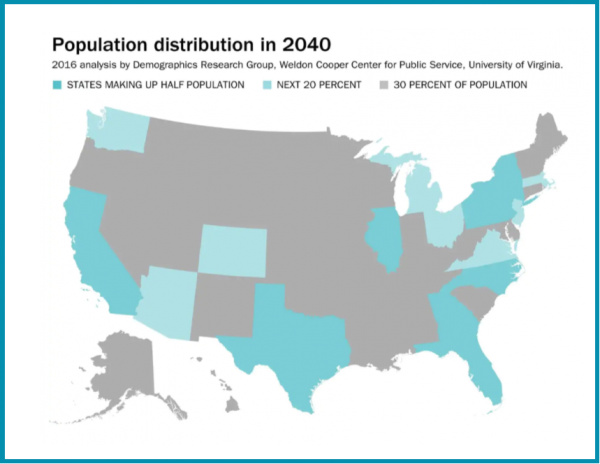
In 2040, it is anticipated that eight states will have just under half of the total population of the country, 49.5 percent, according to the Weldon Cooper Center for Public Service of the University of Virginia, which analyzed U.S. Census Bureau population projections.  Connecticut is not one of them. A report published in the Washington Post also indicated that the next eight most populous states will account for an additional fifth of the population, up to 69.2 percent — meaning that the 16 most populous states will be home to about 70 percent of Americans.

Geographically, the Post reports, most of those 16 states will be on or near the East Coast. Only three — Arizona, Texas and Colorado — will be west of the Mississippi and not on the West Coast.

The eight states expected to dominate the population numbers, with nearly half the nation’s residents, are California, Illinois, Pennsylvania, New York, Texas, North Carolina, Georgia and Florida.  The next eight, which will include 20 percent of the population, are Arizona, Colorado, New Jersey, Ohio, Virginia, Massachusetts, Michigan and Washington.

Connecticut is one of 34 states in which the remaining 30 percent of the nation’s population will reside.

The projections by the Weldon Cooper Center for Connecticut’s population are: 3,606,144 in 2020; 3,634,820 in 2030; 3,585,765 in 2040.

In previous populaton analysis, the Center has noted that the U.S. population is expected to reach 383 million by 2040, but the rate of growth is projected to slow down from nearly 10 percent over the 2000-2010 decade to 6 percent between 2030-2040. Similar trends are also expected from most states.

The geographic distribution of the nation’s overall growing population also reflects geographic shifts. Back in 2000, six of the top ten largest states belonged to the North. By 2040, five of the top ten are expected to be in the South. The slowing down of the northern states growth, along with rapid population growth in the south and west, means that over time the country will become more Southern and Western, the Center indicates. 

The fastest growth is projected to take place in Washington D.C., Texas, Colorado, Utah, and Florida. As noted above, the Connecticut population is expected to drop between 2030 and 2040.  Also expected to see population declines in that decade are Illinois, Maine, Michigan, Mississippi, New Hampshire, Ohio, Pennsylvania, Rhode Island, Vermont and West Viginia.