One-Third of Connecticut Legislators are Women, Reversing State Trend, Ranking 14th in U.S.

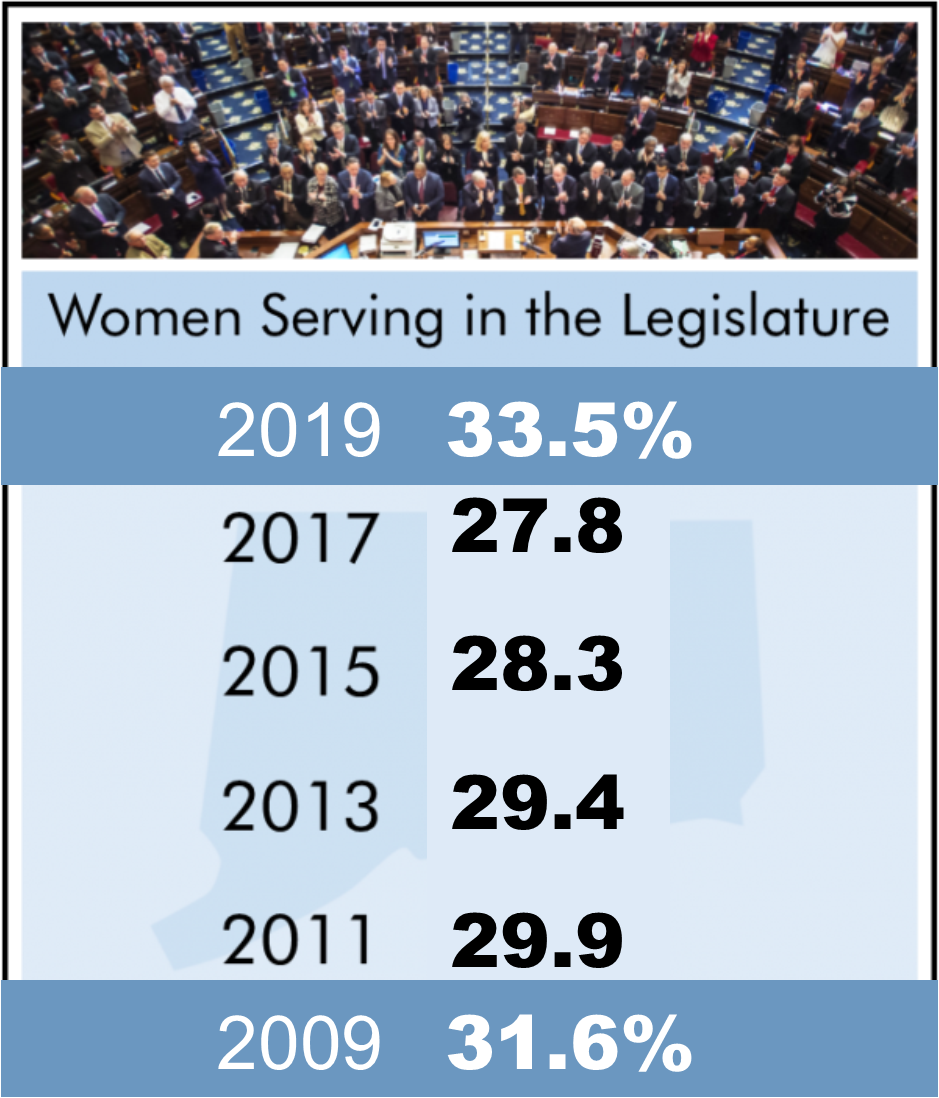
As the new Connecticut legislative session gets underway, 33.5 percent of lawmakers are women, the 14th highest percentage among the states.  The Connecticut legislature now includes 61 women, apparently the high water mark in state history, and exceeding the national average among the states of 28.5 percent. In the Senate, there are currently 9 women out of 33 members.  Eight of the nine are Democrats.  In the House, which currently has 149 members, 29 are Democrats and 22 are Republicans.

Connecticut’s 33.5 percent is from 182 seats, with five vacancies to be filled in special elections on February 26.  Candidates for those seats have not all been selected.

The ranks of women dropped by two in the Senate between Election Day and Opening Day of the legislative session, with former Senators Terry Gerratana of New Britain and Beth Bye of West Hartford accepting positions in the Lamont Administration and not taking the oath of office for a new legislative term.  Two male House members and a male Senate member also did not take their oaths of office in order to join the administration.

Nearly one-third of the women in the legislature this year - 20 of the 61 female legislators - are in their first term in the General Assembly.  Last year, women represented just over 27 percent of the legislature’s membership.

The 2018 election marked a slight comeback for Connecticut in terms of female representation.

Prior to this year, the state had fallen from ranking 8th to 19th during the past decade in the percentage of women serving in the legislature, with the percentage dropping from 31.6% as recently as 2009, according to the National Conference of State Legislatures. Connecticut’s 2009 legislature included 59 women, 31.6 percent of the membership, the 8th highest percentage among the states. In 2011, there were 56 women, 29.9 percent.

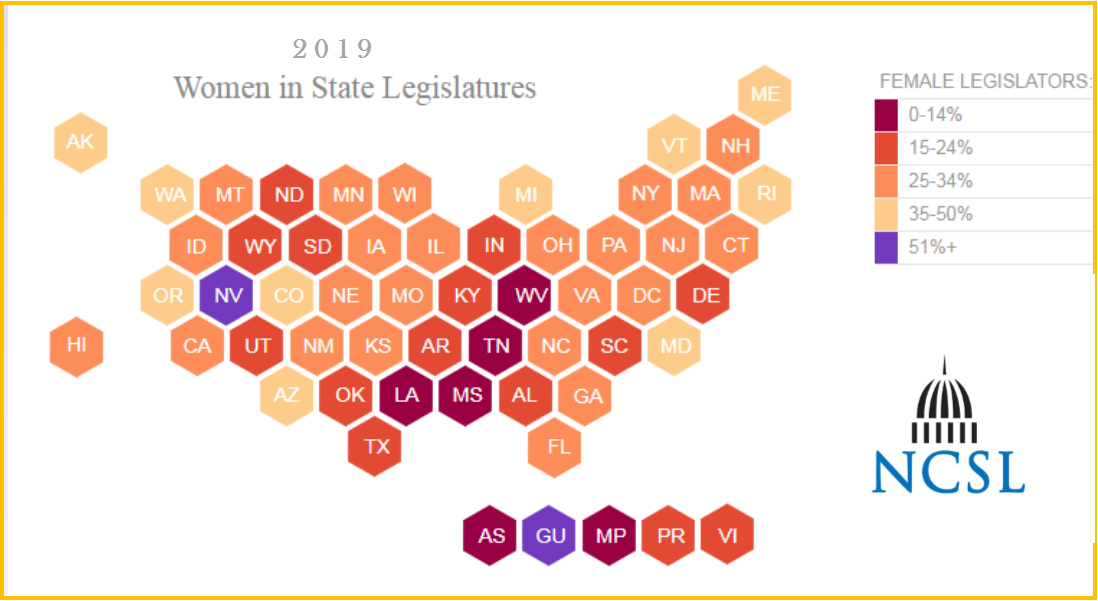
For their 2019 legislative sessions, the states with the largest contingent of female legislators are Nevada 50.8%, Colorado 47%, Oregon 41.1%, Washington 40.1%, Vermont 39.4%, Arizona 38.9%, Alaska 38.3%, Maine 38.2%, Maryland 37.8%, Rhode Island 37.2%, Illinois 36.2%, Michigan 35.8% and New Mexico 34.8%.  As with Connecticut, the numbers in other states may vary slightly due to resignations or elected legislators opting not to serve.

Nationally, women hold 2,110 of 7,383 state legislative seats.  Democrats hold more than twice as many – 1,430 Democrats and 663 Republicans. That is an increase of more than 300 Democratic women and a drop of about 40 Republican women in state legislatures across the country compared with 2017, according to NCSL data.


Hartford Area CFA Charterholders Gather to Hear Economic Forecasts, Focus on Guiding Investors Through 2019

In the midst of tumultuous and uncertain economic times, hundreds of Connecticut’s leading investment and financial professionals will be gathering on Tuesday, Jan. 22 in Hartford to delve into the financial outlook for 2019 with one of the nation’s most respected economists, get an inside look at the state’s cybersecurity efforts to protect the integrity of the election process, and connect with industry peers from throughout the region. More than 400 professionals - CFA® members, investment professionals, personal investors, key decision-makers and college students - are expected.  They will hear from keynote speaker Brian Wesbury, Chief Economist of First Trust Advisors L.P., at the 2019 Annual Forecast Dinner hosted by CFA Society Hartford, the local chapter of the CFA Institute. Connecticut Secretary of the State Denise Merrill will offer comments on the future of voting security with “Election Cybersecurity: A Wake Up Call”.   It is the organization’s premier networking event of the year, being held at the Connecticut Convention Center.

The Hartford chapter is one of 151 local member societies of the CFA Institute, a worldwide organization and a respected source of knowledge in the global financial community. Hartford, with a long history of prominence in financial services – has one of the international organization’s oldest chapters, dating back to 1952. It is also one of the largest chapters outside of a major metropolitan area, with more than 700 members working in over 175 investment organizations, serving the Hartford and Springfield, MA region. There is another Connecticut chapter based in Stamford.

The CFA Institute is a global non-profit organization of investment professionals that distinguish themselves through their commitment to their clients and to the highest ethical and investment standards.  The Chartered Financial Analyst® designation, which has been described as the “industry gold standard,” requires passing one of the most rigorous series of exams in the financial industry to earn the credential.  Fewer than one in five candidates become CFA® charterholders.

“We strive to help advisers understand and anticipate stock market and economic changes to be able to provide the best guidance for their clients,” said Juliana Dalton, CFA, president of CFA Society Hartford.  Members include CFA® charterholders employed by leading financial services companies and those who are private wealth managers.  While many have been in the field for decades – providing much-needed expertise to a range of clients, particularly in turbulent economic times – CFA Society Hartford also continues to reach out to young professionals, as well as college students considering careers in the financial services industry.

In addition to the formal speaking program at the annual event, attendees can learn how the demanding CFA® Program provides a strong foundation of advanced investment analysis and real-world portfolio management skills that will provide a career advantage. Successful candidates for the CFA® designation take an average of four years to complete the program, which includes passing three exams sequentially and accumulating 48 months of approved work experience. Each exam level generally requires six months of preparation.

Dalton, Senior Vice President and Senior Credit Risk Manager at Webster Bank, analyzes credit risk across the organization. She will provide introductory remarks on Tuesday, and CFA Society Hartford Past-President Ray Bovich will introduce the keynote speaker as he shares “The Real News About the U.S. Economy”.

“For the past nine years, analysts have predicted apocalypse for the U.S. economy around every corner, but the strong market and economic recovery are both the longest ever,” commented Dalton.  The program will look ahead at what might be next.

For young members of the profession, applying technology to financial analysis can be particularly attractive. “Technology is all to the benefit,” Dalton explained, “as it helps to provide numbers-based and fact-based analysis. But people skills never go away.”  She noted that even with advancing technology – which is integrated throughout the industry – every client’s investment priorities differ, calling for a mix of people skills and technological know-how by CFA® charterholders.

The CFA Society Hartford chapter, in an effort to interest college students, has been running an annual Research Challenge for the past six years in conjunction with local colleges including the University of Connecticut and Trinity College.  Teams of college students analyze a particular company, and present a written report that is judged by local professionals.  The top three teams go on to make an oral presentation before industry practitioners, and the winning team has an opportunity to advance to national and international competition.  The program has grown in popularity, and although it is quite rigorous, is seen as an excellent educational opportunity and hands-on glimpse into the field. The 2018/2019 competition finals will be held next month.

The forecast dinner’s lead speakers will also provide insight.  Brian Wesbury is Chief Economist at First Trust Advisors L.P., a financial services firm based in Wheaton, Illinois. He has been a member of the Academic Advisory Council of the Federal Reserve Bank of Chicago since 1999. In 2012, he was named a Fellow of the George W. Bush Presidential Center. In 1995 and 1996, he served as Chief Economist for the Joint Economic Committee of the U.S. Congress, and has been ranked by the Wall Street Journal as the nation’s #1 U.S. economic forecaster (2001), and by USA Today as one of the nation’s top 10 forecasters (2004).  Denise Merrill was re-elected in 2018 to her third term as Secretary of the State of Connecticut, and is past president of the National Association of Secretaries of the State.  She previously served in the Connecticut House of Representatives.  Her office oversees elections and business data, among its responsibilities.

For more information about the Hartford chapter, visit www.hartfordcfa.org.  Gold Sponsors for the event include Hartford Investment Management Company (HIMCO), Virtus Investment Partners, Voya Investment Management, and INVESCO.  Individual seats are $110 for CFA® Society Hartford members and $145 for non-members.  There are more than 150,000 CFA® charter holders worldwide in 165+ countries and regions. CFA® and Chartered Financial Analyst® are registered trademarks owned by the CFA Institute.

Trump Told Coast Guard Academy “Things Happen to You That You Do Not Deserve;” Without Paychecks, They’re Now at Food Pantry

Twenty months ago, addressing the graduating class of the Coast Guard Academy in New London and their families, President Donald Trump said: “I hope you feel the full gratitude of our nation… Cadets, you deserve not only the congratulations but the gratitude of each and every American, and we all salute you.” He also noted that “this class has been exceptionally dedicated to public service. You served breakfast at the local food bank every single weekday.”

Now, the tables have turned.  It is members of the Coast Guard and their families that are lining up at a local food pantry to receive – rather than distribute - donated food.

Because the Coast Guard is part of the Department of Homeland Security, one of the federal government agencies subject to the now more than three-week old shutdown, paychecks have ceased and putting food on the table has become the latest challenge.

Adm. Karl Schultz said in a letter to the Coast Guard's 42,000 members this week that the lapse in pay marks the first time to his knowledge that U.S. Armed Forces service members have not been paid because of a shutdown. Other military branches fall under the Department of Defense, which is not affected by the shutdown.

Published reports indicate that the southeastern Connecticut chapter of the Coast Guard Chief Petty Officers Association, the Coast Guard Enlisted Association of Southeastern Connecticut and the Coast Guard Spouses' Association of Southeastern Connecticut, set up the pantry at the Academy, providing items including food, diapers, household items and pet supplies.

Connecticut Senator Richard Blumenthal has said he will advocate for legislation that would authorize paying the Coast Guard, even as the government shutdown continues.

President Trump members of the Coast Guard in May 2017 that “you will face many challenges and many threats, but one thing you will never have to face is that question of what will I do. When you look back, you won’t doubt.”  He added, “Over the course of your life, you will find that things are not always fair. You will find that things happen to you that you do not deserve and that are not always warranted.”

Trump also told that graduates that “you have to learn how to act under great, great pressure. You’re all going to be under great pressure. You have to learn how to respond and to act under great pressure.”


State Office of Early Childhood Welcomes Bye with $8.5 Million from Feds

The Connecticut Office of Early Childhood (OEC) has announced what amounts to a welcome gift for its incoming leader, former State Senator Beth Bye, named by Gov. Lamont two weeks ago to head the state agency.  Just days ahead of Lamont’s inauguration, OEC said it had been awarded an $8,591,087 federal grant - funds intended to enable the state to design and launch better, more cost-effective systems serving families with young children. The most anticipated federal early childhood initiative in years, according to OEC officials, the new Preschool Development Grant program was highly competitive. Connecticut is a national leader among states in both grant size and per capita funding, officials indicated. 

“This new grant will allow Connecticut to build on our nation-leading efforts, giving OEC new resources to work across agencies and increase impact for children and families,” former Gov. Dannel Malloy said as the grant was announced, in the final days of his administration. Connecticut was selected to receive one of the nation’s largest awards by the two federal agencies administering the grant, the Department of Health and Human Services and the Department of Education. Among the largest state recipients, no state received more funding per target family than Connecticut.

Bye will begin serving as the Commissioner-designate later this month. Her nomination will be sent to the General Assembly for confirmation.  Earlier in her career, Bye was director of the University of Saint Joseph School for Young Children and Trinity College Community Child Center preschools, and was early childhood director at the Capitol Region Education Council (CREC), where she supervised the birth to three program for CREC, and also helped to open two early childhood magnet schools.  She was later elected to the Board of Education in West Hartford, then to the State House and State Senate.  Reelected last fall, she did not take the oath of office last week in order to accept Lamont’s offer to lead the agency.

“Beth Bye has devoted her entire professional career to helping to build a more progressive and equitable early childhood system in which all children, regardless of their parent’s socioeconomic status, can grow, learn and develop,” said Lamont. “It’s clear that the formative early childhood years are key to providing children a solid educational base and platform, and I know Beth is the best person to take helm of this critical agency.”

Her soon-to-be-predecessor, David Wilkinson, said “Connecticut punched well above its weight on this grant. That’s because its goals are in our DNA. OEC’s enabling legislation calls on us to be data driven, to be outcomes accountable, and to support the whole family by working across government silos. We’ve been delivering on that mission, but no agency can do those things alone. What’s exciting here is that these resources will allow the next administration to build a smart, collaborative infrastructure across agencies – one that better supports young children and families, reducing redundancies and focusing on shared goals for family success.”

Unlike a previous iteration of this federal grant program – which focused on expanding preschool for four year-olds – the new grant focuses on child success from to zero to five, with an emphasis on infants and toddlers. Further, officials said, it calls on states to look beyond the classroom to broader measures of child and family success, including mental and physical health, family stability, and parental employment. Because such considerations involve multiple agencies, it calls on states to advance a cross-system data and performance infrastructure, asking them to cost-effectively implement new solutions with an emphasis on measurable outcomes.

With this new grant, federal authorities call on states to improve measurable outcomes for children and families and to more efficiently use federal and state resources. The grant program asks states to do this by planning and building more coordinated systems, deploying resources to:

  • Better link families to the full range of services they need, aligning and improving coordination among existing agencies and programs while blending and braiding funds for better efficiencies
  • Advance an infrastructure for data sharing across the silos of government to better support families
  • Design and implement a performance management approach focused on measurable child and family outcomes
  • Develop and implement evidence-based practices to cost effectively improve child and family outcomes
  • Investing in the cross agency, digital infrastructure to support all of the above

Established in 2014 with bi-partisan support and at the urging of Gov. Malloy, Sen. Bye and colleagues, the  Connecticut  Office  of  Early  Childhood  advances  a  family-centered  approach  to support young children  and families. Integrating early childhood programming formerly administered by five separate state agencies, OEC serves children each year through programs including child care, preschool, home visiting, health and safety assurance, early intervention and parenting supports.

From Students to Employees: Businesses Increasingly See Benefits of Hiring People with Disabilities

There are 2.4 million students with disabilities nationwide and 3 out of 5 of them are not currently employed - making this population important for employers to include in their hiring strategies.  That’s according to the website Getting Hired, which teamed up with Hire Potential on a recent webinar for inclusive employers to explain “why it’s important to tailor talent acquisition strategy to engage and hire students with disabilities.” The organizations recommend three organization “touch points” on campus for recruiting businesses: the offices of career services and disability services, and student support groups.  Each plays a different role on campus, and can offer effective connections to students for businesses seeking to considering hiring them.

For the opposite vantage point, for students seeking to evaluate businesses as prospective employers – and their willingness to hire individuals with disabilities - a relatively new national rating may be helpful.

The Disability Equality Index will be issued for the 5th year in 2019, evaluating the practices of leading national corporations.   The DEI measures a wide range of criteria within six categories, including Culture & Leadership, Enterprise-Wide Access, Employment Practices, Community Engagement, and Supplier Diversity.

Developed by the DEI Advisory Committee, a diverse group of business leaders, policy experts, and disability advocates, the DEI is a national, transparent, annual benchmarking tool that offers businesses an opportunity to receive an objective score, on a scale of zero (0) to 100, on their disability inclusion policies and practices. The Disability Equality Index (DEI) is a joint initiative of the American Association of People with Disabilities (AAPD) and Disability:IN.

Former Connecticut State Senator Ted Kennedy, Jr., a leading advocate for persons with disabilities and Board Chair of AAPD, said recently “we cannot achieve our goals without engaging our friends in the corporate community.”

On the 2018 Index, among the Connecticut-based companies scoring 100% were Aetna, Travelers, and The Hartford.   A score of 100 on the DEI means that a company adheres to many of the numerous leading disability inclusion practices featured in the DEI.

Companies can register through January 31, 2019 to be evaluated for inclusion in the 2019 Disability Equality Index when it is published later this year.

For companies making the commitment to hire individuals with disabilities, a recent report suggested they’ve made a good business decision.

Companies that embrace best practices for employing and supporting more persons with disabilities in their workforce have outperformed their peers, according to a research report issued in November by Accenture, in partnership with Disability:IN and AAPD.

“Persons with disabilities present business and industry with unique opportunities in labor-force diversity and corporate culture, and they’re a large consumer market eager to know which businesses authentically support their goals and dreams. Leading companies are accelerating disability inclusion as the next frontier of corporate social responsibility and mission-driven investing,” Kennedy said in the report.

The 45 companies that were identified as standing out for their leadership in areas specific to disability employment and inclusion had, on average over the four-year period, 28 percent higher revenue, double the net income and 30 percent higher economic profit margins than their peers, according to the report. The analysis also revealed that U.S. GDP could get a boost of up to US$25 billion if more persons with disabilities joined the labor force.

Added David Casey, VP, Workforce Strategies & Chief Diversity Officer at CVS Health: “People with disabilities tend to be some of the most creative, innovative and, quite frankly, most loyal employees. A person with a disability wakes up every day thinking about being innovative – that is a skill set. That ability to problem solve is innate to them. Our training programs quickly went from philanthropy to skill search.”


Pedestrian, Cyclist Deaths After Dark Rising Nationally; Highest Rate Among CT Metro Areas in New Haven Region

Across the United States, a total of 4,440 pedestrians and 364 cyclists were killed at night, in dark conditions,  in 2017.  A new analysis reveals that those after-dark fatalities account for the vast majority of all such fatalities each year. The share of all fatalities occurring in dark conditions is slowly rising, climbing from to nearly 72 percent in 2017 from 67 percent in 2010 and 65 percent in 2007.  Roughly a third occur in dark, unlighted conditions, while the other approximately 40 percent are reported near streetlights or other dark, lighted conditions. The analysis, by GOVERNING magazine, looked at the total pedestrian/cyclist deaths and per capita fatality rates for metropolitan areas with populations exceeding 200,000, including four metro areas in Connecticut, 2015-2017.  Total 2015-17 fatalities nationally were 20,004, with 14,153 during hours when it was dark.

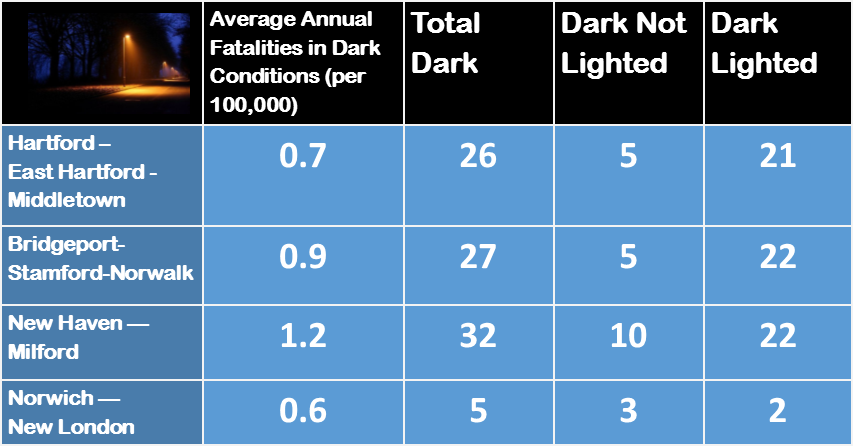
The highest number of fatalities in that multi-year period in Connecticut during darkness occurred in the New Haven metropolitan area, 32.  The Bridgeport-Norwalk-Stamford region has 27 deaths, the Hartford area had 26.  The Norwich-New London region had 5 deaths.

Nationally, pedestrian and cyclist fatalities occurring in all lighting conditions have generally climbed in recent years nationally, but the largest increases are occurring after sunset.

Between 2010 and 2017, annual fatalities in dark conditions (both lighted and unlighted) jumped by 46 percent. Over the same period, they rose only 15 percent in daylight. Totals for dawn (+33 percent) and dusk (+43 percent) lighting conditions also increased significantly, although they accounted for just a few hundred such traffic deaths, GOVERNING reported.

The data breaks down whether the fatality occurred in dark but lighted or dark, unlighted conditions.  In each Connecticut metro area, the vast majority occurred in dark but lighted circumstances.  The numbers were 22-10 in the New Haven area, 22-5 in the Bridgeport region and 21-5 in the Hartford area.

The analysis used National Highway Traffic Safety Administration data, which records lighting conditions in its traffic fatality database. The federal Office of Management and Budget’s latest definitions for metro areas, current as of September 2018, were used.


Hartford Ranks #13 Among Best Metro Regions for STEM Professionals, Analysis Finds

A new analysis of the nation’s best metropolitan areas for workers in the STEM professions has Hartford ranked just outside the top 10 at number 13.  New Haven is ranked at number 55, Bridgeport/Stamford/Norwalk at number 80. The comparison of the 100 largest metropolitan areas in the country by financial services website WalletHub, included 20 key metrics, ranging from per-capita job openings for STEM (Science, Technology, Engineering, Math) graduates to annual median wage growth for STEM workers. 

According to the latest U.S. Bureau of Labor Statistics analysis, STEM — science, technology, engineering and math — professions grew at over twice the rate that non-STEM jobs did between 2009 and 2015, according to WalletHub. Most types of STEM jobs are expected to expand faster than all other occupations until 2024.

The top 10 in the new analysis were Seattle, Boston, Pittsburgh, Austin, San Francisco, Madison, Atlanta, Salt Lake City, Minneapolis and Cincinnati.  Just ahead of Hartford were San Diego and Columbus, and following Hartford in the rankings were Springfield and Worcester, MA.

While Hartford ranked 24th a year ago, the criteria were slightly revised for this year’s analysis.  WalletHub’s analyst explained that “An addition to this year's methodology is the presence of tech summer programs within a given metro area, which Hartford ranked well for. In these programs students start developing skills in coding, game development, robotics or design. Other new metrics that were added this year and contributed to Hartford's overall better ranking are utility patents and the number of tech meetups per capita."

In addition, “the unemployment rate in [metro] Hartford for adults with at least a bachelor's degree is the lowest in all the metropolitan areas analyzed, whereas last year, it was in the middle of the pack.”

The nearly two-dozen metrics were divided into three overall categories:  professional opportunities, STEM-friendliness and quality of life.  Hartford ranked tenth in quality of life category, 14th in professional opportunities, and 17th in STEM-friendliness, which included the quality of engineering universities, research & development spending and intensity, and mathematics performance.

The Quality of Life category included housing affordability, recreation and family friendliness, and singles friendliness.  The Professional Opportunities category included median wage, wage growth, STEM employment growth and job openings for STEM graduates.

Among the various individual metrics, the Bridgeport/Stamford/Norwalk metropolitan region ranked third nationally with among the highest annual median wage growth for STEM workers.  New Haven was eighth nationally in STEM-friendliness. The overall rankings for Bridgeport/Stamford/Norwalk and New Haven were relatively unchanged from a year ago.


Credit Union Branch Inside High School Encourages Financial Literacy

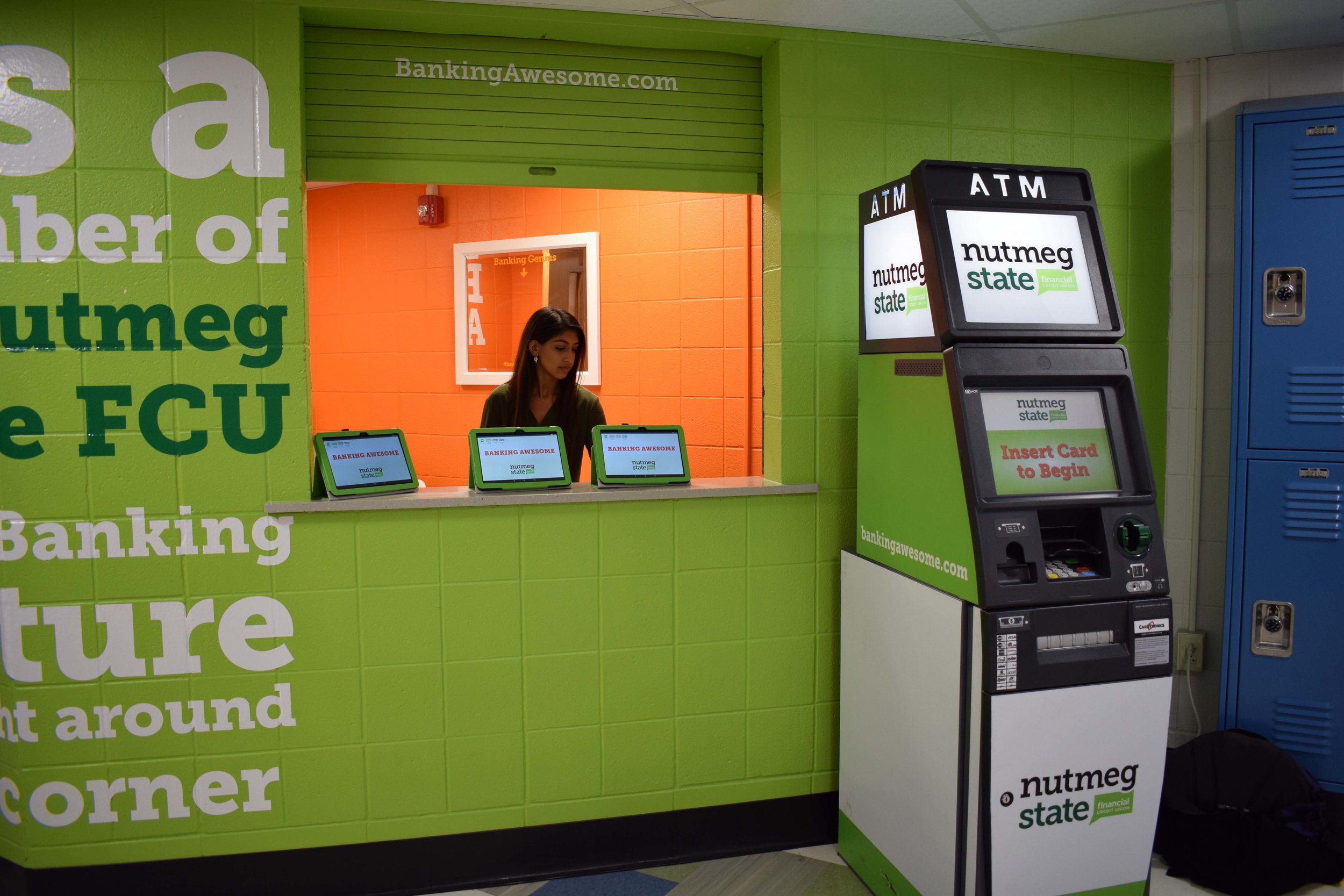
Getting banking business done – or being introduced to an array of personal financial services for the first time – has become easier than ever for students attending Rocky Hill High School.  That’s because they don’t even need to leave the confines of high school to visit a Nutmeg State Financial Credit Union branch – it’s just steps away from their school cafeteria. Credit union branches located inside high schools are not common.  In fact, this might be the first of its kind in Connecticut. The branch is a new step for the credit union and focuses on preparing students for their financial future. It features tablets, an ATM, and (coming soon) a self-service kiosk to be used by students and faculty for transactions such as account transfers, loan payments, and check and cash deposits or withdrawals.
Nutmeg State FCU President and CEO John Holt says his enthusiasm and the support from Rocky Hill High Schools administrators and teachers is matched by the student response.

“We want to give students first-hand knowledge and experience,” Holt explains, “to help them better understand banking and prepare them for smart decision-making in the future.”

The staff includes three Rocky Hill High School students who are specially trained not only in technology but in terminology, so they can pass along that combination of know-how and understanding to their peers. For many, understanding the differences between a credit union and a bank is an unexpected first lesson. And students are often intrigued by the credit union structure, including that it is a non-profit institution which allows them to become members (and therefore part owners of the credit union).

If the initial weeks are any indication, there is a receptive audience of students, very supportive teachers and administrators, and parents looking on approvingly from the sidelines. More than 100 accounts have been opened at the branch in the first few months of operation, and there have been many more conversations providing insight for high school students into the products and services a financial institution offers – plus some tips on how to manage money effectively.

“The need for financial literacy education has never been greater,” said Jeremy Race, President and CEO of Junior Achievement of Southwest New England, an organization with a strong classroom presence focused on financial education and entrepreneurship. “According to a recent Forbes article, 44% of Americans don’t have enough cash to cover a $400 emergency and 33% of adults have $0 saved for retirement.  This is staggering evidence that clearly demonstrates the critical need for young people to learn financial responsibility and financial ‘smarts’ at a young age.”

Because the technology is intuitive for most students, their transaction time can be used to talk about subjects they may be less familiar with – such as balancing a checkbook, how debit cards and account balances relate to each other, loans and interest rates, and what a credit score is all about.  Not the typical teen conversation, but Holt indicates that students have been quite interested in learning more.

“The younger generation has a passion for community,” Holt has observed, “and they see the practical value. This has really opened their eyes.”

Some of the lessons are already being integrated into the school’s business classes – which seem “real” with a financial institution’s branch office just down the hall.  The branch is open during lunch periods, study halls, and other times convenient to students, teachers and staff, without being a distraction from more traditional school curricula.

Outgoing Connecticut State Treasurer Denise L. Nappier, a longstanding proponent of financial literacy, has stressed that “Financial education is important during all stages of life, because economic opportunity can be a catalyst for change and enduring success,” adding that “information and training can help them build a better future.”

With the program off to a solid start, Holt said that Nutmeg State FCU would be interested in a similar initiative in another high school near one of their 11 credit union branches in Connecticut. They are headquartered in Rocky Hill, having been chartered in 1936. In addition to Rocky Hill, they’re located in Manchester, New Britain, Hartford, Glastonbury, West Hartford, Cromwell, Orange, Stratford, Milford and North Haven.

The Connecticut-based credit union also reaches out to local communities in other distinctive ways. In Milford and North Haven, they have added “DMV Express” services in conjunction with the state Department of Motor Vehicles, and three locations are within retail stores – the Walmart in Cromwell, and the ShopRite supermarkets in Stratford and Orange. To learn more about Nutmeg State Financial Credit Union, visit www.nutmegstatefcu.org.

Photos:  (Top right) - Rocky Hill High School Student Alisha Chhabra conveniently accesses the new Nutmeg State Financial Credit Union branch at her school.  (Midde left) - Rocky Hill High School recently celebrated the opening of its first on-site Nutmeg State Financial Credit Union branch. From left: Chuck Zettergren Assistant Superintendent, Dr. Mark Zito Superintendent, Mike Petti Vice Chairman, John Holt President & CEO, Ben Lukens Student, Alisha Chhabra Student, Michael Patano Student, Muhammed Bilal Student, Cynthia Latina Business Education Teacher, Timothy Bifolck Business Education Teacher, Mario Almeida Principal. (Bottom right) Nutmeg State FCU President and CEO John Holt.

Co-Working Headed to Sacred Heart University in Alliance with Verizon, Alley

Co-working in Connecticut will be gaining another player in the field, with a distinctive twist.  Sacred Heart University in Fairfield will be the site, as the university signs an agreement with Verizon and Alley, for the creation, management and operation of a coworking space on the university’s West Campus in Fairfield, formerly the corporate headquarters for General Electric. This new partnership, called Alley powered by Verizon, will be the first in Connecticut and the first time “Alley powered by Verizon” is located on a college campus. Verizon and Alley together have successfully built innovation hubs in New York, Cambridge, and Washington.  Locations in Palo Alto and Los Angeles were announced in September, described as “the next phase of its business that will fuel local innovation and entrepreneurship on the West Coast.”

“Fairfield County has several corporations and businesses that stand to benefit from the work that will be done here, not to mention its ideal location between New York City and Boston. We’re helping to create a startup mindset and environment that will provide members much-needed access to corporate resources typically unavailable to small businesses, from key relationship introductions to cutting-edge technology,” said Jason Saltzman, CEO of Alley.

Work on the new innovation coworking space is expected to be completed with the space open for business late next year.  It is slated to be a hub for innovation teams from large and small companies; for entrepreneurs who want to test their ideas, grow their businesses and work collaboratively in a supportive environment; and for individual professionals who want to work in a dynamic office environment, according to officials.

“A robust commitment to innovation is in keeping with the University’s dedication to educating our students on technology, emerging trends and entrepreneurship. This is exactly the kind of innovative and entrepreneurial platform that Connecticut desperately needs, and we’re delighted to be hosting it on our campus, working collaboratively with Verizon and Alley,” said SHU President John J. Petillo.

A dedicated SHU project coordinator will help identify, activate and create engagement between the innovation community and SHU’s faculty, staff, administration and student body.  As part of this venture, Alley will oversee marketing and advertising to develop a vibrant community of members, manage member experience and help coordinate events and programs. SHU also will establish a Student Concierge Service that members can use as a resource for making connections with various University programs, internships, recruiting, events, speaker sessions, office hours and mentoring.

The new center at Sacred Heart University will further Verizon’s commitment to cultivate strong relationships with academic institutions with emerging technology curricula, officials stressed.  The coworking spaces allow Verizon to tap into local startup and innovation networks, build relationships with potential partners and open new doors for ideas and technology. With Verizon, Alley is bridging the gap between startup and corporation by helping the community workspace build next-level ecosystems for entrepreneurs. Verizon provides entrepreneurs and start-up companies working on new products with the technology and services they need for growth.

As with other coworking spaces that have increasing taken root across Connecticut, the space is expected to offer various levels of memberships and services that include private office space, hot desks, meeting and conference room space, events, recruiting services, marketing services and programming services. The community also plans to draw on SHU faculty, staff, students and other resources to build an academic-focused environment that attracts local startups, entrepreneurs, corporations and other forward-thinking organizations and individuals.

“This is a major boost to Fairfield’s economic development efforts to bring more jobs and businesses to our town,” said Fairfield First Selectman Mike Tetreau. “I am very excited about this Sacred Heart University initiative as it certainly goes a long way to helping replace the loss of GE in our community.”


CT Economic Development Leadership Has Been Changing, With More About to Arrive

Incoming Gov. Ned Lamont’s transition team looked at the state’s economy and business climate and declared, "Given the current fiscal pressures and environment in Connecticut, an economic development and pro-growth platform must have the laser-like focus of the new administration.” If the new administration follows through on that pointed recommendation, it will do so with a relatively new line-up in the field as well as in the administration, where, in addition to a businessman Governor, expectations are that Connecticut will have it's first Secretary of Commerce, along with a restructured economic development framework and approach.

One needs only look as far as four of the state’s leading business organizations to see that change is already underway around the state, and Connecticut’s economic development line-up is in the midst of a major makeover.

The Greater New Haven Chamber of Commerce, the MetroHartford Alliance and the Danbury Chamber of Commerce all have leaders at the helm who came on board with the past year.  And less than two months ago, the Bridgeport Regional Business Council saw a new leader take the reins.

Dan Onofrio began as president and CEO of the Bridgeport Regional Business Council (BRBC) in November after a decade as executive vice president of operations and general manager of business systems operations at Environmental Data Resources. He is also a franchise partner in three Rita’s Ice franchises in Connecticut and was the co-founder of the Greater Valley Chamber of Commerce’s Young Emerging Professionals business networking group, the Fairfield County Business Journal reported.

“The greater Bridgeport region has so much opportunity and I see so much potential to be part of the good things that are ahead of us,” Onofrio said in a recent interview.  “There is a perception that it is difficult to do business in Connecticut, so I think that we — not just as a region but as a state — need to change the perception of what Connecticut is and what we have to offer.”

Among his top priorities: “to get engaged with the small-business community as well as the large corporations, and to work with the universities to see how we can create that ecosystem to create a sustainable downtown.”  Widening to a statewide lens, he observed “If policy in Hartford can change, we will see a domino effect of activity in Connecticut that will boost the economy. But it’s not a silver bullet — there are a multitude of things that need to happen.”

Garrett Sheehan has served as president of the Greater New Haven Chamber of Commerce (GNHCC) since March. Before taking the post at the chamber, Sheehan worked as a broadcast journalist, in economic development and at United Illuminating (UI). He grew up in Middlefield before career stops elsewhere in the country, and service in the U.S. military.  The Chamber of Commerce advocates for business interests in New Haven and 15 suburbs, from Madison to Wallingford to Orange to Milford.  He also serves as 1st Vice President of the Connecticut Economic Development Association.

Sheehan said recently, “from an economic development standpoint I think [the region] has a really strong selling point: location, quality of workforce, institutions of higher education here, and business space we have here…  I’m from Connecticut I want to be a part of the solutions to make Connecticut a great place to be.”

The MetroHartford Alliance’s new leader, David Griggs, also took the helm in March, moving to Connecticut from a similar economic development post in Minneapolis-St.Paul.

“Hartford is a fabulous region that has been flying under the radar,” Griggs said on his arrival in Hartford. “The world needs to know what a great place Hartford is, like the world knows what a great place Minneapolis is… Our focus needs to be less convention and visitors bureau-type messaging about Hartford being a great place to live, work, or play. It needs to be more of a focused message to very specific industries about why they need to be in Hartford if they want to prosper in the U.S. marketplace in their industry.”

In November, Griggs unveiled plans for a changing focus, including an internal restructuring with new leadership staff (to include a research director), strengthening recruiting strategies and an unprecedented level of travel to promote Greater Hartford across the country, the Hartford Business Journal reported.  The Alliance will also rekindle its previous chamber function, bringing back the old Hartford Chamber of Commerce name that hasn’t been used in nearly two decades.

Peter “P.J.” Prunty, who served as director of CityCenter Danbury for the last two and a half years, was appointed as president and CEO of the 10-town Greater Danbury Chamber of Commerce last March. Prunty was born and raised in Danbury.