Growing Senior Population Is Challenge for CT Workforce

As recently as 2010, 14 percent of Connecticut’s population was age 65 or older.  By 2025, that percentage will increase to 20 percent, and will continue to climb.  The implications of a larger, older population on the state’s economy and a range of services present both challenges and opportunities for the state.  Some suggest that the state’s population will begin to look more like Florida. Florida has the greatest proportion of people who are at least 65 (17.3 percent), followed by West Virginia (16 percent), Maine (15.9 percent), Pennsylvania (15.4 percent), and Iowa (14.9 percent).   Connecticut is among the top fifteen, at 14.2 percent.  There are now more Americans age 65 and older than at any other time in U.S. history, according to the U.S. Census Bureau  - 40.3 million people age 65 and older on April 1, 2010, up 5.3 percent from 35 million in 2000 (and just 3.1 million in 1900).

Connecticut is also one of only seven states in the nation with a median age that is above 40.  The others are Maine, New Hampshire, Vermont, Florida, West Virginia, and Pennsylvania.

In a recent presentation to a forum on education, Orlando Rodriguez, Senior Policy Fellow at Connecticut Voices for Children, noted that projections also indicate that the state’s percentage of young people, ages 0-19, will remain steady at 23 percent for the next 15 years, down slightly from the current 26 percent.  Among the state’s challenges is providing for a population at both ends of the age spectrum where costs such as education, health care and housing will be key drivers.

The pressure on the workforce is clear, as the percentage of non-workers (school age children and seniors) increases and the percentage of workers shrinks.  (One impactful variable may be the percentage of seniors who continue working, even part-time, well beyond age 65.)

The projections come as the school age population has declined statewide in recent years by 4 percent, which was largely anticipated but is soon expected to level off.  In only 26 of Connecticut’s 169 municipalities has the school age population increased between 2006-07 and 2010-11. In the remainder, the school age numbers are down, with 19 communities seen more than a 10 percent drop in student numbers and 85 percent of cities and towns experiencing a reduction in their school age population.

CT Leader in Jobs, Salaries in Community & Social Service Fields

If you’re interested in working in the community and social service fields, Connecticut is the place to be, according to the latest federal data.  Nationally, community and social service occupations had an annual mean wage of $43,830, which was just below the U.S. all-occupations mean wage of $45,230, according to data compiled by the U.S. Bureau of Labor Statistics, for the 2011 calendar year.   Out of the 17 occupations in the community and social service group, seven had a mean wage above the U. S. average and 10 had a mean wage below average. Connecticut, however, had among the highest levels in the nation. According to the federal agency, Connecticut had some of the highest annual average wages in the community and social services occupations, and a strong concentration of workers as well. The BLS reported recently that:

  • Hartford-West Hartford-East Hartford had the highest employment of any metropolitan area in Connecticut (2,370).   The area had the 14th-highest location quotient (2.00) out of all U.S. metropolitan areas and an annual average wage of $61,980. (Location quotients are useful for analyzing occupational employment while controlling for the size of the state. They are useful for comparing the composition of jobs in an area relative to the average or for finding areas that have high concentrations of jobs in certain occupations.)
  • Waterbury, the metropolitan area with the highest location quotient (2.41) in Connecticut, had one of the highest average annual wages ($64,270) and employment of 330 for community and social service occupations.
  • With an employment of 430 community and social service workers and a high location quotient (1.54), Norwich-New London had an annual average wage of $58,130, the lowest wage for this group out of the metropolitan areas in Connecticut, but still well above average.The Eastern non-metropolitan area had the second-highest annual average wage ($68,880) out of all U.S. non-metropolitan areas, the fourth-highest location quotient (2.63) out of all non-metropolitan areas, and an employment of 150 for community and social service occupations.

The state of Connecticut also has two non-metropolitan areas, Eastern and Northwestern.

  • The Eastern non-metropolitan area had the second-highest annual average wage ($68,880) out of all U.S. non-metropolitan areas, the fourth-highest location quotient (2.63) out of all non-metropolitan areas, and an employment of 150 for community and social service occupations.
  • The Northwestern non-metropolitan area had the third-highest annual average wage ($65,510) out of all non-metropolitan areas, the 21st-highest location quotient (1.84), and an employment of 140.

Nationally, some of the highest-paying occupations in the community and social service group were educational, guidance, school, and vocational counselors ($56,540); health educators ($52,150); and probation officers and correctional treatment specialists ($52,110). Two of the lowest-paying occupations, social and human service assistants ($30,710) and religious workers, all other ($31,600), had the highest (359,860) and lowest (7,660) employment, respectively, in the occupational group.


Multi-generational homes increasing; CT below national average

The number of multi-generational households - grandparents, parents and children living together under the same roof - has been steadily increasing in recent years, though not as much in Connecticut.  More than 4.3 million, or 5.6 percent, of the 76 million family households in the U.S. today are families living together that include a grandparent, parent and children as well as other family members, according to a study by the U.S. Census Bureau's American Community Survey. The nationwide average of 5.6 percent compares with 3.7 percent of U.S. households that were multi-generational in 2000 and 4 percent in 2010. The American Community Survey conducts small-area estimates on a wide range of statistics about people and housing for every community across the country and Puerto Rico. Among the latest findings:

  • There were more than 76 million family households in the United States. Of these, about 4.3 million (5.6 percent) were multi-generational households.
  • In the Northeast, only New Jersey (6 percent) and New York (6.5 percent) had percentages above the national level.  Connecticut showed 5.1 percent, or an estimated 46,357 multi-generational households.  Massachusetts also had 5.1 percent, as did Rhode Island.
  • Hawaii had the highest percentage of multi-generational households, accounting for 11.1 percent of all family households in that state.
  • More than 85 percent of states where the percentage of family households that were multi-generational exceeded the national average were in the South or West, where more than 85 percent of states in those areas exceeding the national level. Southern states with percentages above the national level included the District of Columbia, Florida, Georgia, Louisiana, Maryland, Mississippi and Texas, all ranging from 5.9 percent to 7.3 percent. Western states with large numbers of multi-generational homes included Arizona, California, Hawaii, Nevada and New Mexico, each ranging from 6.2 percent to 11.1 percent.
  • The state with the smallest percentage of multi-generational households was North Dakota, with around 2 percent.

Among multi-generational households, the majority (64.6 percent) included a householder, a child of the householder and a grandchild of the householder. Thirty-four percent contained a householder, a parent or parent-in-law and a child. Only 1.7 percent contained a parent or parent-in-law, a householder, a child of the householder and a grandchild of the householder.

Among multi-generational households nationally, nearly 65 percent included a head of household, a child and a grandchild. Thirty-four percent of multi-generational households contained a head of household, a parent or parent-in-law and a child, and those households tended to be in the Northeast and West. Only 1.7 percent of multi-generational households contained a parent or parent-in-law, a head of household, a child and a grandchild.

Nationwide, more than 10 percent of Hispanic and American Indian and Alaska Native households were multi-generational, while more than 9 percent of Black and Asian households were multi-generational.

Entrepreneurship is Focus of November Attention in CT and Beyond

November is a terrific month to glimpse the future.  Startup Weekend returns to New Haven the weekend of November 9-11.   And right behind it arrives Global Entrepreneurship Week, November 12-18. Startup Weekend is a global grassroots movement of active and empowered entrepreneurs who are learning the basics of founding startups and launching successful ventures. It is the largest community of passionate entrepreneurs with over 400 past events in 100 countries around the world a year ago. All Startup Weekend events follow the same basic model: anyone is welcome to pitch their startup idea and receive feedback from their peers. Teams organically form around the top ideas (as determined by popular vote) and then it’s a 54 hour frenzy of business model creation, coding, designing, and market validation.

The weekends culminate with presentations in front of local entrepreneurial leaders with another opportunity for critical feedback. Whether entrepreneurs found companies, find a cofounder, meet someone new, or learn a skill far outside their usual 9-to-5, everyone is guaranteed to leave the event better prepared to navigate the chaotic but fun world of startups.  New Haven and Hartford have been host to Startup Weekends in Connecticut.

Right on the heels of that weekend will be Global Entrepreneurship Week, when millions of young people around the world - including some in Connecticut -  join a growing movement of entrepreneurial people, to generate new ideas and to seek better ways of doing things.

Countries across six continents come together to celebrate Global Entrepreneurship Week during Nov. 12-18, an initiative to inspire young people to embrace innovation, imagination and creativity. Students, educators, entrepreneurs, business leaders, employees, non-profit leaders, government officials and many others participate in a range of activities, from online to face-to-face, and from large-scale competitions and events to intimate networking gatherings.

Among the Connecticut locations already signed on to participate in at least one activity during the week are Norwalk High School, Quinnipiac University, RHAM High School in Hebron, and Pathways to Technology Magnet School in Windsor.

Storm Names Influence Baby Names, Research Reveals

Storm names matter – in some unexpected ways.  The more prominent a hurricane name in the news, the more likely that during the coming year there will be an increase in babies named not after the storm specifically (so don’t expect a platoon of Sandy’s), but with names that evoke the storms’ name. Writing in the October issue of Psychological Science, a journal of the Association for Psychological Science, researchers Jonah Berger, Eric Bradlow, Alex Braunstein and Yao Zhang of the University of Pennsylvania’s Wharton School found that names starting with K, such as Karl and Katie, became about 9% more popular after Hurricane Katrina - evidence that parents' choices about what to call their children are influenced by the sound of names in the news. The Harvard Business Review, reporting on the research, points out that the more damaging, and thus the more prominent, a hurricane, the more popular are names containing sounds similar to the storm's oft-repeated name.

The researchers were investigating how psychological processes shape the evolution of culture.  They looked specifically at how a cultural item's popularity is shaped by the recent popularity of other items with features in common.  Using more than 100 years of first-names data, they examined how a name’s popularity is influenced by the popularity of that name’s component sound in other names in the previous year.  They demonstrated the causal impact of similarity on cultural success in an experiment using hurricane names, in their paper titled “From Karen to Katie: Using Baby Names to Understand Cultural Evolution.”  The results suggest how the similarity between cultural items affects their popularity and a way in which culture evolves more broadly.

So, perhaps we should get ready for a bump in babies named Susie, Sara, Sammy, Stacy, Stevie and Steffi in 2013.

Surveys Say: Hartford Great for Working Moms, Retirement Readiness, Sweatpants & Manufacturing Jobs

If you sometimes wonder how the Hartford region stacks up against metropolitan regions around the country, the answers have been pouring in lately.  A variety of surveys – ranking retirement readiness, comfy apparel, manufacturing jobs and best places for working moms – have landed metro Hartford among the leaders. Forbes Magazine looked at the top 50 metropolitan areas in America to come up with their list of the best places for working mothers.  Columbus, Ohio, placed first followed by New Orleans, with Hartford at number three.  Providence, R.I. - the only other New England city in the top 20 - was at number five.  Criteria included average salaries, average commute time, education spending, violent crime rate and the cost of  daycare.  The region included Hartford, Tolland and Middlesex counties.

What could be more comfortable than sweatsExperian Simmons asked survey respondents if they bought any sweats in the last 12 months, as well as the number of individual items they purchased, and for the second year in a row, the nation’s top per capita consumer of sweats is Philadelphia, PA.  Number two?  That would be Hartford, followed by Pittsburgh.  Boston is number six, just one slot ahead of New York City.

On Forbes magazine’s list of “Best Cities for Manufacturing Jobs,” Hartford landed in the top ten, at number eight, between Kansas City and Sacremento.  Topping that list was Houston.

The number of Americans who report making financial preparations for retirement dropped to 70% in 2012, the lowest level in three years, according to Ameriprise Financial's 2012 City Pulse Index. While 63% of respondents report having set money aside for retirement, only 37% feel “on track” for retirement.  The study, which examined consumer retirement planning in the 30 largest U.S. metropolitan areas, found that the country's most prepared and retirement-confident residents reside in Hartford-New Haven.  Following were San Diego and Minneapolis-St. Paul. The least prepared people, according to the survey, live in Indianapolis, Charlotte and Washington, D.C.

Taken together, that would suggest that for a working mom seeking employment in a manufacturing job, who enjoys wearing sweats in her off hours while planning for retirement, Greater Hartford is the place to be.

State’s 14 Regional Planning Organizations to See Demographic Changes Ahead

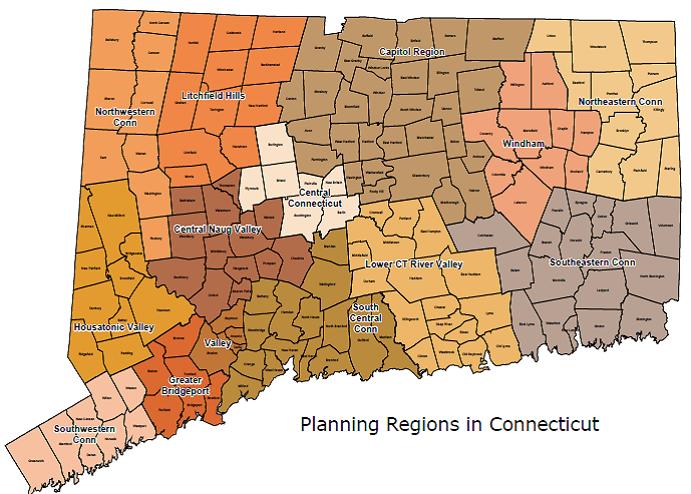
Most people are familiar with the leading numbers that characterize Connecticut… 169 towns, 8 counties, 5 Congressional Districts, and so on.  Fewer people – especially in the Land of Steady Habits – are aware of the 14 Regional Planning Organizations that divvy up the state’s geography. The Office of Policy and Management (OPM) is responsible for the designation and re-designation of planning regions within the state. Through local ordinance, the municipalities within each of these planning regions have voluntarily created one of the three types of Regional Planning Organization allowed under Connecticut statute –

  • a Regional Council of Elected Officials,
  • a Regional Council of Governments,
  • or a Regional Planning Agency.

The mission of the organizations is to carry out a variety of regional planning and other activities on their behalf.  Under state law, each RPO is entitled to a grant-in-aid to support its various planning activities.

The University of Connecticut’s State Data Center has developed population projections for each of the RPO’s through 2030, including a range of demographic breakdowns.  In the Capitol Region, for example, the breakdown by race, between 2000 and 2030, is projected as follows:  white, from 513,283 down to 380,545; Hispanic, from 71,149 more than doubling to 150,321; African-American, increasing from 86,739 to 130,835; and “other” increasing 25,231 to 66,135 – all of which reveals a very different racial and ethnic make-up of the region anticipated in the coming decades.

OPM provides a map showing these regions and a list of municipalities within each region, including town populations based on the 2010 census.

Regional Planning Organizations

  1. Capitol Region Council of Governments Website: http://www.crcog.org Executive Director: Lyle Wray
  2. Central Connecticut Regional Planning Agency Website: www.ccrpa.org Executive Director: Carl J. Stephani
  3. Council of Governments of the Central Naugatuck Valley Website: www.cogcnv.org Executive Director: Peter Dorpalen
  4. Greater Bridgeport Regional Council Website: www.gbrpa.org Acting Executive Director: Brian Bidolli
  5.  Housatonic Valley Council of Elected Officials Website: http://www.hvceo.org Executive Director: Jonathan Chew
  6. Litchfield Hills Council of Elected Officials Planning Director: Richard Lynn
  7. Lower Connecticut River Valley Regional Planning Agency Website: http://www.midstaterpa.org Executive Director: Geoffrey L. Colegrove
  8. Northeastern Connecticut Council of Governments Executive Director: John Filchak
  9. Northwestern Connecticut Council of Governments Executive Director: Dan McGuinness
  10. South Central Regional Council of Governments Website: www.scrcog.org Executive Director: Carl Amento
  11. Southeastern Connecticut Council of Governments Website: www.seccog.org Executive Director: James S. Butler
  12.  South Western Regional Planning Agency Website: www.swrpa.org Executive Director: Dr. Floyd Lapp, FAICP
  13. Valley Council of Governments Website: www.valleycog.org Executive Director: Richard T. Dunne
  14. Windham Region Council of Governments Website: http://www.wincog.org Executive Director: Mark N. Paquette


AARP Forums, Survey Focus on Need for Social Security, Medicare Funding

The Connecticut chapter of AARP will hold public forums in the 4th and 5th Congressional Districts in the coming weeks, just prior to Election Day, highlighting the decisions that will need to be made next year by the newly elected administration and Congress regarding future of Medicare and Social Security.   The forums – which will detail the issues involved to assist people to decade amongst candidates  - will take place on October 29 in Waterbury and November 2 in Bridgeport. As a backdrop to the forums, AARP commissioned the development of a website focusing on the future of Medicare and Social Security, earlier this year.  More than 10,000 Connecticut visitors to the site have responded to AARP’s questionnaire to date.

Interestingly, 86 percent said they believe that Medicare and Social Security will need some combination of more funding or benefit changes. The majority of respondents (58 percent) think Social Security is okay as is or needs only minor changes, while 54 percent feel the same about Medicare. Only 18 percent of respondents believe Social Security is in immediate crisis and only 14 percent believe Medicare is in immediate crisis.

Connecticut Had Nation's 4th Lowest Birth Rate, New Federal Data Shows

The number of births in the U.S.  fell for the fourth year in a row in 2011, and Connecticut’s birth rate was among the lowest in the nation.  Nationally, experts said the declining birth rate was a reflection of the weak economy, which has dampened enthusiasm for having children.  The decline in 2011 was one percent – following a two to three percent drop in other recent years. Falling births is a relatively new phenomenon in the U.S. Births had been on the rise since the late 1990s and hit an all-time high of more than 4.3 million in 2007.  But fewer than 4 million births were counted last year - the lowest number since 1998.  And Connecticut's birth rate was tied for the fourth lowest in the U.S.

The breakdown by race/ethnicity in Connecticut:  37,280 births, including 21,541 white, 8,388 Hispanic, 4,777 black, and 2, 289 Asian or Pacific Islander, according to the National Vital Statistics Report developed for the federal Department of Health and Human Services and the Centers for Disease Control and Prevention.

That’s a birth rate of 10.4 per 1,000 total population, the report indicated.  Only Maine (9.6), Vermont (9.7) and New Hampshire (9.7) had lower rates; Rhode Island also had a birth rate of 10.4.  The highest birth rates in the nation were in Utah (18.2), Alaska (15.8), the District of Columbia (15.1) and Texas (14.7).   The overall U.S. average was 12.7 births per 1,000 population.

The report, released on October 3,  is a first comprehensive look at 2011 birth certificate data compiled from state health departments.

Property Tax Overreliance in Connecticut Slows Economy

The per capita property tax burden in Connecticut is $2,473, an amount that is almost twice the national average of $1,388 and second highest in the nation, the Connecticut Conference of Municipalities (CCM) says in a new report highlighting the state’s overreliance on property taxes to fund municipal government.  Connecticut ranks eighth in property taxes as a percentage of median home value, but CCM says property taxes are not covering the costs of running the state’s cities and towns. Connecticut's 169 cities and towns, along with their boroughs, fire districts and other political subdivisions, levied about $8.7 billion in property taxes in 2009-10, the last fiscal year for which CCM has complete records, the CT Mirror reported, adding that the total, once updated, likely would clear $9 billion for the current year, according to CCM.

Property taxes provide about 72 percent of the revenue for municipalities, while state aid -- which stands at about $3 billion -- represents 24 percent, CCM indicated.  In another breakdown, the CCM report found that:

  • 20 towns depend on property taxes for at least 90 percent ofall their revenue
  • 48 municipalities rely on property taxes for at least 80 percent of their revenue

CCM's five-point plan calls for expanding the new revenue-sharing arrangements that began last year and allows cities and towns to get some revenues from state sales and real estate tax increases.