Surveys Say: Hartford Great for Working Moms, Retirement Readiness, Sweatpants & Manufacturing Jobs

If you sometimes wonder how the Hartford region stacks up against metropolitan regions around the country, the answers have been pouring in lately.  A variety of surveys – ranking retirement readiness, comfy apparel, manufacturing jobs and best places for working moms – have landed metro Hartford among the leaders. Forbes Magazine looked at the top 50 metropolitan areas in America to come up with their list of the best places for working mothers.  Columbus, Ohio, placed first followed by New Orleans, with Hartford at number three.  Providence, R.I. - the only other New England city in the top 20 - was at number five.  Criteria included average salaries, average commute time, education spending, violent crime rate and the cost of  daycare.  The region included Hartford, Tolland and Middlesex counties.

What could be more comfortable than sweatsExperian Simmons asked survey respondents if they bought any sweats in the last 12 months, as well as the number of individual items they purchased, and for the second year in a row, the nation’s top per capita consumer of sweats is Philadelphia, PA.  Number two?  That would be Hartford, followed by Pittsburgh.  Boston is number six, just one slot ahead of New York City.

On Forbes magazine’s list of “Best Cities for Manufacturing Jobs,” Hartford landed in the top ten, at number eight, between Kansas City and Sacremento.  Topping that list was Houston.

The number of Americans who report making financial preparations for retirement dropped to 70% in 2012, the lowest level in three years, according to Ameriprise Financial's 2012 City Pulse Index. While 63% of respondents report having set money aside for retirement, only 37% feel “on track” for retirement.  The study, which examined consumer retirement planning in the 30 largest U.S. metropolitan areas, found that the country's most prepared and retirement-confident residents reside in Hartford-New Haven.  Following were San Diego and Minneapolis-St. Paul. The least prepared people, according to the survey, live in Indianapolis, Charlotte and Washington, D.C.

Taken together, that would suggest that for a working mom seeking employment in a manufacturing job, who enjoys wearing sweats in her off hours while planning for retirement, Greater Hartford is the place to be.
State’s 14 Regional Planning Organizations to See Demographic Changes Ahead

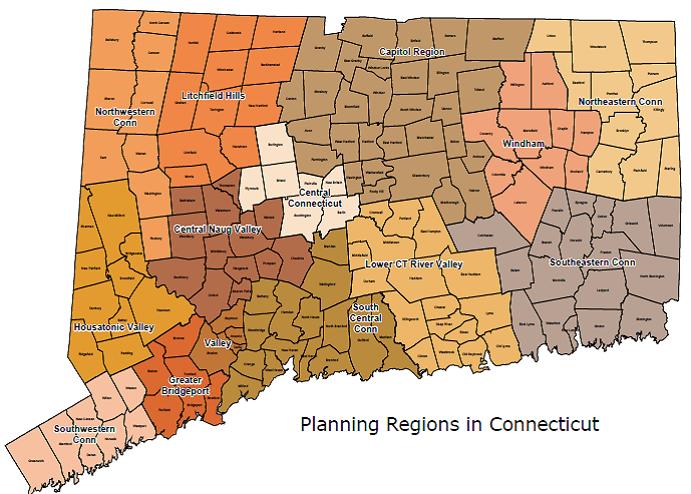
Most people are familiar with the leading numbers that characterize Connecticut… 169 towns, 8 counties, 5 Congressional Districts, and so on.  Fewer people – especially in the Land of Steady Habits – are aware of the 14 Regional Planning Organizations that divvy up the state’s geography. The Office of Policy and Management (OPM) is responsible for the designation and re-designation of planning regions within the state. Through local ordinance, the municipalities within each of these planning regions have voluntarily created one of the three types of Regional Planning Organization allowed under Connecticut statute –

  • a Regional Council of Elected Officials,
  • a Regional Council of Governments,
  • or a Regional Planning Agency.

The mission of the organizations is to carry out a variety of regional planning and other activities on their behalf.  Under state law, each RPO is entitled to a grant-in-aid to support its various planning activities.

The University of Connecticut’s State Data Center has developed population projections for each of the RPO’s through 2030, including a range of demographic breakdowns.  In the Capitol Region, for example, the breakdown by race, between 2000 and 2030, is projected as follows:  white, from 513,283 down to 380,545; Hispanic, from 71,149 more than doubling to 150,321; African-American, increasing from 86,739 to 130,835; and “other” increasing 25,231 to 66,135 – all of which reveals a very different racial and ethnic make-up of the region anticipated in the coming decades.

OPM provides a map showing these regions and a list of municipalities within each region, including town populations based on the 2010 census.

Regional Planning Organizations

  1. Capitol Region Council of Governments Website: http://www.crcog.org Executive Director: Lyle Wray
  2. Central Connecticut Regional Planning Agency Website: www.ccrpa.org Executive Director: Carl J. Stephani
  3. Council of Governments of the Central Naugatuck Valley Website: www.cogcnv.org Executive Director: Peter Dorpalen
  4. Greater Bridgeport Regional Council Website: www.gbrpa.org Acting Executive Director: Brian Bidolli
  5.  Housatonic Valley Council of Elected Officials Website: http://www.hvceo.org Executive Director: Jonathan Chew
  6. Litchfield Hills Council of Elected Officials Planning Director: Richard Lynn
  7. Lower Connecticut River Valley Regional Planning Agency Website: http://www.midstaterpa.org Executive Director: Geoffrey L. Colegrove
  8. Northeastern Connecticut Council of Governments Executive Director: John Filchak
  9. Northwestern Connecticut Council of Governments Executive Director: Dan McGuinness
  10. South Central Regional Council of Governments Website: www.scrcog.org Executive Director: Carl Amento
  11. Southeastern Connecticut Council of Governments Website: www.seccog.org Executive Director: James S. Butler
  12.  South Western Regional Planning Agency Website: www.swrpa.org Executive Director: Dr. Floyd Lapp, FAICP
  13. Valley Council of Governments Website: www.valleycog.org Executive Director: Richard T. Dunne
  14. Windham Region Council of Governments Website: http://www.wincog.org Executive Director: Mark N. Paquette


Connecticut Had Nation's 4th Lowest Birth Rate, New Federal Data Shows

The number of births in the U.S.  fell for the fourth year in a row in 2011, and Connecticut’s birth rate was among the lowest in the nation.  Nationally, experts said the declining birth rate was a reflection of the weak economy, which has dampened enthusiasm for having children.  The decline in 2011 was one percent – following a two to three percent drop in other recent years. Falling births is a relatively new phenomenon in the U.S. Births had been on the rise since the late 1990s and hit an all-time high of more than 4.3 million in 2007.  But fewer than 4 million births were counted last year - the lowest number since 1998.  And Connecticut's birth rate was tied for the fourth lowest in the U.S.

The breakdown by race/ethnicity in Connecticut:  37,280 births, including 21,541 white, 8,388 Hispanic, 4,777 black, and 2, 289 Asian or Pacific Islander, according to the National Vital Statistics Report developed for the federal Department of Health and Human Services and the Centers for Disease Control and Prevention.

That’s a birth rate of 10.4 per 1,000 total population, the report indicated.  Only Maine (9.6), Vermont (9.7) and New Hampshire (9.7) had lower rates; Rhode Island also had a birth rate of 10.4.  The highest birth rates in the nation were in Utah (18.2), Alaska (15.8), the District of Columbia (15.1) and Texas (14.7).   The overall U.S. average was 12.7 births per 1,000 population.

The report, released on October 3,  is a first comprehensive look at 2011 birth certificate data compiled from state health departments.

CT Gas Prices Now Highest in Region, Ranked Third in USA

We’re number one in the Northeast.  On October 1, 2012, Connecticut’s average price-at-the-pump for regular gasoline was $4.12 a gallon, slightly higher than New York’s $4.10 a gallon.  The only states in the nation with higher prices are California and Hawaii.  Rounding out the top six- and the only other states topping $4 a gallon - are Alaska and Washington, according to AAA’s Daily Fuel Gauge Report. The U.S. average retail price of regular gasoline, however, decreased five cents last week to $3.83 per gallon.  Nearly a dozen states hover around $3.60 per gallon for regular gas, according to AAA.

The Independent Connecticut Petroleum Association explains, “Connecticut has the highest combined state taxes on gasoline and as a result has the highest gasoline prices. However, if you subtract the state and federal taxes from average state prices across this region - then Connecticut's gasoline prices are no higher than anywhere else in our region.”

This is, however, one expensive region.  Nationally, Connecticut's combined state and federal gas taxes have been consistently in the top five.  In July, Connecticut was surpassed only by California, Hawaii and New York, according to the American Petroleum Institute;  in January, New York, California and Connecticut were all within six-tenths of a penny in leading the tax pack.

Where is the most expensive place in the most expensive state in the region?  According to connecticutgasprices.com, gas stations located in Westport, West Haven and Wilton have the state’s highest prices, topping $4.40 a gallon.  Guilford, East Haven, and Stratford have among the lowest prices, under $4 a gallon.

The U.S. Energy Information Agency (USEIA) reports that gasoline prices tend to be higher the farther it is sold from the source of supply: ports, refineries, and pipeline and blending terminals. About 60% of the crude oil processed by U.S. refineries in 2011 was imported. The U.S. Gulf Coast was the source of about 23% of the gasoline produced in the U.S. and the starting point for most major gasoline pipelines, so those States farther from the refineries tend to  have higher prices, according to USEIA. They also remind consumers that California prices are higher and more variable  because there are relatively few supply sources of its unique blend of gasoline.  California’s reformulated gasoline program is more stringent than the Federal government’s.  And as for Hawaii, well, the price implications of their location are self-evident.

Dog Owners May Be Next in State’s “Still Revolutionary” Tourism Marketing

Who let the dogs out?  Apparently, Connecticut’s two-year, $27 million tourism campaign is seriously considering doing just that.  So says Kip Bergstrom, Deputy Commissioner of the State Department of Economic and Community Development.  Bergstrom, interviewed by Diane Smith of CT-N for an hour-long discussion (with live audience) as part of the Old State House’s lunchtime conversation series, suggested that dogs – and their owners - may be the next group to boost the state’s tourism numbers and dollars. The state’s tourism team, branding the state as "still revolutionary,"  is starting to compile “dog-friendly places” throughout Connecticut, to add to the state’s tourism website.  Why?  One of Connecticut’s advantages in attracting tourists is that it is a “drive-to” site, rather than a “fly-to” site, with a huge population close by, Bergstrom points out.  Which means the family pet – often a dog – can come along for the ride, and the visit.

It’s a big market, Bergstrom told the CT-N audience, “and we can immediately begin to reveal places you can go in Connecticut with a dog.”  Among the major plusses - the 800 miles of hiking trails in Connecticut - perfect for dog and owner to go for a walk.  Bergstrom, the owner of six dogs, admitted “don’t be surprised if there’s a dog in the next ad.”

Bergstrom also noted that in deciding on the new “still revolutionary” brand, the state and its tourism team of vendors spoke with more than 1,500 people in the state.  He said that the brand should last for decades, propelled by “ambassadors” – individuals throughout the state repeating their own stories of Connecticut’s “places that matter.”

Bergstrom said that the campaign “has already paid for itself” through increased tourism, with more advertising and targeted messaging ahead.  The expectation is that by campaign’s end, the state will receive $3 in state and local taxes for every $1 spent in the marketing effort.  Taking note of the location of the interview, Bergstrom said “democracy is not a noun, it’s a verb.”

Property Tax Overreliance in Connecticut Slows Economy

The per capita property tax burden in Connecticut is $2,473, an amount that is almost twice the national average of $1,388 and second highest in the nation, the Connecticut Conference of Municipalities (CCM) says in a new report highlighting the state’s overreliance on property taxes to fund municipal government.  Connecticut ranks eighth in property taxes as a percentage of median home value, but CCM says property taxes are not covering the costs of running the state’s cities and towns. Connecticut's 169 cities and towns, along with their boroughs, fire districts and other political subdivisions, levied about $8.7 billion in property taxes in 2009-10, the last fiscal year for which CCM has complete records, the CT Mirror reported, adding that the total, once updated, likely would clear $9 billion for the current year, according to CCM.

Property taxes provide about 72 percent of the revenue for municipalities, while state aid -- which stands at about $3 billion -- represents 24 percent, CCM indicated.  In another breakdown, the CCM report found that:

  • 20 towns depend on property taxes for at least 90 percent ofall their revenue
  • 48 municipalities rely on property taxes for at least 80 percent of their revenue

CCM's five-point plan calls for expanding the new revenue-sharing arrangements that began last year and allows cities and towns to get some revenues from state sales and real estate tax increases.


Long Island Sound Coastal Clean-up Volunteers Get Ready

Save the Sound staff have been diligently preparing for the 27th annual International Coastal Cleanup (ICC) that kicks off on Saturday, September 15, 2012.  It's Save the Sound’s tenth year as the Connecticut coordinator for Ocean Conservancy's worldwide cleanup effort and the organization, a project of the Connecticut Fund for the Environment, has planned nearly 40 volunteer events over the next few weeks. Details about upcoming volunteer cleanups are listed on the Save the Sound website's calendar, including events in Stamford, Darien, Norwalk, Westport, Fairfield, Bridgeport, Stratford, Milford, West Haven, New Haven, Branford, Madison, Clinton, Westbrook, Waterford, New London, and Groton.

Long Island Sound contributes more than $9 billion to the regional economy each year.  Last year, Save the Sound brought together 2,665 volunteers, who removed more than 29,000 pounds of trash from 54 miles of coastline.

Long Island Sound is one of the nation’s great estuaries, a place where fresh water from inland waterways flows into salt water from the ocean.  The Sound is a vital economic and recreational resource and provides habitat for diverse animal and plant life.  With 10 percent of the nation’s population living within 50 miles of the Sound, pollution is one of the biggest issues threatening the health of the Sound and the plants and animals that live there.

This year Save the Sound organizers are hoping to get even more people involved, and additional information is available on Facebook, or by emailing Save the Sound's Kierran Broatch at kbroatch@savethesound.org or (203) 787-0646, x113.

CTrides Encourages Carpooling, Mass Transit with Attractive Benefits and Savings

Here’s a sit-up-and-take-notice statistic:  if you commute 20 miles a day (one-way) to work, it can cost $7,000 a year – and by deciding to carpool, commuters can cut that cost in half. So, how exactly does one find a carpool buddy?  Incredible as it may seem, the government is here to help.  The Connecticut Department of Transportation (ConnDOT) has developed commuter services designed to meet the needs of commuters and employers.  CTrides is the network of employer and employee support programs that endorse a variety of alternatives to driving alone - carpooling, vanpooling, riding the bus and train or telecommuting - resulting in improved air quality, reduced traffic congestion and a better quality of life for all.  Not to mention the potential to save consumers money.

If you would like to figure out just how much you might save, well, there’s an app for that, sort of.  The CTrides website has a link where you can punch in the numbers and come away with estimated savings.

Working with employers across the state (103 employers signed up so far), CTrides seeks to improve commuter mobility to help sustain the growth and vitality of the state’s economy and make the state more competitive in the employment marketplace.  Since the CT Rides initiative was launched – less than a year ago – the number of people taking advantage of ride-matching and ride-sharing is substantial.

The Nuride program, for example, has seen 670 Nuriders pre-register since October 2011. They are using the website to locate carpool candidates, and tracking all of their “green” commuting to earn rewards, at locations such as Barnes & Noble, Applebee’s and Mystic Aquarium.   To date, the Nuriders have saved an estimated $136,919 in commuting costs.  Nuride is offered in seven areas of the country, including Connecticut.  The others are Houston, the District of Columbia, Richmond and Hampton Roads, VA, and Massachusetts.

Officials also point out that there are tax benefits to the CTrides program.  Federal law allows tax savings for commuters who travel to work by train, bus or vanpool. An employer sets up a program (with the help of a CTrides representative) that allows an employee to set aside up to $125 per month of salary before taxes to pay for transit or vanpool fares. An employee may also set aside up to $240 per month for qualified parking. Tax savings, officials report, can be more than $800 a year.

For those hesitant to give up their vehicles, there is even a free trial ride offer.  ConnDOT is offering commuters a free trial ride to work on state-subsidized buses and existing Easy Street® vanpool routes with available seats. The free trial ride consists of a 10-trip bus pass or a free week using an Easy Street® vanpool.

For information, CTrides can be contacted at 1-877-CTrides (1-877-287-4337).

Young Entrepreneurs Confident Their Businesses Will Thrive; New Competition Starts

Expectations for the U.S. economy declined overall, but there is a significant optimism gap between older entrepreneurs and those between the ages of 18 and 40, according to the third-quarter Kauffman/LegalZoom Startup Confidence Index, compiled by the Ewing Marion Kauffman Foundation and LegalZoom.  Specifically,  98 percent of the 18- to 30-year-olds and 83 percent of the 31- to 40-year-olds are confident or very confident that their businesses will realize greater profitability in the next 12 months. Overall, almost 40 percent of startup owners now believe the economy will deteriorate over the next 12 months, an increase from 36 percent in the second-quarter survey and 31 percent in the first-quarter survey. Entrepreneurs who were somewhat confident in future profitability fell from 43 percent in second quarter to 40 percent in the third-quarter survey, and those who lacked confidence in improved profitability edged up from 18 percent to 21 percent.

However, 30 percent of startup owners said they plan to hire additional staff in 2012, a slight decrease from 33 percent in the March survey.  Representatives of Kauffman said that state-by-state breakdowns of the data were not available because the sample size would be too small to be statistically significant.

A week ago, Connecticut headquartered Pitney Bowes Inc. launched the Pitney Bowes Entrepreneurial Competition, an innovation-focused contest targeting startup and entrepreneurial organizations. The Company also announced its participation in the sponsorship program conducted by the Stamford Innovation Center, which provides startup-centric programs to accelerate entrepreneurial efforts.

The Pitney Bowes Entrepreneurial Competition is designed to identify and drive the development of growth businesses that can leverage three of the Company's technology areas: Spectrum(R) Spatial analytics and location intelligence; the secure evidencing platform; and the Connect+(R) web-enabled digital envelope and mail printing system.

Winners of the Entrepreneurial Competition will receive one year free utilization of office space and internet access in Pitney Bowes's world headquarters, located in Stamford, Conn.;  access to the three aforementioned Pitney Bowes technology platforms corresponding to their submission, including Pitney Bowes' technical and business expertise; and an introduction and access to the Stamford Innovation Center, and their mentoring and coaching services.

The Pitney Bowes Entrepreneurial Competition runs through September 7, 2012. Information is available at www.pb.com/competition .

More Young Adults Living With Parents in Bridgeport-Stamford-Norwalk Than Anywhere in USA

Battered by the economics of the Great Recession, an increasing number of young adults are taking longer to leave home or are returning to life with mom and dad after having previously moved out.  Those are the findings of a new national study, by the US2010 Project.  In reviewing the 100 largest municipal regions in the nation, the study found that Bridgeport-Stamford-Norwalk was home to the highest percentage of young people living with parents (34 percent).  The region also had one of the lowest percent married (only 29 percent) and one of the highest percent unemployed (8 percent) among 25-29-year-olds.  Its median income was not among the lowest but the cost of living is relatively high because of its proximity to New York City, the report said.  Also making the top ten in the percentage of young adults living back at their parents home, with similar demographics, were New York, Los Angeles, El Paso, Wilkes Barre/Scranton and Miami.

The examination of the 10 metropolitan areas with the highest percentage living with parents revealed several common factors:  high unemployment rates, low marriage rates, low median income and more young adults with a high school education or less and fewer with a college education or more, and a larger share who are either Latino or Asian.

Nationally, the number of young adults ages 20 to 34 who lived with their parents jumped from 17 percent in 1980 to 24percent in 2007-09, the period of the study (and the Great Recession).  As reported in USA Today, the study found that the rise was sharpest among those under 25 – a new high of 43 percent vs. 32 percent in 1980.  The only segment not affected:  young adults with graduate degrees.

The report noted that delays in marriage were a contributing factor in the findings, but the economic impact of the recession was the central driving force behind the numbers.