$93 Million in Tax Credits to Film, Digital Industries in Connecticut
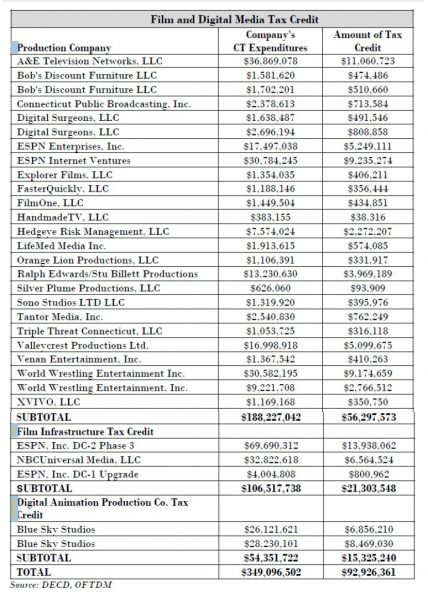
/An estimated $349 million was spent in Connecticut by qualified productions and $93 million in tax credits were issued to 25 media production companies under the state’s tax credit program during fiscal year 2016. The tax credits are designed to boost the state’s economy by attracting film and digital productions to the state, creating employment opportunities for state residents.
According to the Office of Film, Television and Digital Media, which supports and enhances Connecticut’s film, television and digital media industry, companies are provided with direct financial assistance programs, including but not limited to loans, grants, and job expansion tax credits structured to incentivize relocation to Connecticut and the growth and development of current Connecticut-based companies.
The breakdown by industry segment:
- Production Companies - $188 million spent; $56 million in tax credits issued
- Film Infrastructure - $106 million spent, $21 million in tax credits
- Digital Animation - $54 million spent; $15 million in tax credits
Film infrastructure tax credits went to companies including ESPN in Bristol and NBC Universal in Stamford; Digital Animation tax credits to Blue Sky Studios in Greenwich.
The production companies receiving tax credits from the state included well-known names such as A&E, Connecticut Public Broadcasting, ESPN, World Wrestling Entertainment and Bob’s Discount Furniture, which received just under a million dollars in tax credits under the program.
The legislation, first approved in 2006 and amended twice during the past decade, makes it possible for eligible production companies to receive a tax credit on a sliding scale of up to 30 percent on qualified digital media and motion picture production, pre-production and post production expenses incurred in the state. The Office “actively assists local, national and international motion picture, TV and media production entities with finding locations in Connecticut, rules and procedures, securing permits, hiring local cast and crew and other services,” according to the agency’s website. In addition, the Office “represents the state and its agencies, municipalities and resident media professionals in interactions with media production entities and the industry at large.”
The popular reality courtroom drama “The People’s Court” announced this month plans to move to a new location on Stamford’s West Side. The show’s production company, Ralph Edwards/Stu Billett Productions, is moving its headquarters to an 18,739-square-foot space at 470 West Ave., from its current space at 300 Stillwater A venue in the city. Ralph Edwards/Stu Billett Productions received nearly $4 million in tax credits in fiscal year 2016, spending just over $13 million in the state on a number of prominent program productions.
This summer, a digital training program will provide courses at the UConn Stamford Campus including social media management, web design and development, and manipulating digital content. Digital Media CT (DMCT) is developed in partnership by the Connecticut Office of Film, Television & Digital Media and the University of Connecticut Digital Media & Design Department. It has been designed for individuals who want to develop the basic skills necessary to seek work in the industry or enhance their current skill set and advance their careers.
The program is described as most appropriate for individuals with prior or current professional experience in the industry, college graduates with majors in communications, film, television, marketing, and digital media, or students currently enrolled in relative academic coursework.
Later this year from Blue Sky:
https://youtu.be/jyJgGsZo2wA


 The backdrop is offered by more than 700 global companies that have subsidiaries here, employing more than 100,000 people, the Organization for International Investment points out. The state’s convenient access to a variety of transportation options all provides access; there were 4.6 million tons of cargo carried on Connecticut rails in 2015, for example, and 11.4 million tons of freight shipped through Connecticut ports in 2013.
 l and freight movement by rail and highway makes Connecticut a prime location for domestic and international trade,” the report points out. Leading exports include: Aerospace/Transportation Equipment, Non-Electrical Machinery, Computers and Electronics, Chemicals, Electrical Equipment, Fabricated Metals Production, and Primary Metal Manufacturing.
 s specific to their industry.


 “The full ecosystem around the defense industry in the state must come together to address these overlapping trends – and many of these collaborative initiatives are already producing significant results – but state government still has a unique role to play in bringing the right ideas to the table,” the report explains.

 Among the key stats:
 ate “offers the kind of environment that is particularly conducive to growth for companies that are capitalizing on the latest global economic trends. (The top seven are Massachusetts, Delaware, California, Washington, Maryland, Colorado and Virginia.) The ranking is based on measures in five key areas: Knowledge jobs, Globalization, Economic dynamism, digital economy, and innovation capacity.
 The Connecticut Technology Council's annual
  Data used to create the ranking were collected from U.S. Census Bureau, Bureau of Labor Statistics, National Science Foundation, National Center for Education Statistics, Georgetown University’s Center on Education and the Workforce, United States Patent and Trademark Office, Ewing Marion Kauffman Foundation, Tax Foundation, Consumer Technology Association, Akamai Technologies, U.S. Cluster Mapping Project and National Venture Capital Association.
 nts have been selected to receive the prestigious awards, including organizations and initiatives from