In New England, Most Believe At Least Half of High School Grads Not Ready for College, Career
/New Englanders overwhelmingly believe that at least half of high school students across the region graduate unprepared for college and a career, and that student-centered learning environments are part of the solution to this readiness problem.
That’s according to the results of a poll that reflects growing concerns that children are not fully equipped for life after high school. It is seen by some as a tipping point in public opinion that positions student-centered learning—which tailors education to the interests and needs of each student—as an answer to providing young people with the skills and knowledge they need to succeed upon entering post-secondary education and the workforce.
That’s according to the Nellie Mae Education Foundation (Nellie Mae) which released the poll that was conducted by the Rennie Center for Education Research & Policy, which surveyed 2,400 individuals across the region from August 5-31, 2016.
“Although graduation rates are at an all-time high, New Englanders are well aware that a diploma alone is no longer sufficient to ensure success for our students after high school,” said Nick Donohue, president & CEO of the Nellie Mae Education Foundation.
Among Connecticut residents, 33% said most graduates are prepared for college and a career, 48% said about half of graduates are ready, and 18% believe that “few graduates” are prepared for college and career. Connecticut and New Hampshire had the highest percentage indicating that “most graduates” are prepared, with one-third of respondents (33%) expressing that view.
“Too frequently students arrive at college requiring developmental or remedial classes to strengthen basic skills just to move on to college-level material, or they begin careers without the tools and skills necessary to help them early on in their professional lives. The situation is more severe for people in traditionally marginalized communities – places that we need to prosper so our society can advance. The good news is that student-centered approaches to learning represent a path forward in which all students can succeed.”
There were some differences among the states. In Connecticut, 48 percent said “some changes are needed, but basically schools should be kept the same.” Only 14 percent said “public schools work well as they are now,” while 30 percent said “major changes are needed” and 8 percent said “a complete overhaul is needed” (the smallest percentage among the New England states).
A significantly greater proportion in Rhode Island believe “a complete overhaul is needed” than in Connecticut, Massachusetts, New Hampshire and Vermont. A significantly greater proportion in Maine believe “a complete overhaul is needed” than in Connecticut.
 Nearly two-thirds of those surveyed in Connecticut (64%) called for “using technology to enhance the way students learn in the classroom” – the highest percentage among the six New England states. A majority called for “more significant efforts to close achievement gaps” (59%), more effective teachers (62%) and changes to the ways schools are funded (57%). The state legislature in Connecticut is currently considering changes in the school funding formula proposed by Gov. Malloy in the wake of a state court decision.
According to Nellie Mae, across New England, only 50 percent of high school students are graduating with the skills and knowledge necessary to succeed after high school. These poll results show that New Englanders not only agree this is unacceptable, but that 90 percent believe that student-centered learning environments are part of the solution toward ensuring high school graduates are college and career ready.
Nellie Mae defines student-centered learning as personalized and happening anywhere, anytime. In student-centered environments, students move ahead based on mastery of content rather than class-seat time and they exert ownership over their own learning.
New Englanders found teachers to be among the most trusted group when it comes to educational decision-making and showed confidence in their ability to improve public education. Respondents also reported having confidence in parents and school and district leaders for improving education.
The poll comes amidst efforts by Nellie Mae to reshape public education in New England to reach an aggressive benchmark of 80 percent college and career readiness among our high school graduates by 2030. The Foundation is investing $200 million in grantmaking efforts toward advancing student-centered learning in schools and districts across the region in order to achieve this goal.
The Nellie Mae Education Foundation is the largest philanthropic organization in New England that focuses exclusively on education.
To read the poll report in its entirety, please visit http://bit.ly/2k4Dvv5

 The overall rankings were weighted 80-20 between Entertainment & Recreation and Nightlife. The Entertainment & Recreation categories included restaurants, beaches, movie theaters, national parks, arts venues, and state spending on parks and recreation. The nightlife category included average beer & wine prices, movie costs, music festivals and access to bars.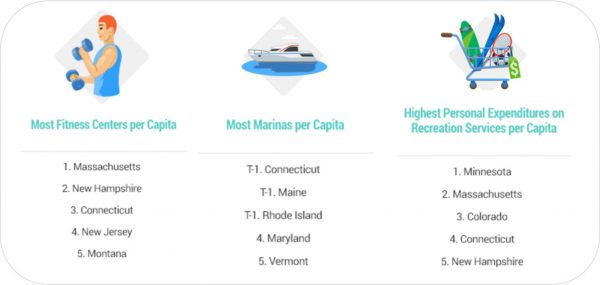



 aphy”.


 The Office “actively assists local, national and international motion picture, TV and media production entities with finding locations in Connecticut, rules and procedures, securing permits, hiring local cast and crew and other services,” according to the agency’s website. In addition, the Office “represents the state and its agencies, municipalities and resident media professionals in interactions with media production entities and the industry at large.”
 venue in the city. Ralph Edwards/Stu Billett Productions received nearly $4 million in tax credits in fiscal year 2016, spending just over $13 million in the state on a number of prominent program productions.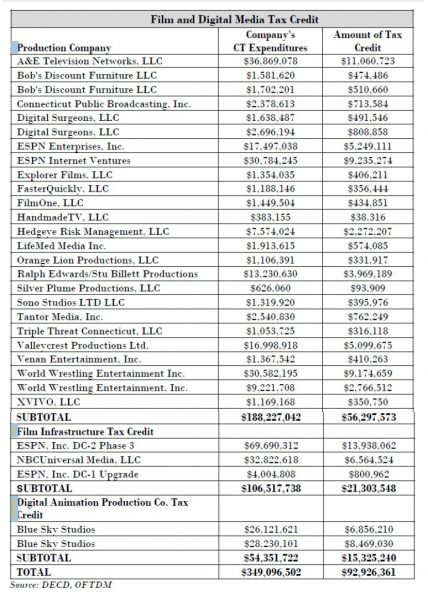


 The backdrop is offered by more than 700 global companies that have subsidiaries here, employing more than 100,000 people, the Organization for International Investment points out. The state’s convenient access to a variety of transportation options all provides access; there were 4.6 million tons of cargo carried on Connecticut rails in 2015, for example, and 11.4 million tons of freight shipped through Connecticut ports in 2013.
 l and freight movement by rail and highway makes Connecticut a prime location for domestic and international trade,” the report points out. Leading exports include: Aerospace/Transportation Equipment, Non-Electrical Machinery, Computers and Electronics, Chemicals, Electrical Equipment, Fabricated Metals Production, and Primary Metal Manufacturing.
 s specific to their industry.