CBIA to Women: Drive a Truck

The Connecticut Business and Industry Association’s Education and Workforce Partnership is turning its attention to the state’s increasing demand for drivers of trucks, buses, and heavy equipment – a demand which is expected to grow to 30,000 by 2024. And the focus of their attention is women, urging them to consider careers in transportation. In an effort to showcase well-paying jobs in the industry, the partnership teamed up with Workforce Solutions Collaborative of Metro Hartford to create a video that highlights this growing industry.

Ellen Underwood, who now drives for the state Department of Transportation’s bridge crew, explains in the video that driving was a “natural pathway” because she enjoyed being outdoors, and driving.  She’s been at it for 20 years, with a number of different employers, including a local municipality.  She says state polices “make it easier for a woman to be treated as an equal,” adding that “if you’re willing to work hard and learn new things, you can do anything.”

A contract driver for CNS Transportation, Karen Roderick, says her career began “as a challenge to see if I could do it.”  She recalls being “the only female” in truck-driving school.  She has since earned Connecticut Driver of the Year, the only woman to do so.

CBIA notes some key facts about women in transportation:

  • Women in historically male-dominated jobs earn an average of 25 percent more than women in historically female-dominated jobs.
  • Women consistently do better with their paperwork, take better care of their trucks, and are often better with their customers.
  • Women, especially when compared with young men, are generally safer drivers.
  • There’s a huge shortage of heavy and tractor trailer drivers yet only 6 percent of truck drivers are female.

Daiana Soto, featured in the video, drives a big rig, and launched her career just four months ago.  “My truck is my office,” she explains. The limited number of women in the field is quite evident, and Soto says it is a challenge she’s ready to take on. “You can do the same job (as men)… and maybe better.”

Ezzie Williams, a professional motorcoach driver for Town & Country in New Britain, began as a school bus driver. She says young people should consider the field, so that they can “get a career and make money.”

Two versions of the video are available—one a full-length video with interviews with six women in six different transportation careers and the other is a one-minute highlight reel.  The project was supported by the Walmart Foundation. The Transportation partnership (Transportation, Logistics, and Distribution Partnership – TDL), convened by the CBIA Education & Workforce Partnership, aims to strengthens the transportation workforce pipeline, support on-the-job training, and improve retention rates among new hires.


https://youtu.be/pNRpQ16ZRNU

Florida vs. Connecticut - Mixed Bag of Growth and Opportunity

Florida Governor Rick Scott spent much of Monday in Connecticut, urging businesses here to relocate to the Sunshine State. There’s no question that Florida has attracted some Connecticut residents and created jobs in recent years, but recent published reports highlight more of a mixed bag that appearances may suggest at first glance.

Chris McCarty, the director of the University of Florida's Bureau of Economic and Business Research, said in a PolitiFact.com article earlier this year that the state has yet to regain the construction jobs that were lost in the recession. McCarty said these jobs are important to note because they are high-paying. Prior to the recession (2006), there were about 668,700 construction jobs and in November 2016 there were only 461,800.

Scott, elected at the start of this decade, pledged to create 700,000 jobs (on top of what the state would have created anyway) in seven years, according to PolitiFact, has “more work to do before Scott hits the jobs total that he promised,” McCarty noted.

PolitiFact Florida is a partnership of the Tampa Bay Times and the Miami Herald, “to help you find the truth in politics.”

Scott’s office announced last month that Florida tied Georgia for the fastest private-sector job growth rate of the 10 largest states in the nation during the past year, when Florida added 233,800 new private-sector jobs, the second-most in the nation.

Scott is a former resident of Stamford.  He has made similar trips to California, Illinois, Kentucky, Maryland and Minnesota, according to the Miami Herald.  The paper reported that Scott brought chief of staff Jackie Schutz Zeckman to Connecticut, but none of his economic development experts joined him. Scott has previously urged GE and Yale University to relocate to Florida.

The Connecticut foray comes a week after he gained legislative approval of a “growth fund” for infrastructure and job training meant to create new jobs, the Orlando Sentinel reported.

The new fund cannot be used for direct payments to businesses, according to published reports, but can be tapped to build roads or other infrastructure and improve job skills to benefit citizens at large, rather than just one company. Local governments and state colleges can apply for money for specific projects from the fund.  It was the result of a compromise with legislative leaders in Florida, who had been critical of what was described as “corporate welfare.”

Job-poaching trips to other states had been routine for Scott, the Sentinel reported, but were cut back last year when lawmakers eliminated funding for direct incentive payments to businesses. Florida legislators have set aside $1.6 billion for business incentives over the past seven years but have become increasingly wary of their effectiveness in light of high-profile projects such as the Orlando biotech firm Sanford Burnham, which is leaving the state after failing to meet its job creation goal, set more than a decade ago. The company had been approved for $350 million in incentives.

A recent United Way report in Florida shows that nearly 70 percent of jobs in the state pay less than $20 an hour, the state’s public radio station, WFSU, recently reported. The most common job in Florida is a retail sales position paying an average of $10 an hour. Next are food preparers and cashiers, according to the report.  An economic analysis compiled for the Miami Herald/Tampa Bay Times Tallahassee Bureau by Florida International University Metropolitan Center last fall showed that although many jobs have returned since the Great Recession, the new jobs are paying workers significantly less than the jobs they replaced, and the rebound has been dramatically uneven across the state.

Last month, Scott announced the unemployment rate in Florida stood at 4.5 percent in April, the lowest it had been since September 2017 and just above the national unemployment rate of 4.4 percent. Connecticut’s unemployment rate rose from 4.8 to 4.9 percent in April as the state lost 1,500 non-farm jobs, according to the state Department of Labor.  The jobless rate was 0.5 percentage points lower than a one year ago and the state added 5,500 jobs during the previous 12 months, with private sector employment increasing by 9,900 positions during the previous year.

Earlier this month, Scott signed a state worker pay raise into law, marking the first time in over a decade that Florida state employees will receive an across-the-board raise. All employees who earn $40,000 a year or less will get a $1,400 raise, and employees who earn more than $40,000 a year will get a $1,000 raise. Most state law enforcement officers will get a 5 percent raise and most correctional officers will get a $2,500 raise, and judges, elected state attorneys and public defenders will get 10 percent pay hikes, the Tampa Bay Times reported.  In addition, state group health insurance will begin moving toward a four tier system, and most public sector employees will default into a 401-k style retirement program.

Connecticut and TESLA: The Battle Lines Expand

It was a one-two punch from Connecticut aimed at Tesla, in the marketplace and in the boardroom. On Tuesday, at the company’s annual shareholder meeting at the Computer History Museum in Mountain view, CA, a shareholder resolution advocated by the Office of State Treasurer Denise Nappier was on the agenda.

And on Wednesday, the Connecticut legislature concluded the 2017 regular session, leaving behind a proposal that would have enabled Tesla to sell cars directly to Connecticut consumers, as is done in many other states.  It was the third consecutive year that the plan did not receive approval from legislators, in the face of strong opposition from the Connecticut Automotive Trades Association.

The Tesla proposal was approved by two legislative committees - Transportation and Finance, Revenue, and Bonding - but was never voted on by House or Senate members in their respective chambers.  The bill pitted the state’s longstanding car dealers against the new model that Tesla prefers.

The Connecticut Retirement Plans and Trust Funds shareholder resolution called for the declassification of Tesla’s board and for the annual election of all of Tesla’s directors.  The $32 billion Connecticut Retirement Plans and Trust Funds (“CRPTF”), of which Treasurer Nappier is principal fiduciary, owned 32,837 shares of Tesla, Inc. common stock with a market value of $11.6 million as of June 6, 2017.

Tesla’s board currently is classified, which means that each year only a portion of the directors are elected by shareholders.  This year shareholders had the opportunity to vote on three of Tesla’s seven directors. The company’s board recommended that “our stockholders vote against this proposal.”

“Independent shareholders gave Tesla a clear message: it's time to sharpen the company's governance profile and strengthen board member accountability to shareholders, whose interests they are elected to represent,” Nappier said after the shareholder vote.

Connecticut’s resolution, the first ever filed to declassify Tesla’s board, received an estimated 47 percent of the votes not controlled by directors and officers, indicating strong support for the annual election of directors, according to the Treasurer’s Office.  Representing the Connecticut Treasurer’s Office at the annual meeting, and presenting the proposal, was Aeisha Mastagni, a Portfolio Manager in the Corporate Governance Unit of the California State Teachers’ Retirement System. Overall, according to a U.S. Securities & Exchange Commission filing, 74.7 million shareholders voted against the proposal, with 32.7 million voting in favor.


“And now that Tesla has joined the ranks of the Fortune 500, we encourage the company to take particular heed of the recent vote,” Nappier added, “given that most of its largest U.S. company peers have already embraced annual election of directors.  It should reconsider its opposition to this fundamental provision of good governance.”

“At the end of the day, Tesla has and will continue to develop and deploy new technologies and products that will be an important part of the global economy’s clean energy future.   The company’s corporate structure should likewise evolve toward a more accountable governance framework that will fortify its bottom line and sustainable value,” said Nappier, a veteran shareholder activist.

In the aftermath of the Connecticut legislative session, a spokesman for Tesla told CT NewsJunkie that the company wasn’t quite ready to give up on the state. Tesla is allowed to sell direct to consumers in most jurisdictions in the U.S. and around the world. They are prohibited from selling directly in Connecticut, Michigan, Texas, and West Virginia, according to the company.

“The residents of Connecticut overwhelmingly want Tesla to be able to freely operate in the state, and despite inaction during this session,” a company spokesman said.  There are approximately 1,300 Tesla vehicles registered in Connecticut.

Innovative Start-Up Companies Seek State Funds to Propel Growth

CTNext will bring together start-up businesses seeking the financing to move forward, providing the opportunity for them  to pitch at the next Entrepreneur Innovation Awards (EIA) event scheduled for Thursday, June 15 at the LOFT at Chelsea Piers in Stamford. Connecticut's "innovation ecosystem" will be highlighted as the nine companies, from all across the state, will be competing for $10,000 grants.  The competitors include:

  • Deo2go (Fairfield): Creating a topical delivery device that can be filled with a variety of products including, but not limited to deodorant, lip balms, and sunscreen
  • Egghead (Danbury): Developing a new way to package and sell ice cream that brings new revenue to a mature market
  • FallCall Solutions (Trumbull): Creating a tele-monitoring system for the Apple watch and other mobile systems for elders and caregivers
  • Fjord Weather Systems (Wilton): Developing a way to turn every boat on the water into a weather-monitoring system
  • LiquidSphere (New Haven): Creating an interactive app that will connect people who struggle with stress, anxiety, depression and addiction with therapists via text and video sessions
  • Lucca Ventures (Southington): Developing a Bluetooth-enabled microphone attachment to a full-face oxygen mask, letting patients communicate clearly while wearing it
  • Obvia (West Hartford): Manufacturing dual-winglet blades and semi-shroud power upgrade for Sunforce Wind Turbines that will improve efficiency and scalability for the turbines
  • Sweet Equations (East Hartford): Making custom candy cakes, edible cupcake displays and other desserts through the development of an on-demand decorating device
  • Trekeffect (Lyme): Developing a system to let individual travel planners buy and sell their itineraries.

To determine the finalist pool, each company’s application was vetted by a separate and independent team of reviewers who deemed their products, services and/or business ideas worthy of consideration for an EIA. Each finalist will have an opportunity to compete for a $10,000 grant as well as the judges’ and crowd favorite awards, each in the amount of $2,000 each.

The judges who will hear the company pitches and determine the winners include:

  • Elena Cahill: Senior Lecturer, University of Bridgeport, Entrepreneurship Department
  • Jim Kern: Co-founder, COMRADITY
  • Greg Kivenzor: Associate Professor of Marketing, Director of Experiential Learning Collaborative, UCONN- Stamford
  • Mark Lasoff: Founder, LearnToProgram
  • Mike Roer: President, The Entrepreneurship Foundation

Throughout the year, CTNext hosts the EIA, a Shark Tank–style pitch event where Connecticut-based startups and entrepreneurs compete for grants that can be applied toward a specific project that will help accelerate growth.

CT Next support the success of companies and entrepreneurs by providing guidance, resources, and networks to accelerate their growth. CT Next is a wholly-owned subsidiary of Connecticut Innovations, described as "a network of passionate people who offer services to busy entrepreneurs." Launched in 2012, there are now more than 1,500 members. Since its inception in 2014, CTNext has held 11 total events in cities and towns all over Connecticut, awarding $544,000 to 52 unique companies.

https://youtu.be/Au4ULyo5L1g

More Daughters Mean More Venture Capital Investment, More Success, Study Shows

As the growing number of Connecticut start-up firms seek to attract venture capital funds to propel their growth, a newly published study may suggest some surprising influences on the investment decisions – and ultimately the success of venture capital investments. A National Bureau of Economic Research (NBER) working paper by Paul A. Gompers and Sophie Q. Wang from Harvard University says that gender diversity may boost performance of venture capital firms.  But it is not the gender diversity of the start-up firms leaders, or the gender diversity of the venture capitalists, who tend to predominantly be white males.

It is the gender diversity of the children of venture capitalists that appears to make the difference.

The paper, “And the Children Shall Lead: Gender Diversity and Performance in Venture Capital,” is based on a study of a dataset of gender of venture capital partners’ children. It finds that partners with more daughters than sons were more likely to hire female partners. But that’s not all.

The study also finds that having more girl children had a positive effect on deal and fund performance of these partners.  The authors indicate that the effects concentrate overwhelmingly on the daughters of senior partners than junior partners.

“Taken together, our findings have profound implications on how the capital markets could function better with improved diversity,” they say in the paper’s abstract.

Venture capital firms are typically deep-pocketed, small companies that bet on startup success by investing millions in exchange for an ownership interest and hopes of high returns.  Published reports indicate that according to the study, firms that increased their gender diversity by hiring more women saw their deal success rate increase by nearly 3 percent. Their profitability, as measured by internal rates of return, rose by more than 3 percent.

Venture capital in Connecticut is available from a range of private and quasi-public sources, including Connecticut Innovations.

The 62-page paper was posted last week; Paul Gompers is Professor of Business Administration and Director of research for the Harvard Business School Finance Unit.  Sophie Q. Wang is a PhD student in the Department of Economics at Harvard University. They based their results on some 12,000 venture-capital investments made between 1990 and 2016, primarily by U.S.-based firms.  They also studied personal information obtained from some 1,400 investing partners.

The NBER is a private, non-profit, non-partisan organization dedicated to conducting economic research and to disseminating research findings among academics, public policy makers, and business professionals.

Matchmaker Event Seeks to Boost Local Small Businesses

Putting entrepreneurial, start-up and small businesses in the same place at the same time with business decision makers seeking suppliers, subcontractors and project partners is the concept that drives the CT Business Matchmaker, among Connecticut's largest events designed to bring together small, established businesses with “primes”—large and medium-sized companies, government agencies, educational institutions, and municipalities who are actively interested in increasing and diversifying their supplier lists. “The Matchmaker program is a premier event offering significant new opportunities for Connecticut-based small businesses,” said Fred Wergeles, director of the University of Hartford’s Entrepreneurial Center, which manages and hosts the event. “Bringing together large companies and agencies with small businesses in the fast-paced Matchmaker environment creates the spark for emerging relationships that will fuel the state’s economy. The Entrepreneurial Center provides pre-event training for both the large and small businesses to maximize the value of their participation in the program.”

The eighth annual event will be held on June 1, 7:00 AM to 2:30 PM on the university campus.  CT Business Matchmaker 2017 will offer an opportunity for small business owners to expand their contracting relationships. During the event, small businesses will present their products and services to potential customers in a series of ten- minute, one-on-one interviews with Primes. All Prime participants, including state and federal agencies, large corporations, municipalities, and educational institutions, come to the event with business needs they are seeking to fill.

“At Viking Construction, we are always looking for qualified subcontractors. We need to find the right company for the job in order to create a successful project, so relationships are very important to us. We know we’ll meet the quality we are seeking at CT Business Matchmaker,” said Michele Yeager, project administrator at Viking Construction.

“Through the CT Business Matchmaker, we accomplished our goal of reaching out to new subcontractors and providing economic opportunities to local businesses. They help get the small businesses ready for the opportunities we put out to bid,” said Michael Jefferson at the Metropolitan District (MDC). “I like to network with those agencies as well so I know what resources are available to support the success of our vendors. The MDC is committed to this process that helps build opportunities for small businesses.”

Wergeles also emphasized his organization’s effort to reach out to businesses run by women and minorities. “Through our Women’s Business Center, we also focus on recruiting women-owned and minority-owned businesses. These businesses traditionally receive fewer contracts, so we strive to provide more opportunities for them through this event.”

Additional organizing partners for CT Business Matchmaker include the University of Hartford’s Construction Institute, U.S. Small Business Administration, state Department of Administrative Services, CT Procurement Technical Assistance Program, state Commission on Human Rights and Opportunities, and the U.S. General Services Administration.

Participants include: Boston Scientific, Canberra Industries, Cianbro Corporation, City of Hartford, City of New Britain, Charter Oak Environmental Services, Inc., Colt's Manufacturing Company LLC, CT Airport Authority, Connecticut Lottery Corporation, CSCU, Dimeo Construction Company, Elbit Systems of America, Kollsman Inc., Enfield Enterprises Inc., Enterprise Builders, Inc., General Dynamics Electric Boat, Great Lakes Dredge & Dock Company, LLC, Greater Hartford Transit District, Harvard Pilgrim, Kaman Composite Structures, Manafort Brothers Incorporated, Methuen Construction Co., Inc., Pioneer Valley Transit Authority, Pitney Bowes, Sikorsky a Lockheed Martin Company, Skanska USA, Staples Business Advantage, Supervisor of Ship Building, The Hartford, The Metropolitan District, The Whiting-Turner Contracting Company, Triumph Integrated Systems, UCONN Health, UCONN Purchasing Dept., UConn Supplier Diversity Program, United States Navy, US Environmental Protection Agency, US General Services Administration – FAS, US General Services Administration – PBS, United Technology Aerospace Systems, Viking Construction, and Western CT State University.

Flexer Sees Bad Choices Ahead if State Doesn't "Do Something Dramatically Different"

“Connecticut’s got to do something dramatically different,” implored State Sen. Mae Flexer.  Her impassioned comments came as part of a panel discussion at the unveiling of the 2017 Kids Count Policy Report at the State Capitol.  With budget negotiations proceeding in earnest amidst a worsening state fiscal situation, Flexer expressed her concern about the forces driving the conversation at the Capitol, and the long-term implications for residents in the state’s rural and urban communities. “As I think about the days and the weeks ahead, I’m frustrated, because frankly, this building as far as I can tell right now, is being ruled by the voices of the people of the wealthy and suburban communities, and not by the voices of people (in these districts),” she said, following concerns raised by colleagues Rep. Brandon McGee (Hartford, Windsor) and Rep. Susan Johnson (Windham), who had focused on the significant disparities outlined in the report, and the adverse impact on children and families in Connecticut.   

“We’re not winning the battle,” said Flexer, who represents Killingly, Brooklyn, Canterbury, Mansfield, Putnam, Scotland, Thompson and Windham.  “And as I sit here and think about what this data should be leading us to do, and the reality of the choices that we are going to be making in the next couple weeks, we’re going to be making bad choices,” Flexer continued.

The 37-page report, “Race Equity in the Five Connecticuts: A Kids Count Special Report“ provided detailed analysis on the disparities in the state’s differing communities, described based on demographic data as being in one of five categories:  wealth, suburban, rural, urban periphery or urban core.   The report was published by the Connecticut Association for Human Services.

The stark differences, according to Chief Executive Officer Jim Horan, “are reflected not only in disparities in economic well-being, but in education, health, and family and community indicators.” The report found “there are persistent inequities in outcomes along racial and ethnic lines. Poverty rates differ starkly by race and ethnicity, as do other economic indicators, academic achievement (including graduation rates), and health outcomes.”

“We need to do things differently,” Flexer told those attending the May 15 panel discussion, one of two held back-to-back as part of the release of the report  that began with a detailed presentation of the report’s findings.  “The workforce training program (that you’re talking about) – it’s not going to exist in four or five years on the path that we’re taking right now in Connecticut of thinking that we have to do things the same way but not bringing anymore resources into the picture and not thinking of creative ways to allocate those resources is just going to make these statistics worse.  It’s going to make the outcomes for the communities that the three of us represent, worse.  It’s going to drive up rates of poverty, it’s going to make a study like this when it’s done again in five years even more stark of a contrast between the different regions.”

Noting that the towns of Chaplin, Hampton, Windham, Scotland, and Mansfield were one town early in the state’s history, Flexer asked “how much money would that save if that were still the case?  Is looking at our past the solution to what we need to do in the future, in a system with limited resources?”

Reflecting on the budget choices being discussed at the Capitol to reign in the multi-billion dollar deficit, Flexer expressed apprehension at some of the options under consideration.

“There are people who think that the Office of Early Childhood should no longer exist, that your commission [Commission on Children, Women and Seniors] should no longer exist, as a solution to Connecticut’s budget situation.  That throwing more families off of HUSKY insurance coverage is the answer to the problem we’re in the State of Connecticut,” Flexer said.

Flexer’s frustration and apprehension, however, was tinged with optimism.

“I’m so grateful to have this report and to have this conversation. I’m hopeful that people will look at what you’ve put together here and understand that we’ve got to do things differently and we can’t fail folks in … these communities.”


CT-N coverage

CT Ranked #4 in US in Education, Economic, Civic Opportunity

Including Connecticut, ranked #4 nationally, the New England states grabbed five of the top 10 slots in the Opportunity Index, an analysis of “how opportunities measure up” in communities across the country.  The Opportunity Index is an annual composite measure at the state and county levels of economic, educational and civic factors that expand opportunity. Leading the opportunity rankings are Vermont, Massachusetts, New Hampshire, Connecticut, New Jersey, Maryland, North Dakota, Nebraska, Maine and Minnesota.  Connecticut exceeded the national average in all three components – Jobs and Local Economy, Education, and Community Health and Civic Life.
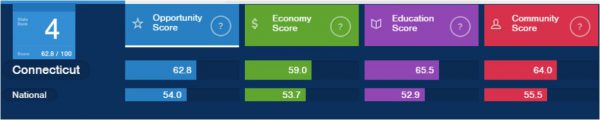
In the Education component of the Opportunity Index, Connecticut ranked second.  The state ranked sixth in the Community aspect of the index, but 20th in the Economy scorecard.  The Economy rankings included data on jobs, wages, poverty, inequality, access to banking, affordable housing and internet access.

Connecticut’s overall score was 62.8, compared with the national average of 54.0.  Among Connecticut’s eight counties, the best overall opportunities are in Middlesex County, which earned a 63.1 score.  Next were Tolland County, 62.3; Fairfield County,62.1; Litchfield County, 60.6; Hartford County 59.5; New Haven County, 56.8; New London County, 54.3; and Windham County 51.2.

The index was jointly developed by Measure of America and Opportunity Nation.

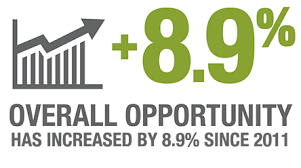
Nationally, overall opportunity has increased by 8.9 percent since 2011, as unemployment has dropped and violent crime has been reduced, the data indicated.  In addition, the rate of young adults from age 16 to 24 who are neither working nor in school has fallen 9.1% since 2011, but remains above pre-recession levels. This number has decreased slightly since 2015.

Opportunity Nation is a bipartisan, national coalition of more than 350 businesses, nonprofits, educational institutions and community leaders working to expand economic opportunity. Opportunity Nation seeks to close the opportunity gap by amplifying the work of its coalition members, advocating policy and private sector actions and releasing the annual Opportunity Index.  Measure of America provides easy-to-use yet methodologically sound tools for understanding well-being and opportunity in America.

The data, according to survey sponsors, comes from the U.S. Census Bureau, the Bureau of Labor and Statistics, the Federal Communications Commission, the National Center for Education Statistics, the Center for Disease Control and Prevention and the U.S. Department of Justice.

Waterbury, Hartford, Simsbury Receive National Recognition for Main Street Initiatives; Eight Local Efforts to Receive Awards

Three Connecticut communities in the Connecticut Main Street network have achieved accreditation for meeting the commercial district revitalization performance standards set by Main Street America, a subsidiary of the National Trust for Historic Preservation. The Connecticut Main Street programs that earned accreditation for their 2016 performance are Simsbury Main Street Partnership, Upper Albany Main Street (Hartford), and Main Street Waterbury.

The accreditation was announced at the 2017 Main Street Now Conference in Pittsburgh. Each year, Main Street America and its partners announce the list of accredited Main Street programs, which have demonstrated exemplary commitment to historic preservation and community revitalization through the Main Street Four Point Approach.

"Connecticut's Main Street America Accredited programs, Simsbury Main Street Partnership, Upper Albany Main Street (Hartford), and Main Street Waterbury, are well-established Main Street management organizations with histories of strong and dynamic leadership. Each has developed and maintained outstanding programs that increase the economic value of their districts while improving the quality of life for area residents," said Kimberley Parsons-Whitaker, Associate Director of Connecticut Main Street Center.

"Main Street revitalization is sustainable when the professional management organization is committed to engaging local stakeholders (business and property owners, anchor institutions, local government, and local residents) in envisioning a vibrant Main Street, and developing strong partnerships that result in action-oriented steps that bring the Main Street neighborhood back to life."

Working in partnership with Main Street America, Connecticut Main Street Center evaluates each of the state's Designated Main Street Programs annually to identify those programs that meet ten performance standards. Evaluation criteria determine the communities that are building comprehensive and sustainable revitalization efforts and include standards such as fostering strong public-private partnerships, securing an operating budget, tracking programmatic progress and actively preserving historic buildings.

The recognition doesn’t stop there.  Connecticut Main Street Center will be presenting its annual Awards of Excellence on Thursday, May 18 at the Legislative Office Building in Hartford.

Among the recipients: a downtown management organization engaging the community in envisioning two underutilized parks as places that downtown residents, visitors, workers and families can mingle with artists and creatives, and a regional planning organization that created a program focused on supporting local businesses, creating jobs and filling vacant spaces in eight village.

In total, eight recipients have been selected to receive the prestigious awards, including organizations and initiatives from Bridgeport, Unionville Village in Farmington, Hartford, Meriden, New Britain, New Haven, and the Northwest Corner.

Among the winning entries: a 14-acre flood control project that created a public park and mixed-use economic development in downtown Meriden; a comprehensive and complete overhaul of the City of Hartford’s zoning language and process; an interpretive wayfinding/signage program that connects Walnut Hill Park, Little Poland and Downtown New Britain; the restoration of a historic ball bearing mill on the banks of the Farmington River into a mixed-use campus in the heart of Unionville Village; a Twilight Bike Race & Street Festival that celebrates biking, food, culture and entertainment in Downtown New Haven; and the redevelopment of a 1903 factory building into 72 units of market rate housing within easy walking distance of jobs and transit in downtown Hartford.

Created in 2003 to recognize outstanding projects, individuals and community efforts to bring traditional downtowns and neighborhood commercial districts back to life, socially and economically, the Awards of Excellence are presented annually. CMSC’s mission is to be the catalyst that ignites Connecticut’s Main Streets as the cornerstone of thriving communities. CMSC is dedicated to community and economic development within the context of historic preservation, and is committed to bringing Connecticut’s commercial districts back to life socially and economically. CMSC is supported by its Founding Sponsors, the CT Department of Economic & Community Development (DECD) and Eversource Energy. CMSC is also supported by its Growth Sponsors, UIL Holdings Corp. and the State Historic Preservation Office.


In New England, Most Believe At Least Half of High School Grads Not Ready for College, Career

New Englanders overwhelmingly believe that at least half of high school students across the region graduate unprepared for college and a career, and that student-centered learning environments are part of the solution to this readiness problem. That’s according to the results of a poll that reflects growing concerns that children are not fully equipped for life after high school.  It is seen by some as a tipping point in public opinion that positions student-centered learning—which tailors education to the interests and needs of each student—as an answer to providing young people with the skills and knowledge they need to succeed upon entering post-secondary education and the workforce.

That’s according to the Nellie Mae Education Foundation (Nellie Mae) which released the poll that was conducted by the Rennie Center for Education Research & Policy, which surveyed 2,400 individuals across the region from August 5-31, 2016.

“Although graduation rates are at an all-time high, New Englanders are well aware that a diploma alone is no longer sufficient to ensure success for our students after high school,” said Nick Donohue, president & CEO of the Nellie Mae Education Foundation.

Among Connecticut residents, 33% said most graduates are prepared for college and a career, 48% said about half of graduates are ready, and 18% believe that “few graduates” are prepared for college and career.  Connecticut and New Hampshire had the highest percentage indicating that “most graduates” are prepared, with one-third of respondents (33%) expressing that view.

“Too frequently students arrive at college requiring developmental or remedial classes to strengthen basic skills just to move on to college-level material, or they begin careers without the tools and skills necessary to help them early on in their professional lives. The situation is more severe for people in traditionally marginalized communities – places that we need to prosper so our society can advance. The good news is that student-centered approaches to learning represent a path forward in which all students can succeed.”

There were some differences among the states.  In Connecticut, 48 percent said “some changes are needed, but basically schools should be kept the same.”  Only 14 percent said “public schools work well as they are now,” while 30 percent said “major changes are needed” and 8 percent said “a complete overhaul is needed” (the smallest percentage among the New England states).

A significantly greater proportion in Rhode Island believe “a complete overhaul is needed” than in Connecticut, Massachusetts, New Hampshire and Vermont.   A significantly greater proportion in Maine believe “a complete overhaul is needed” than in Connecticut.

Nearly two-thirds of those surveyed in Connecticut (64%) called for “using technology to enhance the way students learn in the classroom” – the highest percentage among the six New England states.  A majority called for “more significant efforts to close achievement gaps” (59%), more effective teachers (62%) and changes to the ways schools are funded (57%).  The state legislature in Connecticut is currently considering changes in the school funding formula proposed by Gov. Malloy in the wake of a state court decision.


According to Nellie Mae, across New England, only 50 percent of high school students are graduating with the skills and knowledge necessary to succeed after high school. These poll results show that New Englanders not only agree this is unacceptable, but that 90 percent believe that student-centered learning environments are part of the solution toward ensuring high school graduates are college and career ready.

Nellie Mae defines student-centered learning as personalized and happening anywhere, anytime. In student-centered environments, students move ahead based on mastery of content rather than class-seat time and they exert ownership over their own learning.

New Englanders found teachers to be among the most trusted group when it comes to educational decision-making and showed confidence in their ability to improve public education. Respondents also reported having confidence in parents and school and district leaders for improving education.

The poll comes amidst efforts by Nellie Mae to reshape public education in New England to reach an aggressive benchmark of 80 percent college and career readiness among our high school graduates by 2030. The Foundation is investing $200 million in grantmaking efforts toward advancing student-centered learning in schools and districts across the region in order to achieve this goal.

The Nellie Mae Education Foundation is the largest philanthropic organization in New England that focuses exclusively on education.

To read the poll report in its entirety, please visit http://bit.ly/2k4Dvv5