Connecticut's State Gas Tax is Sixth Highest in the US; Two States Seek to Defeat Increases

Connecticut’s state gas tax – criticized both because some consider it to be too high and because others point out that it is insufficient to keep the state’s roads and bridges maintained appropriately – is not among the highest in the nation, but comes close. Leading the way with the highest state gas tax levels are Pennsylvania (59 cents a gallon), California (54 cents), Washington (49 cents), Hawaii (48 cents), and New York (46 cents).  Connecticut is the nation’s sixth highest, at 44 cents a gallon, followed by Indiana (42 cents), Florida, Michigan and New Jersey (41 cents).

In California, voters will see a referendum question on the November ballot that if passed would repeal a gas tax increase (12 cents a gallon) that was passed by the state legislature a year ago as part of a comprehensive transportation funding package to pay for highway, road and bridge repairs, as well as public transit projects in the state.  Recent polls predict a close vote on Proposition 6.
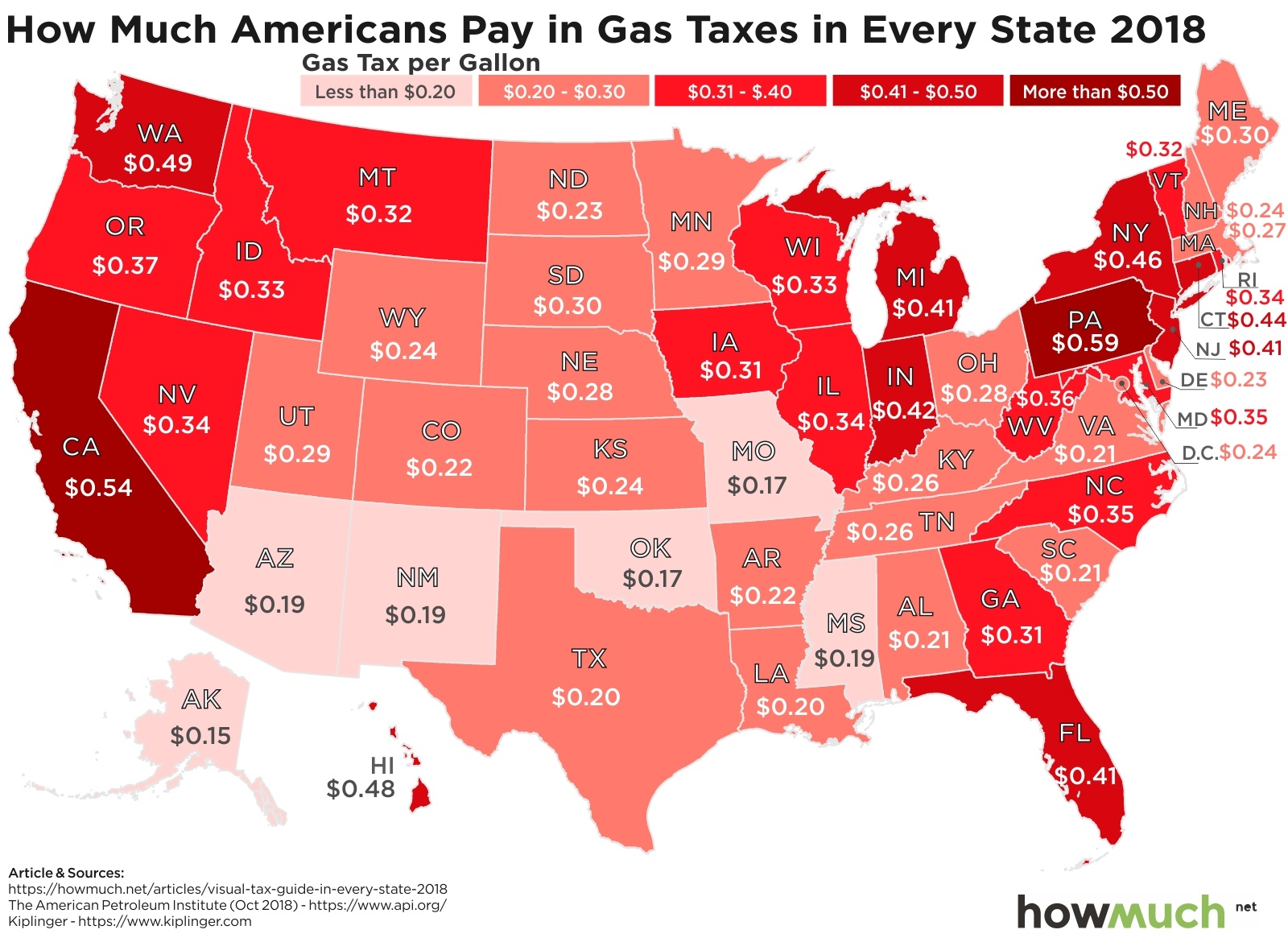
In Missouri, voters will consider Proposition D, which would increase the fuel tax in that state by 2.5 cents a year for four years, totaling 10 cents a gallon. The proposal is intended to provide a stable funding stream to the Missouri State Highway Patrol, as well as millions of dollars to the Missouri Department of Transportation to repair and maintain the state's highways and bridges, according to published reports.

New Jersey’s gas tax, which had been one of the lowest in the nation, was increased in 2016 by 23 cents per gallon under a bipartisan deal engineered by then-Chris Christie and the Legislature.  That pushed New Jersey into the top 10 highest rates in the nation, and was the state’s first gas tax increase since 1988, according to news stories at the time.

In total, 27 states have raised or reformed their gas taxes since 2013.  Indiana instituted a 10-cent increase in 2017; Oregon approved a 10-cent phase-in that began this year. The South Carolina legislature overrode a Governor’s veto to enact a 12-cent-per- gallon increase in the tax rate to be phased in over 6 years, according to data compiled by the Institute on Taxation and Economic Policy.  Oklahoma’s legislature approved a 3 cent increase this year - that state’s first since 1987.

The federal government last raised the gasoline tax 25 years ago in 1993, since then the states – in the vast majority of instances – have nudged tax rates upward in their individual jurisdictions.  The lowest state rates are in Alaska (15 cents a gallon), Missouri and Oklahoma (17 cents), Mississippi, Arizona and New Mexico (19 cents).
CT Residents Concerned About Healthcare Costs, Suggest Policy Actions

Connecticut residents are worried about paying for health coverage and care, and are delaying or skipping recommended medical treatment and tests. They also support bold solutions across party lines, according to policy briefs released this month by Universal Health Care Foundation, based on the results of a statewide survey conducted in partnership with Altarum Institute’s Healthcare Value Hub. The poll found that state residents:

  • Avoided or delayed treatments and tests, cut pills in half or did not fill prescriptions because of cost concerns
  • Worry about affording health care in the future
  • Had difficulty navigating our complex health care system, including dealing with surprise medical bills

The survey revealed that residents are not satisfied with the current health care system: 80 percent agree or strongly agree that “the system needs to change.”  When given more than 20 options, they focused on the high prices charged by industry players, citing most frequently as a “major reason” for high health care costs:

  • Drug companies charging too much money—81 percent
  • Hospitals charging too much money—74 percent
  • Insurance companies charging too much money—74 percent

When asked about possible strategies for tackling high health care costs, residents expressed strong support, across party lines, for government to take action.

  • Show what a fair price would be for specific procedures – 95 percent
  • Authorize the Attorney General to take legal action to prevent price gouging or unfair prescription drug price hikes – 94 percent
  • Set standard payment to hospitals for specific procedures – 89 percent
  • Set standard prices for drubs to make them affordable – 89 percent

The survey found relatively little statistical difference in the responses of individuals indicating their political party affiliation as Democrat, or neither.

In the poll of 900 Connecticut adults, nearly 9 in 10 people (88%) who take prescriptions regularly worry they won’t be able to afford their medication.  And 20 percent reported that they were so worried about drug prices that they did one or more of the following:  not fill a prescription, cut pills in half, or skip a prescribed dose. 

Half of Connecticut adults indicated that they experienced a problem with health care affordability in the past year, and nearly as many, 43 percent, delayed or did not get care due to cost, with one-third indicating that they delayed going to the doctor or having a procedure done.

Universal Health Care Foundation is supporting IVote4Healthcare, a nonpartisan voter registration, education and engagement effort, with Protect Our Care CT, to highlight those findings and changes in the health care system.

National Startup Analysis Sees Potential, Standout Efforts Underway in Hartford

A new analysis of the status of the business startup community in six American cities – including Hartford – has found that Connecticut’s Capitol City has “strong startup potential,” and in some ways is already standing out among peers and competitors. Startup Genome, with support from the Kauffman Foundation, selected six U.S. metropolitan areas that are not in the top 40 most populous and which have been faring less well economically than the country as a whole for a deeper analysis.  In addition to Hartford, the analysis includes Albuquerque, Fresno, New Orleans, Reno and Springfield, MA.

“In each of these metros, efforts are underway to support entrepreneurs, create more startups, and generate stronger economic trajectories. Like many other American cities (and elsewhere), they’ve been through economic ups and downs and now see startups as their next best hope for sustainable and broadly-shared growth,” the report, released this week, points out.  Startup Genome works to increase the success rate of startups and improve the performance of startups across more than 30 countries.

“Every startup ecosystem shows room for growth and improvement, and Hartford has key strengths to build on. The city's strong heritage in insurance is already being leveraged by many stakeholders and the ecosystem is clearly attracting experienced talent to start and join companies,” Dane Stangler, president & chief policy officer of Startup Genome told CT by the Numbers.

In Hartford, reSET, which specializes in encouraging and assisting entrepreneurship and social enterprise, was among several local partners with whom Startup Genome worked to gather data from more than 300 respondents.  Additional partners were the MetroHartford Alliance, Wesleyan University, UConn’s Connecticut Center for Entrepreneurship and Innovation, Upward Hartford,  as well as Launch EZ, the West Hartford Chamber of Commerce and others.

“More broadly, Hartford shows greater diversity than peer ecosystems and already has a few hundred startups operating. By continuing to strengthen the local culture and focusing on startup success in key areas, the Hartford economy will enjoy higher levels of job creation and growth,” Stangler added.

Hartford and the other cities were determined to be in the Early Activation phase of the Ecosystem Lifecycle, with a mix of prominent attributes and areas with potential yet to be realized.  In its analysis, the report indicates that “just in the span of a few years the startup scene has exploded,” in Hartford, noting that:

  • investors and experts in Hartford provide more hours of help to founders than in the other cities, and more than the global average. (Experts include university faculty, corporate employees, mentors, and others.)
  • nearly four in 10 founders in Hartford are women, which is twice the global average across all ecosystems in the Startup Genome database.
  • 11 percent of startup founders in Hartford are immigrants, the second-highest in the sample.

“We’re so grateful that Startup Genome was able to include Hartford in its recent analysis of early-stage ecosystems, thanks to support from the Kauffman Foundation,” said reSET Managing Director Ojala Naeem.  “Our great city is too often overlooked, and with local and state funding being what they are, national attention on all of the amazing businesses making an impact here is more important than ever. We have so many smart and motivated entrepreneurs who are worthy of investment consideration. They just need a spotlight.”

The comprehensive assessment of Hartford’s ecosystem also noted that “Hartford’s [startup] founders claim to have the right ambition to go global,” concluding that “Hartford’s startups have more potential to strengthen Global Market Reach and Global Connectedness.” In a number of areas analyzed in the assessment, Hartford is seen as having potential to strengthen the local startup community, its reach beyond Hartford, and the demographic of startup teams.

During the past seven years Startup Genome has provided a way for entrepreneurs everywhere to “tell us about their journeys and their regions - giving their local expertise a voice at the policy-making table.” The organization’s primary research with founders, supplemented with secondary research and data from global and local partners, helps create the world’s most comprehensive research on startups. Approximately 10,000 startup founders fill out global survey providing direct input each year.

“Hartford has some record of successes – generating more will help ecosystem size and performance,” Startup Genome observed in its assessment of Hartford.

Israeli Speech Communication Firm Earns $1.5 Million Investment at State's VentureClash

An Israeli company developing “a revolutionary mobile application that translates indistinguishable speech into understandable language” won praise and the top investment award of $1.5 million in VentureClash, Connecticut's $5 million global investment challenge for early-stage companies in digital health, financial technology, insurance technology and the Internet of Things. Connecticut Innovations (CI), the leading source of financing and ongoing support for Connecticut’s innovative, growing companies, runs the annual competition. In all, nine companies from six different countries participated in the final pitch event. VentureClash judges awarded six companies with investments, mentoring and customer introductions to help them grow and succeed.  The winning companies are required to establish a presence in Connecticut.

The top placing company, Voiceitt, points out that the market for their product, in the U.S. and worldwide, is vast.  In the US and Europe, a combined 10.4 million people suffer from speech disabilities, and 8 percent of all children suffer from a consistent or temporary communications disorder. (see video, below)

Voiceitt’s core mission is to “make voice recognition technology truly accessible to everyone. Our principal aims are inclusion and independence, and we are committed to helping children and adults around the world communicate freely, spontaneously, and naturally by voice.”

Through a hybrid of unique statistical modeling and machine learning, Voiceitt is working to enable “tens of millions of people to overcome communication barriers and help them connect with the world.”

Two second-place winners were each awarded a $1 million investment:

  • DOZR: A Canadian company that has developed a marketplace for the online rental of heavy equipment, enabling business owners to earn additional revenue from their idle equipment and allowing contractors to rent equipment at lower rates than traditional rental companies.
  • IronYun: A Stamford-based next-generation, AI deep-learning, big-data video search business-to-business software company providing enterprise customers with hyper-converged, private cloud computing and big-data video software products.

Three additional finalists were selected to each receive a $500,000 investment award:

  • CloudKPI: An Irish company developing an insight engine that enables SaaS businesses to predict likely outcomes.
  • Invixium: A Canadian manufacturer of modern biometric solutions for markets needing strong user authentication, convenience and data analytics.
  • Paygilant: An Israeli technology company working to prevent mobile payments fraud on mobile devices in the preauthorization phase.

The finalists pitched their ideas in front of a live audience and a panel of judges at the Yale School of Management in New Haven on October 18. The other finalists were:

  • Kasko: A London-based digital insurance intermediary bridging the gap between the digital and insurance economies.
  • Panoply: An Israeli startup developing a smart data warehouse, using machine learning and natural language processing to automate data integration, data management and query optimization.
  • SnapSwap: A Luxembourg-based company offering white-label end-to-end know-your-customer (KYC) services for financial institutions and businesses.

“The VentureClash competition continues to introduce some of the world’s most innovative and promising early-stage companies to all that Connecticut has to offer,” said Matt McCooe, CEO of CI. “From the initial application period through to the finals, we were so impressed with the caliber of leadership and the depth of innovation represented by the companies involved in the competition. We thank them for their efforts and commitment and look forward to working with the companies to help them make Connecticut a center point of their growth strategy.”

The VentureClash competition started with applications from 300 companies from more than 15 countries. After two rounds of judging, nine finalists were named, and they then went on to compete at the live pitch event.  The judges included investors and subject-matter experts from Greycroft Partners, Oak HC/FT, Real Ventures, Stanley Ventures, Teamworthy Ventures, Travelers and the Royal Bank of Scotland.

Event partners and sponsors included Aetna; aventri; Bernstein; Boehringer Ingelheim; Diameter Health; Disruptive Technologies; Elm Street Ventures; FML; Harman; Hartford Healthcare; Magellan Health; MasterCard; Medtronic; Nassau Re; NatWest Markets; Payflex; Pitney Bowes; Health Venture; ISG; Stanley, Black & Decker; startlab powered by Bank of Ireland; The Hartford; Shipman & Goodwin; Sikorsky Innovations; Synchrony Financial; Teamworthy Ventures; Travelers; Updike, Kelly & Spellacy; Voya Financial; Webster Bank; Yale University; and Yale University’s Office of Cooperative Research.


https://youtu.be/6-rng3rGYws


CT Minimum Wage Tied for 10th Highest in USA

Connecticut's state minimum wage rate is $10.10 per hour, greater than the federal minimum wage of $7.25 but not nearly the highest in the nation. The top five states are District of Columbia: $12.50 per hour; Washington: $11.50 per hour; California: $11.00 per hour; Massachusetts: $11.00 per hour and Oregon: $10.75 per hour, according to U.S. Department of Labor data analyzed by the website howmuch.com.  Arizona and Vermont are just behind the leaders at $10.50, followed by New York at $10.40 and Colorado at $10.20.  Maryland, Hawaii and Rhode Island join Connecticut at $10.10 in a four-way tie.

The Connecticut minimum wage was last changed in 2008, when it was raised $2.45 from $7.65 to $10.10. A proposal considered by the Connecticut legislature in 2018 – but not approved - would have raised the state minimum hourly wage from $10.10 to $12 on Jan. 1, 2019; from $12 to $13.50 on Jan. 1, 2020; and from $13.50 to $15 on Jan. 1, 2021. After reaching $15 in 2022, it would have indexed any future increases to annual increases in the consumer price index.  A similar proposal is expected to be considered when the legislature next convenes in January.

The federal minimum wage is $7.25 an hour, a rate used by 20 states. That includes five states – Alabama, Louisiana, Mississippi, South Carolina and Tennessee – that have no state minimum wage laws and therefore the federal minimum wage is the default.  And two states – Georgia and Wyoming – have minimum wages below the federal level, so the federal minimum is in effect. 

The Massachusetts minimum wage will rise to $15 an hour over five years under legislation approved earlier this year, becoming the third state – after California (effective 2022) and New York – to approve legislation putting the state on a path to a $15 minimum wage in the years ahead.  In New York, the current rate of $10.40 will increase incrementally in the coming years, to $12.50 as of January 1, 2020. Thereafter, it will be adjusted annually for inflation until it reaches $15.00.

Delaware enacted a two-step increase in 2018. The rate rises from $8.25 to $8.75 effective January 1, 2019, and will increase again to $9.25 effective October 1, 2019.

Eighteen states began 2018 with higher minimum wages than the previous year, according to the National Conference of State Legislatures. Eight states (Alaska, Florida, Minnesota, Missouri, Montana, New Jersey, Ohio, and South Dakota) automatically increased their rates based on the cost of living, while eleven states (Arizona, California, Colorado, Hawaii, Maine, Michigan, New York, Rhode Island, Vermont and Washington) increased their rates due to previously approved legislation or ballot initiatives.

Seattle, Washington’s largest city and half of the state’s population, has moved toward a local minimum wage of $15 per hour, based on a city law passed in 2014 that incrementally increased the local minimum over several years.


Connecticut Has Nation's Highest Average Student Loan Debt, Analysis Shows

The average student debt in Connecticut is higher than any state in the nation, according to a new analysis.  The latest annual report from The Institute for College Access & Success (TICAS), a nonprofit and nonpartisan organization focused on making higher education more affordable, looked at the Class of 2017 broken down by the state in which they graduated college. The average student debt in Connecticut was $38,510, just ahead of Pennsylvania ($36,854), Rhode Island ($36,250), New Hampshire ($34,415), Delaware ($34,144), New Jersey ($32,247) and Massachusetts ($32.065).  On the other end of the scale are Utah ($18,838), New Mexico ($21,237) and Nevada ($22.064).

As the data reflects, the highest student debt is in states located in the Northeast. There are only two states from the Deep South where average debt tops $30,000, Alabama and Mississippi, and none are from the West Coast. States in the West produce graduates with average debt burdens of only $19-25,000, substantially less.

Nationally, about two in three graduating seniors had student loans. Their average debt was $28,650, about 1 percent higher than the Class of 2016. New graduates’ likelihood of having debt varied from 38 percent (Utah) to 74 percent.  In Connecticut, it is 57 percent.

In all but 8 states, 50 percent or more graduates are saddled with debt of some amount. New Hampshire, South Dakota and West Virginia are tied for having the greatest percentage of indebted graduates (74%). Utah takes first place as the most affordable where only 38 percent of students leave owing student loans.

Between 1996 and 2012, federal data on bachelor’s degree recipients show that the average debt of borrowers increased steadily, according to the study, at an average of 4 percent per year. It has edged higher only slightly in recent years.

(Infographic by howmuch.)


CT Is 6th Oldest State in the Nation, with Projections Pointing to Even Older Population, Economic Ramifications

Considered the 7th oldest state in the nation for the past few years, Connecticut is getting older relative to other states, according to newly released analysis.  The state is now seen as being the 6th oldest in the nation, following Maine, New Hampshire, Vermont, West Virginia, and Florida. The analysis, by S&P Global Ratings, found that the median age of the U.S. increased to 38.0 from 37.2 from 2010-2017. It is projected that by 2030, all baby boomers will be older than 65, and the size of the older population will be such that one in every five residents will be of retirement age.

Connecticut’s median age is 40.9, among a list of “oldest states” that is dominated by New England.  S&P declared that “Northeast States Face A Substantial Old-Age Wave That Is Verging On A Crisis,” highlighting the economic impact of the aging population.

“This aging population has contributed to diminished economic growth, with Connecticut being one of only four states in the country with contracting output. This occurred while its population growth was nearly at the bottom for all states, along with having one of the largest contractions of prime working-age adults,” S&P noted in their analysis.  “The outlook is equally dim. We expect the state's higher concentration of middle-aged and elderly residents compared with young adults and children to worsen.”

Connecticut’s State Department on Aging (SDA), re-established in 2013, is a cabinet-level agency, which developed in August 2017 the state’s 2018-2020 State Plan on Aging, entitled “Growing Older Together”, to serve as a blueprint for the agency’s work. It outlines the activities and strategies the state will pursue to navigate the issues arising from a growing older population.

Citing U.S. Census Bureau data, the report pointed out that “the nation’s population is aging, but not as fast as Connecticut’s.”  At the time, it noted “Connecticut is the 7th  oldest state in the nation, in terms of median age, with the third longest lived constituency.”

The 100-page report described Connecticut as “one of the slowest-growing states. The state’s total population grew by only 11,169 people from 2010 to 2015. Connecticut had just fewer than 3.6 million residents last year” (2016).

It went on to explain that “upon further look, there is a profound distinction among the projected population shift when broken down by age. Between 2010 and 2040, Connecticut’s age 65 years and over population is on pace to increase by 57%. However, its population between the ages of 20-64 is projected to grow less than 2% and the population age 18 and under is projected to decline by 7%.”

The Connecticut Commission on Women, Children and Seniors, in a presentation titled “Connecticut’s Aging Landscape: State Policy Overview” issued last year, also noted the state’s 7th oldest status.  Looking ahead, the report cited data developed by the former Legislative Commission on Aging and the Connecticut State Data Center that shows that by 2020, the vast majority of Connecticut municipalities will have populations that include more than 20 percent individuals age 65 and older.  Only six towns are projected to have less than 13 percent of their populations in that age bracket, reflecting the anticipated aging of the population throughout the state.

By 2050 the number of people in Connecticut aged 85 and older is projected to increase to 260,052, according to an analysis by the AARP Public Policy Institute in 2015. This age cohort will more than double in 2050 when it will represent 6.3 percent of state’s overall population compared to 2.6 percent in 2015.

CT's Blockchain Working Group Strives to Drive State Policy in Emerging Field

It was established in the final hours of the 2018 legislative session, and held its first meeting the following month, back in June.  Special Act 18-8 created Connecticut’s Blockchain Working Group, with little fanfare and less notice.  The objective:  make recommendations to the incoming 2019 legislature that will “help promote innovation and economic growth by reducing barriers to and expediting the expansion of the state's blockchain industry.” While the Task Force was getting started, another blockchain initiative was grabbing headlines.  Seven Stars Cloud announced in early  July that it was planning to purchase the former University of Connecticut campus in West Hartford to develop a $283 million financial technology hub that would attract more than 50 companies, along with a research institute and training center, with blockchain technology being the centerpiece.

Local zoning approvals are pending, and the state has agreed to loan the company $10 million for renovations to the 58-acre property, and to forgive the loan if the company employs 330 people there over five years. In late August, the company changed its name to Ideanomics.

The legislation calls for the leaders of the legislature’s Commerce Committee – Republicans and Democrats – to  jointly appoint and convene a working group to develop a master plan for fostering the expansion of the blockchain industry in the state and recommend policies and state investments to make Connecticut a leader in blockchain technology. It calls for the “master plan” to:

  • Identify the economic growth and development opportunities presented by blockchain technology;
  • assess the existing blockchain industry in the state;
  • review workforce needs and academic programs required to build blockchain expertise across all relevant industries; and
  • make legislative recommendations that will help promote innovation and economic growth by reducing barriers to and expediting the expansion of the state's blockchain industry.

A final report and recommendations is due on January 1, 2019.

The Working Group, which met initially on June 28 in Stamford, is chaired by Nick Kammerman of Westport-based Chateaux.  Members include David Noble (UConn Business School), Don Tirea (Checkmate Inc.), Jamil Hasan (Blockchain Consultant), Kevin Hart (Green Check Verified), Emily Goodman Binick (Blockchain Consultant), Margaret Feeney (Nat West Markets), Bryant Eisenbach (DappDevs), Spencer Curry (Trifecta Ecosystems), Philip Bradford (UConn Engineering School) and Stephen Ehrlich (Crypto Trading Technologies).  Legislators participating in the Working Group are Senators Joan Hartley and L. Scott Frantz and Representatives Caroline Simmons and Dave Yaccarino.  State Economic and Community Development Commissioner Catherine Smith serves as an ex-officio member.

Among the tax treatments the Working Group discussed preliminarily at the meeting, according to the  official Minutes,  were creating “tax incentives for companies that create blockchain products or use them who are currently in the state or coming to the state,” “changing laws to give blockchain industries access to banks in order to pay taxes,” and “figuring out how the state of Connecticut can implement a system to help blockchain/cryptocurrency companies and individuals pay taxes and fees.”

Testifying in support of the legislature this spring, Spencer Curry, CEO and co-founder of Trifecta Ecosystems, explained that “blockchain stands to revolutionize global industries by creating new revenue models and driving costs down on existing revenue models, automating processes with smart contracts, increasing traceability/visibility, and hardening security to malicious attackers.”

Supriyo B. Chatterjee of West Hartford noted that “blockchain has arrived in the Connecticut industries andwith it brings high-vbalue jobs that will contribute significantly to the Connecticut economy.” He pointed out that blockchain will have a “profound effect on the health sciences industry,” as well as the insurance industry and STEM jobs, and will “fundamentally change the distribution of goods and services worldwide.”

Curry went on to suggest that “supporting this technology will benefit Connecticut’s workforce through an infusion of excellent talent from around the world.  If the State does not embrace blockchain technology, it … will only hasten the corporate flight from our state.”  He said that “if the State chooses to empower companies exploring blockchain technologies, then a new wave of prosperity and success awaits these tried and true Connecticut industries,” such as insurance, advanced manufacturing, healthcare, financial, agriculture and military supply chain.

Commissioner Smith, one of the seven people to submit testimony on the bill, told the Commerce Committee at the March public hearing that the department lacks “the in-house expertise to conduct an informed analysis” of “all facets of blockchain technology.” The original version of the bill included $200,000 allocation for the Department of Economic and Community Development to conduct the study.  The Senate amendment eliminated the funding allocation.

Don Tirea of DappDevs indicated that a blockchain initiative that “incentivizes research and development for enterprises and startups, coupled with a highly skilled tech talent pipeline is a recipe for economic revitalization across Connecticut’s historic industries.  He added that embracing blockchain technology would create a “shift in our nation’s perspective of Connecticut’s ability to innovate”

Co-sponsors of the original legislation (Senate Bill 443), which was later amended in the Senate, included Senators Michael McLachlan, Heather Somers, Scott Frantz, and George Logan.  House co-sponsors included Caroline Simons, Michael Winkler, Livvy Floren, Laura Devlin and Linda Orange.

Business Association Launches Campaign Urging Candidates to "Fix Connecticut"

Connecticut’s largest business association is launching a statewide advertising blitz to exert its voice in the political debate in the aftermath of the state’s primaries as the focus turns to the November elections.  CBIA will on focus on raising public awareness of what it describes as the critical issues and challenges impacting the state's economic future and job growth. The campaign, called “Fix Connecticut” will include digital, broadcast, and print advertising and will run into the 2019 General Assembly session and beyond, officials said.  It includes a website, fixconnecticut.com, and a video that acknowledges some progress made since the 2016 election, noting that "our state's economy is better than it was," but stresses that "we have a long way to go."

“High taxes, job growth, and a sluggish economy are the top concerns for Connecticut residents and must be priorities for lawmakers and candidates for elected office," CBIA president and CEO Joe Brennan said, echoing the video's urging "we need lawmakers that have a plan" to make the state more affordable, cut state spending and "help us compete with other states in the region."

The advertising campaign may also serve as a precursor to anticipated endorsements of candidates by CBIA in statewide and local legislative races.  In 2016, CBIA endorsed candidates in 22 of 36 State Senate races, urging the election of 4 Democrats and 18 Republicans.  There were also endorsements made in 85 of 151 House districts, including 23 Democrat and 62 Republican candidates.  Those endorsements came in mid-September two years ago.

“Lawmakers and candidates must understand what really matters to Connecticut and we want residents to understand how critical these issues are to the state's economic future,” Brennan added.  “We want to make sure those issues are front and center during what we believe is a make-or-break time for Connecticut.

The Fix Connecticut campaign centers on a five-point plan that outlines key policy steps designed to remove barriers to economic growth and leverage the state's many strengths, according to CBIA:

  • Prioritize Economic and Job Growth. Help businesses compete for talent, expand private-public workforce development initiatives, and continue strengthening high school and college programs to meet the needs of our 21st century economy. The best way to solve the state's fiscal problems is to grow the economy.
  • Cut State Spending. Reduce the size and cost of government, privatize appropriate state services, expand the use of non-profit agencies, and put the brakes on spiraling overtime costs.
  • Make Connecticut More Affordable. That starts with lowering taxes. Connecticut's personal income, business, and property tax burden is one of the highest in the country—a key factor behind the state's population decline, including the loss of billions of dollars in income.
  • Reform the State Employment Retirement System. Align state employee compensation and benefits with Northeast states' public sectors and the private sector and end the use of overtime in calculating pensions.
  • Improve Connecticut's Business Climate. Reject costly, burdensome workplace mandates, cut unnecessary red tape, block new taxes and fees that drive up healthcare costs, reform the state's unemployment compensation system, and overhaul transportation infrastructure.

"State lawmakers' actions have a far greater impact on our daily lives, our workplaces, and our economy than decisions that are made at the federal level.  With so much attention on national politics, we cannot lose sight of the critical issues impacting Connecticut,” Brennan pointed out, noting that the campaign will complement CBIA's advocacy efforts during the next legislative session, which begins in January.

https://youtu.be/1UTTqLaVpUI

39 CT Companies Among 5,000 Fastest Growing in U.S.: Inc.

A total of 39 Connecticut companies are among the 5,000 fastest-growing private companies in America, according to the 2018 ranking published by Inc. magazine. Leading the way are Southbury-based Current Staffing Solutions (#133), InGenius Prep (#657), a New Haven business, ONE SOURCE Companies of Wallingford (#824) and Votto Vines Importing (#911) headquartered in Hamden. Stamford Technology Solutions (#919) was the only other Connecticut-based company to earn a spot in the top 1000.

Collectively, the companies on this year’s list, according to Inc., amassed $206.2 billion in revenue in 2017, up 158 percent from $79.8 billion in 2014. Last year's list included 34 Connecticut companies.

No company on the 2018 Inc. 5000 list has grown by less than 50 percent over the past three years. To make the even more exclusive Inc. 500 list this year – as one Connecticut business did - a company had to grow by more than 1,000 percent.

Only about 12 percent of American companies achieve one-year revenue growth of 25 percent or more, according to Inc., yet those are the companies that are responsible for half of all jobs created.

Companies on the 2018 Inc. 500 were ranked according to percentage revenue growth from 2014 to 2017. To qualify, companies must have been founded and generating revenue by March 31, 2014. They must be U.S.-based, privately held, for-profit, and independent--not subsidiaries or divisions of other companies--as of December 31, 2017.

Bill Evans is President of Current Staffing Solutions, an industry leader offering a full variety of staffing options.  The company was founded in 2012.  The company website notes that “as a Disability Owned Business, you will find we are not your typical recruiting agency.” Evans was diagnosed with Early Onset Parkinson's Disease.  The company’s 3-year growth, according to Inc.: 2,987 percent.

The goal of InGenius Prep is to “get you in the school of your dreams, and we have a spotless track record.”  The company’s website indicates that the company is led by “Admissions Experts - Former Deans of Admissions and Grads of Top Universities - who will bring your dream schools into reach.”

Among the 39 Connecticut companies, the largest employee growth was at Inspira Marketing, a Norwalk-based “experiential marketing agency that specializes in forging connections between brands and consumers,” which added 631 jobs.  The top revenue generator among the companies based in the Nutmeg state was Carla’s Pasta, with $116.5 million in revenue in 2017.

A total of 24 Connecticut companies earned a slot in the first 3,000: Current Staffing Solutions (133), InGenius Prep (657), ONE SOURCE Companies (824), Votto Vines Importing (911), Stamford Technology Solutions (919), Julia Balfour (1129), Inspira Marketing (1180), MediaCrossing (1189), The Pi Group (1196), GEM Advertising (1258), Port One (1562), Port One (1562), Laurel Road (1801), Alliance All Trades (1919), The Lockwood Group (2042), Health Products For You (2043), Leap the Pond (2333), northeast Private Clint group (2598), The Junkluggers (2743), NEOS (2863), Buyers Edge (2841), Avanta Systems USA, (2897), Charles IT (2934) and i2e Consulting (2975).

The other companies from Connecticut among the top 5,000 are: IMPACT Branding & Design (3127), Metropolitan Interacrtive (3194), Framework Solutions (3216), heartsmart.com (3258), Choice Merchant Solutions (3343), Bizzmark (3693), CME Associates (3745), Kyber Security (3832), Torque Technologies (4451), Carla'sPasta (4567), Frsh Green Light (4596), FCP Euro (4750), Fosina Marketing Group (4840), SCIO Health Analytics (4908), Strategic Sales (4959), and Mediassociates (4979).


(Note:  a previous version of this story inadvertently indicated 59, rather than 39, Connecticut companies, although the list of companies correctly included 39.)