Solar Panels and Historic Preservation Meet in Connecticut
/Historic preservation and solar panel would seem like oil and water, but increasingly in Connecticut, the advantages are seen to outweigh the disadvantages. The acceptance of solar comes as technology helps to make systems less obtrusive, and also as more historic preservationists recognize the urgency to address climate change, according to a report in Energy Network News.
About one-tenth of Connecticut’s 3,000 historic preservation cases last year involved solar installations. That’s a significant increase from five years ago, Todd Levine, an architectural historical for the state’s preservation office, told Energy Network News. Of those 300 solar cases, however, only 10 were concluded to have adverse effects, but even in those cases the state office was able to work with stakeholders and ultimately approve them all.
The National Trust for Historic Preservation and the Department of the Interior recommend installing solar panels on the area least visible to the public or on any new addition on the property, like a garage. Typically, historic commissions don’t want panels on the principle facade of the building facing the public right-of-ways. Lower public visibility is preferred, but increasingly, that is not ruling out solar panel installation at historic properties.
At the state level, the historic preservation office has partnered with the quasi-public clean energy agency, the Connecticut Green Bank, to mitigate any adverse effects installs could have on historic properties. Energy Network News reports that they are currently collaborating on a publication they plan to distribute in the coming months outlining best practices on the intersection of energy efficiency, renewable energy, and historic preservation.
Also last year, Connecticut upped the ante on renewables across the board.
A new law approved in 2018 requires that by 2030, 40 percent of the power provided by electricity suppliers in the state flow from renewable sources, double the target for 2020. Another law approved by the 2018 legislature established a stringent interim greenhouse-gas-reduction goal of 45 percent below 2001 levels by 2030. The state’s 2008 Connecticut Global Warming Solutions Act mandates an 80 percent reduction by 2050.
The state Department of Energy & Environmental Protection explains that the term renewable energy generally refers to electricity supplied from renewable energy sources such as wind and solar power, geothermal, hydropower, and various forms of biomass. These energy sources are considered renewable sources because they are continuously replenished on Earth.
Currently, Hawaii has the most aggressive clean-energy mandate in the nation: 100 percent by 2045; followed by Vermont: 75 percent by 2032; and California, New York, and New Jersey, which each have a goal of 50 percent by 2030, according to the Council of State Governments.
California set a 100-percent-by-2045 zero-carbon electricity goal in September last year. New York Gov. Andrew Cuomo proposed the state set a 100-percent-by-2040 zero-carbon electricity goal in January. Newly elected governors in Colorado and Connecticut are pushing for 100-percent renewable energy mandates, as well, as are their counterparts in Illinois, Minnesota and Nevada, according to Solar Magazine. Connecticut’s legislature is also considering additional steps to encourage renewable energy in the state, the New London Day recently reported.
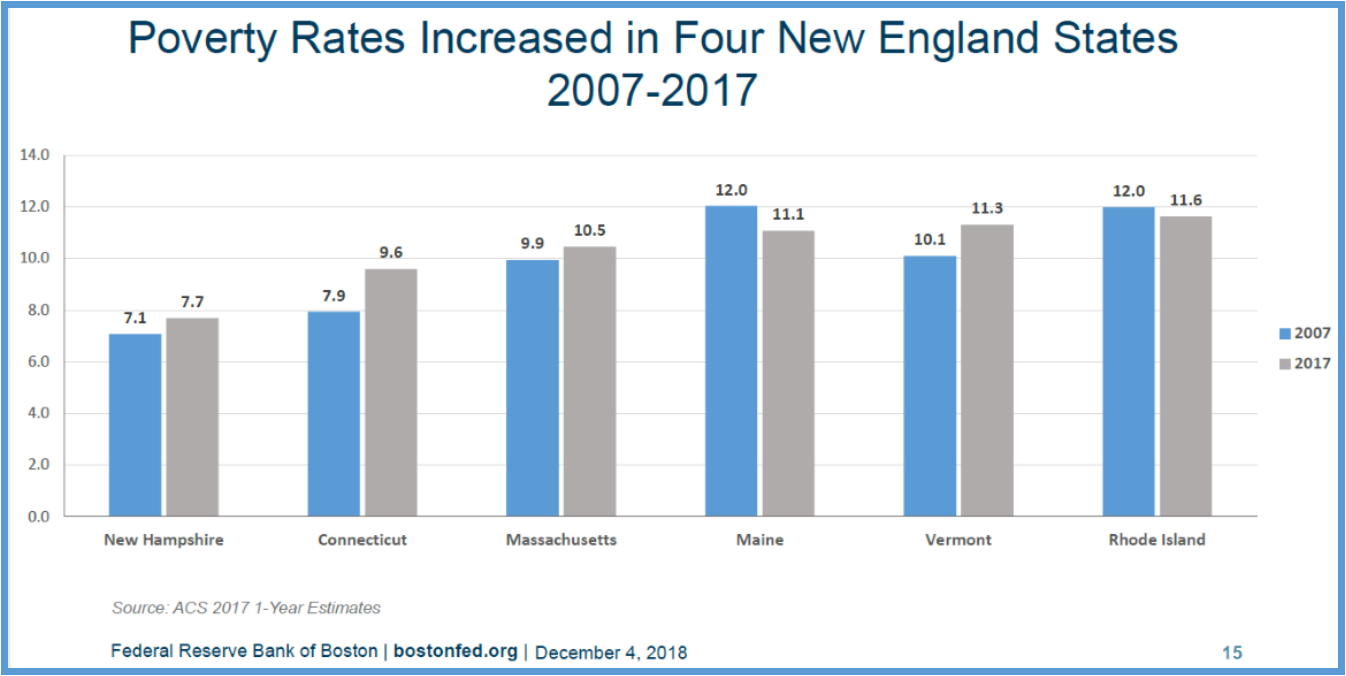
 Although poverty rates declined in all New England states between 2014 and 2017, as of 2017 four out of the six states exhibit higher poverty rates than they did in 2007. Among the region’s unemployed workers, the poverty rate as of 2017 is higher than it was in 2007, and it’s also higher than it was in 2010, after the recession had officially ended, the Boston Fed
  “In 2012, when the



 “We strive to help advisers understand and anticipate stock market and economic changes to be able to provide the best guidance for their clients,” said Juliana Dalton, CFA, president of CFA Society Hartford. Members include CFA® charterholders employed by leading financial services companies and those who are private wealth managers. While many have been in the field for decades – providing much-needed expertise to a range of clients, particularly in turbulent economic times – CFA Society Hartford also continues to reach out to young professionals, as well as college students considering careers in the financial services industry.
 “For the past nine years, analysts have predicted apocalypse for the U.S. economy around every corner, but the strong market and economic recovery are both the longest ever,” commented Dalton. The program will look ahead at what might be next.
 The forecast dinner’s lead speakers will also provide insight. Brian Wesbury is Chief Economist at First Trust Advisors L.P., a financial services firm based in Wheaton, Illinois. He has been a member of the Academic Advisory Council of the Federal Reserve Bank of Chicago since 1999. In 2012, he was named a Fellow of the George W. Bush Presidential Center. In 1995 and 1996, he served as Chief Economist for the Joint Economic Committee of the U.S. Congress, and has been ranked by the Wall Street Journal as the nation’s #1 U.S. economic forecaster (2001), and by USA Today as one of the nation’s top 10 forecasters (2004). Denise Merrill was re-elected in 2018 to her third term as Secretary of the State of Connecticut, and is past president of the National Association of Secretaries of the State. She previously served in the Connecticut House of Representatives. Her office oversees elections and business data, among its responsibilities.
 Current pricing for roundtrip flights in May: from $78 to Raleigh/Durham and Orlando, from $118 to Denver, depending upon length of stay and day of the week of selected flights.
 In addition, “the unemployment rate in [metro] Hartford for adults with at least a bachelor's degree is the lowest in all the metropolitan areas analyzed, whereas last year, it was in the middle of the pack.”

 The new center at Sacred Heart University will further Verizon’s commitment to cultivate strong relationships with academic institutions with emerging technology curricula, officials stressed. The coworking spaces allow Verizon to tap into local startup and innovation networks, build relationships with potential partners and open new doors for ideas and technology. With Verizon, Alley is bridging the gap between startup and corporation by helping the community workspace build next-level ecosystems for entrepreneurs. Verizon provides entrepreneurs and start-up companies working on new products with the technology and services they need for growth.