CT Ranked #4 in US in Education, Economic, Civic Opportunity
/Including Connecticut, ranked #4 nationally, the New England states grabbed five of the top 10 slots in the Opportunity Index, an analysis of “how opportunities measure up” in communities across the country. The Opportunity Index is an annual composite measure at the state and county levels of economic, educational and civic factors that expand opportunity.
Leading the opportunity rankings are Vermont, Massachusetts, New Hampshire, Connecticut, New Jersey, Maryland, North Dakota, Nebraska, Maine and Minnesota. Connecticut exceeded the national average in all three components – Jobs and Local Economy, Education, and Community Health and Civic Life.
In the Education component of the Opportunity Index, Connecticut ranked second. The state ranked sixth in the Community aspect of the index, but 20th in the Economy scorecard. The Economy rankings included data on jobs, wages, poverty, inequality, access to banking, affordable housing and internet access.
Connecticut’s overall score was 62.8, compared with the national average of 54.0. Among Connecticut’s eight counties, the best overall opportunities are in Middlesex County, which earned a 63.1 score. Next were Tolland County, 62.3; Fairfield County,62.1; Litchfield County, 60.6; Hartford County 59.5; New Haven County, 56.8; New London County, 54.3; and Windham County 51.2.
The index was jointly developed by Measure of America and Opportunity Nation.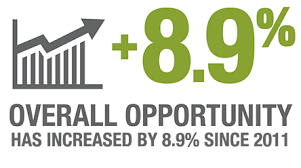
Nationally, overall opportunity has increased by 8.9 percent since 2011, as unemployment has dropped and violent crime has been reduced, the data indicated. In addition, the rate of young adults from age 16 to 24 who are neither working nor in school has fallen 9.1% since 2011, but remains above pre-recession levels. This number has decreased slightly since 2015.
Opportunity Nation is a bipartisan, national coalition of more than 350 businesses, nonprofits, educational institutions and community leaders working to expand economic opportunity. Opportunity Nation seeks to close the opportunity gap by amplifying the work of its coalition members, advocating policy and private sector actions and releasing the annual Opportunity Index. Measure of America provides easy-to-use yet methodologically sound tools for understanding well-being and opportunity in America.
The data, according to survey sponsors, comes from the U.S. Census Bureau, the Bureau of Labor and Statistics, the Federal Communications Commission, the National Center for Education Statistics, the Center for Disease Control and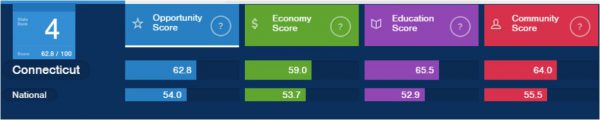 Prevention and the U.S. Department of Justice.


 Nearly two-thirds of those surveyed in Connecticut (64%) called for “using technology to enhance the way students learn in the classroom” – the highest percentage among the six New England states. A majority called for “more significant efforts to close achievement gaps” (59%), more effective teachers (62%) and changes to the ways schools are funded (57%). The state legislature in Connecticut is currently considering changes in the school funding formula proposed by Gov. Malloy in the wake of a state court decision.


 “The U.S. population is increasingly diverse. Cultural competency is essential to deliver health care services that meet the needs of each individual and improves overall health,” said Christina Stasiuk, D.O., National Medical Director for Health Equity at Cigna.

 Connecticut’s best ranked Congressional district is the 2nd, in Eastern Connecticut, with an 8.7 percent of youth ages 16-24 disconnected, ranking 60th among the nation’s 435 Congressional districts. Next best if Connecticut’s 5th district, in Western Connecticut, ranked 116th with 9.9 percent disconnected youth. The 3rd C.D. ranks 134th, at 10.1 percent; the 4th C.D ranks 104th with 10.3 percent; and the 1st C.D. ranks 167th at 10.9 percent.
 The Office “actively assists local, national and international motion picture, TV and media production entities with finding locations in Connecticut, rules and procedures, securing permits, hiring local cast and crew and other services,” according to the agency’s website. In addition, the Office “represents the state and its agencies, municipalities and resident media professionals in interactions with media production entities and the industry at large.”
 venue in the city. Ralph Edwards/Stu Billett Productions received nearly $4 million in tax credits in fiscal year 2016, spending just over $13 million in the state on a number of prominent program productions.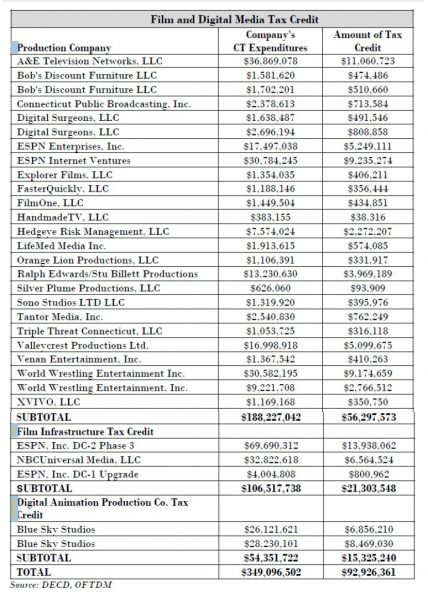

 The five-story building will see researchers will move in to the new space this summer, beginning in July. It will be the first structure on the Storrs campus to utilize an “open lab” concept for research. The shared research space and open floor plan is intended to make it easier for scientists from different disciplines to collaborate, fostering innovation,

 “More than Food focuses on promoting healthy food in pantries and helping people access other resources to find a job. We’re proud to support a partnership that is trying to find a solution to the hunger problem,” said Chris Traczyk, executive director of the Farmington Bank Community Foundation. “It’s a comprehensive, collective-impact project.” Dr. Katie Martin, assistant professor and director of the Public Health Program at USJ, and her research team developed a nutrition stoplight system called Supporting Wellness at Pantries, or “SWAP”, which helps food pantry clients choose healthier foods.

 The Connecticut Technology Council's annual
  Data used to create the ranking were collected from U.S. Census Bureau, Bureau of Labor Statistics, National Science Foundation, National Center for Education Statistics, Georgetown University’s Center on Education and the Workforce, United States Patent and Trademark Office, Ewing Marion Kauffman Foundation, Tax Foundation, Consumer Technology Association, Akamai Technologies, U.S. Cluster Mapping Project and National Venture Capital Association.