Immigration Is Key to Connecticut's Economic Strength, Report Shows
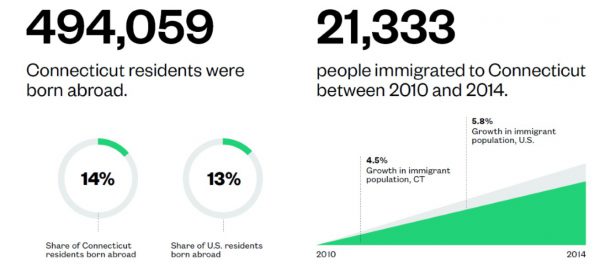
/By 2014, Connecticut was home to almost half a million people who were born abroad. In Connecticut, like the country as a whole, immigrants are currently punching far above their weight class as entrepreneurs, according to a report issued last year highlighting the impact of immigrants in the state. Foreign-born workers make up 21.3 percent of all entrepreneurs in the state, despite accounting for 13.7 percent of Connecticut’s population. Their firms generated $1.1 billion in business income in 2014, according to the report.
The report, “The Contributions of New Americans in Connecticut,” was prepared by the Partnership for a New American Economy, an organization that “brings together more than 500 Republican, Democratic and Independent mayors and business leaders who support sensible immigration reforms that will help create jobs for Americans.”
Immigrants are nothing new in Connecticut. Even the Land of Steady Habits keeps changing. In 1990, the state was already home to more than 279,000 immigrants, a group that made up 8.5 percent of Connecticut’s population overall. By 2010, the number of immigrants in this small state had grown to almost 473,000 people. By 2014, Connecticut was home to almost half a million people who were born abroad.
The report research also found:
- Of the 18 Fortune 500 firms based in the state, 50 percent have at least one founder who was an immigrant or the child of an immigrant. For the country as a whole, the equivalent figure is 41.4 percent.
- In Connecticut immigrants held $13.8 billion in spending power in 2014, defined in this brief as the net income available to a family after paying federal, state, and local taxes.
- In Connecticut 69.8 percent of the foreign-born population is working aged, defined in the report as between the ages 25 and 64, while only 50.8 percent of the native-born population is. That 19 percentage point gap has major implications for the state’s workforce.
- Foreign-born residents makeup more than one in three employees in the state’s computer systems design and related services industry. They also account for 32.2 percent of the state’s workers in medical equipment and supplies, contributing to Connecticut’s sizeable medical devices and supplies manufacturing industry, which generated more than $2.1 billion in sales in 2012.
- Despite making up 13.7 percent of the state’s population, foreign-born Connecticut residents made up 23.8 percent of STEM workers in the state in 2014.
Research for the report also found that in 2016 nearly one in three physicians in Connecticut graduated from a foreign medical school, “a likely sign they were born elsewhere.” Only six other U.S. states had a higher share of foreign-educated physicians. Immigrant healthcare practitioners also made up 15.3 percent of the state’s nurses in 2014, as well as 29.5 percent of those working as nursing, psychiatric, or home health aides. Both those figures were higher than the national average.

 Sponsor), Eversource (Gold Sponsor), AT&T (Gold Sponsor), Accounting Resources, Inc. (Silver Sponsor), Qualidigm (Silver Sponsor), CT by the Numbers (Silver Sponsor), and Aeton Law Partners (Silver Sponsor). The David Alan Hospitality Group and Capture provided in-kind services.

 ess to the issue of childhood drownings. Steven Hernández,, Executive Director of the Commission on Women,
  The statistics about children’s drowning deaths have not changed over time, implying that current strategies for prevention are not enough, officials said. Increasing children’s access to swim lessons, encouraging schools to teach water safety skills to students and giving parents easy-to-use and engaging tools to talk to their children about how to be safe around water are just a few actions that can have a big effect in reducing drowning rates, officials stressed.
 uracy of Fake News," appears on SSSN, a site "devoted to the rapid worldwide dissemination of research."
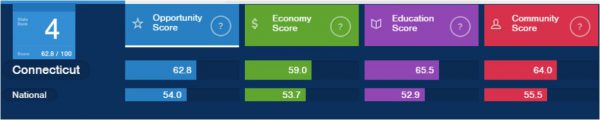
 and Minnesota. Connecticut exceeded the national average in all three components – Jobs and Local Economy, Education, and Community Health and Civic Life.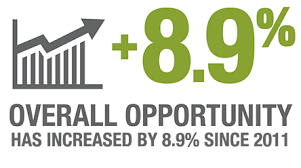
 Prevention and the U.S. Department of Justice.

 Nearly two-thirds of those surveyed in Connecticut (64%) called for “using technology to enhance the way students learn in the classroom” – the highest percentage among the six New England states. A majority called for “more significant efforts to close achievement gaps” (59%), more effective teachers (62%) and changes to the ways schools are funded (57%). The state legislature in Connecticut is currently considering changes in the school funding formula proposed by Gov. Malloy in the wake of a state court decision.


 “The U.S. population is increasingly diverse. Cultural competency is essential to deliver health care services that meet the needs of each individual and improves overall health,” said Christina Stasiuk, D.O., National Medical Director for Health Equity at Cigna.

 Connecticut’s best ranked Congressional district is the 2nd, in Eastern Connecticut, with an 8.7 percent of youth ages 16-24 disconnected, ranking 60th among the nation’s 435 Congressional districts. Next best if Connecticut’s 5th district, in Western Connecticut, ranked 116th with 9.9 percent disconnected youth. The 3rd C.D. ranks 134th, at 10.1 percent; the 4th C.D ranks 104th with 10.3 percent; and the 1st C.D. ranks 167th at 10.9 percent.