Connecticut Earns A+ in Government Data Transparency
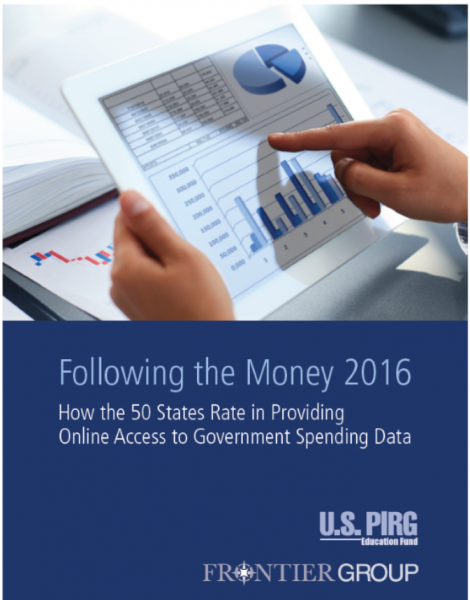
/Connecticut is one of five states providing state residents with the most comprehensive online access to government spending data, according to an analysis by the U.S. Public Interest Research Group (USPIRG). Nationwide, government spending transparency is improving, but many states still lag far behind, according to “Following the Money 2016: How the 50 States Rate in Providing Online Access to Government Spending Data,” the sixth annual report by the organization’s Education Fund. Some states have improved their spending transparency web portals significantly, earning perfect scores in this year’s report, while others are still barely achieving the minimum standards.
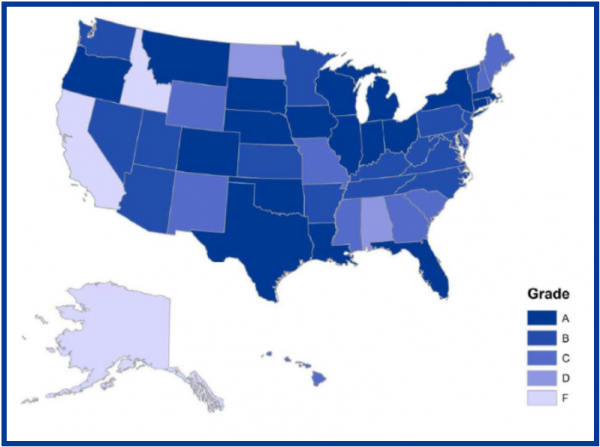
 Based on an inventory of the content and ease-of-use of states' transparency websites, the report assigns each state a grade of “A+” to “F.” The leading states with the most comprehensive transparency websites are Ohio, Michigan, Indiana, Oregon, and Connecticut, with each receiving an A+ grade.
“This A+ is great news – and comes at an important time as Connecticut navigates new fiscal challenges and prickly public policy debates. Facts and truth – not shadowy special interests – should be driving our discussions here at the capitol. The only way to ensure an honest discussion about our financial future is to open government and deliver the truth to the public," said State Comptroller Kevin Lembo. "We are doing everything we can to deliver state financial information in bigger and better ways each year. With a few keystrokes, all of us can find out where state money is going and where it came from. Most recently we have been working to extend that transparency to our quasi-public agencies, as well as towns and cities across the state. We are grateful that ConnPIRG recognized our efforts – and promise that we will treat this grade as a starting point, not a finish line, in making Connecticut the most open and accountable state in the country.”
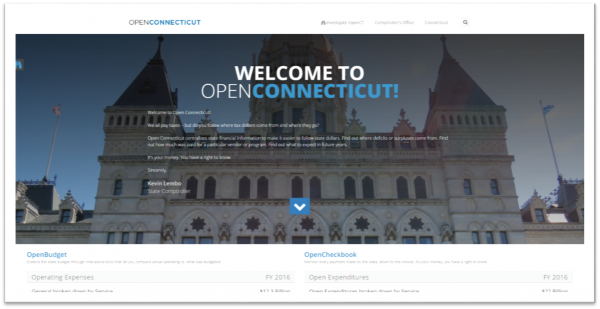
The Comptroller’s Office website providing state government financial data is www.osc.ct.gov/openCT
The report indicates the cost to maintain the website at $18,000, with start-up costs from existing budgetary resources. Among the state programs cited as providing easily accessible data to the public are the Enterprise Zone and Urban Jobs Tax Credit, Film and Digital Media Tax Credits, Jobs Creation Tax Credit, Manufacturing Assistance Act, and Small Business Express programs.
Connecticut’s most significant improvements include the addition of a page that details what data is excluded from the site, allowing citizens to better understand the universe of information the state is providing, according to the state Comptroller's Office. The state also added more information about the projected and actual public benefits of some of its largest subsidy programs. The state could continue to improve its transparency efforts by expanding its site to include spending information from municipalities and more local government bodies, the report noted.
USPIRG officials point out that states that have created or improved their online transparency have typically done so with little upfront cost. Top-flight transparency web portals can save money for taxpayers, while also restoring public confidence in government and preventing misspending and pay-to-play contracts.
“Citizens deserve to be able to follow their tax dollars, from the most minor state expenditures to the most major development subsidies,” said Michelle Surka, program associate with U.S. Public Interest Research Group Education Fund. “This year, it’s clear that several states made a commitment to meeting the high national standards for spending transparency. Other states continue to lag behind, unable to overcome some of the barriers that prevent comprehensive spending disclosures.”
“States’ online spending transparency efforts are paying off in better informed citizens and a more efficient government,” said Elizabeth Ridlington, policy analyst with Frontier Group and co-author of the report. “Our research found that top-ranked states have been making steady improvements to their transparency websites over the years, giving citizens in most states unprecedented access to information on where their tax money goes.”
While many states cont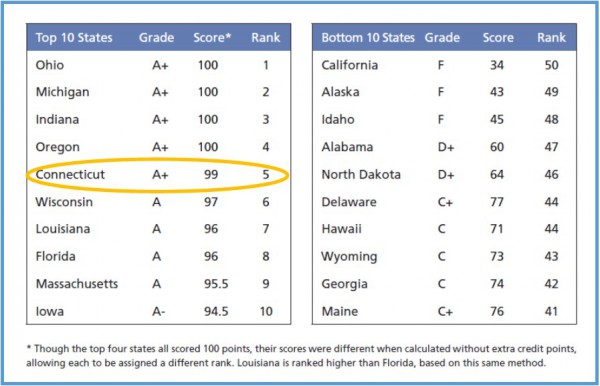 inue to improve, the states that most distinguished themselves as leaders in spending transparency are those that provide access to types of expenditures that otherwise receive little public scrutiny. Only 11 states- including Connecticut - provide checkbook-level information that includes the recipients of each of the state’s most important subsidy programs.
This year, most states have met basic standards for providing online access to information about state contracting and an increasing number provide information about economic development subsidies and off-budget agencies. Several states have made substantive upgrades to their transparency sites or added new features that give the public unprecedented ability to monitor how their government allocates resources. Of particular note, as highlighted in the report:
- Michigan streamlined its transparency data and added functionality to its transparency website, including allowing bulk download of all its data.
- West Virginia launched a new site with data on projected and actual public benefits of the state’s major subsidy programs.
- Utah and Arizona have joined several other states in adding data from localities, municipalities and school districts to their state transparency portals. This provides an inexpensive way to improve the transparency of the spending that often affects ordinary citizens most directly.
- Indiana, Minnesota, Nebraska, New Hampshire and Washington now prominently feature data on quasi-public entities with web pages dedicated solely to these agencies, boards, authorities and commissions.
State spending transparency is a non-partisan issue, USPIRG stressed. The report compared transparency scores against party control of Governors’ offices and the state legislatures. For neither measure did higher levels of spending transparency correspond to Republican or Democratic control, according to the report.


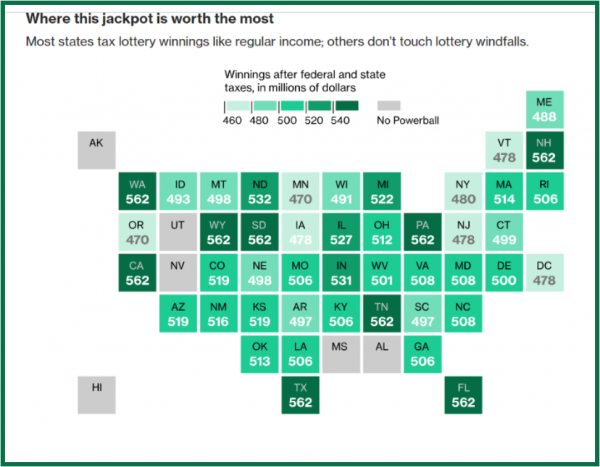
 In an article appearing in this week’s
 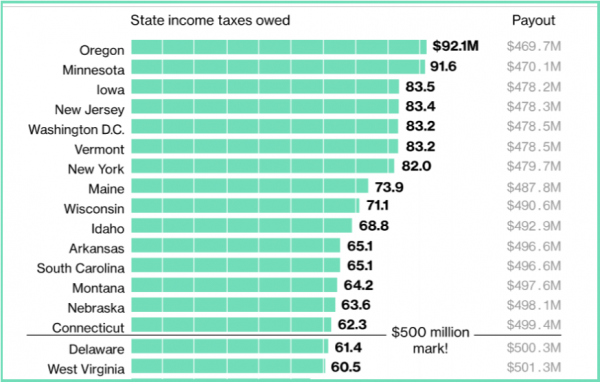 Connecticut’s take on such a jackpot would be 15th highest in the nation, among the states that do tax such winnings at various income tax rates. An analysis by Bloomberg found that the amount of state income taxes owed would be highest for residents of Oregon, Minnesota, Iowa, New Jersey, Washington D.C., Vermont, New York, Maine and Wisconsin.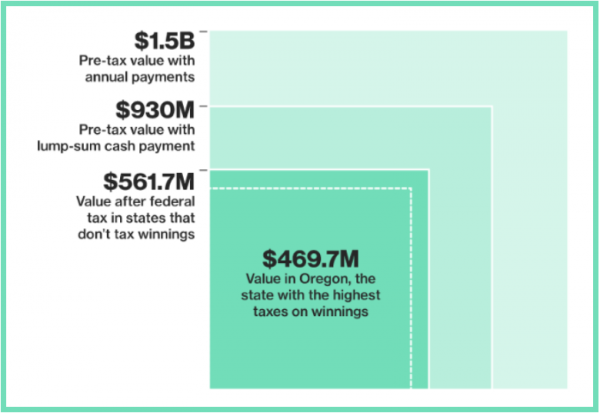
 The issue brief indicated that a disadvantage of a distance toll system on all limited access highways in Connecticut would be that it “could create an incentive for people to use alternative roadways. The increased use of these roadways could shift the burden of maintenance and congestion to municipalities.” The advantage would be that distance tolls “could help to more efficiently allocate the cost of these roadways to drivers who use them the most.”
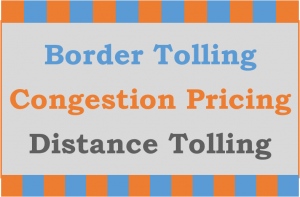 Congestion pricing, which provides for higher toll charges at peak traffic times, “helps to limit traffic on major roadways and create an incentive for people to use more environmentally friendly forms of public transportation,” the policy paper indicates. However, a congestion pricing system “could polarize roadway use by displacing low income commuters during peak driving hours. Congestion pricing could also create displacement effects whereby the increased use of local roadways could shift the burden of maintenance and congestion to municipalities.”

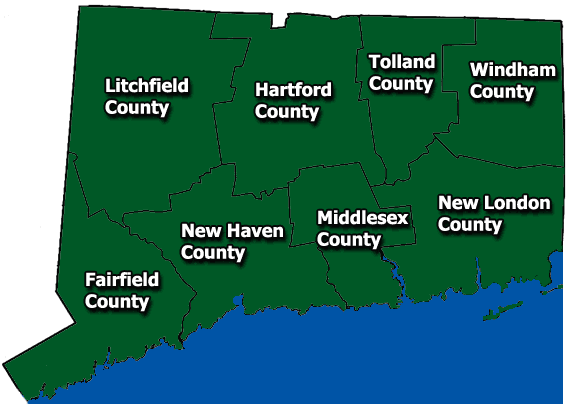 Congressional Districts, with the exception of the Fourth District, did better than the national average in the degree of income inequality.
 stitutions, particularly in low income communities and to people who lack access to financing. By offering tailored resources and innovative programs that invest federal dollars alongside private sector capital, the CDFI Fund serves mission-driven financial institutions that take a market-based approach to supporting economically disadvantaged communities. The institutions to receive CDFI Certification in Connecticut are in the state’s major cities:
 Capital Fund facilitates the flow of capital and expertise into housing and economic developments that “benefit low and moderate income people in the Greater Bridgeport Area.” It was formed in 2005 from the merger of two loans funds.
 he Middlesex Credit Union, Seasons Federal Credit Union was renamed in 2006 after expanding into New Haven County. Over the years, the credit union has “broadened its services beyond simple share savings and small loans to meet the increasingly diverse financial needs of its growing membership.”
 such as credit history, language, cultural differences, financial literacy, or lack of economic assets--that can isolate people from the financial mainstream. As the Fund’s slogan indicates, “We Finance Hope.”
 Rather than having delegates from throughout the nation stream into Washington, D.C., Americans are asked to watch events unfold via live stream – either at home, or by getting together with co-workers or people from their local communities. Officials note that more than 600 public and private Watch Parties—in every state—have been organized and registered with WHCOA.

 rez, U.S. Department of Labor. The panel will include Jean Chatzky, AARP Financial Ambassador; Vickie Elisa, Mothers’ Voices Georgia;
  emarks or participating in panels are Secretary Tom Perez, U.S. Department of Labor; DJ Patil, White House Office of Science and Technology Policy; Secretary Tom Vilsack, U.S. Department of Agriculture; professional athlete Diana Nyad; Vice Admiral Vivek Murthy, U.S. Surgeon General; Director Richard Cordray, Consumer Financial Protection Bureau; and Stephanie Santoso, White House Office of Science and Technology Policy.
 Iowa Governor Terry Branstad provided opening remarks at Wednesday’s session, followed by Malloy’s keynote address. Branstad, a Republican, and Malloy, a Democrat, were re-elected by voters in their respective states last fall.