Awards Will Recognize Innovative Efforts Invigorating CT Main Streets
/A local theater helping to re-energize downtown Fairfield and a New London developer and property manager who took it upon himself to improve a neighborhood by offering attractive housing that is also affordable are just two of the initiatives being recognized with a 2016 Award of Excellence from the Connecticut Main Street Center (CMSC). In total, five recipients have been selected to receive the prestigious awards, including organizations and initiatives from Fairfield, Farmington, Mansfield, New London and Waterbury.
Also being recognized with awards are a public outreach effort in Farmington that resulted in hundreds of residents voicing their opinion on plans for a new gateway into the town; a holiday window display competition that draws shoppers back to downtown Waterbury while garnering extra press and marketing for the businesses; and a new Town Square in Storrs Center, built around the unique needs of the space and the people that use it.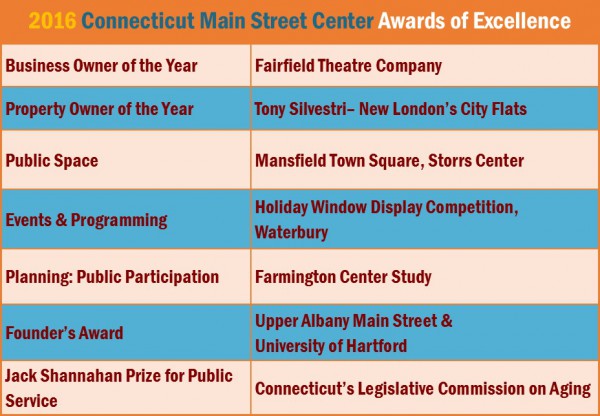
This year's awards will be presented on June 6th at E.O. Smith High School in downtown Storrs. CMSC’s mission is to be the catalyst that ignites Connecticut's Main Streets as the cornerstone of thriving communities. CMSC is dedicated to community and economic development within the context of historic preservation, and is committed to bringing Connecticut's commercial districts back to life socially and economically.
In addition to the competitive Awards of Excellence, where CMSC members submit applications that are reviewed by a jury of industry-related professionals and CMSC staff, CMSC also named Upper Albany Main Street (a CMSC member community) and the University of Hartford to receive the Founder's Award for their long and fruitful partnership - a relationship that has not only helped improve the appearance of the Avenue, but empowered many of the small business merchants in the neighborhood as well.
In addition, the Jack Shannahan Prize for Public Service was awarded to the Legislative Commission on Aging in recognition of their Livable Communities initiative. This initiative aims to create thriving places for residents to grow up and grow older, notably by helping prepare Connecticut for the challenges presented by a rapidly increasing aging demographic through education, awareness and advocacy.
"This year's crop of winners is really special, because they demonstrate how important incorporating the voice of the people is in the final success of a project," said CMSC President & CEO John Simone. "In Farmington, Fairfield and Mansfield especially, each one either specifically asked - or was smart enough to observe - what people wanted in the space, and made changes accordingly. As a result, there is greater support and usage of their public spaces and private businesses, meaning more people on Main Street and more money for the town coffers."
The June 6 awards ceremony will be followed by interactive experiences in the new Storrs Center. Activities will include guided tours of the downtown development, a collaboration with the Ballard Institute and Museum of Puppetry, time for dinner and exploration among the Center's many shops and restaurants, and a closing concert featuring the Funky Dawgz Brass Band.
Created in 2003 to recognize outstanding projects, individuals and partnerships in community efforts to bring traditional downtowns and neighborhood commercial districts back to life, socially and economically, the Awards of Excellence are presented annually at CMSC's Awards Gala. The evening’s welcome Reception Sponsor is United Illuminating and awards are presented with support from Webster Bank and Eversource Energy.
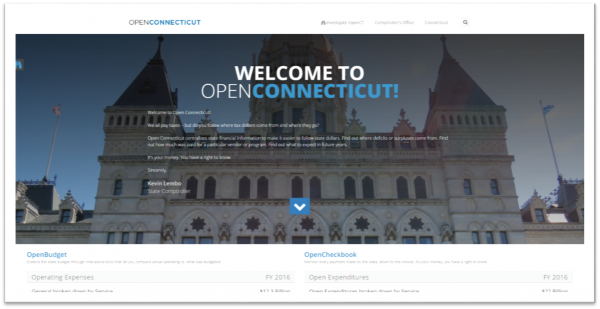 Based on an inventory of the content and ease-of-use of states' transparency websites, the report assigns each state a grade of “A+” to “F.” The leading states with the most comprehensive transparency websites are Ohio, Michigan, Indiana, Oregon, and Connecticut, with each receiving an A+ grade.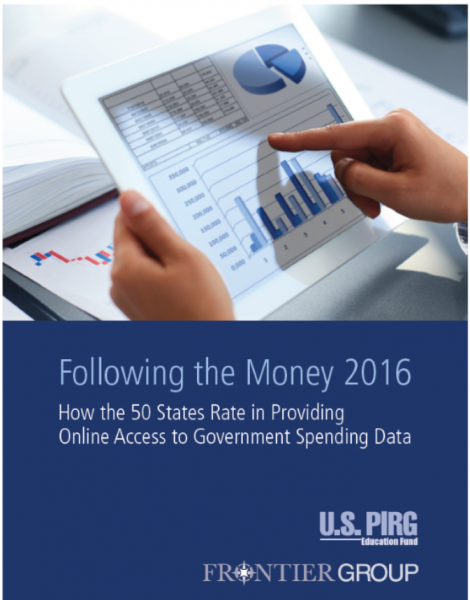
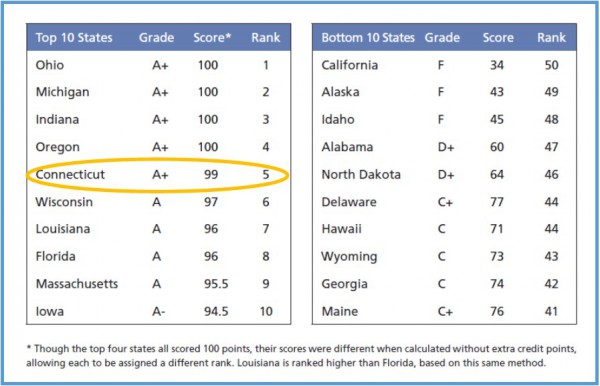 inue to improve, the states that most distinguished themselves as leaders in spending transparency are those that provide access to types of expenditures that otherwise receive little public scrutiny. Only 11 states- including Connecticut - provide checkbook-level information that includes the recipients of each of the state’s most important subsidy programs.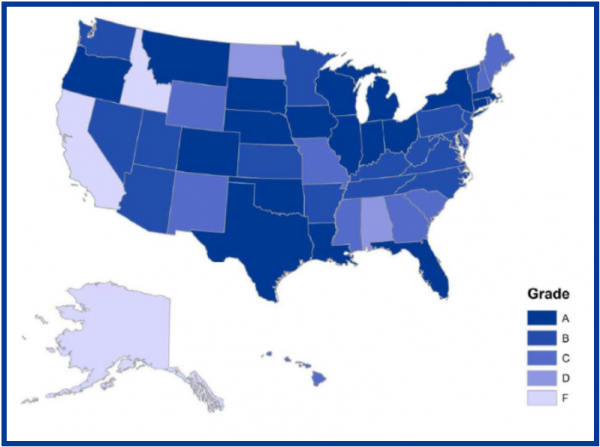


 In an article appearing in this week’s
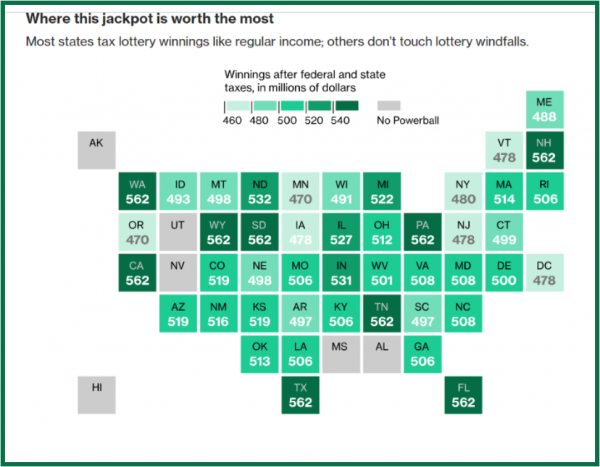
 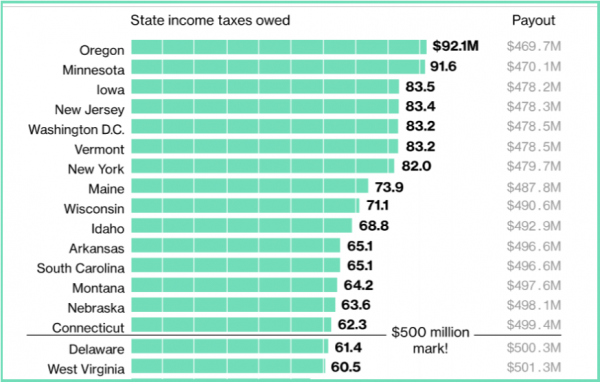 Connecticut’s take on such a jackpot would be 15th highest in the nation, among the states that do tax such winnings at various income tax rates. An analysis by Bloomberg found that the amount of state income taxes owed would be highest for residents of Oregon, Minnesota, Iowa, New Jersey, Washington D.C., Vermont, New York, Maine and Wisconsin.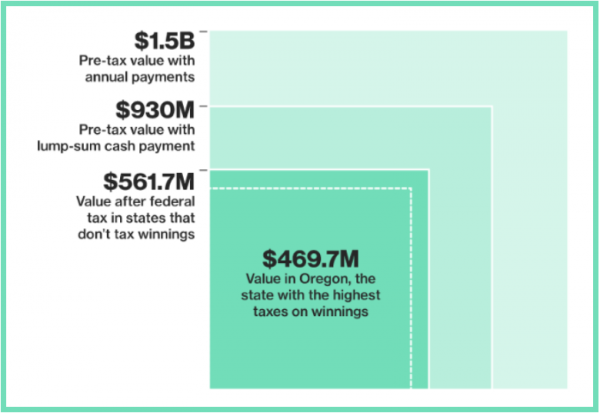
 The issue brief indicated that a disadvantage of a distance toll system on all limited access highways in Connecticut would be that it “could create an incentive for people to use alternative roadways. The increased use of these roadways could shift the burden of maintenance and congestion to municipalities.” The advantage would be that distance tolls “could help to more efficiently allocate the cost of these roadways to drivers who use them the most.”
 Congestion pricing, which provides for higher toll charges at peak traffic times, “helps to limit traffic on major roadways and create an incentive for people to use more environmentally friendly forms of public transportation,” the policy paper indicates. However, a congestion pricing system “could polarize roadway use by displacing low income commuters during peak driving hours. Congestion pricing could also create displacement effects whereby the increased use of local roadways could shift the burden of maintenance and congestion to municipalities.”

 Congressional Districts, with the exception of the Fourth District, did better than the national average in the degree of income inequality.
 stitutions, particularly in low income communities and to people who lack access to financing. By offering tailored resources and innovative programs that invest federal dollars alongside private sector capital, the CDFI Fund serves mission-driven financial institutions that take a market-based approach to supporting economically disadvantaged communities. The institutions to receive CDFI Certification in Connecticut are in the state’s major cities:
 Capital Fund facilitates the flow of capital and expertise into housing and economic developments that “benefit low and moderate income people in the Greater Bridgeport Area.” It was formed in 2005 from the merger of two loans funds.
 he Middlesex Credit Union, Seasons Federal Credit Union was renamed in 2006 after expanding into New Haven County. Over the years, the credit union has “broadened its services beyond simple share savings and small loans to meet the increasingly diverse financial needs of its growing membership.”
 such as credit history, language, cultural differences, financial literacy, or lack of economic assets--that can isolate people from the financial mainstream. As the Fund’s slogan indicates, “We Finance Hope.”
 Rather than having delegates from throughout the nation stream into Washington, D.C., Americans are asked to watch events unfold via live stream – either at home, or by getting together with co-workers or people from their local communities. Officials note that more than 600 public and private Watch Parties—in every state—have been organized and registered with WHCOA.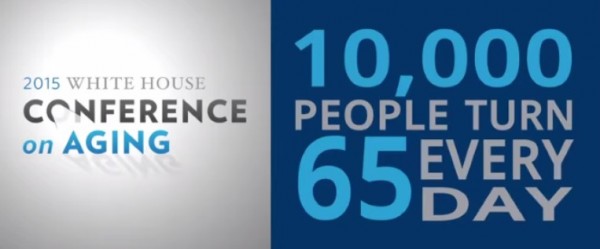
 rez, U.S. Department of Labor. The panel will include Jean Chatzky, AARP Financial Ambassador; Vickie Elisa, Mothers’ Voices Georgia;
  emarks or participating in panels are Secretary Tom Perez, U.S. Department of Labor; DJ Patil, White House Office of Science and Technology Policy; Secretary Tom Vilsack, U.S. Department of Agriculture; professional athlete Diana Nyad; Vice Admiral Vivek Murthy, U.S. Surgeon General; Director Richard Cordray, Consumer Financial Protection Bureau; and Stephanie Santoso, White House Office of Science and Technology Policy.
 Iowa Governor Terry Branstad provided opening remarks at Wednesday’s session, followed by Malloy’s keynote address. Branstad, a Republican, and Malloy, a Democrat, were re-elected by voters in their respective states last fall.