Most CT Residents Concerned About Loss of Jobs, Access, Care in Aetna-Humana Merger, Poll Shows; Missouri Decision Points to Adverse Impact

The State of Missouri raised a red flag today, waving it directly into the headwind that is the pending merger between health care giants Aetna and Humana.  Missouri’s action came just as a public poll was released in Connecticut by consumer advocates opposing the merger which indicated a general lack of public awareness about the merger plan and substantial concern about potential job losses and adverse health care affordability and choices here if the merger goes forward. The Missouri Insurance Department issued an order banning Aetna and Humana from selling certain types of insurance in the state if the companies’ planned $37 billion merger comes to fruition. The order states that Aetna and Humana should “cease and desist from doing business” throughout Missouri with respect to individual and small group insurance and the group Medicare Advantage market if Aetna’s acquisition of Humana is completed.aetna humana
In Connecticut, the Connecticut Campaign for Consumer Choice coalition released results of a recent poll which found that most Connecticut voters “didn’t know that the five major national health insurance companies – UnitedHealth, Anthem, Cigna, Aetna, and Humana - are attempting to merge down to three companies from five. The new research found that only 27 percent of respondents were aware of the plans.Picture8

After they were given more information about the consequences of the mergers among the five national health insurance providers (Aetna-Humana and CIGNA-Anthem), 71 percent of Connecticut voters were opposed to State Insurance Commissioner Katherine Wade approving the mergers in Connecticut.

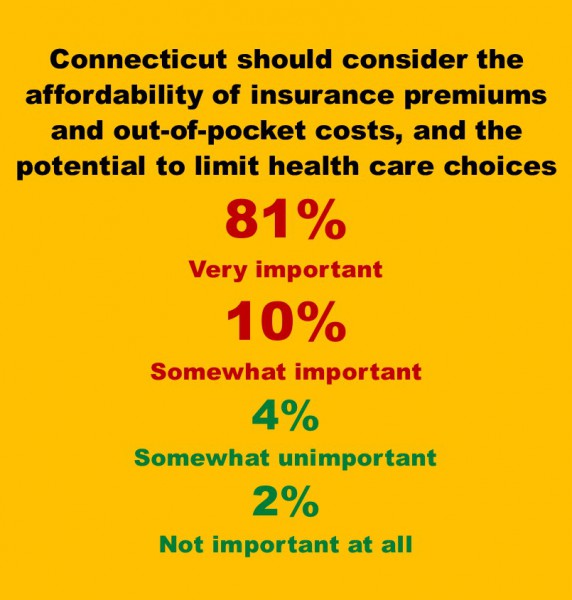
Nine in ten state voters (91 percent) think that it’s either very or somewhat important that Commissioner Wade “considers the impact of these mergers on the affordability of insurance premiums and out-of-pocket costs, and their potential to limit health care choices, in her decision making process.” And those surveyed were overwhelmingly concerned that the proposed mergers will lead to job losses in Connecticut.stat1
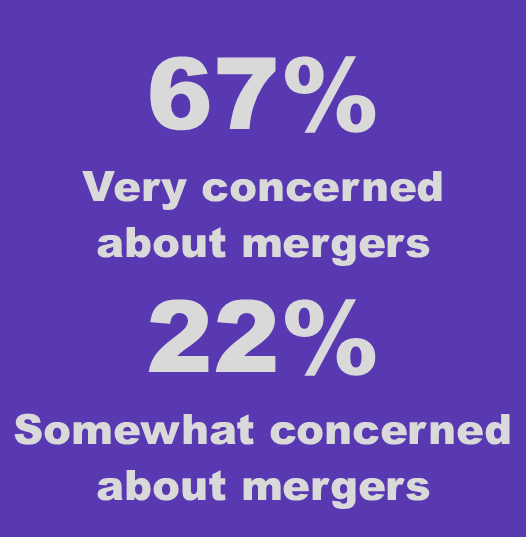
The Connecticut survey, conducted earlier this month by Public Policy Polling, found that 89 percent of Connecticut voters are either very or somewhat concerned that the proposed mergers will lead to job losses in Connecticut. Additionally, 89 percent of those polled believe it’s either very or somewhat important that the impact of these mergers on job losses in Connecticut be considered by state regulators.

Missouri is the first state regulator to release findings against the proposed deal, announced last year, published reports indicated. The deal is being reviewed by the U.S. Department of Justice, as well as state regulators and antitrust authorities, who are also reviewing competitor Anthem’s plan to buy Cigna Corp. Aetna has filed for regulatory approval in the 20 states where Humana is domiciled and of those, 15 have approved the deal thus far, including Connecticut.  Because of Humana's limited footprint in Connecticut, the review was more form than substance.  The Cigna-Anthem merger, however, is to receive a much fuller review, according to state insurance officials, as Cigna is a state-domiciled company.

Regarding Aetna-Humana, the Missouri Insurance Department “found that in its current, unmodified, form – as to a few specified lines of insurance – that the proposed acquisition would violate the competitive standard set forth in Missouri law, meaning that as to those lines the acquisition would substantially lessen competition in this state.”

The Missouri Insurance Department stressed that the decision “is not a final order. The statute provides that Aetna and Humana may submit a plan to remedy the anticompetitive effect of the merger as to those specified lines.”  If that step is taken, the department “would evaluate the plan and may modify or vacate” the order issued today banning the merged company from certain lines of insurance in the state.

"The Missouri order does not impede the Department of Justice approval process," Aetna said in a statement. "We're disappointed, but expect to have a constructive dialogue with the state to address their concerns."
Picture7In addition to the public poll, Connecticut Campaign for Consumer Choice – a coalition that includes the Universal Health Care Foundation, Connecticut Citizen Action Group and Connecticut State Medical Society -  released a letter to Commissioner Wade signed by 17 state legislators calling for multiple public hearings on the merger, intervenor status for interested consumer advocates, and a study that would “analyze the potential impact on cost, access, and the Connecticut economy, including jobs” and warning that if the merger is approved, “the resulting mega-insurer will cover 64 percent of covered lives in Connecticut, with an even greater concentration in some regions of our state.”

The Missouri decision comes following a public hearing held on May 16.  In testimony provided as part of the public record, Consumers Council of Missouri expressed “profound concern,” warning that the merger would result in a “significant reduction in competition (that) will most certainly result in increased cost to consumers,” adding that “the results will be catastrophic and we will have no power to undo it.”

The Missouri Hospital Association, in offering a detailed 21-page analysis, indicated that “Consolidation will affect the ability of hospitals and other health care providers to bargain competitively for contracts containing appropriate fees for medical services. In turn, such providers are less able to invest in the resources to maintain and improve the quality of care. An anticompetitive suppression of healthcare payments will suppress innovation, to the detriment of consumers.”
CT Aims to Keep Ultra-Wealthy in State; Tracks Tax Payments of 100 Top Earners

Connecticut is ranked second in the nation in the number of millionaires per capita.  Only Maryland has more.  But with Connecticut’s precarious financial situation amidst what has been described as a “new economic reality,” any drop in the plethora of extremely wealthy residents can almost instantly have far-reaching consequences, officials say. In Connecticut, as well as California, Maryland and New Jersey, the top 1 percent pay a third or more of total income taxes, The New York Times reported this month. “There's an outmigration trend. It's real,'' Sullivan recently told The Hartford Courant, describing the departure of wealthy residents from Connecticut.

But Connecticut is not sitting idly by.  The state is trying to keep its wealthy residents right here in the Land of Steady Habits.DRS

Connecticut, the Times reported, now tracks the quarterly estimated payments of 100 of its top earners. State Revenue Services Commissioner Kevin B Sullivan told Inside Wealth columnist and CNBC wealth editor Robert Frank that about five or six of the highest earners could have a "measurable impact on the revenue stream."

By way of example, Sullivan said that when one of the state's rich hedge fund executives planned to move his family and company to a lower-tax state, state officials met with him and persuaded him to leave some of his work force in Connecticut, the Times reported.  "We knew we were going to lose him," Sullivan said, "but we wanted to keep some of the higher-paying jobs."

chartHe added, “We advised him that there are ways to be close to family and friends in Connecticut on occasion that are perfectly legal.  We're trying to send a more welcoming message to the high earners as a group." Homeowners who spend more than 183 days in the state are considered residents for tax purposes.

The top 10 states in millionaires per capita, after Maryland and Connecticut, are Hawaii, New Jersey, Alaska, Massachusetts, New Hampshire, Virginia, Delaware and the District of Columbia, according to Phoenix Marketing International’s Global Wealth Monitor.

Earlier this year, the Courant reported that one of three Connecticut residents with an 11-figure net worth, according to the latest Forbes magazine list of the forbeswealthiest individuals, had relocated from Greenwich to Florida, the second individual in that tax bracket to do so recently.  The exits, the Courant reported, “leave Connecticut with 13 billionaires, including Ray Dalio ($15.6 billion) and Steven Cohen ($12.7 billion), both hedge fund owners who live in Greenwich.”  Eight of those 13 state residents list Greenwich as their home address, according to Forbes.

Connecticut is not alone in keeping a watchful eye on its billionaires.  New York is now more closely monitoring wealthy taxpayers who have homes in New York but claim Florida as their tax residence. And New Jersey is collecting data on all of the taxpayers who make more than $1 million to forecast their tax payments more accurately, the Times reported.phoenix

As is true in a number of states with wealthy residents, including New York, New Jersey and California, even as some of the state's wealthiest residents head to warmer climates and more favorable tax structures, the number of millionaires in the state grows.

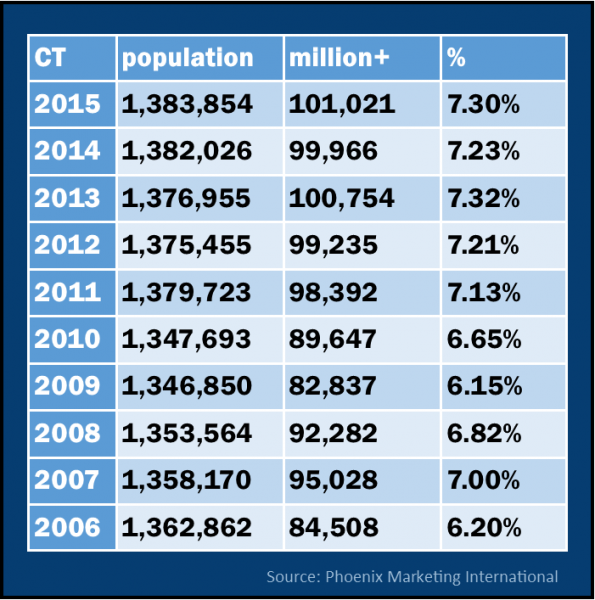
Just three years ago, in 2013, the number of millionaires in Connecticut topped 100,000 for the first time.  In 2015, it exceeded 101,000.  That compares with just over 84,000 in 2006.  Millionaires made up 6.2 percent of state residents that year, compared with 7.3 percent in 2015, based on data from Phoenix Marketing International.

Awards Will Recognize Innovative Efforts Invigorating CT Main Streets

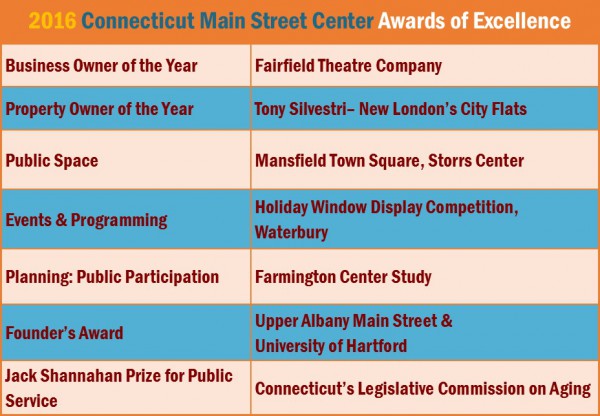
A local theater helping to re-energize downtown Fairfield and a New London developer and property manager who took it upon himself to improve a neighborhood by offering attractive housing that is also affordable are just two of the initiatives being recognized with a 2016 Award of Excellence from the Connecticut Main Street Center (CMSC). In total, five recipients have been selected to receive the prestigious awards, including organizations and initiatives from Fairfield, Farmington, Mansfield, New London and Waterbury.

Also being recognized with awards are a public outreach effort in Farmington that resulted in hundreds of residents voicing their opinion on plans for a new gateway into the town; a holiday window display competition that draws shoppers back to downtown Waterbury while garnering extra press and marketing for the businesses; and a new Town Square in Storrs Center, built around the unique needs of the space and the people that use it.chart

This year's awards will be presented on June 6th at E.O. Smith High School in downtown Storrs.  CMSC’s mission is to be the catalyst that ignites Connecticut's Main Streets as the cornerstone of thriving communities. CMSC is dedicated to community and economic development within the context of historic preservation, and is committed to bringing Connecticut's commercial districts back to life socially and economically.

In addition to the competitive Awards of Excellence, where CMSC members submit applications that are reviewed by a jury of industry-related professionals and CMSC staff, CMSC also named Upper Albany Main Street (a CMSC member community) and the University of Hartford to receive the Founder's Award for their long and fruitful partnership - a relationship that has not only helped improve the appearance of the Avenue, but empowered many of the small business merchants in the neighborhood as well.

In addition, the Jack Shannahan Prize for Public Service was awarded to the Legislative Commission on Aging in recognition of their Livable Communities initiative.  This initiative aims to create thriving places for residents to grow up and grow older, notably by helping prepare Connecticut for the challenges presented by a rapidly increasing aging demographic through education, awareness and advocacy.

"This year's crop of winners is really special, because they demonstrate how important incorporating the voice of the people is in the final success of a project," said CMSC President & CEO John Simone. "In Farmington, Fairfield and Mansfield especially, each one either specifically asked - or was smart enough to observe - what people wanted in the space, and made changes accordingly.  As a result, there is greater support and usage of their public spaces and private businesses, meaning more people on Main Street and more money for the town coffers."mainstreet1

The June 6 awards ceremony will be followed by interactive experiences in the new Storrs Center.  Activities will include guided tours of the downtown development, a collaboration with the Ballard Institute and Museum of Puppetry, time for dinner and exploration among the Center's many shops and restaurants, and a closing concert featuring the Funky Dawgz Brass Band.

Created in 2003 to recognize outstanding projects, individuals and partnerships in community efforts to bring traditional downtowns and neighborhood commercial districts back to life, socially and economically, the Awards of Excellence are presented annually at CMSC's Awards Gala.  The evening’s welcome Reception Sponsor is United Illuminating and awards are presented with support from Webster Bank and Eversource Energy. 

Connecticut Earns A+ in Government Data Transparency

Connecticut is one of five states providing state residents with the most comprehensive online access to government spending data, according to an analysis by the U.S. Public Interest Research Group (USPIRG). Nationwide, government spending transparency is improving, but many states still lag far behind, according to “Following the Money 2016: How the 50 States Rate in Providing Online Access to Government Spending Data,” the sixth annual report by the organization’s Education Fund.  Some states have improved their spending transparency web portals significantly, earning perfect scores in this year’s report, while others are still barely achieving the minimum standards.

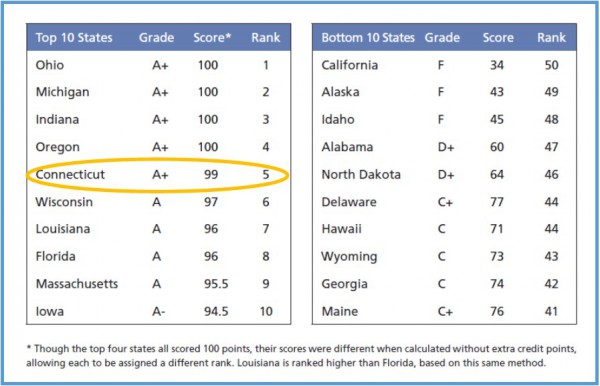
web shotBased on an inventory of the content and ease-of-use of states' transparency websites, the report assigns each state a grade of “A+” to “F.” The leading states with the most comprehensive transparency websites are Ohio, Michigan, Indiana, Oregon, and Connecticut, with each receiving an A+ grade.
“This A+ is great news – and comes at an important time as Connecticut navigates new fiscal challenges and prickly public policy debates. Facts and truth – not shadowy special interests – should be driving our discussions here at the capitol. The only way to ensure an honest discussion about our financial future is to open government and deliver the truth to the public," said State Comptroller Kevin Lembo. "We are doing everything we can to deliver state financial information in bigger and better ways each year. With a few keystrokes, all of us can find out where state money is going and where it came from. Most recently we have been working to extend that transparency to our quasi-public agencies, as well as towns and cities across the state. We are grateful that ConnPIRG recognized our efforts – and promise that we will treat this grade as a starting point, not a finish line, in making Connecticut the most open and accountable state in the country.”

The Comptroller’s Office website providing state government financial data is www.osc.ct.gov/openCT

The report indicates the cost to maintain the website at $18,000, with start-up costs from existing budgetary resources.  Among the state programs cited as providing easily accessible data to the public are the Enterprise Zone and Urban Jobs Tax Credit, Film and Digital Media Tax Credits, Jobs Creation Tax Credit, Manufacturing Assistance Act, and Small Business Express programs.

Connecticut’s most significant improvements include the addition of a page that details what data is excluded from the site, allowing citizens to better understand the universe of information the state is providing, according to the state Comptroller's Office. The state also added more information about the projected and actual public benefits of some of its largest subsidy programs. The state could continue to improve its transparency efforts by expanding its site to include spending information from municipalities and more local government bodies, the report noted.

report

USPIRG officials point out that states that have created or improved their online transparency have typically done so with little upfront cost. Top-flight transparency web portals can save money for taxpayers, while also restoring public confidence in government and preventing misspending and pay-to-play contracts.

“Citizens deserve to be able to follow their tax dollars, from the most minor state expenditures to the most major development subsidies,” said Michelle Surka, program associate with U.S. Public Interest Research Group Education Fund. “This year, it’s clear that several states made a commitment to meeting the high national standards for spending transparency. Other states continue to lag behind, unable to overcome some of the barriers that prevent comprehensive spending disclosures.”

“States’ online spending transparency efforts are paying off in better informed citizens and a more efficient government,” said Elizabeth Ridlington, policy analyst with Frontier Group and co-author of the report. “Our research found that top-ranked states have been making steady improvements to their transparency websites over the years, giving citizens in most states unprecedented access to information on where their tax money goes.”

While many states contchart 1inue to improve, the states that most distinguished themselves as leaders in spending transparency are those that provide access to types of expenditures that otherwise receive little public scrutiny. Only 11 states- including Connecticut - provide checkbook-level information that includes the recipients of each of the state’s most important subsidy programs.
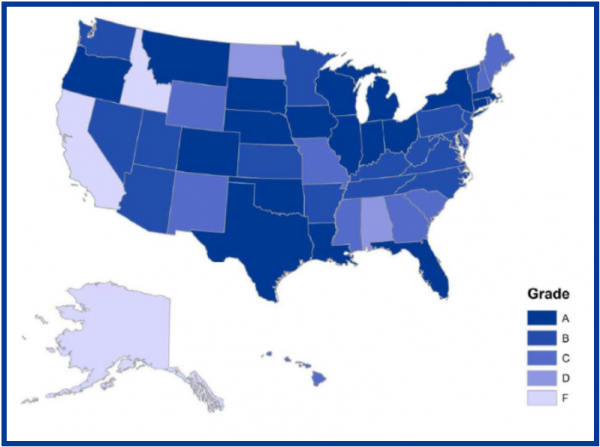
This year, most states have met basic standards for providing online access to information about state contracting and an increasing number provide information about economic development subsidies and off-budget agencies.  Several states have made substantive upgrades to their transparency sites or added new features that give the public unprecedented ability to monitor how their government allocates resources. Of particular note, as highlighted in the report:

  • Michigan streamlined its transparency data and added functionality to its transparency website, including allowing bulk download of all its data.
  • West Virginia launched a new site with data on projected and actual public benefits of the state’s major subsidy programs.
  • Utah and Arizona have joined several other states in adding data from localities, municipalities and school districts to their state transparency portals. This provides an inexpensive way to improve the transparency of the spending that often affects ordinary citizens most directly.
  • Indiana, Minnesota, Nebraska, New Hampshire and Washington now prominently feature data on quasi-public entities with web pages dedicated solely to these agencies, boards, authorities and commissions.

State spending transparency is a non-partisan issue, USPIRG stressed. The report compared transparency scores against party control of Governors’ offices and the state legislatures. For neither measure did higher levels of spending transparency correspond to Republican or Democratic control, according to the report.

usa

Structural Problems Seen in the Connecticut Economy

In an analysis highlighted by the Connecticut Institute for the 21st Century, well-known economist Don Klepper-Smith, in a newsletter to clients of economic forecasting consultancy DataCore Partners, is voicing concerns about Connecticut’s economic prospects, short and long-term.  His views come as the legislature grapples with approximately a billion dollars in projected deficit, and the Institute is signaling a heightened profile in the state, with a new director visibly sharing the organization’s economic concerns. Klepper-Smith’s latest findings, headlined “Troubling Trends,” are the result of comparisons between economic activity in different parts of Connecticut and Massachusetts conducted over the last several years, the Institute website reports. Although both states share many of the same characteristics, Klepper-Smith notes the Massachusetts labor market is notably healthier than the Connecticut market and that seems to be a key factor holding back the Connecticut economy.logo

The job recovery rate in Connecticut since 2006 is 76.6 percent, according to DataCore, compared with the Massachusetts job recovery rate of 240.3 percent. The significantly lagging job recovery rate in Connecticut has “led to negative impacts in other parts of the Connecticut economy.” Examples cited include that the median price for single family homes in Connecticut dropped 3 percent in 2015, while it went up by 3 percent in Massachusetts during the same period.

Similarly, over the last six months, Connecticut’s unemployment rate has edged upwards, while the Massachusetts rate has dropped slightly. Technically, according to DataCore, this is a sign of a growth recession in which the local economy is not strong enough to prevent a rise in the jobless rate, the Institute indicates.

The website goes on to state that “The DataCorp findings, when combined with other recently published reports, provides continuing evidence of a fundamental shift in the basic foundations of the Connecticut economy.”

Scott Bates, a Connecticut native, has recently been named as executive director of the Connecticut Institute for the 21st Century.  He previously served in the administration of Virginia’s Governor, for the U.S. House Select Committee on Homeland Security, and as president of The Center for National Policy in Washington.Scott_Bates_400x400

quoteIn an article appearing in this week’s Hartford Business Journal, Bates describes Connecticut’s fiscal dilemma as both a spending problem and revenue problem, indicating that “our state will only return to a sustainable fiscal model when incremental changes - taken together – substantially reduce the cost of government.”

Bates adds that “the tax problem is a major issue that may take years to sort out,” suggesting that available savings be pursued immediately.  Among the suggestions, moving to embrace a policy of “aging in place,” a change in approach that could save more than $650 million over the next 20 years according to a recent report from the Institute and the Connecticut Economic Resource Center.

The Connecticut Institute for the 21st Century is a non-partisan non-profit organization of businesses and civic groups dedicated to identifying effective and efficient ways for state and local government to deliver services while reducing cost to the taxpayer and making Connecticut’s economy strong.

The organization researches best practices, publishes reports, and educates policymakers and the public on key spending and policy issues including transportation, public pensions, smart growth and social service spending.

Connecticut Tax Bite on Powerball Big Winner Would Be 15th Highest in US

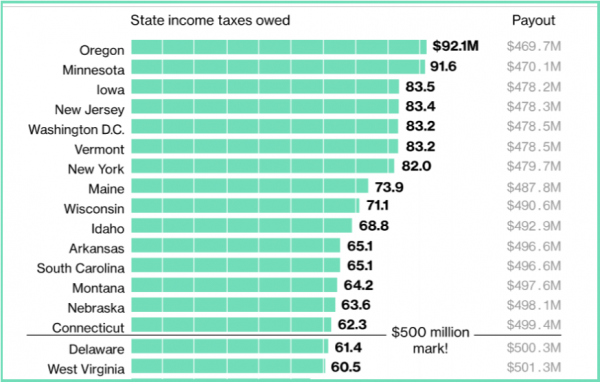
If you happen to win a $1.5 billion Powerball lottery jackpot, you’d be well advised to be a resident of one of nine states that do not tax such winnings.  Connecticut is not among them.states Connecticut’s take on such a jackpot would be 15th highest in the nation, among the states that do tax such winnings at various income tax rates.  An analysis by Bloomberg found that the amount of state income taxes owed would be highest for residents of Oregon, Minnesota, Iowa, New Jersey, Washington D.C., Vermont, New York, Maine and Wisconsin.
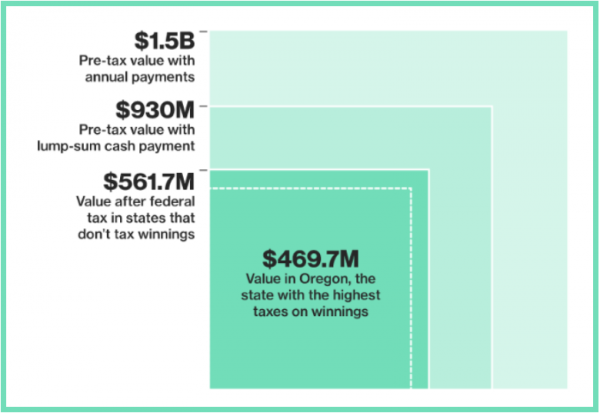
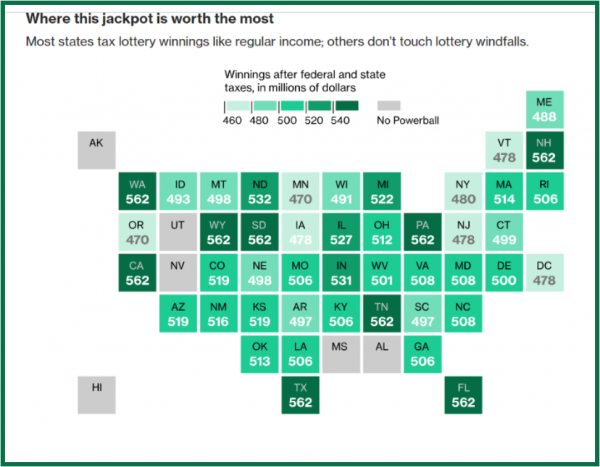
Connecticut residents would need to pay the state $62.3 million, which, when combined with the federal tax bite, would leave the Powerball winner with just under $500 million of the $1.5 billion jackpot.bites

According to the analysis, the IRS takes 25 percent off the top. The winner will then have to pay the federal government an additional 14.6 percent at tax time, for a total of 39.6 percent–the maximum individual tax rate. That means the most a winner can hope to take home is $561.7 million.

Then the home state – with the exception of the nine states that don't go after such winnings – take their share, ranging from $92.1 million for an Oregon resident to $29.9 million for a North Dakota resident.  Connecticut is approximately in the middle of the pack.

States can also receive a revenue boost when there isn't a Powerball winner for quite awhile, as happened between November 2015 and January 2016.  As the jackpot grew each week, sales of tickets increased.  According to published reports,  the state of Connecticut received more than $20 million out of the $50.1 million in Powerball tickets sold.

map

Increased Municipal Burden, Disproportionate Impact on Low-Income Drivers Among Possible Effects of Highway Tolls, Report Finds

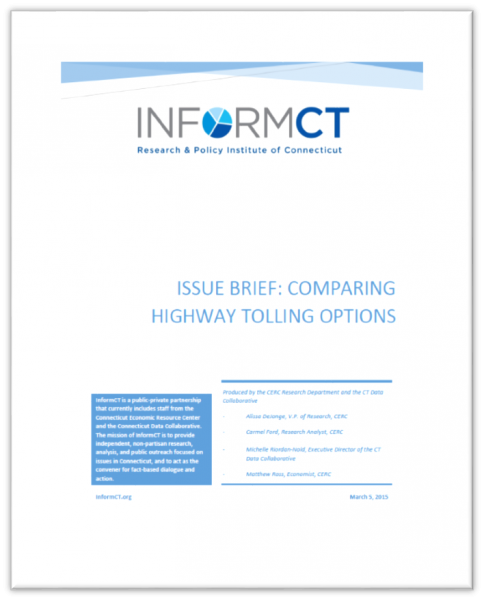
If Connecticut opts to introduce a system of tolls on the state’s roads to help fund a significant expansion of transportation infrastructure projects in the years ahead, the toll system instituted could run the risk of causing an increased use of local roadways that “could shift the burden of maintenance and congestion to municipalities,” and lower income residents in the state could be faced with “a higher burden relative to their incomes than wealthier Connecticut residents.” Those warnings to policy makers are included in an Issue Brief  by Inform CT that reviews the various tolling options and respective challenges posed.  Connecticut eliminated tolls more than 30 years ago in the aftermath of a horrific accident at the Stratford toll plaza, and state leaders have been in a “perpetual debate about whether to reinstate them ever since,” the paper points out.issue brief

With overhauling the state’s transportation system is a leading element in Governor Malloy’s agenda to boost the state’s economy, renewed attention is being paid to methods of generating sufficient revenue to support those initiatives, and to issues raised in the 2015 policy brief.  Spurred by advances in technology, the possibility of imposing a system of electronic tolls, such as those in use in other states, are among the considerations, with border tolling, distance tolling and congestion pricing among the options.

920x920The issue brief indicated that a disadvantage of a distance toll system on all limited access highways in Connecticut would be that it “could create an incentive for people to use alternative roadways. The increased use of these roadways could shift the burden of maintenance and congestion to municipalities.” The advantage would be that distance tolls “could help to more efficiently allocate the cost of these roadways to drivers who use them the most.”
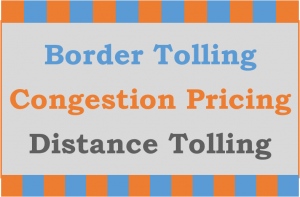
In analyzing the potential impact of tolls placed at Connecticut’s borders, the policy paper notes that while such an approach would “help to ensure that out-of-state residents driving through Connecticut pay for their use of Connecticut’s roadways,” border tolls “place a disproportionate burden on residents of Connecticut who commute out-of-state to work. This burden is further amplified if we believe that, on average, these out-of-state commuters use a smaller share of the roadways than their in-state commuting counterparts.”

toll optionsCongestion pricing, which provides for higher toll charges at peak traffic times, “helps to limit traffic on major roadways and create an incentive for people to use more environmentally friendly forms of public transportation,” the policy paper indicates.  However, a congestion pricing system “could polarize roadway use by displacing low income commuters during peak driving hours. Congestion pricing could also create displacement effects whereby the increased use of local roadways could shift the burden of maintenance and congestion to municipalities.”Print

The report suggests that “congestion pricing and distance tolls could become more affordable for low income residents if electronic payment systems were implemented that allow for income-based rate reductions.”

Earlier this year, a study panel recommended installing tolls and raising taxes in order to pay for Malloy's 30-year, $100 billion transportation program.  Legislators have said that any decision on the imposition of tolls is at least a year away, as attention focuses during the current session on establishing a method to assure that money allocated to transportation is not redirected to other areas of government.

The issue brief also stress that “a key consideration when trying to outweigh the benefits and costs of implementing tolling in Connecticut is how the revenue from the tax will be redistributed to the residents of the state.” It goes on to highlight that “as the bill stands, the monies raised would go into the Special Transportation Fund but allocation of the monies from there is not specified. The allocation of these funds is an important discussion that needs to take place before the impact of the legislation can be considered in earnest.”

InformCT is a public-private partnership that currently includes staff from the Connecticut Economic Resource Center and the Connecticut Data Collaborative. The mission of InformCT is to provide independent, non-partisan research, analysis, and public outreach focused on issues in Connecticut, and to act as the convener for fact-based dialogue and action.

Award-Winning Start-Up Accelerator to Launch Largest Class of Social Enterprises, Fledgling Businesses

When the Hartford-based Social Enterprise Trust, known as reSET, was among the winners of the U.S Small Business Administration’s Growth Accelerator Competition last year – the only Connecticut organization to do so and one of 80 nationwide – it was not known what earning that designation, and  the $50,000 that came with it, would mean for reSET’s Impact Accelerator program. Now, the picture is becoming clearer – and boosting Hartford’s reputation as a city for socially committed entrepreneurial start-up businesses.  The expanding initiative is attracting not only home grown companies, but start-ups from elsewhere across the country, including as far away as California.

Tailored for impact-driven businesses but available to all early-stage ventures, reSET’s Impact Accelerator, now beginning its fourth year, has as its primary objective to test and hone entrepreneurs’ models, and to connect them to networks, mentors, customers, and resources.

A cohort of 22 businesses have been accepted to the program and most of their models are impact focused, serving the educational technology, health and health tech, energy, and agriculture industries. More than 60 percent of them are already generating revenue.  It is the largest group of companies to take part in the accelerator program at reSET, and the first to include a handful of out-of-state participants.cohort 2016

Running from January 20 to June 2, reSET’s accelerator will feature a more flexible program designed for busy, full-time entrepreneurs, as well as a ‘pay what you can’ model.  Entrepreneurial teams will attend five weekend summits, with 30+ optional workshops, mentor office hours, and consultations with an Entrepreneur in Residence conducted during the week.

At program’s end, a $25,000 accelerator funding pool will be available to the cohort, and they'll have priority access to reSET’s investment fund as well, via mentors and advisors that can help them put their best foot forward with their applications, according to reSET officials.

The 2016 cohort includes: Agyncy (www.agyncy.com), AmRide (www.amride.com), Asarasi (www.asarasi.com), BLT Robotics (www.bltrobotics.com), Doors to Explore (www.doorstoexplore.com), DopaFit (www.mydopafit.com), Enviro Power, LLC (www.enviropowertec.com), Keep Sight (www.keepsight.com), Lion’s Heart (www.lionsheartservice.org), Mivy (www.mivyapp.com), Movia Robotics (www.moviarobotics.com), Muni (www.muni.info), myHomeProNetwork (https://myhomepronetwork.com), Plucked (www.pluckedadmissions.org), RepVisits (www.repvisits.com), ScripFlip (www.scriptflip.org), SnapSeat (www.snapseatbooths.com), Tainted Inc. (www.tainted-beauty.com), Text Engine (www.textengine.info), The TubieGuard (the-tubieguard.myshopify.com), Trekeffect (https://trekeffect.com), and Untapped Potential (www.upotential.org).

“We’ve made a strategic shift with our accelerator model so it can accommodate more participants at one time, which we feel will really encourage more collaboration,” said Rosie Gallant, reSET’s Director of Programs. “The shift will help tee up the accelerator for our annual Impact Challenge as well, since the program will wrap in the spring right around when applications will open for the competition in which participants will vie for this year’s $100,000 prize purse.”

reSET is a non-profit organization whose mission is to advance the social enterprise sector.  Its strategic goals are threefold: to be the “go-to” place for impact entrepreneurs, to make Hartford the Impact City, and Connecticut the social enterprise state.  reSET aims to inspire innovation and community collaboration, and to support entrepreneurs in creating market-based solutions to community challenges.  reSET’s goal is to meet entrepreneurs wherever they are in their trajectory and to help them take their businesses to the next level.

Income Inequality in CT's 4th Congressional District is 4th Largest Gap in Nation; 2nd District Has Least Income Inequality in State

Connecticut’s 4th Congressional district, centered in Fairfield Country, has been ranked as the district with the 4th highest level income inequity in the nation.  A year ago, the 4th C.D. was ranked fifth. A ranking of congressional districts of by their level of income inequality, conducted by Bloomberg, uses the Gini coefficient, a formula that measures the distribution of income across a population. The closer a Gini number is to 1, the greater the level of inequality; the closer to zero, the closer to perfect equality. The average score for the United States was 0.4804.

All of Connecticut’s ctcountiesCongressional Districts, with the exception of the Fourth District, did better than the national average in the degree of income inequality.

Bloomberg Businessweek has previously pointed out that the U.S. congressional districts with the most inequality share certain traits: “they contain a small, enormously wealthy elite surrounded by impoverished neighbors.” Most of the districts with the greatest disparity are located in or near major urban metropolitan areas.

The greatest income inequality in the most recent analysis indicated that the Congressional Districts with the most income inequality are Pennsylvania’s 2nd District, New York’s 10th District, and Florida’s 27th District.  Following Connecticut’s 4th District on the list are Illinois; 7th District, and three additional Congressional Districts in New York – the 12th, 7th and 16th.  Rounding out the 10 C.D.’s with the most income inequality are Ohio’s 11th District and Georgia’s 5th District.inequality

In Connecticut’s 4th Congressional District, which includes Bridgeport, the state’s largest city, as well as the communities often referred to as the “Gold Coast,” 59.3 percent of the population has household income in the highest quintile, while 6.7 percent of households have income below the poverty level.

Connecticut’s 5th Congressional District (.4810) ranked number 88 on the list of Congressional Districts with the most income inequality among residents.  The state’s 3rd Congressional District (.4792) ranked at number 95, and the 1st C.D. (.4631) at number 175.  Much later in the rankings, Connecticut’s 2nd District (.4261) came in at number 387, indicating it is the C.D. in Connecticut with the least income inequality.

The Gini coefficient, which is calculated by the U.S. Census from household income share by quintiles, was used to measure distribution of wealth. It ranges from zero, which reflects absolute equality, to one, complete inequality. The data was updated in November 2015, using 2014 data.  In 2014, a person living alone making less than $12,071 was classified as in poverty. The threshold increases for each additional household member and varies by the number of adults and children in each household.


Seven CT Financial Institutions Earn Federal Designation to Assist Low Income Communities

Across the country, there are 963 institutions designated by the U.S. Department of the Treasury’s Community Development Financial Institutions Fund as having earned CDFI Certification.  Seven of them are based in Connecticut’s urban centers, the focus of their financial activities. CDFIs are specialized community-based financial institutions with a mission to promote economic development by providing financial products and services to people and communities underserved by traditional financial inTiny CDFI Fund logostitutions, particularly in low income communities and to people who lack access to financing.  By offering tailored resources and innovative programs that invest federal dollars alongside private sector capital, the CDFI Fund serves mission-driven financial institutions that take a market-based approach to supporting economically disadvantaged communities. The institutions to receive CDFI Certification in Connecticut are in the state’s major cities:CT

CDFIs include regulated institutions such as community development banks and credit unions, and non-regulated institutions like loan and venture capital funds. By building the capacity of a nationwide network of CDFIs, the CDFI Fund works to empower low-income and underserved people and communities to enter the financial mainstream.

Certified CDFIs are eligible to apply for awards through a variety of programs offered by the CDFI Fund. These awards enable CDFIs to finance a wide range of activities—including mortgage lending for first-time homebuyers, flexible underwriting for community facilities, and commercial loans for businesses in low-income areas. Through varying strategies, each CDFI contributes to the cultivation of a healthy and stable local economy, the CDFI website points out.

Speaking last week in Detroit, where CDFI Certified institutions are involved with the city’s rebound, CDFI Director Annie Donovan said “CDFIs have always led the way, demonstrating to mainstream investors that there are opportunities in communities that have been overlooked, or judged to be too risky. If mainstream financial institutions move into markets behind us, we must continue to blaze new trails, to find the next community that is even harder to serve than the last one.”

The Housing Development Fund, Inc. was established in 1989 as a nonprofit organization to finance the development of affordable housing in Stamford, CT. Today, with offices in Stamford, Bridgeport, and Danbury, HDF provides lending and homeownership counseling services to the entire state of Connecticut as well as Nassau, Suffolk, Rockland, and Westchester counties in New York.

Community logoCapital Fund facilitates the flow of capital and expertise into housing and economic developments that “benefit low and moderate income people in the Greater Bridgeport Area.”  It was formed in 2005 from the merger of two loans funds.

The 27-year old Greater New Haven Community Loan Fund’s mission is to create and sustain vibrant neighborhoods and communities. Through its lending and investment, the Loan Fund is the flexible source of alternative financing for affordable housing and community development in the greater New Haven area.

Since 1975 HEDCO Inc. has helped clients and their communities improve, achieve and succeed by supporting their growth and progress. They “build productive partnerships, create new programs that meet the changing needs of entrepreneurs and increase the funds available to help people build and improve their business and non-profit organizations.”

Formerly tlogo (1)he Middlesex Credit Union, Seasons Federal Credit Union was renamed in 2006 after expanding into New Haven County. Over the years, the credit union has “broadened its services beyond simple share savings and small loans to meet the increasingly diverse financial needs of its growing membership.”

The First City Fund Corporation (FCFC), Start Community Bank’s parent company, was formed in 2004 as a result of a challenge of the city of New Haven to New Haven Savings Bank’s conversion to a public company. In the fall of 2012 the bank received certification as a Community Development Financial Institution, (CDFI). There are only 100 CDFI certified banks in the country, and Start Community Bank is the only bank so designated in New Haven.

The work of the Hartford Community Loan Fund is to provide and promote just and affordable financial services that benefit low-wealth residents of Hartford.  HCLF helps borrowers overcome barriers—logosuch as credit history, language, cultural differences, financial literacy, or lack of economic assets--that can isolate people from the financial mainstream.  As the Fund’s slogan indicates, “We Finance Hope.”

Providing access to affordable financial products and services in underserved communities is a vital part of the CDFI Fund’s mission. By building the capacity of a nation-wide network of specialized financial institutions serving economically distressed communities, low- income people are empowered to enter the financial mainstream, the CDFI website emphasizes.

Donovan, in her Detroit speech last week, underscored that “CDFIs do connect their strategies with many community stakeholders, but let’s make sure we aren’t leaving out the important voices of the people who live in the communities we serve. If we are to deepen our impact and increase economic opportunity, we must know and serve our target markets from the bottom up.”