
Responding to Hunger with Capacity Building; Coalition Initiative Renewed
/The University of Saint Joseph (USJ) and Urban Alliance received a $30,000 grant from the Farmington Bank Community Foundation to support More than Food, a framework that helps food pantries with more capacity-building resources in addition to short-term food supplies to help address the root causes of hunger. More than Food, developed by USJ, Urban Alliance and Foodshare, was initially launched with funding from the Farmington Bank Community Foundation in 2014. This latest grant supports the program over the next two years. “More than Food focuses on promoting healthy food in pantries and helping people access other resources to find a job. We’re proud to support a partnership that is trying to find a solution to the hunger problem,” said Chris Traczyk, executive director of the Farmington Bank Community Foundation. “It’s a comprehensive, collective-impact project.” Dr. Katie Martin, assistant professor and director of the Public Health Program at USJ, and her research team developed a nutrition stoplight system called Supporting Wellness at Pantries, or “SWAP”, which helps food pantry clients choose healthier foods.
USJ is collaborating with the UConn Rudd Center for Food Policy and Obesity and the Council of Churches of Greater Bridgeport to pilot the SWAP system in six food pantries in CT, which together serve over 5,000 people on average every month. Under the More than Food framework, the grant from the Farmington Bank Community Foundation will help expand this work to offer trainings and implement and evaluate the SWAP system in additional food pantries.
As part of the More than Food framework, Urban Alliance has developed various training series and toolkits to equip food pantry staff and volunteers to offer case management services and resource centers that help connect clients to necessary community programs through its Beyond the Basics initiative. Also, Urban Alliance is developing a training program to help pantries create a welcoming environment that fosters the dignity and respect of each person served.
A website, www.ittakesmorethanfood.org , has been developed to share information about the More than Food framework and provide practical guidance and tools to food pantries to help them offer healthy foods with choice, connect clients to needed services, and create a welcoming culture. The recent grant award will help refine, disseminate, and evaluate materials that will be shared through the website.
The website points to the mission ahead: "When the 'emergency' of hunger has lasted over three decades, and with strong evidence that food insecurity is associated with chronic health problems, it is time to rethink the way we provide food assistance and time to examine the effectiveness of food pantries. Through our work, we are changing the conversation about hunger away from emergency food to a person-centered and strength-based approach to help people set and achieve goals in their life."
“We are very grateful for the continuing support of the Farmington Bank Community Foundation, as well as the collaborative work of our partner organizations in making More than Food a holistic way to address hunger in our area,” said USJ's Martin. Currently there are multiple food pantries in Connecticut, Texas and Rhode Island that are implementing the More than Food framework to address the root causes of hunger.
 d childcare slots for fifteen percent of the county’s children ages 0 to 2, and enough subsidized slots to cover only twenty-two percent of these youngest children in low-income households.


 ped the list in two additional categories: Lowest Percentage of Adults Who Experienced Pain in the Past Year Due to Oral Condition and Lowest Sugar-Sweetened Beverage Consumption Among Adolescents. The state also ranked in a tie for third for having the lowest percentage of elderly population with no natural teeth.

 serves as an expert resource on oral health policy; and publicizes oral health policy analysis and recommendations.

 The Connecticut Health Policy Project is a non-profit, non-partisan research and educational organization dedicated to improving access to affordable, quality health care for all Connecticut residents.

 “Unlike mental health consultation,” the report states, “overall health consultation is not supported with state level infrastructure and payments for health consultants to early Childhood Education sites. For private child care or preschool programs, the cost to hire a health consultant is borne by the program, with no system in place to ensure the quality of the CCHC workforce or ensure that health consultation is implemented to maximize the health and safety of children in child care.”


 The researchers say it’s important to look at the context in which foods are presented as well as the frequency, observing that the people they interviewed rarely noticed that food was mentioned in children’s books, nor what messages were being conveyed, UConn Today reported.
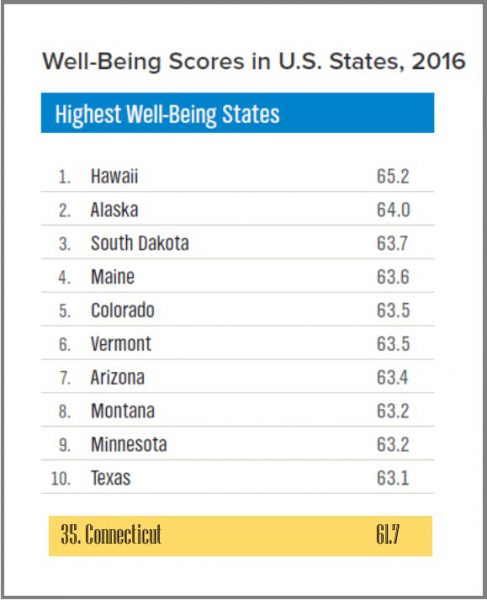
 In 2016, Connecticut had a Well-Being Index score of 61.7, which is lower than the national Well-Being Index score of 62.1. The report, which is part of the Gallup-Healthways State of American Well-Being series, examines well-being across the nation, including how well-being varies by state and which states lead and lag across the five elements of well-being. They are:

 The findings of a state review would be reported to the legislature and governor to evaluate the appropriateness of the price increases in question.