Five Connecticuts: Disparities Persist, Continue to Adversely Impact State's Children

Connecticut is among the wealthiest states in the country, and aggregated statewide economic, health, and education indicators suggest that children and families fare better here than in much of the United States. According to a new report developed by the Connecticut Association of Human Services, the reality on the ground is not what it appears to be. “Race Equity in the Five Connecticuts:  A Kids Count Special Report,” found that Blacks’ and Hispanics’ poverty rates are lower in Connecticut than nationally, and Blacks’ median incomes are higher. However, “as we have seen when looking within communities, historic patterns of inequality observed nationally do indeed persist here.”

The report indicates that as is the case nationally, Blacks and Hispanics in Connecticut are “disproportionately impoverished, and have the highest rates of negative outcomes for most of our indicators. Merely being a resident of one of the most affluent states in the U.S. is not a sufficient buffer against the intransigent inequality that affects our children and families along racial and ethnic lines,” the report explains.

"Not all children in our wealthy state are doing well," summed up Jim Horan, Chief Executive Officer of the Connecticut Association of Human Services, in releasing the report at a State Capitol complex conference. "All children, regardless of the color of their skin or their zip code, should have the opportunity to succeed. Connecticut can do much more to provide opportunity for all and address the huge inequities we see today, so that all children will prosper and contribute to and share in Connecticut’s growth," he said in the report's Foreword.

“Five Connecticut’s” refers to a breakdown developed by the Connecticut Data Center based upon each town’s median income, population density, and population below 100% of the poverty threshold (Levy, et al, 2004).

  • Wealthy Connecticut towns have “exceptionally high-income, low poverty, and moderate population density.”
  • Suburban towns have “above average income, low poverty, and moderate population density.”
  • Rural towns are those with “average income, below average poverty, and the lowest population density.”
  • Urban Periphery towns are marked by “below average income, average poverty, and high population density.”
  • Urban Core towns have “the lowest income, highest poverty, and the highest population density.”

The report used data from communities representing each of the five Connecticuts:  Wealthy (New Canaan, W3ilton, Weston, Easton, Fairfield); Urban Periphery (East Hartford and Manchester); Urban core (Hartford); Suburban (Branford, East haven, North Branford, Guilford and Madison); and Rural (Ashford, Brooklyn, Canterbury, Chaplin, Eastford, Hampton, Killingly, Plainfield, Pomfret, Putnam, Scotland, Sterling, Thompson, Woodstock, and Windham).

“Blacks are more segregated in Connecticut than in Arkansas and Hispanics are more segregated than in Texas,” pointed out Orlando Rodriquez, research associate at the UConn Health Disparities Institute, speaking at a forum on the report at the Legislative Office Building, noting that Connecticut is among the nation’s most segregated states.

Demographically, Connecticut, like the nation, is becoming more racially and ethnically diverse. It is estimated that by 2055, America will not have a single racial or ethnic majority.  From 2000 to 2015, as the total population grew by 5%, Connecticut’s Black, Hispanic, Asian, and Native American populations combined grew by 42.3%. In 2000, Connecticut’s population was 22.5% Non-White; in 2015, it was 30.8%.

The research also found that “place can correlate somewhat with the degree of the differences observed across these indicators, with outcomes either ameliorated or exacerbated depending on one’s ‘Connecticut’ of residence.”

The general trend, the analysis indicated, “is that White and Asian children and families experience positive outcomes, while their Hispanic and Black counterparts are almost invariably worse off. Even in those areas where Hispanic and Black households have relatively higher median incomes, they often still have worse outcomes than White and Asian households for many non-economic indicators.”

“Place remains tightly intertwined with opportunity, compounding the effects we observe along racial lines,” the report indicated.

“While more affluent suburban towns offer safer neighborhoods and greater social and economic opportunity to residents,67 these neighborhoods and towns tend to have less affordable housing and perhaps less economic opportunity for employees of limited credentials. Finances tie less affluent families to areas of low opportunity, contributing to a cycle of poor outcomes.”

Officials said the report is intended to be the beginning of a “more nuanced and continuous conversation about the role of place in social and economic equity in the State of Connecticut,” to assist in the development of “policies that work earnestly to close the racial and ethnic gaps among our families and children.”

In 2000, Connecticut’s population totaled 3,405,565, with 2,638,845 non-Hispanic Whites, 309,843 Blacks, 320,323 Hispanics, 9,639 Native Americans, and 82,313 Asians. In 2015, the estimated total population was 3,593,222, with 2,478,119 non-Hispanic Whites, 346,206 non-Hispanic Blacks, 526,508 Hispanics, 8,908 Native Americans of any ethnicity, and 149,368 non-Hispanic Asians.

Minorities, Children with Autism at Greater Risk of Drowning; Legislative Response Launched

“I understand all too well the dangers that water can represent,” said Karen Cohn, founder of the Zac Foundation, pointing out that drowning is the second leading cause of death for children under age 14.  “Many of these deaths could have been prevented.” Cohn’s 6-year-old son drowned in 2007 after his arm became stuck in the suction of the drain in their backyard pool.  Although he was a strong swimmer, “swimming skills are not enough to combat an entrapment,” she said.  The foundation named for her son is dedicated to educating parents about water safety, which goes beyond swimming skills.  The ZAC Foundation held its first water safety awareness camp, called ZAC Camp in Greenwich in April 2011. “We can save lives,” Cohn stressed.

Cohn was among advocates and legislators who held a State Capitol news conference to announce the creation of a legislative task force to bring awareness to the issue of childhood drownings.  Steven Hernández,, Executive Director of the Commission on Women, Children and Seniors, said the goal of the effort was “to prevent tragedies like these,” adding that “we need a multi-pronged response to a multi-pronged problem.”

The initiative was launched during National Water Safety Month, held each year in May, driven by statistics including:

  • Almost 800 children die the U.S. every year from accidental drowning;
  • 54% of these deaths are among children ages 0-4;
  • African-American and Latino children are more than twice as likely to die from drowning, compared to Caucasian children; and
  • According to the National Autism Association, accidental drowning led to 90% of the deaths of children with autism ages 14 and younger.

The statistics about children’s drowning deaths have not changed over time, implying that current strategies for prevention are not enough, officials said. Increasing children’s access to swim lessons, encouraging schools to teach water safety skills to students and giving parents easy-to-use and engaging tools to talk to their children about how to be safe around water are just a few actions that can have a big effect in reducing drowning rates, officials stressed.

An issue brief on the subject, prepared by Jennifer L. Masone of the Institute for Educational Leaders, and Principal, Wolfpit Elementary School in Norwalk, indicated that “from 2004-2014, 62 children from birth to 19 died from unintentional drowning. Of those, 35% were white and 34% were minority while the general population averaged 75% white and 25% minority. These data do not include children who experienced other short or long term effects.

The State Department of Public Health corroborates this information with its summation that for 2000-2004, “The Non-Hispanic Black population experienced a drowning rate twice that of the Non-Hispanic White population, and 33% higher than the Hispanic population.”

Senate Majority Leader Bob Duff said the issue needs to be “seen as a community solution through education.”   He said “this is an issue we can solve,” saluting the effort to bring interested parties together to work collectively.

In addition to establishing the task force, proponents of the initiative highlighted their support for HB 6260, which would require police officers to be trained to handle incidents involving juveniles with autism.  The measure has passed the House and is awaiting Senate action. Rep. Liz Linehan, who introduced that bill, said, “Children with autism are at an increased risk of drowning because they have a tendency to wander away from adult supervision and to seek out bodies of water.”

Rep. Cathy Abercrombie said “accidental drownings in Connecticut are a serious problem that deserves our full attention and one thing we can stress is the need for more education for parents and people overseeing children, especially now as we approach summer.”


https://youtu.be/CULPxBSa_10

https://youtu.be/hkmY3oZWxyU

Fun in CT? Ranked 37th in the US, But Among Leaders in Marinas, Fitness Centers, Money Spent on Recreation

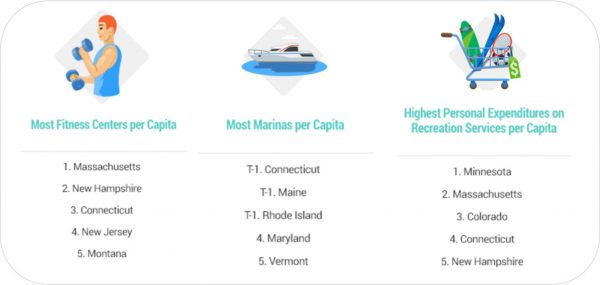
While Connecticut ranked 37th overall among the nation’s 50 states analyzed for their “fun” quotient, the state did have some standout rankings in specific categories – including the amount of money individual residents spend on recreation.  Despite ranking 35th overall in “entertainment & recreation” categories and 40th in “nightlife,” the state reached the top five in three sub-categories. In the analysis by the financial website WalletHub, Connecticut ranked third in the number of fitness centers per capita, at 15.7. New England neighbor Massachusetts ranked #1 with 17, and New Hampshire, New Jersey and Montana rounded out the top five in that category.

Connecticut ranked #1 in number of marinas per capita, tied with Maine and Rhode Island. Connecticut has 3.48 marinas per 100,000 residents, the data indicated. Maryland and Vermont ranked fourth and fifth, respectively.

In another top five finish, Connecticut ranked fourth in Personal Expenditures on Recreation per capita, at just over $1,900. Minnesota ranked first at $2,058. The Top 5 states, in order, were Minnesota, Massachusetts, Colorado, Connecticut and New Hampshire.

Overall, the “most fun states” were Nevada, South Dakota, Colorado, North Dakota, New York, Wyoming, Oregon, Louisiana, Montana, Hawaii, Maine, Minnesota, Florida, Vermont and California.  At the bottom of the list were Arkansas, Kentucky, Alabama, West Virginia and Mississippi.

The overall rankings were weighted 80-20 between Entertainment & Recreation and Nightlife.  The Entertainment & Recreation categories included restaurants, beaches, movie theaters,  national parks, arts venues, and state spending on parks and recreation. The nightlife category included average beer & wine prices, movie costs, music festivals and access to bars.
Data used to create the ranking, which included 22 separate sub-categories, were collected from U.S. Census Bureau, Bureau of Economic Analysis, National Park Service, Council for Community and Economic Research, TripAdvisor, Beachapedia, Stadium and Arena Visits, Graphiq, American Gaming Association and WalletHub research.


Cigna Recognized for Cultural Competency Efforts

Health disparities directly and indirectly cost the U.S. economy $309 billion annually, and it is estimated that approximately 30% of direct medical costs for Blacks, Hispanics, and Asians are unnecessary costs resulting from health disparities, according to a paper prepared by Connecticut-based Cigna. Indirect costs, the paper points out, include lost work productivity and premature death. The paper, focusing on Cultural Competency in Health Care, is part of an initiative by Cigna that has been recognized with an "Innovation in Advancing Health Equity Award" by the National Business Group on Health, which honored the insurer for its ongoing commitment to promoting health equity and reducing health care disparities in the workplace and community.

"Health equity exists when all people, regardless of race, gender, socio-economic status, geographic location, or other societal constructs have the same access, opportunity, and resources to achieve their highest potential for health. It is our hope that these companies provide an example and encourage other employers to advance health equity," said Brian Marcotte, president and CEO of the National Business Group on Health.

Cigna was recognized for its nationwide program, America Says Ahh, to improve preventive care and encourage regular check-ups. A key feature of the campaign is the TV Doctors of America preventive care advocacy campaign featuring five famous TV doctors.  Among them is Alan Alda, best known for his role on M*A*S*H.  Alda will be on Hartford on Saturday evening at The Connecticut Forum.

“For Cigna's network doctors and clinicians, we created and delivered an in-depth cultural competency training with an emphasis on engaging Hispanic patients, and produced an external white paper on Cultural Competency in Health Care,” said Peggy Payne, a leader within Cigna's Health Equity Strategy area.

“The U.S. population is increasingly diverse. Cultural competency is essential to deliver health care services that meet the needs of each individual and improves overall health,” said Christina Stasiuk, D.O., National Medical Director for Health Equity at Cigna.

Racial and ethnic minorities currently make up about a third of the U.S. population, and are expected to become a majority by 2055, the paper points out, noting that:

  • Hispanics will continue to make up the largest portion of the minority population
  • The Asian population is expected to grow at the fastest rate between 2015 and 2055
  • The foreign-born population will increase at a higher rate than the native born population, accounting for approximately 20% of the U.S. population by 2060

As the U.S. becomes more diverse, it is likely that more individuals will have limited English proficiency or will not adhere to Western cultural norms, which may contribute to greater health disparities, the Cigna paper points out.

“Reducing health disparities is a business and social imperative. Minority populations will likely become an increasing share of providers’ patient panels, employers’ workforces, and health plans’ customers, requiring that all stakeholders seek ways to promote health equity to improve health and access, reduce costs, and improve experience,” the Cigna paper emphasizes, suggesting employers can take to build cultural competency and improve health outcomes for all their employees by:

  • Expanding their human resources leadership team to include experts in cultural competency and diversity
  • Instituting multicultural staff representatives to support onsite health services, such as health fairs and open enrollment
  • Seeking feedback from diverse groups of employees about their experiences as health care customers
  • Providing materials and benefits information that are culturally competent, e.g., culturally adapted or language-specific
  • Proactively gathering the demographic data of their workforce to measure and take action on health trends
  • Collaborating with their health plan to better engage employees in their health

Cigna indicates that the company has “ongoing efforts to help ensure that Cigna staff is culturally and linguistically competent.”

The National Business Group on Health is the nation's only non-profit organization devoted exclusively to representing large employers' perspective on national health policy issues and helping companies optimize business performance through health improvement, innovation and health care management.

https://youtu.be/foL9gfbfweY

Edible Arrangements, Subway Take Steps Forward and Back in Roller-Coaster Economy

Two of Connecticut’s leading food franchise success stories - Edible Arrangements and Subway – have both been in the news in recent days, seemingly moving in opposite directions.  Subway, for the first time in memory, is reducing the number of franchises across the country, while Edible Arrangements is in the midst of extending its brand, as its founder has taken back control of the equity in the business. Subway dropped 359 U.S. locations in 2016, the first time that Subway has had a net reduction. The store count dropped 1.3 percent to 26,744 from 27,103, but Subway remains the nation’s most ubiquitous eatery. (Behind only McDonald’s in sales.) Sales at Subway franchises fell 1.7 percent last year to about $11.3 billion, according to published reports. Subway is still growing internationally, with sales outside the U.S. increasing 3.7 percent to $5.8 billion last year, as the company continued to open locations.

Subway was founded about 52 years ago by Fred DeLuca and Peter Buck in Bridgeport. DeLuca died in 2015, leaving the company in the hands of his younger sister, Suzanne Greco, who became chief executive officer. The chain’s restaurants are entirely owned by franchisees.

Since its founding in 1999 in East Haven, Edible Arrangements has grown to more than 1,300 locations worldwide. Tariq Farid developed a "healthy obsession with fruit," and used his experience in the floral industry insight to develop a new business concept: fruit bouquets. Edible Arrangements began franchising in 2001, according to the company website.

Farid has completed a buyback of equity of the company which had been held by Greenwich private equity firm L Catterton.  The company has entered into a strategic partnership with L Catterton in June of 2012. Farid said the relationship provided assistance during a key growth phase for the brand, a time in which Edible Arrangements expanded into offering fresh fruit smoothies, froyo fruit blends, chocolates and more.

“The timing was right to take back full ownership so that I could be more fully engaged in building the future of the brand with our franchisees," Farid said, adding that "Edible Arrangements finds itself well-positioned for a future that includes exciting new opportunities for our franchises and the brand.”

Edible Arrangements has launched a system-wide conversion of traditional stores to a "whole-store" experience in the Edible To Go platform, featuring fresh fruit smoothies, froyo fruit blends and other fresh fruit treats. The company is coming off a year in which it registered a 27 percent increase over the previous year in both the number of new store openings and signings of new franchise agreements. It was named in Entrepreneur's Top 40 of "Fastest Growing Franchises" and "America's Top Global Franchises" as well as being included among the "Inc. 5000" list of the fastest growing privately-held companies.

"This is an exciting time to be a part of Edible Arrangements," Farid said. "At heart we are really a family of small businesses that have enjoyed incredible growth through a shared passion and willingness to work together towards common goals. Now we can focus all our energy on working together on the next evolution of the Edible Arrangements brand."

Edible Arrangements is headquartered in Wallingford; Subway is headquartered in Milford.

Responding to Hunger with Capacity Building; Coalition Initiative Renewed

The University of Saint Joseph (USJ)  and Urban Alliance received a $30,000 grant from the Farmington Bank Community Foundation to support More than Food, a framework that helps food pantries with more capacity-building resources in addition to short-term food supplies to help address the root causes of hunger.  More than Food, developed by USJ, Urban Alliance and Foodshare, was initially launched with funding from the Farmington Bank Community Foundation in 2014. This latest grant supports the program over the next two years. “More than Food focuses on promoting healthy food in pantries and helping people access other resources to find a job. We’re proud to support a partnership that is trying to find a solution to the hunger problem,” said Chris Traczyk, executive director of the Farmington Bank Community Foundation.  “It’s a comprehensive, collective-impact project.”  Dr. Katie Martin, assistant professor and director of the Public Health Program at USJ, and her research team developed a nutrition stoplight system called Supporting Wellness at Pantries, or “SWAP”, which helps food pantry clients choose healthier foods.
USJ is collaborating with the UConn Rudd Center for Food Policy and Obesity and the Council of Churches of Greater Bridgeport to pilot the SWAP system in six food pantries in CT, which together serve over 5,000 people on average every month. Under the More than Food framework, the grant from the Farmington Bank Community Foundation will help expand this work to offer trainings and implement and evaluate the SWAP system in additional food pantries.

As part of the More than Food framework, Urban Alliance has developed various training series and toolkits to equip food pantry staff and volunteers to offer case management services and resource centers that help connect clients to necessary community programs through its Beyond the Basics initiative. Also, Urban Alliance is developing a training program to help pantries create a welcoming environment that fosters the dignity and respect of each person served.

A website, www.ittakesmorethanfood.org , has been developed to share information about the More than Food framework and provide practical guidance and tools to food pantries to help them offer healthy foods with choice, connect clients to needed services, and create a welcoming culture. The recent grant award will help refine, disseminate, and evaluate materials that will be shared through the website.

The website points to the mission ahead: "When the 'emergency' of hunger has lasted over three decades, and with strong evidence that food insecurity is associated with chronic health problems, it is time to rethink the way we provide food assistance and time to examine the effectiveness of food pantries. Through our work, we are changing the conversation about hunger away from emergency food to a person-centered and strength-based approach to help people set and achieve goals in their life."

“We are very grateful for the continuing support of the Farmington Bank Community Foundation, as well as the collaborative work of our partner organizations in making More than Food a holistic way to address hunger in our area,” said USJ's Martin. Currently there are multiple food pantries in Connecticut, Texas and Rhode Island that are implementing the More than Food framework to address the root causes of hunger.


Disparities Evident As Fairfield County Considers Its Community Wellbeing

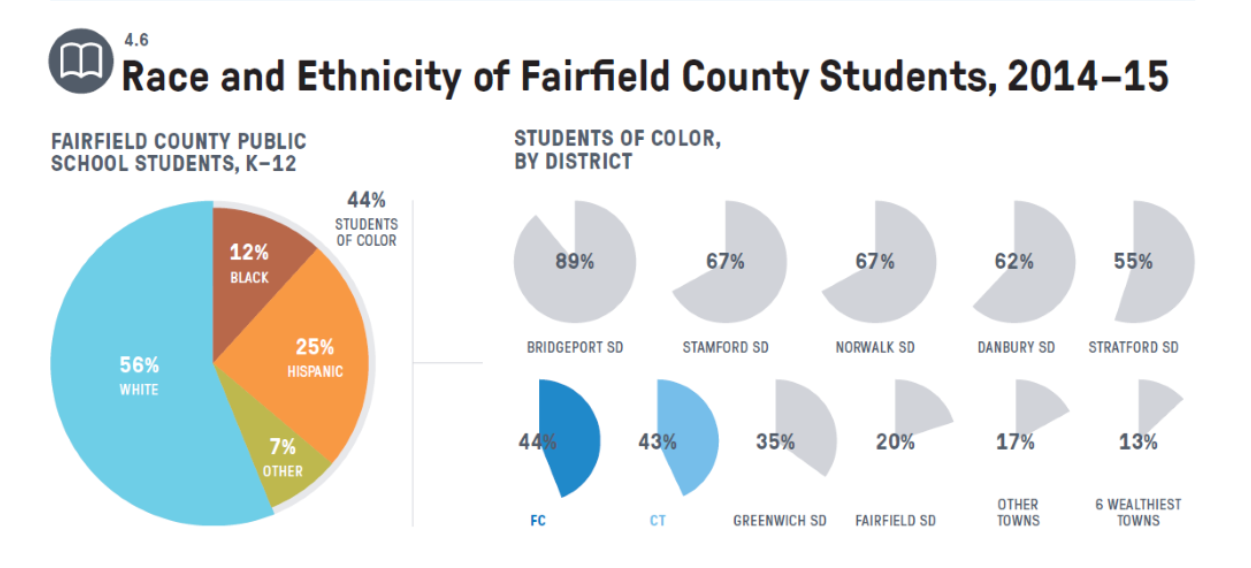
Fairfield County’s sizeable immigrant population - twenty percent of Connecticut’s most populous county - grew 89 percent from 1990 to 2014. In some municipalities, foreign-born residents make up as much as a third of the population. That is among the findings in the Fairfield County Community Wellbeing Index 2016, which examined regional demographics, economic opportunity, education, health, quality of life, and happiness.  The report includes analysis of the communities, populations, and neighborhoods of Fairfield County, as well as opportunities available and issues facing the area.

Since 1980, the size of the population living in neighborhoods that are considered most affluent – defined as those with an average family income more than 2.5 times higher than the state level - has tripled within Fairfield County. Meanwhile, the number of people living in poor neighborhoods is 3.5 times its 1980 size. The number of people in middle-income neighborhoods has decreased by sixteen percent.

Fairfield County’s Community Foundation, a major funder of the report, partnered with DataHaven, area hospitals, and government agencies to help launch a more robust and comprehensive resource that could serve as a part of the hospitals’ and health departments’ Community Health Needs Assessments as well as a broader county-wide indicators program.

“Fairfield County’s Community Foundation is committed to addressing the most pressing issues facing Fairfield County, but to do that we first need to be able to identify and understand those issues,” stated Nancy M. von Euler, Vice President, Programs, Fairfield County’s Community Foundation. “The data in the Fairfield County Community Wellbeing Index 2016 will help us to develop priorities for collective action to build a stronger, healthier Fairfield County where everyone has the opportunity to thrive, regardless of their zip code.”

The report states that "Despite its overall affluence, Fairfield County is among the nation’s most unequal metropolitan areas. Inequities in well-being appear when evidence is stratified by income, age, race, gender, and zip code. These differences are often most apparent after considering data that were collected specifically for the age groups and neighborhoods that are most impacted."

Among the findings, between 2014 and 2025, adults ages 65 and over are Fairfield County’s only age group projected to grow significantly, with a thirty-seven percent increase. Disparities in the County were also evident:

  • High and rising childcare costs are often prohibitively expensive for low and middle-income families. While Fairfield County has nearly enough spaces for all 3- to 4-year-olds to attend preschool, there are only enough regulated childcare slots for fifteen percent of the county’s children ages 0 to 2, and enough subsidized slots to cover only twenty-two percent of these youngest children in low-income households.

  • The issue of dental care arose as an indicator of well-being, particularly among younger adults and families. The Index shows that for every 10,000 residents living in Fairfield County, 12 residents visit an emergency room to receive treatment for preventable dental conditions in any given year, whereas on the East Side of Bridgeport, 178 residents do.
  • Fairfield County residents are healthy when compared to national benchmarks. However, many conditions and risk factors—such as asthma, food insecurity, exposure to community violence, and the early onset of diabetes—are disproportionately prevalent in lower-income neighborhoods and communities of color. Sections of Bridgeport in particular fall very far behind the surrounding area in many of these measures.
  • Disparities in access to reliable transportation persist between racial and income groups. A majority of Fairfield County workers, regardless of income, commute to another town for work. Many low-income (annual wages under $40,000) workers leave Bridgeport for work, while large shares of high-income workers commute to New York City.

“The process of developing this report allowed local partners and community members to identify links between the well-being of residents and the places where they live. Looking beyond typical measures like income levels or unemployment rates, the Community Wellbeing Index reveals a much more uneven distribution of opportunities in areas such as neighborhood walkability, economic development, public health, and education,” said Mark Abraham, Executive Director of DataHaven and a lead author of the report. “The impact that these barriers to opportunity have on overall well-being and happiness will serve as a call to action for many groups working to improve Fairfield County’s diverse neighborhoods and towns.”

The Fairfield County Community Wellbeing Index 2016 was based on a variety of federal and statewide data sources. Partners of DataHaven’s Fairfield County Community Wellbeing Index 2016 include Fairfield County’s Community Foundation; Bridgeport Hospital; Danbury Hospital; Greenwich Hospital; Norwalk Hospital; St. Vincent’s Medical Center; and Stamford Hospital.

Healthy Eating Not So Great Among Children, Community Can Help

Only one-third of parents of children ages 4-18 feel they’re succeeding at fostering healthy eating habits in their kids, according to a recent national survey.  The University of Michigan C.S. Mott Children’s Hospital National Poll on Children’s Health found that just over half of parents believe their children eat mostly healthy, and only one in six parents rate their children’s diets as “very nutritious,” according to a press release. A fourth of parents polled said their child’s diet is “somewhat or not healthy at all.” Common challenges – not surprisingly - get in the way, according to experts: price, picky eaters and convenience.

“Most parents understand that they should provide healthy food for their children, but the reality of work schedules, children’s activities and different food preferences can make meal preparation a hectic and frustrating experience,” poll co-director Sarah Clark explained. “The tension between buying foods children like, and buying foods that are healthy, can be an ongoing struggle. Many of us know the feeling of spending time and money on a healthy meal only to have our children grimace at the sight of it and not take a single bite.”

Other data from the poll – which involved 1,767 parents – include that one in five parents don’t think limiting their child’s intake of fast food or junk food is important, and that 16 percent said limiting sugary drinks is “somewhat or not important.”

In general, parents of teens were less worried about unhealthy eating habits compared to parents of younger children.

The C.S. Mott Children's Hospital National Poll on Children's Health measures current national public opinion, perceptions and priorities regarding major health care issues and trends for U.S. children and people in their communities.

Also this month, the Rudd Center for Food Policy and Obesity at the University of Connecticut found that residents of one Maryland county bought fewer sugary drinks after a campaign to reduce the consumption of sugar-sweetened beverages that included policy changes and public health outreach efforts.

The Rudd Center study, published in JAMA Internal Medicine, is the first to use objective retail sales data to measure the effectiveness of a community-led campaign to reduce consumption of sugary drinks.

“This study demonstrates the power of a community-based public health campaign that combines health-supporting policy changes with extensive outreach. The residents of Howard County have been engaged in every phase of this effort and their commitment to switching their drinks showed up in the supermarket sales data,” said Marlene Schwartz, Director of the UConn Rudd Center for Food Policy and Obesity, and the study’s lead author.

Beverages with added sugars are among the leading sources of empty calories—calories that supply little or no nutrients—for both children and adults, and overconsumption of sugar is associated with obesity and increased risk of heart disease.

The study’s key findings show that based on sales data from Howard County supermarkets:

  • Sales of sugar-sweetened soda declined nearly 20 percent.
  • Sales of 100 percent juice fell 15 percent.
  • Sales of fruit drinks with added sugars fell a little more than 15 percent.

Comparing sales data in 2012, before the Howard County Unsweetened campaign, to sales data in 2015, researchers found notable declines in purchases over the three-year period.

In determining the campaign’s impact, researchers compared weekly beverage sales of top-selling brands in 15 Howard County supermarkets with a matched group of 17 supermarkets in southeastern Pennsylvania. The study did not include sales data from non-supermarket vendors such as convenience stores.

The Rudd Center for Food Policy & Obesity at the University of Connecticut is a distinguished multi-disciplinary policy research center dedicated to promoting solutions to childhood obesity, poor diet, and weight bias through research and policy.  The study was funded primarily by the Horizon Foundation, with additional funding from the Robert Wood Johnson Foundation, and from the Rudd Foundation to support data collection. Voices for Healthy Kids, a joint initiative of the Robert Wood Johnson Foundation and the American Heart Association, is a strategic partner of both Howard County Unsweetened and Sugar Free Kids Maryland.

CT Ranks 5th in U.S. in Dental Health, Best in New England

The neighboring states of Minnesota, Wisconsin, Illinois and North Dakota have the best dental health in the nation, but Connecticut and Massachusetts break the mid-west logjam, ranking fifth and sixth in a new survey of nearly two dozen dental-health related categories by the financial website WalletHub. Connecticut ranked second in a series of oral health categories and 17th in a group of dental habits and care categories, according to the survey, resulting in the 5th place finish overall.  Connecticut and Massachusetts ranked one-two in the highest percentage of adults who visited a dentist in the past year, and Connecticut placed third, after New Hampshire and Pennsylvania, in the highest percentage of adolescents who visited a dentist in the past year.

Connecticut also topped the list in two additional categories:  Lowest Percentage of Adults Who Experienced Pain in the Past Year Due to Oral Condition and Lowest Sugar-Sweetened Beverage Consumption Among Adolescents.  The state also ranked in a tie for third for having the lowest percentage of elderly population with no natural teeth.

Data used to create the ranking were collected from U.S. Census Bureau, Bureau of Labor Statistics, Centers for Disease Control and Prevention, Healthy Grid, American Dental Association, Health Resources & Services Administration, Medicaid and CHIP Payment and Access Commission, American Academy of Pediatric Dentistry and Oral Health America, according to WalletHub.

With the state’s ranking in the background, the Connecticut Oral Health Initiative (COHI) will host a session on health equity during Oral Health Day at the State Capitol on Wednesday, March 8, from 10 am to 3 pm in the Legislative Office Building.

Connecticut oral health-related organizations will on hand throughout the day to raise awareness and educate decision-makers and the public about policies to improve the oral health of Connecticut residents. The organization’s focus this year is on preserving Medicaid coverage for adults and children, allowing children to remain on their parents' dental insurance until age 26, and integrating oral health into health systems.

Other legislative initiatives include a proposal to increase the number of adults aged 19 to 26 years covered by dental insurance to provide continuity of dental care into adulthood, and another to decrease the incidence of oral and other cancers by decreasing tobacco use by Connecticut residents. By raising the Legal Age For Purchase and Use of Tobacco Products.

COHI leads and collaborates in statewide oral health advocacy efforts; promotes the necessity of oral health to overall health; serves as an expert resource on oral health policy; and publicizes oral health policy analysis and recommendations.

Also at the Capitol, the Department of Public Health is proposing a mandate for dental hygienists to have at least one contact hour in cultural competency prior to the renewal of their license, as part of the commitment to health equity.

Health Reform Efforts Earn CT a C+, Survey Says

Connecticut health care thought leaders have again given the state a C+ grade for health reform, as the state’s GPA dropped slightly  from 2.4 to 2.2. Connecticut’s grade for effort didn’t change from last year – holding steady at a B-/C+ (GPA 2.5) in the annual survey by the Connecticut Health Policy Project, as part of their efforts to increase public awareness of health care issues among state residents. Connecticut continues to earn higher marks for Medicaid and the health insurance exchange, according to the survey. Grades for patient-centered medical homes were down from recent years. Lowest marks went to efforts to address the health care workforce, the only area that received a D grade overall.

Unlike past years, thought leaders gave more C’s across the majority of issue areas, mirroring the overall grade for the first time. A new question assessing the level of trust between stakeholders in Connecticut health policymaking elicited low responses, averaging only 26 out of 100 possible points, with zero to ten being the most common response. Low trust scores were found in every stakeholder group.

The Connecticut Health Policy Project is a non-profit, non-partisan research and educational organization dedicated to improving access to affordable, quality health care for all Connecticut residents.

Sixty-one thought leaders across Connecticut’s health fields and sectors were surveyed online between December 20, 2016 and February 9, 2017. Forty-one (67%) responded. The invitation list was collected from membership of health-related state councils, board and committees, and leadership of health-related organizations.

Respondents represented community organizations, foundations, providers, payers, consumer advocates, labor, media, business people, insurance brokers, and academics. To ensure independent responses, state officials responsible for reform were not surveyed, officials said.