New Haven is Among Safest Cities in U.S. for Cycling, Analysis Shows
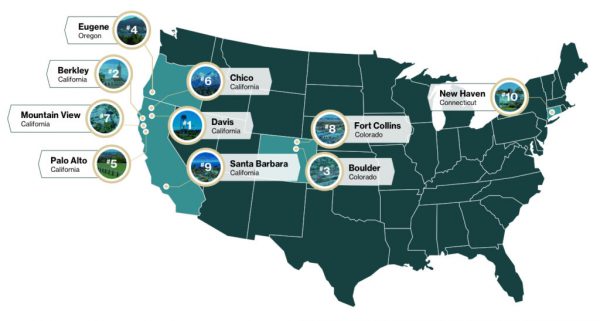
/New Haven is one of the nation’s ten safest cities for cyclists, according to a new analysis. In a ranking dominated by communities in California, with six of the top ten, New Haven was not only the lone Connecticut city to earn a spot among the top ten, it was the only city in the Northeast to do so. 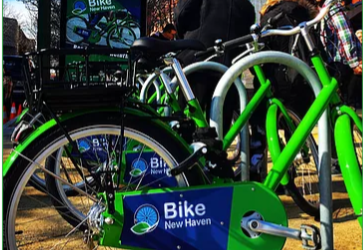 The ranking saw Davis and Berkeley California named the safest cities for bicyclists, followed by Boulder, Colorado; Eugene, Oregon; Palo Alto, Chico, and Mountain View, California; Fort Collins, Colorado; Santa Barbara, California, and New Haven. Minneapolis ranked number 12.
Five other Connecticut cities made their way into the top 100 nationally: Hartford at number 55; Norwalk at number 82; Bridgeport at number 85; New Britain at number 91 and Waterbury, which was ranked at number 92. Lower down the list were Stamford, ranked number 221 and Danbury, which came in at number 229.
New Haven debuted Connecticut’s first protected bike lanes a year ago, according to published reports, from City Hall to Long Wharf, and city officials have said “New Haven encourages alternative transportation options in the city so there is a variety of existing supported infrastructure available, including off-street shared use paths, on-street bicycle lanes, a contra-flow bike lane, bike boxes at intersections, on-street bike corrals, bike racks on sidewalks, bike racks on parking meters and bike racks on buses.”
"New Haven likely fared well due to their bike laws, a high percentage of spending per capita on bike lanes and their low percentage of fatal crashes," said Laura Schmitz, Safety Writer with Your Local Security. "The city of New Haven should be proud of their efforts to make their city safer for cyclists!"
 The city also launched a bike sharing program this year, in February, and celebrated National Bike to Work Day in May with a program encouraging bike riding. In addition, Yale University is a Gold-level Bicycle Friendly University, as awarded by the League of American Bicyclists, and the city has developed on-line bike route maps.
The safest city in Massachusetts, Somerville, ranked number 58. Providence was the safest in Rhode Island, but ranked number 482 on the national list. Syracuse was determined to be the safest in New York State, ranking number 537.
The rankings were issued by yourlocalsecurity.com, an ADT Authorized Premier Provider. To determine the safest and least safe US cities for bikers, metrics and data were used from Census.gov, the National Highway Traffic Safety Administration, People for Bikes, and The League of American Bicyclists to find the percentage of bike commuters, number of fatal crashes, amount of bike lanes, and what bike laws are in place or in the works in each city.
At the bottom of the list, the ten most dangerous cities included Los Angeles, New York, Houston, and five cities in Iowa. Cities were included if these sources had data for them. Cities included had populations of 20,000 or more.
 The purpose of the pilot program, according to OPM, is to encourage and allow for the testing of fully autonomous vehicles (FAV) on local highways in Connecticut. The goal for the pilot program is to allow a variety of FAV testing to occur in four municipalities throughout the state, bringing Connecticut to the forefront of the innovative and burgeoning autonomous vehicle industry.
 The state law outlines a framework of the minimum requirements to be included in agreements between municipalities and autonomous vehicle testers approved for participating in the Fully Autonomous Vehicle Testing Pilot Program (FAVTPP). The Connecticut law, according to the
  3 Seconds Behind the Wheel, which debuts on Connecticut Public on Thursday evening, is a new
  The film also gives audiences a firsthand look at emerging technologies that could one day offer solutions to rising crash statistics. The documentary follows researchers at Google who are using driving simulators to develop next-generation in-car infotainment systems, and explores how one Swedish company is experimenting with technology that could one day allow cars to understand human feelings and make driving decisions based on individual needs.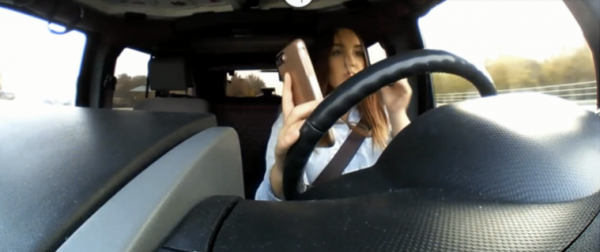

 The survey found that 38 percent of students whose grades were mostly A’s texted or e-mailed while driving a car on at least one occasion in the 30 days prior to the survey. The percentage was slightly less among students with lower grades: 31% of students with mostly B’s, 30% of students with mostly C’s and 23% of students with mostly D’s and F’s.
 The ranking does not capture the full extent of deprivations or hardships affecting children. Instead, it focuses on some key rights, or “guarantees” of childhood: life, healthy growth and development, education and protection from harm. If a child experiences all of these, his/her childhood is considered to be “intact.”
 The report notes that “While children are only 20 percent of the population, they are 100 percent of America’s future.” Save the Children’s ranking reveals children in New Jersey, Massachusetts, Vermont and New Hampshire are far more likely to experience safe, secure and healthy childhoods than children in Louisiana, Mississippi, Oklahoma and New Mexico.


 “We understand, by all accounts, many of them may be using products that closely resemble a USB flash drive, have high levels of nicotine and emissions that are hard to see. These characteristics may facilitate youth use, by making the products more attractive to children and teens. These products are also more difficult for parents and teachers to recognize or detect. Several of these products fall under the JUUL brand, but other brands, such as myblu and KandyPens, that have similar characteristics are emerging.”
 The Summit will feature nearly a dozen sessions and speakers, many from local businesses, highlighting best practices and latest developments in a range of technology arenas.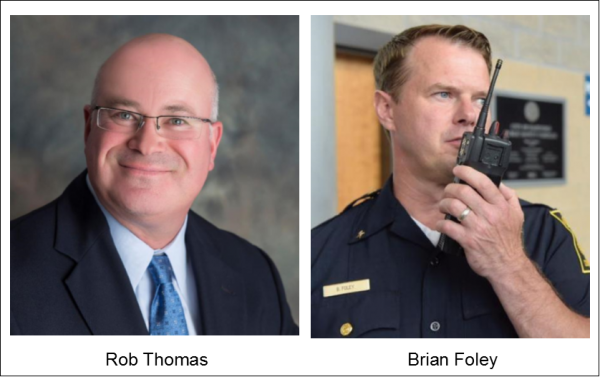
 If you have a sense that reports of hit-and-run accidents have increased in frequency, you’re correct.
 In all states, it’s the drivers legal and moral responsibility to avoid hitting pedestrians, bicyclists, or another vehicle; and leaving a crash scene significantly increases the penalties, whether or not the driver caused the crash, AAA emphasized.