Next Digital Citizenship Summit will be at Twitter Headquarters, One Year After Hartford Area Launch

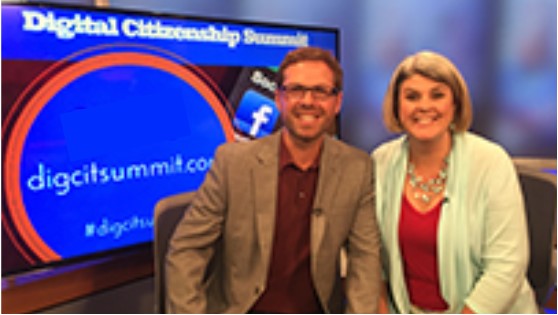
What a difference a year makes.  The Digital Citizenship Summit, launched last year in Greater Hartford at the University of Saint Joseph, will be hosted at Twitter headquarters in San Francisco on October 28 this year, as the launch event for U.S. Media Literacy Week at the social media giant’s global headquarters. The Digital Citizenship Summit, described as the only global network of summits and projects focused on the safe, savvy & ethical use of social media and tech, was developed locally and has quickly grown internationally, with sessions taking root across the globe. digcitsum

A major gathering of organizations, industry, parenting experts, students, and more, will bring together new, well-known, and unexpected voices from a wide variety of backgrounds for a fast-paced and energetic mix of presentations, panels, videos, and awards at Twitter headquarters this fall.

The day will be live-streamed to a large global audience, and seeks to broaden the appeal and accessibility to digital citizenship and media literacy. "Digital Citizenship" has been defined by Dr. Mike Ribble, author of Digital Citizenship in Schools, as "the norms of appropriate, responsible behavior with regard to technology use."

The Digital Citizenship Summit will serve as the kick-off event for Media Literacy Week (October 31-November 4) led by the National Association for Media Literacy (NAMLE). Media literacy “is the ability to access, analyze, evaluate, communicate and create using all forms of media,” and an area of heightened relevance so close to the presidential election.logo mix

“We are thrilled to be partnering with the Digital Citizenship Summit and Twitter on this event,” says Michelle Ciulla Lipkin, Executive Director of NAMLE. “We are excited about bringing thought leaders in digital citizenship and media literacy together. There is so much to be done to ensure a media literate world and exploring digital citizenship is a great way to get the conversation going.”

“Society has adopted new social media platforms and technologies before we have collectively had the chance to determine what constitutes safe, savvy, and ethical behavior,” says Digital Citizenship Summit co-founder David Ryan Polgar of West Hartford.

“There are multiple stakeholders who desire an active role in the process, including students, educators, parents, administrators, media specialists, and organizational leaders. All of these groups have crucial insight, and the Digital Citizenship Summit was setup to bring these voices together to solve current issues regarding social media and tech use,” Polgar said.

The issues, according to Polgar, are endless. “Some major areas of concern include how smartphones should or shouldn’t be used in the classroom, finding ways to improve civility online, adjusting to an Internet that never forgets our posts, and being able to determine the veracity of what we read online.”Polgar, Curran
By bringing together a broad range of experts, organizations, and interested parties, the Digital Citizenship Summit on October 28th aims to take a multi-stakeholder participatory approach to solving some of the vexing issues regarding social media and tech use.

Partnering organizations include the National Association for Media Literacy Education (NAMLE), Common Sense Media, Family Online Safety Institute (FOSI), #iCANHELP, ConnectSafely, iKeepSafe, and Trend Micro’s Internet Safety for Kids & Families.

The inaugural Digital Citizenship Summit in the United Kingdom was held earlier this year and another is already being planned in that nation, and plans are now being developed for similar initiatives in St. Louis as well as Ireland and Australia later this year.  A Summit was held in Wisconsin last month.

“We are thrilled to have the involvement of so many prominent organizations,” says co-founder Dr. Marialice B.F.X. Curran. “By collaborating on this event we can expose a wide audience with some incredible resources that can be used at home or in the classroom.” “At the same time,” chimes in her co-founder David Ryan Polgar, “the open and collaborative nature will bring forward new voices that can influence this important conversation around social media and tech use.”

“We want people impacted by tech and social media to feel empowered,” Curran continues. “Instead of being reactive, we want people to be active participants in the digital future. We want people to be the digital change.”

Media Literacy Week (#MediaLitWk) is designed to bring attention and visibility to media literacy education in the United States. Inspired by Canada’s Media Literacy Week, the National Association for Media Literacy Education is leading the efforts to create a media literacy week in the United States to showcase the work of amazing media literacy educators and organizations around the country. The mission of Media Literacy Week is to highlight the power of media literacy education and its essential role in education today.

The Digital Citizenship Summit is a global network of summits and projects focused on the safe, savvy, and ethical use of technology and social media. They are dedicated to creating a new culture in which everyone—particularly the next generation of digital natives, educators and parents—has a voice, and feels empowered to use it. The Digital Citizenship Summit brings diverse groups together to connect in person, join the conversation and take an active role in creating positive digital change on both a local and global level.

The first Digital Citizenship Summit was held on October 3, 2015 at the University of Saint Joseph in Connecticut. It drew over 220 educators, students, parents, administrators, organizations, and members of industry, and trended #1 in the nation (#digcitsummit).

Number of Special Education Students in CT Schools Continues to Increase, Data Shows

The number of Connecticut students in kindergarten through 12th grade with disabilities eligible for special education and related services has increased by nearly 6,000 between the 2008-09 school year and the current school year, as the overall student population has dropped by more than 32,500 students in that time. Data included in a new website developed by the Connecticut State Department of Education indicates that the prevalence of special education in Connecticut schools has increased from 11.6 percent of students to 13.4 percent of students over the past seven years.stat

The prevalence of autism has doubled in the overall school population, from eight-tenths of one percent in 2008-09 to 1.6 percent in the current year.  The percentage of students with learning disability has also increased, while the percentage with speech or language impairment has dropped, as a percentage of the overall student population.

Overall, the Special Education K-12 count in 2008-09 was 64,187 students.  In the 2015-16 school year, the number has climbed to 70,055, an eight percent increase, even as the total student count has gone from 555,411 to 522,906.

The website points out that “Prevalence rate is a statistic about the identification of students with disabilities eligible for special education and related services,” adding that “Connecticut has seen increases in the number and percent of students with disabilities statewide over the last five years.”

The site also notes that the overall decreasing public school enrollment causes the prevalence rate to appear to grow at a must faster rate than one would perceive from actual special education count data.web FT

Connecticut State Department of Education Commissioner Dianna R. Wentzell launched the new website, www.edsight.ct.gov, in late April.  It is designed to strengthen transparency and streamline online access to important school and district information.  The site integrates information from over 30 different sources – some reported by districts and others from external sources.

“The launch of our new data portal is a critical step in our mission to ensure all Connecticut students have access to the kind of high-quality education that prepares them for success in college, career and civic life,” Commissioner Wentzell said.

Over the coming months, additional information and reports will be made accessible to the public through this portal. The site is the culmination of more than two years of work and development by the Department with support from important partners, including the state Department of Administrative Services.

The Department also joined the world of social media last week with the launch of an official Facebook page and Twitter account. The Department’s Facebook page address is http://www.facebook.com/ctdepartmentofeducation. On Twitter, the Department is @EducateCT.

SpedTable_Prev


CT Is National Microgrid Leader, Seeking Electricity Resiliency

The cover story in this month’s edition of State Legislatures magazine, published by the National Conference of State Legislatures, examines new technologies that are keeping the lights on when disasters strike the electric grid.  And it turns out that New England – especially Connecticut – is showing the way for states across the country in one of the new approaches, the electricity microgrid. The sit-up-and-take-notice event that has sent state legislature scurrying to act was SuperStorm Sandy, which knocked out power to nearly 8 million people across 15 Eastern states, including wide swaths of Connecticut.  One of the primary responses aimed at making the electric system more resilient has been the development of microgrids, and Connecticut has been swifter than most in seizing the technological advance. Cover_May2016_240

Microgrids are an example of how state legislators are seeking to make the electrical grid more reliable and resilient through strategies that strengthen infrastructure and shorten the time it takes to restore power, reporter Dan Shea explained in the article.  The whole idea is to minimize the damage and disruption of a disaster.

The article was drawn from research for the NCSL report, State Efforts to Protect the Electric Grid, published in April.  The report points out that nearly 40 percent of the U.S. population—over 123 million people—live in coastal shoreline counties, according to U.S. Census Bureau data.

“We had Irene. We had Sandy. We had a snowstorm that went on forever. We had people in the dark, substations threatened by flooding and power out for eight, 10, 12 days,” Connecticut State Representative Lonnie Reed (D-Branford) told the publication. “We began to see just how vulnerable the whole interconnected system is.”

Many Northeastern states have taken action on microgrids, but the Connecticut General Assembly has been the most active legislative body, Shea reports, passing or updating microgrid-inclusive bills in each of the past four years (2012-2015). These laws offer a range of options for potential microgrid developers—and could even incentivize distributed generation developers to expand their projects to incorporate microgrid technologies.

The three main incentives are:

  • A microgrid grant and pilot program;
  • The Connecticut Green Bank’s commercial sustainable energy program;
  • And municipal energy improvement districts.microgrid image

The Connecticut General Assembly passed legislation enacting a microgrid pilot program in 2012 – the first in the nation according to the Connecticut Department of Energy and Environmental Protection (DEEP). Initially, the program granted $18 million to nine projects. The initiative was later extended and given an additional $30 million to expand microgrid deployment, Shea reports.

Eligibility was extended to municipalities, electric distribution companies, municipal electric companies, energy improvement districts and private entities. On March 6, 2014, Wesleyan University in Middletown became the first of the CT microgrid projects to come online, according to the DEEP website.

The State Legislatures article reports that in 2015, lawmakers in 17 states, including New York and New Jersey, introduced more than two dozen bills on microgrids, six of which have been enacted. Several pending bills direct state agencies to study microgrids, while at least six states are considering legislation that would offer grants, loans or other incentives to develop them. Microgrids, although growing most rapidly in the Northeast, are taking root elsewhere, including California, State Legislatures reports.

In addition, a growing number of businesses and organizations are also investing in resilient systems that allow them to operate independently whether the grid is up or down.

“You’re really talking about having an economic leg up if you have the capacity to stay open and operational when others aren’t,” Reed told State Legislatures.

The state legislature has also directed the Connecticut Green Bank to include microgrid projects within its definition of “energy improvements” that the bank is authorized to make appropriations and issue bonds or other obligations to help finance.

The legislature has also authorized any municipal government to establish an energy improvement district by vote of its legislative body. The state statute outlines how the district’s affairs will be managed and authorizes a board to fund the development of energy improvement projects within the district.

Nationally, more than a dozen states introduced legislation in 2015 that calls for greater diversity in power sources—from expanding renewables to supporting nuclear and fossil fuels.  The State Legislatures report indicates that those efforts are likely to intensify in the years ahead, as weather events are predicted to become more frequent and more severe.

image


204,000 Self-Employed in CT; Freelancers Increasing Nationwide

The ranks of the self-employed are growing in Connecticut, as the number of freelancers continues to expand nationwide.  In Connecticut, there are now an estimated 204,000 individuals who are self-employed, more than 11 percent of the state’s workers, which exceeds the national average. As of March 2016, approximately 15.3 million people in the United States designated their employment status as “self-employed,” according to the U.S. Bureau of Labor Statistics, and increase of about 700,000 since May 2014, just over 10 percent of all U.S. employment.state stat

In 2015, 29 states and the District of Columbia had self-employment rates below the U.S. rate of 10.1 percent, and 21 states had rates as least as high. Montana had the highest rate among states, 16.1 percent, followed by Maine (15.4 percent), Vermont (14.4 percent), and South Dakota (14.2 percent). The lowest rates were in the District of Columbia (7.1 percent), Delaware (7.2 percent), and Alabama (7.5 percent), according to BLS data.

Additionally, published reports last fall indicated that 54 million individuals report doing freelance work, either full-time or on the side, in the U.S., representing about one-third of the nation’s workforce.  That is an increase of 700,000 since 2014, according to a comprehensive study conducted by the independent research firm Edelman Berland.

“Americans who are freelancing already contribute more than $700 billion to our national economy and help U.S. businesses compete and find the skills that they need,” said Fabio Rosati, CEO of Elance-oDesk, which commissioned the survey with Freelancers Union.  The study identified five freelancer segments:stats

  • Independent Contractors (36% of the independent workforce / 19.3 million professionals)
  • Moonlighters (25% / 13.2 million)
  • Diversified workers (26% / 14.1 million)
  • Temporary Workers (9% / 4.6 million)
  • Freelance Business Owners (5% / 2.5 million)

In its scale, scope, and complexity, the transformation (of the workforce) will be unlike anything humankind has experienced before," Klaus Schwab, founder and executive chairman of the World Economic Forum, which organized the Davos gathering,  wrote earlier this year. "The speed of current breakthroughs has no historical precedent. ... These changes herald the transformation of entire systems of production, management, and governance."

2014 2015Already, 2.9 million freelancers earned more than $100,000 last year, up from 2 million who hit the six-figure mark just four years earlier, according to MBO Partners.  The report indicated that 60 percent of freelancers surveyed said they started freelancing by choice—up from 53 percent last year—and 67percent of freelancers agree that more people are choosing to work independently today compared to three years ago.

The survey commissioned by Freelancers Union and Upwork in 2015 found that than one-third of freelancers report that demand for their services increased in the past year, and 3 in 4 non-freelancers are open to doing additional work outside their primary jobs to earn more money, if such an opportunity was available.  The report stated that “freelancing is becoming a more prevalent, viable option for workers—a trend that spans across borders, industries and occupations.”

Conversation in the Digital Age: Panel of Experts Will Discuss How We’re Changing

The topic of the evening is an exploration of conversation in the digital age, as two Hartford institutions come together to bring some perspective to how we communicate in the age of technology, and how we don’t. On Wednesday, May 4, The Connecticut Forum in partnership with the Mark Twain House & Museum will present DISCONNECT: Conversation in the Digital Age. The event is described as an (old-fashioned) conversation with three nationally-recognized digital experts to discuss “how social media and our ubiquitous devices have impacted the art of authentic conversation.”  They pose the question: if conversation is how we truly connect to others, what happens when face-to-face communication decreases?Forum, Twain

The panel will feature Dr. David Greenfield from the Center for Internet & Technology Addiction, Slow Tech Movement founder Janell Burley Hofmann, and tech ethicist David Ryan Polgar. Jamie Daniel, director of programming at The Connecticut Forum, will moderate the conversation.

Polgar says that opportunities for fluid conversations have diminished, to our detriment. “We have adapted technology faster than we can adjust our norms or our etiquette.  Do we ever have a prolonged conversation anymore?  There’s a difference between communication and conversation,” he suggests.

“We’re constantly packaging ourselves – exercising brand management in our conversations,” he observes.  “We’re so plugged in, we don’t do eye-to-eye communicating much anymore – there’s a need to increase facetime in our communication.”

Polgar is a frequent speaker and respected tech commentator/writer, and has been featured in The Boston Globe, Financial Times, BBC, SiriusXM, Sydney Morning Herald, VentureBeat, US News & World Report, TEDx, and Forbes, among other publications. He is also co-founder of the Digital Citizenship Summit, a global network of summits focused on safe, savvy, and ethical use of social media and technology. With a background as an attorney and educator, he examines tech use from an ethical, legal, and emotional perspective, providing a unique look into emerging trends and business insight.digital speakers

“We’re thrilled to collaborate with the Twain House on this timely event,” said Connecticut Forum Executive Director Doris Sugarman. “We welcome opportunities like this to facilitate and encourage dialogue about compelling topics that impact our communities and our lives.”

Individuals planning on attending can send in a question in advance of May 4, via a link  that provides a form for questions to be directed at a specific panelist, or the entire panel.

Janell Burley Hofman is the author of the book, iRules: What Every Tech-Healthy Family Needs to Know About Selfies, Sexting, Gaming and Growing Up. She is also a speaker and consultant on topics like technology, media, health, relationships and personal growth. She will be signing copies of her book after the program.

Dr. David Greenfield is the founder of The Center for Internet and Technology Addiction and an Assistant Clinical Professor of Psychiatry at the University of Connecticut School of Medicine. He is recognized as one of the world’s leading voices on Internet, computer, and digital media behavior, and a pioneer concerning compulsive and addictive use. He is the author of the Virtual Addiction, which rang an early warning bell with tech overuse when it came out in 1999.  He lectures to public and medical/psychiatric groups throughout the world, and has appeared numerous times on national media and publications.

“I am looking forward to hearing from this panel of experts on questions that we consider every day,” said Jamie Daniel, Director of Programming at The Connecticut Forum, who will be moderating the discussion.  “How is technology changing the way we make friends, fall in love, and parent our kids? How is our online discourse impacting the way we engage in politics? Connect with one another? Shape our communities? And how is social media changing our relationships - and our brains? This amazing panel will help us consider all of this, and more.”

-----

The Connecticut Forum is a (c)(3) nonprofit organization serving Connecticut and beyond with live, unscripted conversations among renowned experts and celebrities, and community outreach programs including the Connecticut YOUTH Forum.  The Mark Twain House & Museum has restored the author's home, where the author and his family lived from 1874 to 1891. In addition to providing tours of the National Historic Landmark, the institution offers activities and educational programs that illuminate Twain's literary legacy and provide information about his life and times.

Tickets for DISCONNECT are $10. ($5 for Mark Twain House & Museum members and Connecticut Forum subscribers) The program on Wednesday, May 4 begins at 7 PM.  Photo: (l to r) David Greenfield, Jannell Hofmann, David Ryan Polgar.

CT Ranks Behind 33 States as Technology Innovation Adopter, Report Finds

Twelve states and the District of Columbia are now championing innovation-friendly policies at the highest level according to the 2016 Innovation Scorecard, an annual innovation policy performance index developed by the Consumer Technology Association (CTA). Arizona, Kansas, Nebraska, North Dakota and Wisconsin are first-time Innovation Champions – the top designation - joining repeat champion winners Delaware, Indiana, Massachusetts, Michigan, Texas, Utah, Virginia and the District of Columbia.CT scorecard

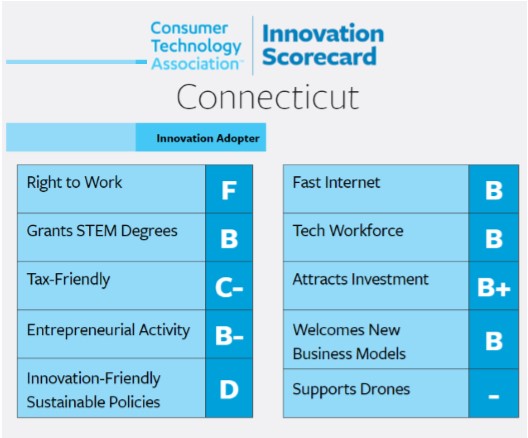
Connecticut ranked in the third of four tiers, as an Innovation Adopter. The CTA Innovation Scorecard grades every state and the District of Columbia on 10 criteria, ranging from quantitative to qualitative, and ranks them across four categories — Innovation Champions (13 states), Innovation Leaders (20 states), Innovation Adopters (12 states including Connecticut) and Modest Innovators (6 states).

"We hope the Innovation Scorecard will be a guide for states who want to embrace those policies that best drive innovation, create good jobs and fuel economic growth," said Gary Shapiro, president and CEO, Consumer Technology Association. "We've identified and measured some key practices that enable innovators to thrive including drawing entrepreneurs from across the country, welcoming disruptive business models and educating the workers of tomorrow. But unless more state policymakers adopt a light regulatory framework, they risk sending valuable talent and economic growth to a neighboring state - or, far worse, overseas."cover

The 2016 Innovation Champion states earned high grades for maintaining strong right-to-work legislation, fast Internet access, a robust entrepreneurial climate and an open posture to new business models and technologies. Other Scorecard criteria are tax policy, tech workforce, investment attraction; Science, Technology, Engineering and Mathematics (STEM) degrees; unmanned innovations and sustainability policies. Since the last edition of the Scorecard, six states regressed to a lower tier.

Connecticut’s top grade, a B+, come in the Attracts Investment category.  The state earned a B in four categories:  Fast Internet, Tech Workforce, Welcomes New Business Models and Grants STEM degrees, and a B- in Entrepreneurial Activity.  The state’s lesser grades were in the categories Tax Friendly (C-), Innovation-Friendly Sustainable Policies (D) and Right to Work (F).  The report indicates that “Connecticut’s state-run electronics recycling system overcharges residents and manufacturers of consumer tech products, who pay for recycling at twice the market rate.”

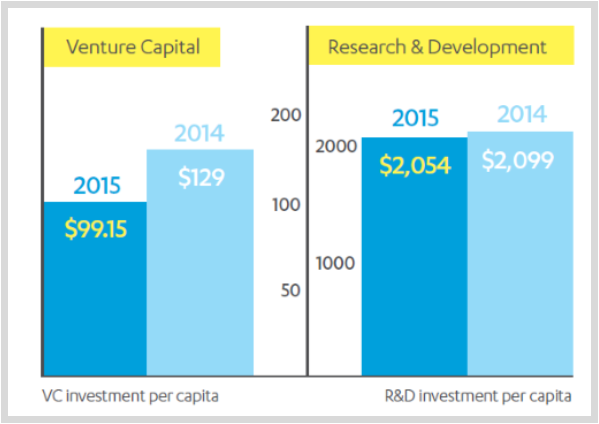
investmentThe report also highlights an area of decline in Connecticut:  “Over $100 million of venture capital left Connecticut in 2015, causing the state to lose ground after earning an ‘A-’ in the category in the inaugural 2015 Scorecard. Connecticut should improve its tax code, which is among the least growth-friendly in the country, and reform regulations that stifle innovation.”
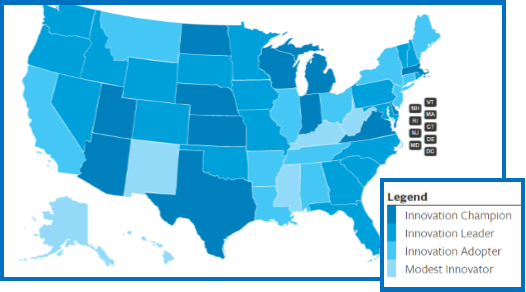
Among the findings: Delaware, Massachusetts, Rhode Island, Utah and the District of Columbia have the fastest Internet speeds in the country; Montana, North Dakota and Wyoming are among the leading states - along with the District of Columbia - at creating new jobs and new small businesses; and Arkansas, Maryland, Mississippi and Oregon were the only states earning a top grade for creating a policy environment favorable toward drones.

Consumer Technology Association (CTA)™, formerly the Consumer Electronics Association (CEA)®, is the trade association representing the $287 billion U.S. consumer technology industry.

usa map

CT Women of Innovation To Be Honored This Week

The 12th annual Women of Innovation® awards gala this week will recognize 52 women who are accomplished in science, technology, engineering, math and who are involved in their community, five college students and seven high school students who have already begun to demonstrate similar accomplishment. The annual awards event is “a time for like-minded, successful women to network and celebrate their accomplishments,” continuing a tradition led by the Connecticut Technology Council aimed at recognizing women in a range of innovative businesses, education and communities, and highlighting role models for young women looking ahead to career pursuits.

The categories include:

  • Youth Innovation and Leadership
  • Collegian Innovation and Leadership
  • Community Innovation and Leadership
  • Research Innovation and Leadership
  • Academic Innovation and Leadership
  • Entrepreneurial Innovation and Leadership
  • Small Business Innovation and Leadership
  • Large Business Innovation and Leadership

One woman in each of the eight categories will be selected as a top Woman of Innovation in her category, at the April 6 awards ceremony.

Among the nominees, in the Entrepreneurial Innovation and Leadership category, are Marcia Fournier, Founder & CEO of BioArray Therapeutics, Inc.; Gloria Kolb, CEO/Owner of Elidah, Inc.; Wendy Davis, CEO of GestVision, Inc.; Amy McCooe, Co-CEO of Level Up Village; Nicole Bucala, CEO of MIFCOR; Kelly Simpson-Angelini, CEO and Chief Strategic Officer of Simpson Heathcare Executives; Janine Darling, Founder & CEO of STASH America, LLC; and Anuja Ketan, Chief Technology Officer at Zillion Group Inc.innovationlogo

The women nominated in the Small Business Innovation and Leadership category include Melissa Casini – etouches, Norwalk, (Director of Account Management); Dina Dubey – Z-Medica, Wallingford,  (Executive VP, Corporate Development); Merrie London – Connecticut Innovations, Rocky Hill (Manager, SBIR and Federal Leveraging Programs); Jackie Mulhall – SMC Partners, Hartford (Director); Pam Perdue – Continuity Control, New Haven (Founder, EVP Regulatory Operations); and Kathleen Roberge – etouches, Norwalk (VP of Global Sales).

The full list of nominees includes individuals at some of Connecticut’s leading companies, including Sikorsky Aircraft, Frontier Communications, Hartford Hospital, Pfizer, and Pratt & Whitney. Academic institutions with Women of Innovation include the University of Connecticut, Wesleyan University, University of Bridgeport, and Yale University.

The keynote speaker for the April 6 awards program will be Congresswoman Elizabeth H. Esty, U.S. Representative for the 5th Congressional District of Connecticut. During the past 11 years, more than 500 women have been honored by Women of Innovation.

“Our state’s innovation sector recognizes the essential contributions its female engineers, scientists, programmers, physicians, mathematicians and teachers make in developing new products and services, advancing health technologies and serving as educators and role models for generations of women that follow,”said Connecticut Technology Council President and CEO Bruce Carlson. “Women of Innovation® allows us to put the spotlight on these exceptional innovators and leaders and connect them with a professional network of other women who strive for excellence.”

https://youtu.be/Uz1gQ96Yk1c

Survey Says: Parents Don't Trust On-line Doctor Ratings, But Use Them

As the annual observance of National Doctors’ Day approaches this week, a new national survey indicates that nearly one-third (30%) of parents report looking at online doctor ratings for themselves or a family member in the past year, with mothers (36%) more likely than fathers (22%) to visit such sites. Among these parents, two-thirds say they selected or avoided a doctor based on the ratings they viewed. Among parents who choose doctors based on the ratings, most (87%) say the online ratings accurately reflect their experience with the doctor. The survey was conducted for C.S. Mott Children’s Hospital at the University of Michigan.logo-2016

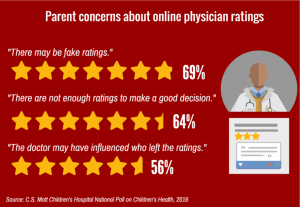
The survey also found, however, that a majority of parents have concerns about doctor rating websites in general. About two-thirds of parents believe some ratings may be fake; slightly fewer feel there are not enough ratings on the websites to make a good decision. More than half of parents feel doctors may influence who leaves ratings. Among parents in this survey who had ever left an online rating about a doctor (11% overall), nearly one-third (30%) reported that the doctor or office staff had asked them to do so.mouse doc

National Doctors’ Day was established to recognize physicians, their work, and their contributions to society and the community. National Doctors’ Day is observed on March 30 each year.  The holiday was officially signed into U.S. law in the early 1990s by President George H. W. Bush, although since the early 1930s patients and healthcare organizations across the country have been celebrating their physicians on this day.

In the on-line ratings survey, older parents generally had more concerns than younger parents. Of parents age 30 and older, 71 percent were concerned about the possibility of fake reviews compared to 59 percent of parents under age 30. Older parents (65%) also were more concerned about the low number of ratings compared to younger parents (55%).doctor

The survey analysis pointed out that “while the use of online physician rating sites is expected to keep rising, their growth may be limited by concerns from parents about accuracy and authenticity.”

In recognition of National Doctors’ Day, Connecticut Children’s Medical Center in Hartford has urged patients to post a message to their doctor, and many of the messages have been displayed on the hospital’s web site.  Other organizations around the state also take note of the contributions of physicians to the well-being of the population.

Most Expensive State for Car Insurance? Michigan Ranks First, CT is 17th

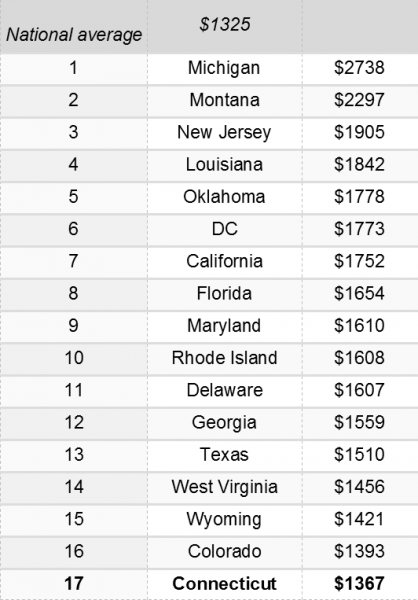
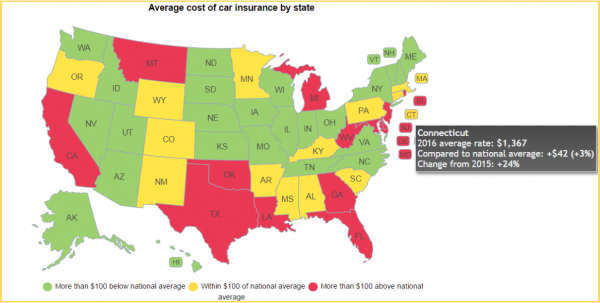
The most expensive car insurance rates in the nation are in Michigan.  Connecticut ranks 17th.   It is the third consecutive year that Michigan has topped the list. Connecticut’s average of $1,367 is 3 percent above the national average of $1,325.  The average rate in Connecticut jumped by 24 percent from 2015 to 2016, according to the survey.  The Connecticut data was compiled in February.  Among the New England states, Rhode Island was ranked tenth, averaging $1,608, Massachusetts ranked 21st at $1,325. Maine had the lowest rates, at $808 annually.

Insure.com’s 2016 state-by-state comparison of auto insurance premiums found that Montana captured the No. 2 spot for the second year in a row. New Jersey broke into the top five for the first time ever, Louisiana was No. 4, and Oklahoma rounded out the top five.list

On the flipside of the cost coin, Maine led the way for the cheapest car insurance in the country. Maine has been in the top three for the least expensive car insurance for all six years of the study, according to insure.com. This year, Ohio came in No. 2, Wisconsin was three, Idaho took fourth, and New Hampshire earned No. 5.

The annual study compiles rates from six large insurance carriers in 10 ZIP codes in every state. Rates were for the same full-coverage policy for the same driver -- a 40-year-old man with a clean driving record and good credit. The rates are an average for the 20 best-selling vehicles in the U.S. in order to present more accurate rates for the average driver – without high-end sports or luxury cars skewing the data. Each model was rated on its cheapest-to-insure trim level.

mapThe national average for a full-coverage policy as featured in the Insure.com report came in at $1,325 this year – a slight increase from last year’s average of $1,311. Rates varied from a low of $808 a year in Maine to a budget-busting $2,738 in Michigan. Insurance rates in Michigan are more than double (107 percent) the national average.

Insurance rates are influenced by a number of different factors. Everything from traffic, crime rates, state and local laws, the percentage of uninsured drivers, as well as the number of insurance companies competing in a market can all result in higher or lower insurance premiums in your state.

Insure.com commissioned Quadrant Information Services to calculate auto insurance rates from six large carriers (Allstate, Farmers, GEICO, Nationwide, Progressive and State Farm) in 10 ZIP codes per state. Insure.com averaged rates in each state for the cheapest-to-insure 2016 model-year versions of America’s 20 best-selling vehicles and ranked each state by that average. Rates are for comparative purposes only within the same model year.

CT is Nation’s 5th Most Innovative State, Ranks 4th in Productivity

Massachusetts is the nation’s most innovative state, with California scoring a close second and Washington, New Jersey and Connecticut rounding out the top five states, according to The Bloomberg U.S. Innovation Index, in findings that highlighted the connections between education, research and innovation.index "There are some things that state governments can do to make their states more attractive to research and development," including R&D tax credits, Nariman Behravesh, chief economist at IHS Inc. in Lexington, Massachusetts told Governing magazine. "State governments — if they carefully target areas where they think they have a bit of a competitive advantage — they could develop a cluster around their universities, as well."

Bloomberg scored each of the 50 states on a 0-100 scale across six equally weighted metrics: R&D intensity; productivity; high-tech density; concentration of science, technology, engineering and mathematics (STEM) employment; science and engineering degree holders; and patent activity.

Mississippi, West Virginia and South Dakota are the three least innovative states.

Reviewing Connecticut rankings by category, the state ranked 4th in productivity, 8th in R&D intensity, 10th in science & engineering degree holders, 11th in patent activity, 13th in STEM concentration and 22nd in high-tech intensity. innovation

Rounding out the top 10 most innovative states were Oregon, Maryland, Colorado, Delaware and Minnesota.  Among the other New England states, New Hampshire ranked 12th, Rhode Island was 14th, Vermont ranked 25th, Maine finished near the bottom at number 43.

The data analyzed by Bloomberg came from the Bureau of Economic Analysis, Bureau of Labor Statistics, National Science Foundation, StatsAmerica.org and the U.S. Patent and Trademark Office.

mpa