Student News Stories Showcase Next Generation of Journalists

With journalism and journalists under increasing criticism and new technology making old models of financing investigative journalism tougher, Hartford’s FOX 61 is showcasing young journalists as they learn the profession and develop stories that reach local newscasts. FOX 61 Student News was relaunched in February after a multi-year absence, and last week honored students at a special year-end awards ceremony held at Goodwin College in East Hartford. During the school year, FOX61 Student News empowered Connecticut middle and high school students to explore the world of multi-media journalism by giving them the opportunity to capture, edit and publish original content under the guidance of industry professionals.

Each student produced and hosted a news segment that showcased a local story or event that aligns with the station’s weekly HOPE segment. The student stories were featured on-air during Friday's Good Day Connecticut at 6:20 a.m. 7:30 a.m., and during the 5 and 10 p.m. news.

Among the winning stories:

  • Best in Student News Reporting and Writing was awarded to Manchester High School’s Kailey Feshler for her story on the CT Humane Society.
  • Best in Student News Pre and Post Production and Editing was awarded to three students from Daniel Hand High School in Madison: Liam Bennett, Delvantae Hutton and Ashleigh Violette for their story on Saferides.
  • Best in Student News Photography and Lighting was awarded to two students from Norwich Free Academy: Alyssa Friedrich and Maggie Peter for their story on Local Manufacturing.

The winners in each of these categories received a scholarship, donated by Fox 61.

  • Most Compelling Student News Story was awarded to three students from South Windsor High School: Lauren Adamo, Madison Donahue and Hannah Mitchell for their story on Josie the Therapy Dog. They shared the $3,500 scholarship provided by local sponsor, Big Y World Class Market.

Through the years, many students have participated in the Fox 61 Student News, reporting on different issues in their communities.

FOX 61 is one of the nation's most highly rated FOX Network affiliates, producing more news and winning more awards than any station in Connecticut. FOX 61 now airs more than 61 hours of local news and public affairs programming each week, more than any other market station. FOX 61 is owned and operated by Tribune Media, one of the country’s leading multimedia companies.


Innovative Start-Up Companies Seek State Funds to Propel Growth

CTNext will bring together start-up businesses seeking the financing to move forward, providing the opportunity for them  to pitch at the next Entrepreneur Innovation Awards (EIA) event scheduled for Thursday, June 15 at the LOFT at Chelsea Piers in Stamford. Connecticut's "innovation ecosystem" will be highlighted as the nine companies, from all across the state, will be competing for $10,000 grants.  The competitors include:

  • Deo2go (Fairfield): Creating a topical delivery device that can be filled with a variety of products including, but not limited to deodorant, lip balms, and sunscreen
  • Egghead (Danbury): Developing a new way to package and sell ice cream that brings new revenue to a mature market
  • FallCall Solutions (Trumbull): Creating a tele-monitoring system for the Apple watch and other mobile systems for elders and caregivers
  • Fjord Weather Systems (Wilton): Developing a way to turn every boat on the water into a weather-monitoring system
  • LiquidSphere (New Haven): Creating an interactive app that will connect people who struggle with stress, anxiety, depression and addiction with therapists via text and video sessions
  • Lucca Ventures (Southington): Developing a Bluetooth-enabled microphone attachment to a full-face oxygen mask, letting patients communicate clearly while wearing it
  • Obvia (West Hartford): Manufacturing dual-winglet blades and semi-shroud power upgrade for Sunforce Wind Turbines that will improve efficiency and scalability for the turbines
  • Sweet Equations (East Hartford): Making custom candy cakes, edible cupcake displays and other desserts through the development of an on-demand decorating device
  • Trekeffect (Lyme): Developing a system to let individual travel planners buy and sell their itineraries.

To determine the finalist pool, each company’s application was vetted by a separate and independent team of reviewers who deemed their products, services and/or business ideas worthy of consideration for an EIA. Each finalist will have an opportunity to compete for a $10,000 grant as well as the judges’ and crowd favorite awards, each in the amount of $2,000 each.

The judges who will hear the company pitches and determine the winners include:

  • Elena Cahill: Senior Lecturer, University of Bridgeport, Entrepreneurship Department
  • Jim Kern: Co-founder, COMRADITY
  • Greg Kivenzor: Associate Professor of Marketing, Director of Experiential Learning Collaborative, UCONN- Stamford
  • Mark Lasoff: Founder, LearnToProgram
  • Mike Roer: President, The Entrepreneurship Foundation

Throughout the year, CTNext hosts the EIA, a Shark Tank–style pitch event where Connecticut-based startups and entrepreneurs compete for grants that can be applied toward a specific project that will help accelerate growth.

CT Next support the success of companies and entrepreneurs by providing guidance, resources, and networks to accelerate their growth. CT Next is a wholly-owned subsidiary of Connecticut Innovations, described as "a network of passionate people who offer services to busy entrepreneurs." Launched in 2012, there are now more than 1,500 members. Since its inception in 2014, CTNext has held 11 total events in cities and towns all over Connecticut, awarding $544,000 to 52 unique companies.

https://youtu.be/Au4ULyo5L1g

Good News, Bad News in State Health-Related Data, Analysis Finds

Connecticut is 11th best among states in the number of people who had no trouble finding a doctor in 2015, according to State Health Compare. The top 10 states were Minnesota, Kansas, Vermont, Utah, North Dakota, Montana, Maine, Nebraska, Hawaii and Tennessee.  That's the good news. But Connecticut is also 17th worst among states in the percent of residents with high medical cost burdens, at 23.1 percent. Utah has the highest percentage at 27.5 percent; Maryland the lowest at 15.3 percent, among the 50 states.

According to the data, 70.7 percent of state residents had a general doctor or provider visit during the year, a lower percentage than the national average of 73 percent, and ranking the state 38th in the nation.  The data also reveal that Connecticut is 19th lowest among states in the percent of state budget devoted to Medicaid, and 28th lowest in state public health spending per person.

Nearly one in ten Connecticut residents (9.1 percent) spent the night in a hospital during the year, 15th highest in the nation.

Created by SHADAC, State Health Compare is a new online comparison tool with state-level estimates across 46 measures of health and health care from six federal agency sources. SHADAC is a multidisciplinary health policy research center with a focus on state health policy, supported by the Robert Wood Johnson Foundation and affiliated with the Health Policy and Management Division of the School of Public Health at the University of Minnesota.

Categories in the database include health insurance coverage, cost of care, health behaviors, outcomes, access, utilization, quality of care, public health, and social and economic factors. Metrics include costs of potentially preventable hospitalizations, percent of residents who needed but did not get care due to cost, chronic disease prevalence, weight assessment in schools, and adult cancer screening rates.

Data for most measures is available for multiple years, allowing trend analysis. Within most of the 46 measures, the tool allows visitors to dive deeper into the data by subpopulations such as by age, race/ethnicity, and education level. The tool provides a map, state rank and trend display for each metric. The data can be downloaded and exported.

The data was recently featured in CT Health Notes, a biweekly informational newsletter of the Connecticut Health Policy Project. It includes research summaries, news, event notices, policy proposals and other issues important to Connecticut’s health policy.

New Ventures Impress, Receive Funds to Advance Entrepreneurial Efforts

reSET, the Social Enterprise Trust (www.reSETCo.org), whose mission is advancing the social enterprise sector and supporting entrepreneurs of all stripes, revealed the winners of its 2017 Venture Showcase last night at The Mark Twain House and Museum to a sellout crowd of 200. The annual event recognizes the talented entrepreneurs and innovative businesses that have just graduated from reSET’s nationally recognized accelerator. 17 early stage enterprises graduated from the recent cohort, and last night, seven finalists competed for $30,000 in unrestricted funding.

The entrepreneurs pitched their business models to an audience of founders, investors, and community and corporate stakeholders. An esteemed panel of judges, including Tony Vengrove of Miles Finch Innovation, Michael Nicastro of Continuity, and Lalitha Shivaswamy of Helios Management Corporation, selected the ultimate winners.

Recipients of the competition’s three “reSET Impact Awards” are listed below, as is the winner of the “Tech Impact Award,” which was given by reSET’s Founding Partner and the evening’s Presenting Platinum Sponsor The Walker Group.

reSET Impact Awards:

$10,000 - Career Path  http://www.careerpathmobile.com

$6,000- Pelletric  http://www.pelletric.com

$4,000 - Phood  http://phoodsolutions.com

The Walker Group’s Tech Impact Award:

$10,000 - Phood http://phoodsolutions.com

Other finalists included:  Almasuite http://www.almasuite.com, Eureeka BI http://www.eureekabi.com, Optima Sports System http://optimasports.es,

and Sweetflexx http://sweetflexx.com/en.

The Showcase’s prize purse was made possible by a handful of reSET’s community partners: The Walker Group (Presenting Platinum Sponsor), The Hartford (Platinum Sponsor), Eversource (Gold Sponsor), AT&T (Gold Sponsor), Accounting Resources, Inc. (Silver Sponsor), Qualidigm (Silver Sponsor), CT by the Numbers (Silver Sponsor), and Aeton Law Partners (Silver Sponsor). The David Alan Hospitality Group and Capture provided in-kind services.

CareerPath is a platform that enables career planning teams to "effectively connect and communicate with students." Using a series of milestones, tasks, and events as drivers, CareerPath allows students to "tackle their career planning objectives in an organized and manageable way."

reSET also receives generous support from its Strategic Partners: The Walker Group, Connecticut Innovations, MetroHartford Alliance, and the Connecticut Department of Economic and Community Development.  reSET, the Social Enterprise Trust is a non-profit organization whose mission is to advance the social enterprise sector. Its strategic goals are threefold: to be the “go-to” place for impact entrepreneurs, to make Hartford the Impact City, and Connecticut the social enterprise state.  Since its inception, reSET has awarded more than a quarter of a million dollars to scaling ventures. Graduates of the organization’s accelerator have generated $4.4 million in revenue and have taken on $5.5 million in investment.

https://youtu.be/EAC6W3Dn_k8

$93 Million in Tax Credits to Film, Digital Industries in Connecticut

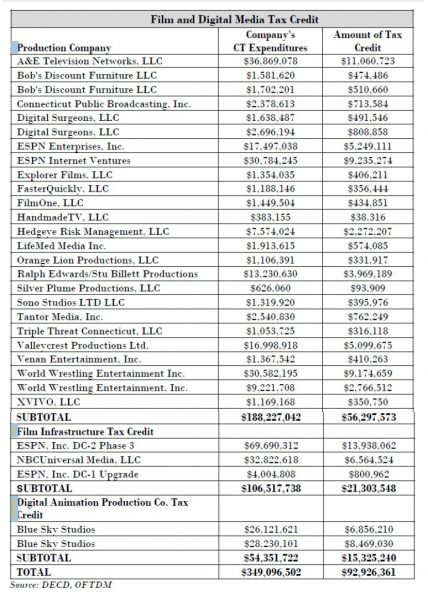
An estimated $349 million was spent in Connecticut by qualified productions and $93 million in tax credits were issued to 25 media production companies under the state’s tax credit program during fiscal year 2016.  The tax credits are designed to boost the state’s economy by attracting film and digital productions to the state, creating employment opportunities for state residents. According to the Office of Film, Television and Digital Media, which supports and enhances Connecticut’s film, television and digital media industry, companies are provided with direct financial assistance programs, including but not limited to loans, grants, and job expansion tax credits structured to incentivize relocation to Connecticut and the growth and development of current Connecticut-based companies.

The breakdown by industry segment:

  • Production Companies - $188 million spent; $56 million in tax credits issued
  • Film Infrastructure - $106 million spent, $21 million in tax credits
  • Digital Animation - $54 million spent; $15 million in tax credits

Film infrastructure tax credits went to companies including ESPN in Bristol and NBC Universal in Stamford; Digital Animation tax credits to Blue Sky Studios in Greenwich.

The production companies receiving tax credits from the state included well-known names such as A&E, Connecticut Public Broadcasting, ESPN, World Wrestling Entertainment and Bob’s Discount Furniture, which received just under a million dollars in tax credits under the program.

The legislation, first approved in 2006 and amended twice during the past decade, makes it possible for eligible production companies to receive a tax credit on a sliding scale of up to 30 percent on qualified digital media and motion picture production, pre-production and post production expenses incurred in the state. The Office “actively assists local, national and international motion picture, TV and media production entities with finding locations in Connecticut, rules and procedures, securing permits, hiring local cast and crew and other services,” according to the agency’s website.  In addition, the Office “represents the state and its agencies, municipalities and resident media professionals in interactions with media production entities and the industry at large.”

The popular reality courtroom drama “The People’s Court” announced this month plans to move to a new location on Stamford’s West Side. The show’s production company, Ralph Edwards/Stu Billett Productions, is moving its headquarters to an 18,739-square-foot space at 470 West Ave., from its current space at 300 Stillwater Avenue in the city. Ralph Edwards/Stu Billett Productions received nearly $4 million in tax credits in fiscal year 2016, spending just over $13 million in the state on a number of prominent program productions.

This summer, a digital training program will provide courses at the UConn Stamford Campus including social media management, web design and development, and manipulating digital content.  Digital Media CT (DMCT) is developed in partnership by the Connecticut Office of Film, Television & Digital Media and the University of Connecticut Digital Media & Design Department. It has been designed for individuals who want to develop the basic skills necessary to seek work in the industry or enhance their current skill set and advance their careers.

The program is described as most appropriate for individuals with prior or current professional experience in the industry, college graduates with majors in communications, film, television, marketing, and digital media, or students currently enrolled in relative academic coursework.

Later this year from Blue Sky:

https://youtu.be/jyJgGsZo2wA

Accent on Exports in Connecticut; State Supports Business Outreach Overseas

If Connecticut were a country, it would be the sixth-most productive in the world, according to the state’s annual report by the department of Economic and Community Development. A critical building block for economic productivity is exports, and a look at the data reveals some surprisingly positive statistics. The backdrop is offered by more than 700 global companies that have subsidiaries here, employing more than 100,000 people, the Organization for International Investment points out.  The state’s convenient access to a variety of transportation options all provides access; there were 4.6 million tons of cargo carried on Connecticut rails in 2015, for example, and 11.4 million tons of freight shipped through Connecticut ports in 2013.

The U.S. Commercial Service and the Connecticut District Export Council have teamed up to create a series of events throughout Connecticut marking the annual Connecticut Export Week. These events will take place during  April 24-28. Connecticut Export Week 2017 will educate businesses on initiating and or expanding their global market. Officials describe Connecticut  Export Week 2017 as the only free event of it’s kind in the nation.  A series of free events and webinars will be offered at locations around the state.  Topics include exporting to China, expanding to new markets, initial market research, how to develop and maintain an export network, and export logistics.

“The ease of global travel and freight movement by rail and highway makes Connecticut a prime location for domestic and international trade,” the report points out.  Leading exports include: Aerospace/Transportation Equipment, Non-Electrical Machinery, Computers and Electronics, Chemicals, Electrical Equipment, Fabricated Metals Production, and Primary Metal Manufacturing.

The top three trading partners for the state are Germany (10.8% of state exports), Canada (10.7%), France 12.7%, United Arab Emirates (10.4%) and Mexico (8.7%).

The Connecticut Department of Economic and Community Development (DECD) recently called on companies to apply for grants of up to $7,000 for a wide range of export-related activities. Funding is from the Small Business Administration (SBA), which awarded Connecticut a $244,000 grant to help increase state exports and the number of small businesses that export. The Department has provided more than 350 grant awards allowing Connecticut companies to participate in Medica, the leading international medical device trade show in Dusseldorf, Germany; Hannover Messe, the world’s largest industrial technology trade show in Hannover, Germany; and the international air shows in Farnborough, U.K. and Paris. Additionally, companies can request reimbursement for trade shows, trade missions and other export activities specific to their industry.

“These investments are helping Connecticut’s small businesses compete in the global economy,” said DECD commissioner Catherine Smith. “For example, grants have been provided to companies to help offset the costs of attending the Farnborough Air Show, one of the most important air shows in the world. Without these grants many of the suppliers and component manufacturers in Connecticut’s supply chain could not attend, missing a key opportunity to establish important contacts and build relationships with the leading aerospace contractors across the globe.”

New Facilities at Southern, UConn Stress Science Education, Careers

In the fall of 2015, Connecticut’s efforts to encourage science careers among students attending state colleges ramped up with the opening of a new Science and Laboratory Building on the campus of Southern Connecticut State University in New Haven, and the groundbreaking for a Science and Engineering Building at the University of Connecticut in Storrs. Both projects are back in the news.

Southern’s Academic Science & Laboratory Building has been certified LEED® Gold, placing it among the top one-third most sustainably designed certified buildings in the state.  The building saves the university 34 percent on its energy consumption and reduces water use by 20 percent.

Designed by Centerbrook Architects & Planners, the nearly 104,000-square-foot building exceeded expectations with its sustainable features. Originally targeted for LEED® Silver, the Academic Science & Laboratory Building scored 63 points on the LEED® scale to earn BD+C (Building Design + Construction) Gold.  The $49 million project was created entirely through state bonding, and predominantly features interactive laboratory spaces, with only two traditional lecture halls.

In Storrs, UConn’s new Engineering and Science Building is now 75 percent complete, and will be operational this fall.  It is expected to provide room for some of the university’s fastest growing research fields – systems genomics, biomedical sciences, robotics, cyber-physical systems (think drones) and virtual reality technology.

The five-story building will see researchers will move in to the new space this summer, beginning in July. It will be the first structure on the Storrs campus to utilize an “open lab” concept for research. The shared research space and open floor plan is intended to make it easier for scientists from different disciplines to collaborate, fostering innovation, according to UConn Today. The new structure will also give scientists access to a high-speed broadband network can process large amounts of data quickly – a necessity in many research fields today.

The building’s first floor is to include a Robotics and Controls Lab, Computational design Lab, Adaptive systems, Intelligence, and Mechatronics Lab and Manufacturing Systems Laboratory.  The second and third floors will feature the Institute for Systems Genomics, Center for Genome Innovation, Computational Biology Core and Microbial Analysis.  The top two floors will include labs focusing on Cellular Mechanics, Neuroengineering and Pain research, Interdisciplinary Mechanics, Membrane Separations, Advanced Solar Cells and Computational Atmospheric Chemistry.

Southern's Academic Science and Laboratory Building features Connecticut’s only center for nanotechnology and training labs for high performance computing, astronomy, cancer research, and molecular biology. It is also home to the Werth Center for Coastal and Marine Studies. Stressing the connection between education and employment, Southern notes that the Greater New Haven area is home to the second-largest cluster of biotechnology companies in New England.

https://youtu.be/0GLnUUlsQ7g

https://youtu.be/kSkgezEqcJs

Number 9: CT Among Nation's Leaders in Innovation

Connecticut is the nations 9th most innovative state, according to a new analysis by the financial website WalletHub.  The state also placed sixth in research & development spending per capita and ninth in venture-capital funding per capita, the review of the 50 states found. Overall, the top 10 most innovative states included District of Columbia, Maryland, Massachusetts, California, Colorado, Washington, Virginia, Utah, Connecticut and New Hampshire.  New Jersey ranked #12 and New York was #16.  At the other end of the spectrum, the least innovative states were Louisiana, Mississippi and West Virginia.

In individual categories, Connecticut placed:

  • 13th – Share of STEM Professionals
  • 14thShare of Science & Engineering Graduates Aged 25+
  • 15th – Projected STEM-Job Demand by 2020
  • 15th – Avg. Internet Speed
  • 24th – Share of Technology Companies
  • 27th – Eighth-Grade Math & Science Performance

WalletHub’s analysts compared the 50 states and the District of Columbia across two key dimensions, “Human Capital” and “Innovation Environment,” evaluating those dimensions using 18 relevant metrics.

The Norwalk Hour is reporting that Connecticut Public Television is moving forward with its plan to create an innovation and tech center along Wall Street in the heart of Norwalk. The project would require bonding from the state, with Connecticut Public Broadcasting borrowing another $5 million to $7 million, Hearst Connecticut Media learned last October.

The Connecticut Technology Council's annual Women of Innovation event takes place next week, on March 29.  The Women of Innovation event seeks to create :"a growing network of women in the “trenches” of STEM." Finalists are the scientists, researchers, academics, manufacturers, student leaders, drafters, entrepreneurs, and technicians "who create tomorrow’s advancements through their tireless efforts today," the organization said.  The awards will recognize Academic Innovation and Leadership at the High School and College level, Community Innovation and Leadership, Entrepreneurial Innovation and Leadership and Research and Innovation Leadership, as well as innovation and leadership at small and large businesses.

Data used to create the ranking were collected from U.S. Census Bureau, Bureau of Labor Statistics, National Science Foundation, National Center for Education Statistics, Georgetown University’s Center on Education and the Workforce, United States Patent and Trademark Office, Ewing Marion Kauffman Foundation, Tax Foundation, Consumer Technology Association, Akamai Technologies, U.S. Cluster Mapping Project and National Venture Capital Association.

Higher Ed Panel on Innovation and Entrepreneurship Seeks to Map Statewide Plan

The charge of the state's Higher Education Innovation and Entrepreneurship Initiative is to strengthen innovation and entrepreneurship within Connecticut’s public and private higher education institutions while fostering collaboration and providing economic value to Connecticut. The Higher Education Innovation & Entrepreneurship Working Group, in accordance with Public Act 16-3, met in December, and again in mid-February, and aims to complete its work in May to develop a plan to support innovation and entrepreneurship.  Joanne Berger-Sweeney, Trinity College president and professor of neuroscience, and Mark E. Ojakian, president of the Connecticut State Colleges and Universities system (CSCU), were selected in December to co-chair the working group that includes public and independent institutions of higher education from throughout the state.

The group, which is staffed by CTNext, will send its strategic roadmap to CTNext’s board of directors for approval. Once the plan is approved, the board will elect an advisory committee made up of public and private school officials and student representatives. This new committee will advise the CTNext board of directors as it deploys $2 million each year for the next five years to projects and initiatives that fit the priorities identified in the strategic road map, according to the CTNext website.

The working group is tasked with developing a master plan for fostering innovation and entrepreneurship at in-state public and independent colleges and universities. The master plan will:

  1. address opportunities and risks to innovation and entrepreneurship resulting from existing and emergent conditions affecting entrepreneurial programs and initiatives at institutions of higher education;
  2. assess the scope and scale of existing entrepreneurial programs and initiatives at such institutions in the context of best practices at state and national institutions of higher education that are leaders in innovation and entrepreneurship;
  3. recommend initiatives that facilitate collaboration and cooperation among institutions of higher education on projects that address and strengthen innovation and entrepreneurship at such institutions;
  4. provide for the establishment of a state-wide intercollegiate business plan competition; and
  5. identify funding priorities for higher education entrepreneurship grants-in-aid pursuant for projects that expand and enhance entrepreneurial programs and initiatives or projects involving partnerships among institutions of higher education.

“As co-chair, I look forward to working closely with colleagues from across Connecticut,” said Berger-Sweeney. “Our strategic planning to support entrepreneurship and innovation is critical to the economic vitality and future of the state.”

“I’m excited to work with all our presidents, both public and private, to find ways to nurture innovation and entrepreneurship at our institutions,” said CSCU President Ojakian. “Our mission is help our students turn their creative ideas into businesses that will grow and thrive in Connecticut.”

During the working group’s December meeting, which ran just over an hour, participants from 27 colleges and universities, including the presidents of most of the institutions, discussed the challenges and opportunities to advance innovation and entrepreneurship on their campuses and in the state.

According to the meeting minutes, there was discussion on how best to allocate $10 million ($2 million/year for 5 years), centered on determining a strategy to leverage the funds.  Participants suggested a focus on partnerships, and urged efforts to “think from the beginning about how to connect people (broadly) to the jobs that will be created,” along with a “commitment to creating a whole that is greater than the sum of the parts.”  Education leaders also noted that Connecticut “is relatively more highly regulated than other states in public education,” which could make the effort “more difficult.”

The college and university leaders also listed an array of assets that exist in Connecticut which could spur their efforts.  Among those cited were:

  • Strong medical/bio-science institutions
  • Long standing leader in advanced manufacturing
  • Lower cost of real estate relative to Cambridge and Silicon Valley
  • Leadership in aerospace
  • International linkages/partnerships
  • Prime location between NYC and Boston

Also mentioned was the fact that Connecticut has “a lot of empty buildings” in “legacy cities ripe for redevelopment.”  Connecticut’s status as a financial capital, and the potential collective political force of higher education leadership were also noted as potential pluses.

Late last year, CTNext issued an RFP for “qualified independent higher education institutions, policy institutes, or research organizations to conduct certain analyses of innovation and entrepreneurship in the state.”  The assignment proposed included: “a baseline assessment of the state’s innovation and entrepreneurship based on certain program measures,” including:
  1. the increase or decrease in the state’s (a) start-up businesses, including growth stage start-ups; (b) software developers; and (c) serial entrepreneurs (i.e. those having brought at least one start-up business to venture capital funding by an institutional investor);
  2.  job growth within growth-stage businesses;
  3. the amount of private venture capital invested in start-up and growth-stage businesses;
  4. employee turnover at start-up and growth-stage businesses;
  5. the amount of entrepreneurship and innovation research funded by higher education institutions in the state;
  6.  the rate at which businesses enter and leave the state; and
  7. the degree to which the state’s (a) hiring rate exceeds its job creation rate and (b) employment separation rate exceeds its job loss rate.

CTNext is Connecticut’s innovation ecosystem designed to build a more robust community of entrepreneurs and to accelerate early-stage growth by providing access to talent, space, industry expertise, services, skill development, and capital to foster innovation and create jobs in Connecticut.  CTNext is a wholly-owned subsidiary of Connecticut Innovations.


Photos:  Trinity College President  Joanne Berger-Sweeney, CSCU President Mark Ojakian; February meeting of working group.  

10 CT Companies Are Finalists at Entrepreneur Innovation Awards, Three Receive Funds to Boost Growth

Fledgling entrepreneurial businesses in West Hartford, New Haven and Marlborough will be getting a financial boost in their efforts to gain a foothold in their respective industries. CTNext, Connecticut’s go-to resource for entrepreneurial support, announced the three winners of the most recent Entrepreneur Innovation Awards (EIA), held this month at the Connecticut Historical Society in Hartford.

The finalists, Connecticut-based companies and entrepreneurs, presented their innovative project ideas to a panel of entrepreneurial experts for an opportunity to secure $10,000 awards to help support business growth. The top winners, to receive $10,000 awards, were:

  • GinzVelo Hybrid Electric Cycles (West Hartford): A personal transportation solution powered by pedaling or the electric motor to effortlessly travel up to 100 miles to and from your destination.
  • Sweetflexx (Marlborough): Resistance technology active wear enables muscles to work more efficiently, resulting in a higher rate of calorie burn.  McCullough Shriver founded Sweetflexx. (see video below)
  • Verb Energy Manufacturing (New Haven): A healthy, caffeinated, energy bar that combines your cup of coffee and an energy bar for less cost. Verb Energy  was founded in 2016 by four Yale students.

The “judges’ favorite” went to Sweetflexx, and the “crowd favorite” was awarded to Verb Energy.  Each business will receive an additional $2,000.

The other finalists included:

  • Global Hydro Pneumatic High Tech Inventions (Shelton) Developing an all-wheel hydraulic power jack system that is safer and less damaging to cars.
  • Loki (Woodbridge) Creating an app that gives users control over their own multi-perspective visual experience.
  • Mobile Sense Technologies (Farmington) Engineering an “off-the-chest” ECG monitor for 24/7 management of cardiac arrhythmias.
  • Obvia (West Hartford) Creating a lightweight, dual-winglet blade for small to mid-sized wind turbines that is both energy- and cost-efficient.
  • Olie Robotics (Manchester) Building a professional robotic vacuum that cleans offices at a third of the cost with no labor hassles.
  • PennSMART (North Branford) Producing a universal retrofit for lighting fixtures that allows surveillance and sends alert notifications.
  • Trekeffect (Niantic) Creating an app that allows individuals to sell their travel itineraries.

“The Entrepreneur Innovation Awards seek to give new and growing companies the support they need to thrive,” said Glendowlyn Thames, executive director of CTNext. “Through these events, we have seen a number of incredible companies that are changing their respective industries and creating a positive economic impact in our state. These grants continue to support companies at the earliest stages of growth and to drive them to the next level of development.”

To be eligible for an EIA, startups must be Connecticut-based, registered as CTNext members, and looking to conduct growth-related activities to help advance their business. Project examples include but are not limited to prototyping, performance testing, compliance testing, product or service development, market research, licensing and more.

A full list of criteria can be found on the application page. For more information on the program or to apply, please visit: http://ctnext.com/entrepreneur-innovation-awards/.  CTNext launched in 2012 and has more than 1,500 members in its network, since initiating the awards program in February 2014 CTNext has awarded $544,000 to 52 companies.

The goal of CTNext is to build a more robust community of entrepreneurs and to accelerate startup growth by providing access to talent, space, industry expertise, services, skill development and capital to foster innovation and create jobs for people in Connecticut.


https://youtu.be/f7AxJz-KsUA