PERSPECTIVE: Reaching Untapped Potential of Urban Students

by Jahana Hayes My personal experiences are the greatest contributing factors to my becoming a teacher. These experiences shaped my views and continue to influence my teaching style. Being the first in my family to attend college helps me to fully appreciate the importance of education.

As a child everything I learned about school I learned at school. Teachers provided me with the support and encouragement to be a good student. My family provided for me; however education was not seen as a pathway to success. None of their experiences included higher education so they stressed the importance of hard work and industry. They told me to get a job with decent pay and benefits and work hard to support myself. This message was contradicted by the constant cycle of drugs, welfare and abuse that persisted in my family.

CT perspectiveTeachers exposed me to a different world by letting me borrow books to read at home and sharing stories about their college experiences. They challenged me to dream bigger and imagine myself in a different set of circumstances. I was oblivious to opportunities that existed outside of the projects where I grew up, but my teachers vicariously ignited a passion in me. I was surrounded by abject poverty, drugs and violence, yet my teachers made me believe that I was college material.

I can still remember the teachers who refused to accept the stereotypical views of inner city children and for them I am grateful. As a result, I entered this profession with a passion for the work that I do and an understanding that my work would extend beyond the classroom and into the world. I have a full understanding that many students come to school struggling to solve adult problems and teachers have to work through that before they can even begin to teach.

I became a teenage mother in high school and almost gave up on my dreams completely. However, my teachers showed me the many options that were still available if I continued my education. These positive experiences at school inspired me to become a teacher and that has always been my driving influence.qyote 1
As a teacher, my own life is a constant reminder that students come from different circumstances and experiences. I have learned that teaching is a lifestyle that extends well beyond the contracted hours. I strive to meet students where they are, and not dwell on where they should be. I remember myself at various points in my journey and wonder how hopeless I must have seemed to the teachers who continued to work with me. They saw potential in me and did not give up even when it seemed like I would not graduate.

Working in an urban public school district with a widely diverse population, I see so many things that fall outside of traditional teaching responsibilities. It is those times when I am transformed into an advisor, counselor, confidant and protector. I also recognize that not all of my students have the same desire as I did to go to college. I remind them that this too is ok.

Students have to learn to be their best selves and pursue their own dreams even if higher education is not their best option. Many students are amazed that I don’t constantly push them into a college setting. I let them know that it is wholly acceptable to be an entrepreneur or a carpenter, hairdresser, plumber or whatever they desire.

One of the most critical issues affecting both education and society is the lack of empathy and understanding of others. If we show students that they are important, begin to engage them in dialogue, help them develop an appreciation for diversity and recognize that all people matter while they are still in school; many of the challenges we face in society will be improved.

As a teacher, I strive to facilitate learning in a way that engages students by connecting on a personal level and stimulating academic growth while simultaneously producing contentious and productive members of society. By serving their community students are able to demonstrate personal growth and model adult behaviors. This has become extremely personal to me because I feel that graduating students who demonstrate respect, responsibility, honesty and integrity is as critically important as mastering content and demonstrating proficiency.
quote 2As a child growing up in an urban poverty stricken environment, I only came in contact with one minority teacher. This contact greatly influenced the person I became. Most of my teachers lived outside the district and had experiences that were very different from mine. Many of my teachers were second or third generation educators and had always known they would be teachers. I saw little of myself in any of them.

I do not say this to imply that only minority educators would have a clearer understanding of my life, or that a minority teacher would have similar experiences; but to say that as a child I would have loved to see a teacher who looked like me and shared my cultural background.

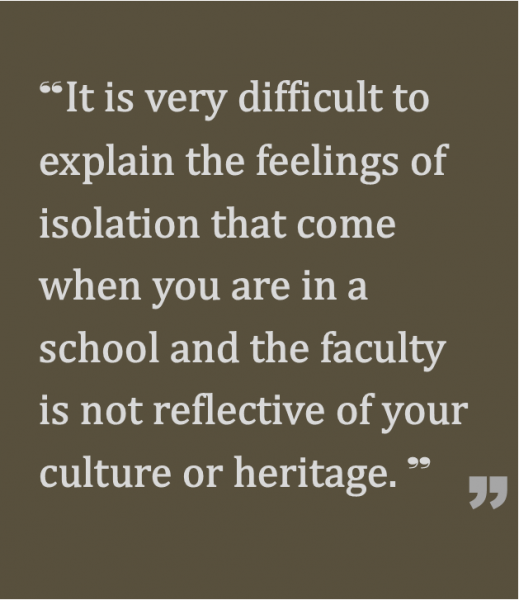
In a recently published study in Economics of Education Review, it was shown that Black, white and Asian students benefit from being assigned to a teacher that looks like them. Their test scores go up in years when their teacher shares their ethnicity, compared to years when their teacher has a different ethnicity. It is very difficult to explain the feelings of isolation that come when you are in a school and the faculty is not reflective of your culture or heritage. As population demographics continue to shift, school districts must be intentional in their efforts to create a more diverse workforce.

As a teacher, I try to always be enthusiastic and express a sincere interest in my students’ academic success. I aim to inspire students to be more interested in the process than the product. I am constantly trying to challenge students to take a constructivist approach, ask questions, and in turn, apply their learning in different ways. My goal is for students to become self-directed, intrinsically motivated learners who are less concerned with grades and more concerned with gaining deeper knowledge and understanding.

While I have a passion for educating students, I am most proud of the influence I have beyond the classroom and I see this as my greatest contribution. Students are constantly coming to me for advice and direction. In my job I have been able to engage students in a variety of multi-faceted service projects. I never expected community service to be such a pronounced part of my work but the satisfaction that comes from watching students take ownership of their community is unmatched.

I believe that it doesn’t matter how bright a student is or where they rank in a class or what colleges they have been accepted to if they do nothing with their gift to improve the human condition. I try to teach students that we are all obligated to help others and improve society. Oftentimes people in the community ask me how I get so many young people to volunteer for community service and my answer is always the same, “I ask.”

_________________________________________

Connecticut’s 2016 Teacher of the Year, Jahana Hayes, teaches social studies at John F. Kennedy High School in Waterbury.  In January, she was named one of four finalists by the Council of Chief State School Officers for National Teacher of the Year, which will be selected next month.  This perspective is an excerpt of her 18-page National Teacher of the Year application.  A native of Waterbury, she attended Naugatuck Valley Community College, Southern Connecticut State University, University of Saint Joseph and University of Bridgeport.

PERSPECTIVE commentaries by contributing writers appear each Sunday on Connecticut by the Numbers.

 LAST WEEK: Suicide Prevention - Creating a Message of Hope for Young Adults 

PERSPECTIVE: Jordan Porco Foundation’s Suicide Prevention Journey - Creating a Message of Hope for Young Adults

By Rachel Papke The Jordan Porco Foundation (JPF) is a Hartford-based non-profit foundation founded in 2011 by Marisa Giarnella-Porco and Ernie Porco after their son Jordan Porco died by suicide while a freshman in college. JPF’s mission is to prevent suicide, promote mental health, and create a message of hope for young adults. They accomplish their mission through innovative peer-based programs conducted in partnership with colleges and high schools. The journey started with tragedy and has evolved into a critical message of hope for young adults.

CT perspective“Five years, five months, five days, five hours, five minutes, five seconds—it all feels the same. The loss of you has been huge to your whole family, we will never be the same. But the one thing that we have all vowed to do is make sure we continue to live, love, and care for everyone around us like you taught us. Your loss has saved so many. Thank you for giving us the strength to do what we do with your foundation and mission,” said Porco.suicide 1

In five years, JPF has grown to become a nationally recognized leader in the field of suicide prevention. Suicide is the second leading cause of death for young adults aged 15-24 in the U.S.1 We know that more than 2 million college students (out of 20 million total) contemplate suicide, and that 1.2 million high school students (out of 14.9 million total) attempt suicide each year.2 Young adult suicide is a major public health concern, which has led to the formation of a National Suicide Prevention Strategy. JPF’s primary prevention programs connect with and are advised by National Strategy. Their programs have been designed to fill gaps in existing suicide prevention strategies in schools and communities.

With the generous support of private donors, corporate sponsorships, and foundation grants, JPF provides critical mental health awareness programming for young adults. By forming partnerships with high schools, two and four year colleges, community organizations, foundations, and leading prevention providers, JPF delivers innovative programs that increase awareness of the mental health resources and services available to young adults.

JPF’s goal is to break through the misconceptions around mental health and suicide that often deter individuals from seeking help with programs designed to empower peers to be gatekeepers by understanding the warning signs and knowing what to do if a friend is exhibiting signs of suicide or a mental health concern. Since inception, JPF has engaged tens of thousands of students. The programming empowers young adults to take charge of their mental health.

suicide 2“We've received incredible support from our network of friends, family, business leaders, colleges, and universities. This generosity has been integral to expanding recognition of our suicide prevention and mental health promotion programs for colleges and universities—nationwide. At our 5th Annual Gala we'll journey through the beginning, the progress along the way, and what’s next. This generation of young adults is our future and our network of supporters enables us to continue on our journey to provide young adults with a message of hope," said Giarnella-Porco.

On April 2, 2016, JPF will host their 5th Annual Jordan’s Journey Gala at Mohegan Sun Casino in Uncasville, CT. You are invited to purchase tickets to this year’s Jordan’s Journey Gala. JPF is incredibly grateful for kindness—the theme of this year’s Gala. The kindness of many continues to instill hope and is a catalyst for change.

JPF will present four awards including the Community Mental Health Advocate of the Year Award to United States Senator Chris Murphy, who will be in attendance, in recognition of his advocacy of mental health legislation in Congress.

The Perfect Promotion will sponsor the evening’s keynote speaker. Jody Ferrer, President of The Perfect Promotion, said, "As a Mother I have a profound heartfelt connection with the Jordan Porco Foundation's mission. I want to support the journey; to give high school, and college age kids the resources and tools they need to cultivate hope.”suicide 3

The keynote speaker will be the Emmy Nominated Motivational Speaker and Mental Health Advocate, Jordan Burnham, who tours the country speaking to high school and college-aged students about depression and other mental health issues.

“Over the last three years, I've been able to see the difference that the Jordan Porco Foundation is making. This is possible because Marisa and Ernie are creating a culture of talking about mental health and suicide prevention on college campuses. Being a public speaker on mental health awareness is an incredibly rewarding experience, but, one of the best moments of my job was meeting two parents who had the bravery and passion to create such an impactful foundation. It's an honor that Ernie and Marisa have chosen me to be a part of their mission, their message, and the special night that the 5th Annual Jordan's Journey Gala will be,” said Burnham.

The numbers are daunting but progress can be made – and is being made - to save lives.  Your support helps keep program momentum strong and allows JPF to continue to expand programs nationwide. By supporting the mission to prevent suicide and promote mental health, you are creating a message of hope for the future generation of young adults.

_____________________________________

Rachel Papke is Communications Coordinator for the Jordan Porco Foundation.  She may be contacted at (860) 904-6041 or rachel@rememberingjordan.org.  Learn more about the Jordan Porco Foundation at www.rememberingjordan.org

PERSPECTIVE commentaries by contributing writers appear each Sunday on Connecticut by the Numbers.

LAST WEEK: Connecting the Dots… to Transit-Oriented Development


JMPlogoAbout the Jordan Porco Foundation

The Jordan Porco Foundation’s mission is to prevent suicide, promote mental health, and create a message of hope for young adults by providing engaging and uplifting programming. Their programming emphasizes peer-to-peer messaging promoting help seeking behavior, self-care, and coping skills. They challenge stigma by talking openly about mental health, and educating about the risk factors and warning signs of suicide and other related mental health concerns. 

1 Centers for Disease Control, “Understanding Suicide 2015 Fact Sheet,” National Center for Injury Prevention and Control, http://www.cdc.gov/violenceprevention/pdf/suicide factsheet-‐‐a.pdf

2 National Center for Education Statistics, “Back to School Statistics 2015, http://nces.ed.gov/fastfacts/display.asp?id=372 and Centers for Disease Control, “Youth Risk Behavior Surveillance—United States, 2013,” Morbidity and Mortality Weekly Report 63.4; 13 June 2014, http://www.cdc.gov/mmwr/pdf/ss/ss6304.pdf

PERSPECTIVE: Connecting the Dots... to Transit-Oriented Development

by Kimberley Parsons-Whitaker We all talk about it. We all bemoan the fact that far too often the dots aren’t connected; that there are too many silos, sometimes resulting in pervasive duplication of efforts. That if we would just partner-up we could get a whole lot more done. And with a topic as massive and complex as transit systems in a predominantly auto-oriented state, connecting the dots can easily be assumed to be a topic that leaves us not knowing where to start.

CT perspectivePerhaps it begins by recognizing that Main Streets of all sizes thrive with a mix of uses, a mix of businesses, a mix of incomes, a mix of cultures. Connecting people to housing, retail & dining, jobs, community resources, and transportation choices is critical if our Main Streets are to be vibrant and sustainable. Offering a range of housing options located near transit and within a walkable distance of life's necessities like grocery stores, pharmacies, doctor's offices and more can only help to attract anyone who desires to live in a vibrant neighborhood.

The CT Main Street Center (CMSC) network is comprised of over 75 members across the state. This translates to over half of the state’s population living within our member towns. Realizing one out of two residents is directly affected by Connecticut Main Street revitalization efforts makes what we do all the more vital. After all, having a strong downtown core is the foundation of a healthy community, increasing economic resiliency, enabling social interaction, and enlivening public spaces.

Transit Oriented Development (TOD), which connects people to housing, retail & dining, jobs, community resources, and transportation choices, is part and parcel of vibrant Main Streets. A critical component of TOD must be the redevelopment of underutilized buildings into housing above commercial space.quote 1

The award-winning Come Home to Downtown program aims to bring more housing downtown by assisting the owners of small properties to redevelop their underutilized buildings into housing above commercial space. Engaging an expert team of consultants, CMSC provides select communities and property owners with customized technical assistance, working with them to develop viable redevelopment options. But what is glaringly apparent is that we need solutions to address the financial gap.

This program would not exist without the Community Investment Act which helps further the goals of protecting and preserving the beauty and unique character of Connecticut for future generations. Established 10 years ago, the law has directed more than $133 million toward preserving and reusing historic buildings and sites, saving hundreds of farms and supporting agriculture programs, saving fields and forests from development, and building much-needed affordable housing. These programs have leveraged private investment and created jobs in virtually every community in the state.

A greatly improved tool for our Main Streets is Tax Increment Financing (TIF), a public financing method that is used to incentivize and catalyze development, infrastructure, and other projects. In short, TIF allows property tax benefits from a project to be used to help finance that project. This improved enabling legislation permits municipalities to form TIF Districts that include both the project itself and other properties that will experience property value increases as a result of the project.

One way that CT Main Street Center is working to connect the dots is by partnering with Partnership for Strong Communities and the Connecticut Chapter of the American Planning Association, bringing critical information to a statewide audience in a recent forum.  The focus was how we must connect our transit systems to well-planned development that allows for full utilization of these resources: housing, jobs, education, healthcare, and recreation.

quote 2Together with our partners, we were thrilled this week to bring to Hartford Christopher Zimmerman, Smart Growth America’s Vice President for Economic Development, and Director of the Governors’ Institute on Community Design. Much of his work focuses on the economic and fiscal impact of development policies on localities and regions.

Zimmerman said surveys have shown that employers in the 21st century are looking to move to areas where prospective workers live, whereas, in the days of factories, workers moved toward large employers. Speaking of what millennials want, Zimmerman says: "They like housing choice and they're looking for places with a sense of place. “

Chris Zimmerman has been introducing Smart Growth America’s new publication, (Re)Building Downtown: A Guidebook for Revitalization, a resource for local elected officials who want to re-invigorate and strengthen neighborhood centers of economy, culture, and history through a smart growth approach to development.

This guide uses Smart Growth America’s seven-step approach to downtown redevelopment:

  1. Understand your community – engaging the public
  2. Create an attractive, walkable place – the built environment
  3. Diversify economic uses – fostering a diverse mix of uses, including jobs and housing
  4. Plan for equity – do this up front so that success benefits everyone
  5. Improve government regulations and processes – making it easy for the private sector to do what you want
  6. Finance projects – think creatively about funding downtown initiatives and management
  7. Establish on-going place management – development is not the end of your work, you must keep downtown interesting and competitive and professionally managed

I encourage you to read the entire publication – there are actionable steps that can be taken right away!

_______________________________________________________

Kimberley Parsons-Whitaker is Associate Director of the Connecticut Main Street Center.  

PERSPECTIVE commentaries by contributing writers appear each Sunday on Connecticut by the Numbers.   

LAST WEEK: Insurance Company Mergers - Why Patients and Consumers Will Not Be Better Off 

PERSPECTIVE: Insurance Company Mergers - Why Patients and Consumers Will Not be Better Off

by Frances Padilla Many Connecticut residents still don’t know that by the end of this year, Anthem Insurance Co. and CIGNA may merge—forcing us all into a dire situation.

Anthem currently provides health insurance to about 1.1 million state residents and CIGNA covers just short of half a million.  If the proposed Anthem-CIGNA merger is approved, the resulting mega-insurer will cover 64 percent of covered lives in Connecticut.  Anthem and CIGNA have policyholders in 27 states.

CT perspectiveAdditionally, Aetna, with a Connecticut enrollment of about 500,000, is proposing to merge with Kentucky-based Humana, and recent news accounts speculate that it is contemplating moving its headquarters out of Connecticut.

We at Universal Health Care Foundation have been tracking these mergers since last June.  The plans were made public shortly after the King vs. Burwell Supreme Court decision.  That decision, upholding the subsidies in the Affordable Care act, was a big win for consumers.

However, it was also a big win for insurers; as Wendell Potter pointed out in his blog post.  Since then, the merger proposals were submitted for approval to the Federal Trade Commission and individual states’ departments of insurance. The United States Department of Justice also has to rule on monopoly implications of the mergers.quote

In a letter to the Antitrust Division of the DOJ, the American Antitrust Institute states, “The acquisitions are troubling for two important reasons.  They are likely to substantially lessen competition in numerous health insurance markets in the U.S., to the detriment of consumers. And, crafting relief that would adequately protect consumers is inherently difficult.”

Mergers are justified on the basis of increased efficiency and opportunity for innovation, but past experience doesn’t uphold those claims. The Anthem-CIGNA proposal should be carefully questioned, because it can be expected to increase health insurance premiums, and cause deductibles, co-pays, and co-insurance out-of-pocket costs to spike.

Cost is already a major reason why consumers put off care. A Consumers Union poll found that costs are a “top of mind” worry for consumers, whether they are insured or not.  Thirty-five percent of respondents reported relying on home remedies or over-the-counter drugs instead of going to see the doctor when sick. Another 27 percent did not fill a prescription for needed medicine.

The Kaiser Family Foundation reports that for Connecticut, the average combined employee contributions to health insurance and deductibles doubled from 4.2 percent of income to 8.8 percent between 2003 and 2013, as a percent of median household income.  Workers are faced with increasing cost-sharing shifted to them by employers, many of whom are self-insured, and contract insurers to provide administrative services.  The use of high deductible plans, widely viewed as “under-insurance,” has taken off.

The Foundation has been using the image of two sumo wrestlers with the consumer and patient caught between the insurers and the hospitals. Hospitals merge, develop new revenue centers, acquire physician practices and create mega-systems with bargaining power over insurers.  And insurers merge to gain bargaining leverage, creating monopolies to protect the value of their stocks and meet shareholder expectations. Meanwhile, patients and consumers are left bereft of necessary care and shouldering the burden of medical debt.

https://youtu.be/eTRXFzb_U6c

Final resolution of the insurer mergers is in a holding pattern.  No one knows when the DOJ will rule on the antitrust issues, though. It may be in the next few months. Most state insurance commissioners are waiting for that decision to render theirs.  Some state statutes require public hearings, but most don’t.

percentageSome observers think “all eyes are on Connecticut” with how the Anthem-CIGNA merger is handled here, given the market concentration that can be expected.  Connecticut statutes require our insurance commissioner, Katherine Wade, to evaluate the financial solvency of the merging companies and the benefit to policyholders.  She is a national leader among insurance commissioners and faces some criticism here for her refusal to recuse herself, given her ties to CIGNA.

The Department of Insurance is not required by statute to consider the impact of a proposed merger (or of rate hike increases) on affordability to policyholders.  Public hearings held in the past have been held at times and locations inaccessible to most consumers. They do accept testimony online, but few people provide it.

It is not yet clear when there will be a public hearing called in Connecticut. We do know that there has to be 30 days public notice.  And we have been told that there is interest in hearing from consumers, health care providers and employers.

Contact us if you want to have your voice heard by state officials, and join us to make sure people’s interests are put first.

_________________________________________________

Frances Padilla is President of Universal Health Care Foundation of Connecticut

anthem-merger

PERSPECTIVE commentaries by contributing writers appear each Sunday on Connecticut by the Numbers.  

Last week: 2016 to be a Year of Power Shifts and Workforce Facelifts.  


PERSPECTIVE: 2016 to be a Year of Power Shifts and Workforce Facelifts

by Thomas Phillips and Sandra Rodriguez With New England as clearly the oldest region in the country with an average age of 40.3 years,[1] there significant retirements are expected for the next 15 years that will have a profound impact on the size and quality of our labor force.

Yet, with workforce demand at high levels, the supply side isn’t sufficient to meet employer needs.  There are many reasons for this supply/demand mismatch.

CT perspectiveNOT ENOUGH PEOPLE.  The growth rate of the US population aged 18 to 64 is rapidly decelerating and will remain very low through 2030.[2]  That should translate into a continued difficult time in finding qualified workers, while the knowledge base within businesses and organizations is eroding.

NOT ENOUGH HARD and SOFT SKILLS. There is a perceived shortage of people with the hard and soft “essential” skills both required and desired by hiring professionals.  This may be why nearly half of those jobless in Connecticut and neighboring states are considered long-term unemployed.[3]  The technical skills these individuals possess are no longer applicable and essential skills get “rusty” when not used over a period of time.  For the younger population, these skills are often untested.

NOT ENOUGH INTEREST FOR THE JOBS IN DEMAND.  Demand is high for healthcare and manufacturing workers.  Construction employment has also been increasing in Connecticut[4] and is expected to continue to rebound over the next few years.[5]  However, according to The Hartford’s 2015 Millennial Leadership Survey (published by The Hartford), less than 7% of the younger generation interviewed responded favorably to wanting careers in Manufacturing or Construction.  Fortunately, 31% of the 18-34 year olds interviewed said their interests lie in healthcare, but percentage-wise, they are more interested Arts and Entertainment, Education and Technology.

NOT ENOUGH COLLABORATION. As Connecticut and the New England region is facing economic quotechallenges, an aging workforce, and lack of coordination and overlap in services, now is the time to create more public / private partnerships to drive success.


PROMISING APPROACHES.  The Supply/Demand Workforce mismatch can’t be solved by any one organization, with any one grant or source of funding, or with any one strategy.  In North Central Connecticut, Capital Workforce Partners and other collaborative organizations are stoking the pipeline with skilled talent, in areas of current or expected business demand through a web of integrated partnerships.  Here are just two examples:

MOVEUP! COLLABORATIVE. This is a collaborative effort among 26 adult education providers, workforce training programs and community colleges to improve adult literacy services in the Capital Region of Connecticut.  Move UP!’s partners envision a regional adult literacy system that offers a coordinated continuum of literacy services, childcare, counseling and other social service support, career pathways that lead to well-paying jobs and coordination within the community to get the work done.

HARTFORD OPPORTUNITY YOUTH COLLABORATIVE.  This Collaborative includes leaders in education, youth development, and workforce development committed to addressing the education and employment needs of 16 to 24 year old disconnected youth (not in school and not working or no high school diploma) otherwise known as ‘Opportunity Youth.’  With financial support from the Aspen Forum for Community Solutions, Hartford Foundation for Public Giving, and the Social Innovation Fund (as a subgrantee of Jobs for the Future), a full scale, multi-year comprehensive plan has been developed and several youth-centered programs are underway.

These initiatives share one common thread – partnership between business, workforce development, education, economic development and government.  In this new year of power shifts and workforce facelifts, it will take all community stakeholders together to ensure there are enough people, trained and ready to work in the jobs that are in demand today and will be in demand tomorrow.  It will take public/private partnerships to guarantee that the education system is preparing youngsters with the mastery they will need to be successful in their career pathways.  And it will take groups with differing ideologies and competing missions to continue to convene and collaborate until as much common ground can be identified as possible for progress.

_________________________________________

Thomas Phillips is President and CEO, and Sandra Rodriguez is Communications Director, at Capital Workforce Partners, which provides a range of services and training to job seekers and businesses.  Learn more at www.capitalworkforce.org

PERSPECTIVE commentaries by contributing writers appear each Sunday on Connecticut by the Numbers.


[1] 2010-14 American Community Survey 5-Year Estimates

[2] Conference Board: “From Not Enough Jobs to Not Enough Workers What Retiring Baby Boomers and the Coming Labor Shortage Mean for Your Company” Publication Date: September 2014 Report Number: TCB-R-1558-14-RR. Data Source:  The Census Bureau

[3] Nick Difiesta and Derek Thomas, MPA, Connecticut Voices for Children, “The State of Working Connecticut 2015,” November 2015

[4] Connecticut Department of Labor

[5] Economic Modeling Specialists International (EMSI)