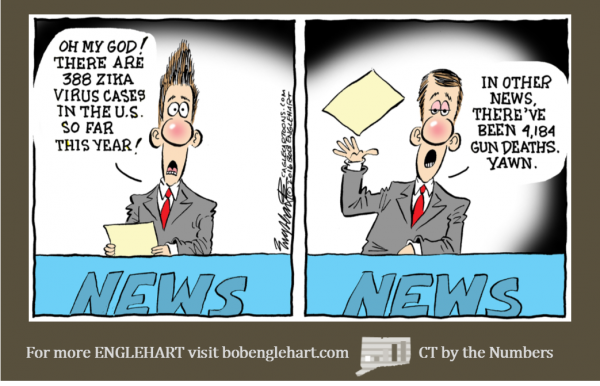
Editorial Cartoon by Bob Englehart
/
by Paul Steinmetz
Even those of us who love our jobs dread some tasks that we can’t avoid. For many politicians, it’s the interview with the local newspaper’s editorial board. I imagine a lot of candidates will relive the scene many times: You sit across a conference room table from a handful of people, some of whom you have grown to loathe, and others you may not know. The editorial board is usually made up of the editorial page editor, the editor, maybe the publisher, and a reporter or two.
If you are an incumbent, the editorial page editor likely has written something biting and cruel about you in the past several months. You only talk to the editor when you call to complain about the editorial page editor. You may see the reporter frequently; he or she has repeatedly told you that the reporters have nothing to do with the editorials, and don’t know their content until they’re published. You aren’t positive that’s the truth. Nevertheless, you have convinced yourself this is a duty you must take on. If the newspaper endorses you, it might persuade some voters in your favor.
As the editor of a daily community paper, I sat on the editorial board for many election cycles. Unbeknownst to those running for office, I never prepared as well as I promised myself I would. And often they were stilted interviews because in the interest of fairness, we asked each candidate running for the same office the exact same questions, when it would have been much more interesting to get them talking on a personal level.
 For example, one year a third-party candidate ran for mayor. He also hosted a local cable talk show and a couple of years earlier, in a rant against the newspaper and me, he had urged viewers to dump their household garbage at the foot of my driveway. No one did, and I decided finally not to torture him.
And torture is what it seemed to be for most of the politicians who came to see us. The most experienced wore a weary air or were angry and combative. John Rowland, when he was Connecticut’s governor, hated our editorials and our editorial page editor and he usually complained throughout the interview. (We usually endorsed him.)
One gentleman running for a seat as a state representative had no political experience and seemed terrified. He stammered, started to answer one way and then changed direction, and practically squeaked by the end of the session. I don’t recall any particularly tough questions; he had built it up in his mind that we were going to rip him apart, or ask him something he didn’t know. Admittedly, the editorial page editor was a little scary. She always did her homework and knew the issues. Her editorials routinely skewered politicians.
For the most part, journalists understand that they must see many sides of an issue, and their personal feelings are not to enter the equation. I know that sounds naïve to those outside the newsroom, but in my experience it was true. And the politicians who did best understood what we were trying to do and what, for the most part, they could expect.
After I left the paper a friend of mine who was running for re-election asked me to help him prepare for his upcoming editorial board interview. I suggested some of the issues the editors might bring up and some of the positions he had taken in the past couple of years that he would be criticized for. Then I pointed out he was not going to get the endorsement. He was a Republican and fairly conservative. The editor was unabashedly liberal. My friend’s opponent was a minority – and gay. “He’s their dream candidate,” I said. “They can’t pass this up.”
He laughed, sat back and acknowledged I was right. Later he said it was the most fun he had ever had at an editorial board interview.
When you admit that some parts of the job just aren’t as fun as others – but they still must be tackled – it is easier to address them with courage and even a sense of humor.
________________________________
Paul Steinmetz is director of Public Affairs & Community Relations at Western Connecticut State University. As the founder of Writing Associates, he consults on writing and media issues for businesses and individuals.
PERSPECTIVE commentaries by contributing writers appear each Sunday on Connecticut by the Numbers.
by Tom Wood The retirement party, it’s a familiar sight; we’ve all been to our fair share. Once you get past the cake, balloons, and bittersweet nostalgia you have to face the fact that you just lost a valued member of your management team. This is when many nonprofit organizations begin to address their succession planning. Even if it is only unspoken, there is a general consciousness that a retirement is coming, but when it comes to resignations there is usually a lack of any advanced noticed.
The effects of sudden turnover resonate strongest for nonprofit entities. For one, employees are driven by the mission and therefore tend to stay for a long time making them unwritten resources. In addition, everyone wears more than one hat so multiple aspects of the organization are affected. A few unplanned departures can have a great impact on multiple facets of the organization resulting in lost institutional knowledge. It also takes more time to replace a position as the skill set for many nonprofit organizations is program specific, which limits the pool of potential candidates.
So when is the best time to start thinking about succession planning? Like everything else in life, an ounce of prevention is worth a pound of cure. As cliché as it sounds, the key is to address succession planning before it ever becomes an issue. A process should be developed to identify and monitor management positions that are at risk. From there, you can take three simple steps to mitigate succession related issues: 1) update your procedures manual annually, 2) cross train staff, and 3) develop from within.
Every nonprofit has a handful of individuals who have been around forever. They are the ones who know everything. The first step to proper succession planning is to document what they do. It sounds simple, but how often does your organization update its employee handbook or procedures manual? Make sure that the manual is reviewed by the person actually performing the duties. Having a current procedures manual will make sure that institutional knowledge isn’t lost.
 Once your procedures are up to date, start cross training your staff. Not only will it be helpful in the event of unforeseen turnover, but it is an important internal control. Cross training is a temporary solution, but it can buy you time to find the perfect candidate.
Nonprofits have mission specific programs which can make it difficult to find qualified replacements for program leaders. Often times, very specific job requirements including years of experience and advanced degrees limit the candidate pool. Now, you could hire an expensive headhunter who might come up with a handful of so-so replacements, but there is another option, albeit more long-term: hire from within. Identify potential leaders within your organization and then create a long term development plan. Unlike outside recruits, internal hires already understand the organization, fit in with the culture, and are passionate about the mission.
Senior management isn’t the only group that can benefit from succession planning. A healthy nonprofit is usually the result of an involved board of directors; a strong board takes time to develop and needs to be maintained. Typically, most nonprofit boards have a nominating or governance committee which are charged with finding and vetting future directors. Term limits and classes will keep the board fresh and prevent all the responsibility falling on a few individuals.
So the next time your nonprofit has a retirement party, enjoy a piece of cake and don’t worry because you’ll be ready.
____________________________________
Tom Wood is an audit manager with Whittlesey & Hadley, P.C. He specializes in audits of nonprofit organizations. Whittlesey & Hadley, P.C. is a leading, regional provider of accounting, financial, business and technology consulting services, headquartered in Hartford, with offices in Hamden, CT and Holyoke, MA.
PERSPECTIVE commentaries by contributing writers appear each Sunday on Connecticut by the Numbers.
LAST WEEK: Driven by Discovery
by Dr. France A. Córdova You deserve hearty congratulations for this remarkable achievement. This is an important milestone – you now have a degree, and all the expertise and knowledge that slip of paper implies, and you are charged with venturing out into a big world – full of possibilities. After all, you are ENGINEERS – you design and make things. The world is open to your creativity.
This is also a particularly special milestone for your University, since you are UConn Engineering's centennial graduating class. You join a long lineage of top-flight engineers, including the man this very arena is named after, Harry A. Gampel.
I'm not sure that Harry, a 1943 civil engineering major, knew what a powerhouse the Huskies would become when he pledged to help build this arena. But I guarantee he would be disappointed if I did not also congratulate the men's and women's basketball teams on another spectacular year.
Gampel Pavilion has become a home of excellence: the men's team with another appearance in the national tournament, and the women's team undefeated for a record-breaking fourth year. For some of you, they have been national champions every year of your time at UConn Engineering! It may seem inevitable at this point, but I can promise you nothing about being a champion is inevitable.
It takes teamwork and dedication, early mornings and late nights, risk and redemption. It takes, in other words, the same qualities you will have to demonstrate as engineers.
 Nothing is inevitable about being a scientist or an engineer – and that's one of the most frustrating and wonderful things about our chosen field. Experiments fail and hypotheses crumble. Data might not be as neat, as revealing as you'd hoped, technology might break at the worst moment, you might spend years chasing a question only to have the answer continually slip away. But then there are wonderful moments of discovery -- and I promise you the euphoria makes up for all the frustration.
I am driven by discovery. As a young girl, I wanted to be a detective. Parents – think Nancy Drew – I wanted to be Nancy. I love a difficult problem, putting the puzzle pieces together. This passion drew me to astronomy, a field with lots of Big Mysterious Questions: What are the origins of stars? Does life exist on distant planets, and what might it look like? Surely not like you or me! What is the nature of 95% of the mass energy content of the universe? It turns out that we know so little…
It took me a while to actually get to astronomy – the path of a scientist or engineer is always more of a random walk than people think – but once I got my own science degree, my own entry into the "real world," all I wanted to do was be a cosmic detective.
As a Ph.D. student I studied x-ray astronomy, then a nascent field. I used a high-energy satellite, controlled by the Goddard Space Flight Center, to collect data on close binary stars. One night I got word that one of these stars had gone into visual outburst. I ran to my thesis advisor and told him we must stop the satellite scanning and point it directly at the star.
My advisor asked me if I was absolutely sure I would detect something extraordinary – after all, pointing that satellite was an expensive proposition. I took a deep breath, crossed my fingers behind my back and said without pause, "Absolutely."
Graduates, remember this – because one day you will be asked the question by your boss, “Are you sure [you want to do that]?” You’ll have to rely on all your reading, your knowledge, your experience, and your intuition before you respond. I said “Absolutely” and I was rewarded. When I received my data, there it was, a beautiful signal: the first-ever detection of rapid x-ray pulsations from a collapsed star accreting matter from a normal star like our Sun.
It was a message that had traveled thousands of light years, through space and time, to me. That discovery remains one of the highlights of my life.
You will make your own discoveries, suffer your own frustrations. Prepare for them, as best you can. UConn has already done an exemplary job of preparing you for the hard work it takes to be a discoverer, an inventor, a champion.
You are graduating at an exciting time in engineering. The field is becoming increasingly intertwined with other disciplines. STEM fields are melding together, creating a rich breeding ground for new discoveries and new inventions. The grand challenges of our time – building smarter cities, improving access to clean water, harnessing sustainable energy – will be tackled by engineers like you, working in concert with designers, social scientists or computer scientists or biologists. A team of new discoverers and inventors.
For any team, the road to success is not an easy one. From my own experiences, ones that led me to become head of NSF, I have learned this: find great people to be a part of your team, those you can depend on. Find a mentor/coach who will continue to teach you how to navigate high-risk and high-reward career plays. Find someone who will become your number one fan in your personal cheering section. And find worthy opponents – those real and abstract – who challenge you, keep you guessing, and drive your passion.
As I close my remarks I want to leave you with a quote from my virtual mentor, Einstein. … Actually, my favorite quote from him is “Gravity cannot be held responsible for people falling in love.” But that really has nothing to do with my narrative today, so, I’ll leave you with this one instead: Einstein said "I have no special talents. I am only passionately curious."
I encourage you to always be passionately curious, for this leads to discovery, to invention. Know that you are in control: technology will continue to shape our lives, but you – our future engineers – can shape technology to better human life. We are counting on you!
______________________________
Dr. France A. Córdova is Director of the National Science Foundation. These remarks were delivered to the graduates of the University of Connecticut School of Engineering at commencement ceremonies on May 7, 2016.
Dr. Córdova, was sworn in as director of the National Science Foundation (NSF) on March 31, 2014. Nominated by President Barack Obama to head the $7.2-billion independent federal agency, she was confirmed by the United States Senate. Córdova is president emerita of Purdue University, where she served as president from 2007 to 2012. Previously, she led the University of California, Riverside, as chancellor and was a distinguished professor of physics and astronomy. From 1993 to 1996, Córdova served as NASA's chief scientist.
PERSPECTIVE commentaries by contributing writers appear each Sunday on Connecticut by the Numbers.
LAST WEEK: An Intervention in History
by the Equity Task Force of Wesleyan University In recent years, due to the increasing corporatization of universities across the nation, and the pressures of the economy, campus cultures have become more fragmented as students negotiate learning, professionalization, and community engagement.
Wesleyan’s mission as a transformative liberal arts education begins with a “holistic review” of potential applicants who are, in many ways, already fragmenting under these pressures. Moreover, the well-being of students is increasingly affected. We need a sustainable and integrative educational approach that is mindful of the uneven impact of these pressures.
The overcommitted student does not have time for thinking. In Spanish there is a saying, “Hay que darle tiempo al tiempo,” we must give time the time. Learning is a process and contemplation is an integral component. Our institutional pedagogy should recognize and inspire a more present, civic-minded, and active learner. It may also serve to counteract the academic, personal, and social dissonance in students’ lives.
Considering this as we forge ahead, it is imperative that we reassess our scholastic values. Indeed, after a period of capitulation to the market,  the University must reaffirm and recenter itself on our source of pride, our intellectual mission. Although it is a sign of our times, opting for digitization and screen culture has only encouraged students (and not only students) to view faculty as “resources,” reducible to delivery mechanisms; the result is no longer contemplative learning, but the passive quantifiable consumption of information without attentiveness to pedagogy.
This growing trend, doomed to become our Achilles’ heel, grossly undermines faculty-student relations and the creativeness and possibilities in the exchange of knowledge. An educational mission is not the provision of consumer-centered services. The consumer model that has allowed the institution to compete is leading us astray from our very educational standards.
Students are not partners in transactions, and faculty and staff also require work environments with boundaries, protection, and inspiration. We must work diligently together to reconcile the disjuncture between our branding and reality as we recommit to an integrative and non-instrumental style of learning, based on the twin strengths of Wesleyan’s scholar-teachers and its dynamic staff.
Moreover, it should not be taken for granted that Wesleyan’s known history of activism (especially during the 1960s-90s) continues to determine the campus climate or that it gives students the same sense of belonging as their non-activist peers. Although students have demonstrated over the years and waged campaigns such as Diver$ity Univer$ity, AFAMIsWhy, Trans/Gender Group, and WesDive$t more recently, in the last decades, evident commitment to social justice on a global scale has been waning on this campus, just as it has nationally.
While recent events indicate a resurgence of some awareness, we must admit and confront the shifting generational tendency towards insularity and the interpersonal, which threatens to diminish cognizance and interest in international matters.
Global strife resonates at all levels, and as such is not unrelated to political struggles at home. And with the pervasiveness and persistent power of structural racism, Wesleyan needs the institutional will and commitment from members of its community to ongoing reflection and engagement.
 Therefore, effective and sustainable solutions will not arrive from above. Students, staff, and faculty together must create a campus environment of mutual respect. That environment depends on shared and deliberately articulated community principles. In this regard, on the one hand, the Office of Equity and Inclusion needs to better define, articulate, and communicate the institutional commitment to diversity, equity, and inclusion. That office should also provide a clear policy framework. On the other hand, that environment will be shaped most powerfully by our collective community practices.
As we reel in the wake of the 2015, we must ask ourselves what we want our relationship to this historical moment of crisis to be. Our view is that we must seize this time as an opportunity to intentionally shape Wesleyan’s future narrative…we should consider which aspects of our history continue to serve our progress, and which condemn us to repeat the past.
_____________________________________
This excerpt is from the Final Report of the Equity Task Force of Wesleyan University in Middletown, issued this past week. The Task Force was created by President Michael S. Roth, and seeks to “address persistent problems of inequality and structural racism that are endemic both in our society at large and at Wesleyan.” The report makes three major recommendations:
President Roth said this week that Wesleyan “will move forward immediately on all three recommendations.” Task Force members included Gina Athena Ulysse (Faculty and Tri-Chair), Elisa Cardona (Staff), Antonio Farias (Staff and Tri-Chair), Matthew Garrett (Faculty), William Johnston (Faculty), Makaela Kingsley (Staff), Caroline Liu (Student), Henry Martellier, Jr. (Student), and Shardonay Pagett (Student and Tri-Chair).
PERSPECTIVE commentaries by contributing writers appear each Sunday on Connecticut by the Numbers.
LAST WEEK: Every Generation Has Something to Teach
by Kim Sirois Pita Have you noticed the dynamics of your work environment changing right before your eyes? Our technology-connected youth are swooping in with their infinite wisdom and scooping up the jobs once occupied by our elders. We are in the midst of a true generational shift stemming from the reality of the graying of America.
This shift has brought five generations together into the workforce for the first time spanning from our aspiring teens to our active seniors. As these generations naturally converge, it becomes even more necessary to understand the vast differences among them, and how each can share essential knowledge.
Gloria Steinem, an 81-year-old pioneer of the feminist movement, said it best: “We need to remember across generations there is as much to learn as there is to teach.”
Take for example The Intern movie featuring Anne Hathaway and Robert DeNiro. The 2015 movie cleverly unveils work style differences between boomers and millennials by putting 20-something Hathaway in charge of 60-something DeNiro at her thriving Internet company.
While waiting for an assignment from the “boss lady,” he reads the morning paper from his brown leather attaché case. Hathaway barely notices him as she pedals her retro bicycle through the swanky open-space office, doing business from a blue tooth apparatus stuck to her ear.
 Hathaway’s character is a smart, savvy young businesswoman, who doesn’t want to face overwhelming feelings of stress and unease. But she is being forced to recognize her lack of business management experience by her company’s Board of Directors. When Hathaway finally realizes DeNiro’s value, she opens herself up to learning from him, and even yields to his advice on major business decisions.
Learning, most definitely, is a two-way street. When you change your attitude and free your mind to take it all in and refrain from the “know it all” attitude, an amazing behavioral shift and transfer of knowledge begins to occur between people of all ages.
While teaching a generational marketing class at Capital Community College, I remember an adult student commenting about the younger generations who seemed to look down on the older generations in her office. She used the word “aloof” to describe how the young professionals felt about the baby boomers.
By the end of the class, this student realized that perhaps she and her coworkers never fully embraced the talents of the younger generation, and perhaps they were being a bit dismissive of what they could contribute. Thanking me for opening her eyes, she went back to the state office with a new outlook — one where learning across generations should be embraced rather than dismissed.
Younger generations are entering the workforce with far greater expectations than their older counterparts. They are highly educated, information hounds with 24-hours access to knowledge. An afternoon at the library has since been replaced with a 15-minute Google search from anywhere, at any time — and they have harnessed the power of this.
The term “paying your dues” is no longer relevant in our changing workforce. Instead it is more about the skills and talents you can bring to the job. Sure, this will cause resentment among many, but it is the new reality that, ultimately, needs to be accepted to maintain a happy and cohesive workplace environment.
And not only do employees need to play nice in the sandbox during the work day, company leaders needs to understand and address the communication and work style differences across generations. They need to encourage collaboration and knowledge swapping between generations.
Gen X (age 34 to 45) and Millennials (age 18 to 33) tend to communicate in sound bytes using email, social media and mobile, while the older generations (Silent and G.I.) prefer lengthy detailed explanations. Baby Boomers (age 46 to 64) fall somewhere in the middle — they want details, but they are often time-challenged to absorb too much, often balancing work, home, kids, volunteer commitments and elderly parents.
While companies are trying to adapt to varying preferences among the generations, immediate change is not always possible. Company leaders need to balance what will work best for the business and its evolving employee population.
_____________________________________
Kim Pita is founder of Pita Peaces and former managing principal of The Pita Group. She is a transformational brand leader who works with industry pioneers and family owned businesses in transition. She takes them from a place of chaos and uncertainty to harmony and prominence. Kim serves as chair of CBIA’s Small Business Advisory Council and vice chair of the Mental Health Connecticut Board of Directors.
PERSPECTIVE commentaries by contributing writers appear each Sunday on Connecticut by the Numbers.
LAST WEEK: Progress Made on Regional Cooperation
















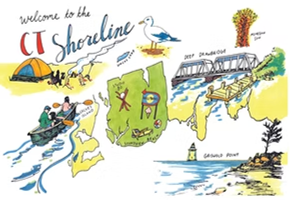
To see more Connecticut illustrations, visit christycoreyart.com

© 2026 Connecticut By The Numbers [TM] 557 Prospect Avenue - 1st Floor, West Hartford, CT 06105
Designed by RDK Design & Photography