PERSPECTIVE - How to Attract and Retain a Young, Skilled and Energetic Workforce
/by Kayleigh Lombardi and Christine Schilke
Connecticut can be tough for young people, that’s for sure. A telling example of this was shared at a recent forum on the economic impact of exclusionary zoning when a representative from the manufacturing industry told the audience how he’d recruited a young, skilled professional from the south, offering him an alluring $25 an hour wage to keep pace with Connecticut’s cost of living — more than double the $11 an hour he was making back home. Yet, it wasn’t enough.
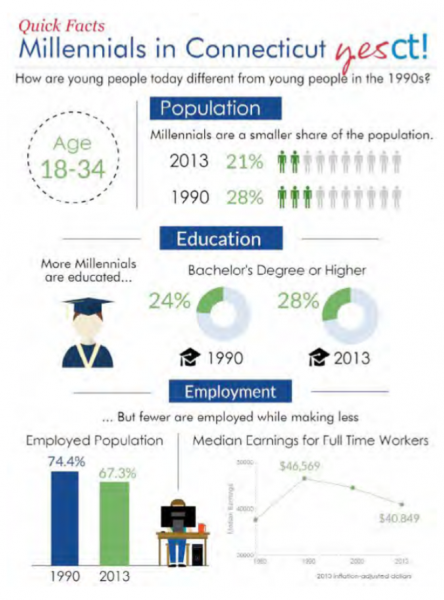
After about two years, the young man decided to head back south. His reasoning: that even making more than double his salary, his costs — like paying $1,000 monthly rent — were simply too high for him to be able to afford to stay in Connecticut. His decision that he could have a better quality of life somewhere else, even earning less, is a scene being played out by millennials all across the state. The high costs of housing, college debt, transportation, and a myriad of other factors, mean that today’s millennials face a far tougher environment than their 1990s peers.
The data is pretty stark: despite being more educated, today’s young people are less likely to be employed, earn less overall, and, not surprisingly, are more likely to live with their parents or roommates. What’s more, the cost of that higher education lingers, hampering their ability to get ahead. With an average college debt of $34,773, they can little afford Connecticut’s housing costs — the 3rd highest in the nation — meaning our state’s young workers are starting their professional lives in the red and with little to spare for other expenses like a car, healthcare costs, or retirement savings.
 Connecticut’s inability to retain young people has become increasingly evident over the past several years, resulting in dour headlines as major companies pick up stakes and move to those locations that are attracting young talent. An interest in lively downtowns, a variety of housing options, walkable communities, access to transit, and availability of jobs and economic opportunity are topping their lists, according to numerous studies and reports.
Recognizing the need to attract and retain a young, skilled, and energetic workforce, the Partnership for Strong Communities and Connecticut Main Street Center are partnering on Young Energetic Solutions (YES). YES is a statewide initiative aimed at empowering young people to create a vibrant Connecticut — a Connecticut where young people want to live. Building on the value gained in partnering with like-minded programs and organizations, YES is continuously forging partnerships with a variety of groups, in order to act as a resource for young people to effectuate positive change.
By engaging and educating young people to participate in their towns, on their local committees, or on statewide initiatives, YES works to support change in communities, expand the state’s housing options, and ultimately strengthen the state’s economy. Empowering young people to participate meaningfully in their neighborhoods and towns can develop a strong sense of ownership and belonging.
Participation at a local and state level allows young adults to provide necessary input into important decisions surrounding affordability, zoning, density, and transportation, as well as proactively address housing needs across municipalities.
Bolstering the millennial generation with dynamic, connected communities is a good thing for older and younger generations alike, as amenities such as walkability, access to transit and a variety of housing options are beneficial to all of us. Dynamic communities and diversity in housing are also economically fruitful, as the younger generation replaces retiring workers, providing the revenue towns and cities need in order to offer critical services to residents. With a fresh supply of young people and families to create that demand and potentially move into larger single-family homes as they grow their families, new opportunities to downsize will be available to our older residents stuck in large homes they may no longer want or need.
While our state clearly faces daunting budget challenges, there is hope. There’s growing consensus around the need to attract and retain young people, an increasing demand for information about what can be done and what’s working elsewhere, and a willingness to be innovative in our response. YES is finding a niche as this resource, building a network of young people and organizations that recognize the need for more millennials to stay and come to Connecticut, with the goal of incorporating young people’s perspectives into planning and design. And while we don’t claim to have all the answers, having the support of our respective organizations behind us means that we have access to experts in the realms of affordable housing and downtown revitalization — two key components in attracting this valuable demographic.
Beyond our work, there is much positive progress in the state. Efforts to improve the connectivity and appeal of our communities are everywhere— from Windsor’s revised website that lists available local board and commission seats, to Hartford’s revamped zoning code, or from Simsbury’s new multifamily housing to New Haven’s miles of bike lanes, change is coming to Connecticut. YES aims to add to these efforts by spurring more civic engagement among young people, while offering new ideas, best practices, and ultimately policies around how to attract and retain millennials.
_____________________________________
Kayleigh Lombardi is a Policy Analyst at the Partnership for Strong Communities. The Partnership is a statewide nonprofit policy and advocacy organization dedicated to ending homelessness, expanding the creation of affordable housing, and building strong communities in Connecticut.
Christine Schilke is Communications Director for the Connecticut Main Street Center, whose mission is to be the catalyst that ignites Connecticut’s Main Streets as the cornerstone of thriving communities. CMSC is dedicated to community and economic development within the context of historic preservation, and firmly believes that when our downtowns are great, they’re great for everyone, attracting young talented workers, creative thinkers and entrepreneurs, and in turn powering Connecticut’s economy.
For more information on YES, visit www.yesct.org or email yes4ct@gmail.com.
This article first appeared in the Summer 2017 issue of Connecticut Planning, a publication of the Connecticut Chapter of the American Planning Association.
 mon? Both made equal access to educational opportunity a top priority.
 If our educational system in America provided equal educational opportunity to all students regardless of income level, making the SAT and ACT free might significantly increase the number of low-income students in college. However, since this is a far cry from our current reality, it is higher education’s responsibility to think more creatively about whom it allows in the door. We are a long way from ensuring that every citizen has equal access to high-quality education, but in the meantime, universities can play a significant role in ensuring inclusivity of all talent.
 These research findings have important implications for society. If early childhood programs produce healthier adults, investing in these programs could reduce the burden on the health care system. If children who participated in early childhood programs grow up to experience higher employment rates and earnings, requests for public assistance should decrease. If these children are less likely to engage criminal activity, their communities and society as a whole should benefit.
 Nationally, rescinding DACA would be disastrous to our economy. Removing 800,000 people from the workforce nationwide would be short-sighted and harmful. It would cost the country $433.4 billion in GDP loss over a decade. It would cost employers $3.4 billion in unnecessary turnover costs. Contributions to Medicare and Social Security would be cut by $24.6 billion over a decade.

 s of their sex, race, gender, ethnicity, orientation or religion.
 We must admit that with a Connecticut College education we are more than ready to take on some of the most important challenges that the human population faces today. At a time in our world where poisonous hatred has already ripped apart communities and destroyed lives, our education and our experiences are the much-needed antidote that can heal and rebuild.
 The words were almost around the corner—in fact, my preceptor went right on to the next question—when I interrupted him and said, "You know, you just said 'I'll jump that bridge when I come to it,' and the expression is I'll cross that bridge when I come to it. Are you upset about the thought of one day being alone?" Her smile evaporated and she started crying. She was not only depressed, which helped explain what was bothering her 8-year-old daughter, but she was suicidal, and we immediately arranged for treatment. That moment was simultaneously the most exhilarating and the most terrifying moment of medical school. What if I had missed it? What if we had just gone on to the next question? What had I already missed with other patients? And what was I going to miss in the future?


 However, fewer and fewer businesses are organized as corporations. Personal taxation of pass-through business income now drives state business tax revenue. Different taxes and different rules for businesses that differ in form only. There are also many other types of Connecticut business taxes determined solely by the nature of the product or service provided.
 Early in Nikole's recovery, she knew she had to do something to help combat motor vehicle crashes caused by young drivers, the number one killer of teens in America. She met members of !MPACT (an acronym for Mourning Parents Act, Inc.) at a presentation she made at Cromwell High School. Not long afterwards, she began delivering her safe teen driving message with the !MPACT moms at high schools across Connecticut and into greater New England.
 So what does this mean for you? It means that, as you begin your career in the law, it is essential for you to understand that your obligations as an attorney extend far beyond the interests of your clients. They extend to the justice system, to the legal profession, and to society at large.