PERSPECTIVE: The Social Media 'Leash' Can Choke Anyone

by Adam Chiara Social media gives everyone access to the most powerful communication tool in history, but that power can also be used against anybody.

Like the proverbial dog on a leash, companies, public figures, and even private citizens can be choked by those who have a massive social following. Those with social power can target anyone online using intimidation or shaming, which can leave us all to be potential victims.

Companies

Let’s look at a recent case: Ann Coulter’s battle with Delta Air Lines. Put aside who was right in the matter; that’s really not the point here. What’s important for is to apply the concept of what happened to future issues.

Coulter did not just complain, which even a celebrity has the right to do. Instead, she chained a leash on the company and tried to choke it. 

After insulting the airline and its employees, she then used a form of intimidation; Coulter tweeted pictures of passengers who had nothing to do with the incident and tried to embarrass them.

That is a threat from a company’s perspective. Coulter gave a clear message — if you anger me, I will even shame your customers.

Companies should of course be held accountable, and social media is one way to do that, but an organization should not be in the position where if something goes wrong, they are forced to act in fear of blackmail.

Yes, this day it was Delta, and they have not made too many friends lately. But tomorrow it could be a smaller company. Maybe a local place that has been a pillar to your community. Do you trust Coulter, or any other person with social power, with the ability to tarnish a business’ reputation indefinitely?

Private Citizens

It’s not just companies who must fear the wrath of an angry person with power. The social media leash can be tied on you by our president.

In 2015, when an 18-year-old college student told the presidential candidate Donald Trump that she didn’t think he was “a friend to women,” Trump made sure to humiliate her on Twitter.

“The arrogant young woman who questioned me in such a nasty fashion at No Labels yesterday was a Jeb staffer! HOW CAN HE BEAT RUSSIA & CHINA?,” Trump tweeted the next day.

The Washington Post reported that she then began receiving calls, emails, and Facebook posts that were threatening and were often sexual in nature.

“I didn’t really know what anyone was going to do,” she was quoted saying in the Post. “He was only going to tweet about it and that was it, but I didn’t really know what his supporters were going to do, and that to me was the scariest part.”

Whether you support Trump or not, understand what he did here. He either intentionally or ignorantly signaled for supporters to intimate this young woman. Why? To send a message — go after me, and I will go after you — only I have more power.

I’m sure there are some who just read that and would argue something along the lines of “she deserved it.” Again, that day it was her, tomorrow it might be your child who is targeted by a public figure.

Cutting the leash

If your tweet isn’t retweeted, does it make a sound?

The answer is no.
The reason why someone with millions of followers has so much power is because they know their post can be amplified. But if that tweet does not get spread, it will be lost in the river of endless content.

So even if you agree with something that was posted, it would be wise to take a moment and think before you share it.

What kind of precedent is this creating?

What if this post was directed toward an institution or person whom I care about?

Is this post advancing a dialogue or is it intended to intimidate or humiliate?

After considering these questions, then you can ultimately decide if you are going to help strap the leash on or not.

____________________________

Adam Chiara is an assistant professor of communication at the University of Hartford. He has worked as a legislative aide in the Connecticut General Assembly, as a journalist, and as a public relations practitioner. He's on Twitter at @AdamChiara. This article first appeared in The Hill. 

PERSPECTIVE: The Significance of Investing in Early Childhood Education

by Silvana Alarcon As a Connecticut native and a student at Dickinson College majoring in Psychology and minoring in Education and Spanish, I hope to make an impact in the early childhood education field by focusing on children with special needs. I have taught children how to swim with SwimAmerica and how to build Legos with Play-Well Teknologies, but I wanted to learn more about how children learn inside and outside of classrooms.

This summer I was fortunate to intern with the Partnership for Early Education Research (PEER) at The Consultation Center at Yale University. PEER is research partnership that works with the school districts and early childhood education providers of Bridgeport, Norwalk, and Stamford to support the use of data to inform education for young children. During this internship I achieved more than what I was hoping for: I learned about early education research and met many collaborators who are involved in the early childhood education system of Connecticut.

A specific part of what I learned from my internship at PEER is that the education system is a tall ladder of influential people who affect the children at the base of the ladder. Teachers, principals, district leaders, and state leaders from the Connecticut State Department of Education (SDE) and Office of Early Childhood (OEC) all influence the educational experiences of young children. These students are the future leaders of the nation, and educators and researchers should work together to raise students to be the people we want to see lead the world. Collaborative research can benefit multiple stakeholders by addressing educators’ needs and using readily available data to inform educational policy and practices.

The younger years of children are crucial because the brains of the children grow extremely rapidly between birth and the age of 8. Specifically the brain undergoes rapid cognitive development as well as linguistic and motor development in the first 3 years of life. By the age of 5 children have developed problem-solving skills and pre-literacy skills. Children are constantly learning from the environment and behaviors surrounding them.  Early brain development has a great influence on children’s long-term outcomes [1].

The first teachers in a child’s life are their parents. Parents teach their children how to speak, tie their shoes, and care for their bodies. However, school teachers also have a very important role such as teaching reading, mathematics, and appropriate social interactions. However, the role of a school teacher is different than parents because the teacher is someone outside the home who teaches the students how to connect with the outside world.  The students spend many of their waking hours with the teachers, building a foundation for future learning. Alongside parents, school teachers support children by providing motivation, skills, and lessons.

Effective early childhood education programs can produce positive outcomes because of the skilled teachers, small class sizes, strong curricula, and rich linguistic environments [1]. Early childhood education teachers have a significant role in the transition between the home and the K-12 school environment.

For this reason, it is powerful that PEER focuses its research on the age range of Pre-K to third grade. Because of children’s rapid growth in learning during these early years, I believe that Connecticut needs to focus more attention on educational opportunities, student services and family engagement programs that serve young children.

Collaborative research, which engages stakeholders in identifying research questions that will produce useful results, can help Connecticut provide quality education for children, which would increase the success of the students. I have truly enjoyed learning about the preschool and early childhood education systems, and I am very grateful for PEER and the work it is accomplishing in this area.

___________________________

Silvana Alarcon is a senior at Dickinson College studying psychology and education. She is a native of Norwalk, CT who received education from Kendall Preschool, Columbus Magnet School, and The Montessori Middle School, as well as the Harvey School in Katonah, NY. 

The Partnership for Early Education Research (PEER) is an alliance among early childhood stakeholders in Connecticut that engages in collaborative research focused on children from birth through age 8. By pursuing questions developed in collaboration with its members, PEER aims to produce rigorous, actionable research that can inform early childhood education policy and practice at the local and state levels, increase access to high-quality early childhood education, and reduce disparities in educational outcomes. Funding support for PEER is provided by the U.S. Department of Education’s Institute of Education Sciences (IES) and the Spencer Foundation.


Resources:  Center on the Developing Child (2007) A Science-Based Framework for Early Childhood Policy.


PERSPECTIVE: State Cuts will Mean Ballooning Costs; People with Traumatic Brain Injury Left Without Services

by Julie Peters Numbers matter. Traumatic brain injury (TBI) is a major cause of death and disability in the United States.  TBIs contribute to about 30 percent of all injury deaths. TBI was the diagnosis in more than 2.5 million ED visits. (www.cdc.gov). There were over 36,000 TBI ER visits in CT alone in 2014 (CT Dept. of Public Health).  Every 21 seconds in the US, a person sustains a brain injury.  5.3 million Americans currently have a long-term need for assistance to perform activities of daily living as a result of TBI.

The Brain Injury Alliance of Connecticut (BIAC) has been Connecticut’s resource for those with brain injuries and their families for over 35 years, and is the only organization that offers support to survivors and their caregivers while providing prevention education completely free of charge. BIAC’s brain injury specialists field thousands of calls each year, requesting our help.  Our 20 support groups provide peer support. We provide education and training to professionals who serve individuals with brain injury, assuring that they have the most up-to-date information possible.

Because Connecticut has no department of brain injury, and no mechanism to assist its residents with information regarding brain injury, they have contracted with BIAC for over 30 years to provide helpline, support, and community education on behalf of the Department of Social Services. Calls to 211 are referred to BIAC.

So when the State is considering a budget that would entirely eliminate BIAC’s funding, and a loss of up to 40 percent of our entire budget, the results could be catastrophic for those who need our help.

People like Linda, a 63 year old woman who contacted BIAC, is one such example.  Linda’s electricity was scheduled to be turned off, and her medical benefits, food stamps and cash assistance had all been discontinued as she had not remembered to fill out the redetermination paperwork.  She was out of her prescribed medication and was unable to see a doctor.  She had no medical insurance nor any medical transportation.  Additionally, Linda does not drive and has minimal family support.

All of the reported issues posed a significant health/safety risk for Linda within the community. Linda was not able to successfully complete the steps and activities necessary for her to pay bills or respond to mail which led to repeated discontinuation of benefits putting her housing and healthcare at risk. HelpLine staff were able to provide her with assistance in response to all of her concerns.  Calls and emails were made on Linda’s behalf to facilitate her obtaining services.  Together we were able to prevent the electricity from being turned off, an application was made for fuel assistance, medical insurance, food stamps, cash assistance were all reactivated.

Michael, a veteran injured during his second tour in the United States Army, contacted BIAC via his Veteran’s Affairs office. He was struggling with significant health issues, as well as cognitive challenges, behavioral and marital problems – decades after his initial injury from a fall. Navigating daily life became increasingly more challenging for him.  His BIAC brain injury specialist connected him to community based resources, including a physician who has successfully assisted him with medication. Michael remains independent and has also learned how to proactively advocate for his needs to be met in and outside of the VA system.  He credits his progress and significantly increased quality of life to his relationship with BIAC.

State funding for BIAC is an investment that pays off substantially, ensuring that those in need have access to lives of wellness, dignity and fulfillment.  In the short time it took you to read this article, at least 5 people in the U.S. sustained a brain injury. This could be your neighbor, your co-worker, your family member, or you.

Think about it – every number equates to a person, and every person has a name and a face – and a story to tell. Should funding for BIAC be severely reduced or eliminated, the State will experience ballooning costs as those who contact BIAC have nowhere to go for help.  They will end up in hospitals, long-term nursing facilities, or on the street.  And those numbers will matter to all of us.

____________________________

Julie Peters, CBIS, is Executive Director of the Brain Injury Alliance of Connecticut, which provides critical resources and support to brain injury survivors, their families and caregivers while educating individuals throughout Connecticut about brain injury awareness and prevention.

PERSPECTIVE: How Connecticut Businesses Are Doing More For People With Autism

by Lucy Wyndham Even as the number of children with special needs increases in Connecticut schools, businesses are creating sensory-friendly environments to accommodate the growing population of children and adults with Autism Spectrum Disorder (ASD). In fact, while there are examples in Europe, the UK, and Australia of retail centers working to accommodate their ASD customers better, small businesses in Connecticut might just be leading the way in the United States.

What Do Sensory Issues Have to Do With Autism?

Autism is a mental condition present from early childhood. Children and adults with autism are characterized by difficulty in forming relationships with other people due to difficulty in grasping social skills, and difficulties in using language and abstract concepts.

Sensory issues are especially prevalent for ASD individuals, as they likely have issues processing information take in through the senses. Where a fluorescent light in a store might not even be noticed by a typical person, a person with autism might find the light physically painful, and might respond in ways that seem aggressive or violent.

Can Autism Help Us?

Growing research indicates that neurodiversity, i.e. the idea that neurological differences like autism are the result of normal variations in the human genome, might actually be a competitive advantage. However, even as the number of children with autism increases, people on the spectrum are largely considered unemployable.

Companies like EY, which created a pilot program to bring new hires with Asperger’s, and airports across the globe that are creating quiet rooms in for children with sensory issues, are at the tip of the spear of a new movement to capture ASD customers and increase ASD hires. Connecticut firms are not far behind.

Sensory Friendly Accommodations

The Connecticut Science Center in Hartford provides over 150 hands-on exhibits for young people, as well as a state-of-the-art 3D digital theater and four education labs. However, for young people struggling with sensory overload, the bustling sounds and bright lights make it nearly impossible to navigate for families with autistic children.

The Science Center has created special Sensory Friendly Hours in the past, and now has a Sensory Friendly Day planned. Visitors with special needs can enjoy a special sensory-friendly theater presentation, lowered PA volume, and dimmed lights for the hours of the event. What’s especially attractive to families about events like these is the lack of stigma.  Families know they’ll be entering an environment that understands and cares, and is truly a judgment-free zone.

Even theaters are beginning to provide sensory-friendly film experiences for families. Last summer, select AMC theaters hosted special film viewings with the lights up, the sound turned down, and an open invitation for audience members to move around, be active, and make noise. The program was jump started with a parent request, and over 300 children and parents attended the first screening.

It’s a Great Start

Making conducive physical accommodations available for those with autism is helpful and popular with children on the spectrum, but businesses don’t have to stop there. One of the most valuable things a company can do is educate staff and employees on autism, enabling staff to be resources in a supportive environment for children and adults. 

Also, businesses can:

  • Change how they hire (moving away from interview-based hiring practices to low key, informal tasks and projects)
  • Offer more online experiences so ASD individuals don’t have to go into the store
  • Dim the lights, and make more use of natural light
  • Create quiet rooms or break away spaces
  • Provide noise canceling headphones and fidget spinners
  • Lower the noise

Autism impacts over 1% of the worldwide population, but with nearly 1 in 3 young adults on the spectrum disconnected from work and school, businesses must do more to accommodate for the neurological differences autism causes. Special hours and program just for customers with sensory processing issues are a great start, but most Connecticut firms continue to strive to do more to hire ASD staff and to accommodate ASD customers.

_____________________________

Lucy Wyndham is married to a guy on the autism spectrum. It's a wonderful and interesting ride, which has opened up her eyes to a new way of seeing the world. She is also a writer, content manager, and a mother to two wonderful daughters.

PERSPECTIVE - How to Attract and Retain a Young, Skilled and Energetic Workforce

by Kayleigh Lombardi and Christine Schilke Connecticut can be tough for young people, that’s for sure. A telling example of this was shared at a recent forum on the economic impact of exclusionary zoning when a representative from the manufacturing industry told the audience how he’d recruited a young, skilled professional from the south, offering him an alluring $25 an hour wage to keep pace with Connecticut’s cost of living — more than double the $11 an hour he was making back home. Yet, it wasn’t enough.

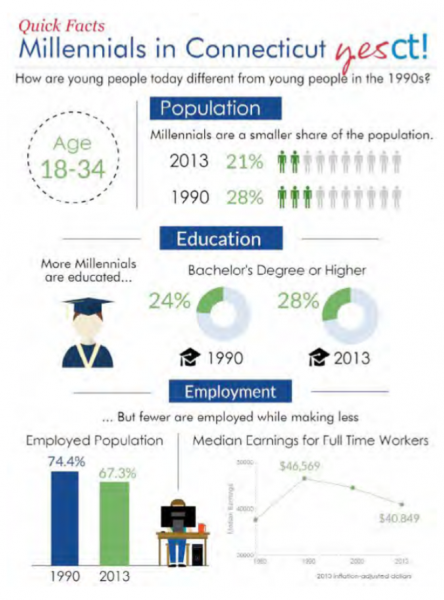
After about two years, the young man decided to head back south. His reasoning: that even making more than double his salary, his costs — like paying $1,000 monthly rent — were simply too high for him to be able to afford to stay in Connecticut. His decision that he could have a better quality of life somewhere else, even earning less, is a scene being played out by millennials all across the state. The high costs of housing, college debt, transportation, and a myriad of other factors, mean that today’s millennials face a far tougher environment than their 1990s peers.

The data is pretty stark: despite being more educated, today’s young people are less likely to be employed, earn less overall, and, not surprisingly, are more likely to live with their parents or roommates. What’s more, the cost of that higher education lingers, hampering their ability to get ahead. With an average college debt of $34,773, they can little afford Connecticut’s housing costs — the 3rd highest in the nation — meaning our state’s young workers are starting their professional lives in the red and with little to spare for other expenses like a car, healthcare costs, or retirement savings.

Connecticut’s inability to retain young people has become increasingly evident over the past several years, resulting in dour headlines as major companies pick up stakes and move to those locations that are attracting young talent. An interest in lively downtowns, a variety of housing options, walkable communities, access to transit, and availability of jobs and economic opportunity are topping their lists, according to numerous studies and reports.
Recognizing the need to attract and retain a young, skilled, and energetic workforce, the Partnership for Strong Communities and Connecticut Main Street Center are partnering on Young Energetic Solutions (YES). YES is a statewide initiative aimed at empowering young people to create a vibrant Connecticut — a Connecticut where young people want to live. Building on the value gained in partnering with like-minded programs and organizations, YES is continuously forging partnerships with a variety of groups, in order to act as a resource for young people to effectuate positive change.

By engaging and educating young people to participate in their towns, on their local committees, or on statewide initiatives, YES works to support change in communities, expand the state’s housing options, and ultimately strengthen the state’s economy. Empowering young people to participate meaningfully in their neighborhoods and towns can develop a strong sense of ownership and belonging.

Participation at a local and state level allows young adults to provide necessary input into important decisions surrounding affordability, zoning, density, and transportation, as well as proactively address housing needs across municipalities.

Bolstering the millennial generation with dynamic, connected communities is a good thing for older and younger generations alike, as amenities such as walkability, access to transit and a variety of housing options are beneficial to all of us. Dynamic communities and diversity in housing are also economically fruitful, as the younger generation replaces retiring workers, providing the revenue towns and cities need in order to offer critical services to residents. With a fresh supply of young people and families to create that demand and potentially move into larger single-family homes as they grow their families, new opportunities to downsize will be available to our older residents stuck in large homes they may no longer want or need.

While our state clearly faces daunting budget challenges, there is hope. There’s growing consensus around the need to attract and retain young people, an increasing demand for information about what can be done and what’s working elsewhere, and a willingness to be innovative in our response. YES is finding a niche as this resource, building a network of young people and organizations that recognize the need for more millennials to stay and come to Connecticut, with the goal of incorporating young people’s perspectives into planning and design. And while we don’t claim to have all the answers, having the support of our respective organizations behind us means that we have access to experts in the realms of affordable housing and downtown revitalization — two key components in attracting this valuable demographic.

Beyond our work, there is much positive progress in the state. Efforts to improve the connectivity and appeal of our communities are everywhere— from Windsor’s revised website that lists available local board and commission seats, to Hartford’s revamped zoning code, or from Simsbury’s new multifamily housing to New Haven’s miles of bike lanes, change is coming to Connecticut. YES aims to add to these efforts by spurring more civic engagement among young people, while offering new ideas, best practices, and ultimately policies around how to attract and retain millennials.

_____________________________________

Kayleigh Lombardi is a Policy Analyst at the Partnership for Strong Communities. The Partnership is a statewide nonprofit policy and advocacy organization dedicated to ending homelessness, expanding the creation of affordable housing, and building strong communities in Connecticut.

Christine Schilke is Communications Director for the Connecticut Main Street Center, whose mission is to be the catalyst that ignites Connecticut’s Main Streets as the cornerstone of thriving communities. CMSC is dedicated to community and economic development within the context of historic preservation, and firmly believes that when our downtowns are great, they’re great for everyone, attracting young talented workers, creative thinkers and entrepreneurs, and in turn powering Connecticut’s economy.

For more information on YES, visit www.yesct.org or email yes4ct@gmail.com.

This article first appeared in the Summer 2017 issue of Connecticut Planning, a publication of the Connecticut Chapter of the American Planning Association. 


PERSPECTIVE: Reexamining Our Approach to College Access

by Angel B. Pérez Recently, I read yet another higher education professional’s case for standardized testing, specifically that making such tests free and universal would help level the playing field for low-income and minority students seeking access to top colleges. But while the SAT’s hefty $57 fee contributes to the barriers low-income students face, eliminating it won’t solve the problem. Access to higher education in America is much more complex.

The problem is our nation’s inability to offer consistent college preparation, academic rigor and counseling across varying socioeconomic communities. Data from the College Board show that the higher your family’s income, the higher your SAT scores are. Standardized tests then do more to keep low-income students out of top colleges than to invite them in. There is no shortage of talent in America. The shortage lies in its cultivation.

Many countries surpassed the United States in educational attainment because they believe in providing equal educational opportunity for all.  In fact, the Organisation for Economic Co-Operation and Development, which measures global student performance, notes that the U.S. is not on the top 10 list of achievement in Math, Reading and Science. Canada and Japan on the other hand, are. What do these two nations have in common? Both made equal access to educational opportunity a top priority.

In Japan, students may live in a poor neighborhood, but they don’t attend poor schools. In Canada, one third of young people come from immigrant families and, when given the same educational opportunities, perform at the same level as their peers. Equity has clearly benefited Canada tremendously since it is the only nation in the world where more than half its citizens have a college degree. Unfortunately, the U.S. lags behind on this issue. Instead of exerting energy investigating “affirmative action” in college admissions, perhaps the current administration could address the educational inequities that have resulted in America being knocked off the world stage.

study by the National Association for College Admission Counseling shows that the average public school counselor has a caseload of 476 students and spends only 22% of his or her time on postsecondary counseling. This is in stark contrast to the 55% that private school counselors spend. Most low-income high schools can’t afford to offer expensive test-preparation courses to their students, and while free or low-cost online options are available, the services offered to students who pay for preparation courses are unparalleled.

Yet knowing how stark the contrasts are in preparation between low- and high-income students in America, most colleges still insist on using an exam that was created in 1926 by Carl C. Brigham to “test” America’s intelligence. The exam was originally touted as a tool of meritocracy, the great equalizer among students in America. We all know that dream never actualized. Our world has evolved tremendously since then, and a one-size-fits-all approach cannot be used to evaluate whether a student is ready to succeed in college. Our nation’s talent abounds. It’s higher education’s job to identify it.

From my own experiences as a vice president and teacher at several of America’s most selective institutions, I know it’s easy to dismiss an applicant because he or she doesn’t meet the university’s average test scores, or even worse, would hurt its average on U.S. News and World Report rankings.

But research shows that rather than test scores, the best predictors of success in college are high school grades and academic rigor.

At Trinity College, I have led efforts to rethink how we admit students, and we’ve changed our admissions process to think differently about what it means to be “college ready.” One of the changes we made was to adopt a test-optional policy. Next month, the college will welcome the most diverse first-year class in its history. It includes the highest number of low-income and first-generation students in Trinity’s history. In addition, the academic profile has increased tremendously. The Class of 2021 has twice as many students at the top of our academic evaluation scale as last year’s entering class. We focus on grades, rigor, curriculum and all quantitative data high schools submit to us. But we also pay very close attention to personal qualities that we know will help students succeed in college—qualities such as curiosity, love of learning, perseverance and grit.

Since we’ve redefined our admissions process, members of our faculty have told us that their students are more curious, engaged and involved. Isn’t that what we want from all of our students?

If our educational system in America provided equal educational opportunity to all students regardless of income level, making the SAT and ACT free might significantly increase the number of low-income students in college. However, since this is a far cry from our current reality, it is higher education’s responsibility to think more creatively about whom it allows in the door. We are a long way from ensuring that every citizen has equal access to high-quality education, but in the meantime, universities can play a significant role in ensuring inclusivity of all talent.

The demography of the U.S. is shifting dramatically. Our population is younger, more diverse and less wealthy. If we are going to prepare the nation for future challenges and regain our status on the world stage, we must rethink our approach to college access. We either fundamentally change student preparation for college or make our admissions processes more inclusive of diverse talents and less traditional—but more predictive—measures of success. Actually, our nation’s future depends on our doing both.

________________________

Angel B. Pérez is vice president for enrollment and student success at Trinity College in Hartford.  This article first appeared in the New England Journal of Higher Education.


PERSPECTIVE - Early Childhood Care and Education: A Prudent Investment

by Joanna Meyer, Michael Strambler, Clare Irwin and George Coleman Young children are often compared to sponges because they constantly soak up new knowledge. In serving children under five, high-quality early childhood care and education programs aim to capitalize on this stage of rapid brain development in efforts to promote positive outcomes among children.

Much has been learned about the impact of early childhood education from research over the past several decades. While some researchers have shown that the positive effects of early childhood programs on children’s achievement may fade over the first years of elementary school, research with longer time horizons tells a different story about long-term effects.

For example, the Perry Preschool Project and the Carolina Abecedarian Project are two rigorously studied programs in which at-risk children were tracked from birth into their 30s. Half of the children participated in an intensive early childhood education program from infancy to kindergarten entry while the other half did not. When children who had participated in these programs grew into adults, they had improved educational attainment, employment, earnings, and health outcomes. They also engaged in less criminal activity and fewer unhealthy behaviors.

These research findings have important implications for society. If early childhood programs produce healthier adults, investing in these programs could reduce the burden on the health care system. If children who participated in early childhood programs grow up to experience higher employment rates and earnings, requests for public assistance should decrease. If these children are less likely to engage criminal activity, their communities and society as a whole should benefit.

Research also points to clear economic implications of investing in early childhood education. For example, through studies of two specific programs that served students from birth to age five and following children into their thirties, economists have estimated a social benefit to society of $7.30 for every $1.00 spent on early childhood programs, with an annual return on investment of 13.7%.

While this estimate is based on two small demonstration programs, another study analyzed evaluations of a wider range of early childhood programs and noted that the federal Head Start program produces persistent beneficial effects on long-term outcomes. It also made the case that a comprehensive cost/benefit analyses of Head Start would reveal a high rate of return.

How would investing in early childhood education pay off in Connecticut?  In a recent policy brief by Connecticut Voices for Children, the authors use the 7.3 benefit/cost ratio to estimate the benefits and costs of early childhood education in Connecticut. According to these estimates, it would cost $1.8 billion dollars to provide high-quality early childhood care and education to all Connecticut children under age 5, and this care would have a long-term economic benefit of $13.3 billion.

It is also important to note that in states like Connecticut with vast economic disparities, the provision of high-quality early childhood education alone is not enough to level the playing field for disadvantaged children. Many low-income children are concentrated in poor neighborhoods, and research has shown that the neighborhood in which a child is raised impacts the child’s inter-generational mobility.

Children living in poverty are more likely to face toxic stress that results from food insecurity, housing instability, and limited access to health care, all of which can impact children’s short- and long-term outcomes. Maximizing the impact of high-quality early childhood education may include addressing the causes of toxic stress, which in turn requires investment in supportive services for families.

In the midst of the current fiscal crisis in Connecticut, lawmakers are urgently seeking ways to reduce the short-term budget deficit. When evaluating potential reductions to spending on education and social services for young children and their families, it is critical to consider the long-term impacts of such an approach.

According to the cost-benefit analyses described above, cutting $1M of early childhood education funding from the state budget now could result in a $7.3M reduction in long-term benefits to society. The evidence suggests that across-the-board cuts to the programs that serve Connecticut’s most vulnerable citizens is economically imprudent in the long run.

_____________________________________

Joanna Meyer, M.A.T., Michael Strambler, Ph.D., Clare Irwin, Ph.D, and George Coleman, M.Ed., M.A.are the Management Team for the Partnership for Early Education Research (PEER)an alliance among early childhood stakeholders in Connecticut that engages in collaborative research focused on children from birth through age 8. By pursuing questions developed in collaboration with its members, PEER aims to produce rigorous, actionable research that can inform early childhood education policy and practice at the local and state levels, increase access to high-quality early childhood education, and reduce disparities in educational outcomes. Funding support for PEER is provided by the U.S. Department of Education’s Institute of Education Sciences (IES) and the Spencer Foundation.


PERSPECTIVE: Protect Connecticut DREAMers, A Vital Part of Our Communities

by Khadija Gurnah Nearly 800,000 DREAMers -- young adults who were brought to America as children -- received critical protections and work authorization under the 2012 Deferred Action for Childhood Arrivals (DACA) program. It provided undocumented immigrant youth with opportunities to study and participate in the workforce.

DACA has been operational for five years and it is a success. It is popular with the public and enjoys the support of employers, educators, community leaders and elected officials from both political parties.

But despite this widespread support, DACA is under attack. President Trump has not decided whether to continue or end the program, and Texas Attorney General Ken Paxton -- joined by attorneys general from nine other states -- is threatening to sue the Trump Administration if DACA is not rescinded by September 5th.

Ending DACA would be short-sighted and inhumane. It would directly harm roughly 5,000 people in Connecticut who have work permits under the program, and it would indirectly harm thousands more -- young people who are a dynamic part of their communities and who contribute tremendously to the strength and vitality of our state.

Nationally, rescinding DACA would be disastrous to our economy. Removing 800,000 people from the workforce nationwide would be short-sighted and harmful. It would cost the country $433.4 billion in GDP loss over a decade. It would cost employers $3.4 billion in unnecessary turnover costs. Contributions to Medicare and Social Security would be cut by $24.6 billion over a decade.

DACA recipients are employers and consumers. Some 6 percent have launched businesses that employ American citizens. Almost 55 percent have purchased a vehicle, and more than one in ten has purchased a home.

Recognizing their contributions, last month U.S. Senators Lindsey Graham (R-S.C.) and Dick Durbin (D-Ill.) took a step in the right direction when they introduced the bipartisan DREAM Act of 2017. This urgently needed legislation would provide a path to citizenship for the nearly 1.8 million DREAMers who have grown up in this country and know no other home.

They include DREAMers like Carolina Bortolleto, a Connecticut resident, a DACA recipient and an advocate who has lived in the United States since she was ten. In October 2010, Bortolleto founded Connecticut Students for a DREAM, a statewide organization of young adults who works for the rights of undocumented youth and their families.

I met Carolina at a community roundtable with U.S. Senators Chris Murphy and Richard Blumenthal and Congresswoman Rosa DeLauro. She is working hard to create a platform to ensure other young DREAMers have an opportunity to come out of the shadows and actively participate in the economy and the communities in the only home they've ever known. Our state is stronger, and more just, for her tireless work.

Protecting family unity, ensuring that our public policies address the concerns of immigrant women and children, and ending human rights abuses that are occurring in the name of immigration law enforcement are in our national interest. We urgently need a constructive national dialog on reforming our country’s immigration policies, so they will finally reflect our values as a nation and allow all families to contribute to our culture and economy.

That begins with passing the DREAM Act -- a smart, humane immigration policy that will strengthen our communities and our country. The incredible young people known as DREAMers are contributing to our communities and our economy. Our state and our nation will benefit tremendously if the DREAM Act becomes law and we move to permanently protect DREAMers, to give them the opportunity to build lives in the country we all call home.

________________________________

Khadija Gurnah is a Campaign Director with MomsRising, an on-the-ground and online grassroots organization of more than a million people. She lives in Wallingford, Connecticut.


PERSPECTIVE: Resilience is So Much More Than Bouncing Back

by Taryn Stejskal In the face of adversity, why do some people flourish while others fold?

The essential condition required to live a flourishing life is not found in the absence of challenge, but rather in a person’s ability to persevere amidst trials. Resilience is demonstrated in both positive and negative life events.

“Man never made any material as resilient as the human spirit.” - Bern Williams

What Resilience is Not – Merely Bouncing Back

Resilience is not merely bouncing back; it is so much more than elasticity and returning to where you began. It’s not more than merely marking time until the suffering recedes, it’s actively engaging in growth through the lessons life presents. As Andy Warhol said, “They always say time changes things, but you actually have to change them yourself.”

What Resilience is

As Rumi put it, “the business of being human” describes resilience.

Adversity is a trip we take. Resilience paves the road; it is the willingness to endure hardship and as a result, allow ourselves to be fundamentally and forever changed. For our effort, when we return from the journey, we receive gifts of greater confidence, strength, wisdom and compassion.

How does a person flourish during and after confronting challenge?

Five universal practices of resilience:

  1. Vulnerability: There is a struggle in every good life. There is life at the heart of every good struggle.

“Resilience is very different than being numb. Resilience means you experience, you feel, you fail, you hurt. You fall. But you keep going.” – Yasmin Mogahed

In our culture, there is shame bias: the belief that others’ adversity makes them more worthy, while believing our own adversity is shameful, making us less worthy.

When a colleague shared her 29 years of sobriety or a friend bravely overcame child abuse, I marveled at these living warriors with admiration! Yet sharing my own messy struggles make me cringe and panic at others’ responses.

Practice: Resilient leaders let their whole authentic selves shine, they allow their inside selves (thoughts, feelings, and experiences) to be congruent with their outside selves - the self they project to the world.

  1. Productive Perseverance: Choose the intelligent application of persistence.

“Patience, persistence and perspiration make an unbeatable combination for success.” - Napoleon Hill

As a result of my undiagnosed dyslexia, I didn’t read well until third grade. Later, I was determined to successfully pursue of my Ph.D. despite my learning disability. Conversely, when I was diagnosed with thoracic outlet syndrome, a condition that reduces blood flow to the arms and hands, I redirected my athletic pursuits away from collegiate swimming and took up running instead. We’ve all received conflicting advice: “Stay the course” versus “don’t be afraid to shift gears.”

Resilient leaders are able to navigate the polarity of this seemingly contradictory advice.

Practice: Develop the flexibility and intelligence to navigate the strategic dilemma of opposing forces. Know when to pivot and rethink the plan while maintaining the mission.

  1. Connection: Connectivity with those outside of ourselves.

“We rise by lifting others.” - Robert Ingersoll

A while back, I was assaulted at a concert. In the pit area next to the stage, a group of men cornered me and pressed their bodies aggressively into mine. Later, I was bruised and sore. Inside, I felt angry and violated. I wanted to disconnect from my body along with my purpose of teaching others to overcome adversity.

A wise colleague instructed me, instead of asking, “Why this is happening to me?” ask, “Why is this happening for me?” This question brought clarity in the midst of chaos. Countless women endure harassment, even far worse, and didn’t quit. If they could stay the course, I told myself, so could I. I owed it to them to keep going. My story foster connection with others and allows me to create something beautiful from something that, initially made me feel broken.

Practice: Connection with the perspective of purpose inspires greater meaning and closeness with others, and prevents us from being derailed from our path.

     4.“Grati-osity:” Our difficulty may be ordinary - loss, hurt and tragedy, but the wisdom is extraordinary.

“It’s not happy people who are thankful, it’s thankful people that are happy.” - Unknown

Rather than allowing pain to make them stingy, resilient leaders allow adversity to amplify their experience through gratitude and generosity. Gratitude and therefore resilience, is not about praising the sorrow. It is about honoring the capacity for healing and growth that springs from suffering.

Practice: Be patient. Most people have to wait to realize the benefit that often follows this pattern: pain - patience - growth – “grati-osity.”

  1. Possibility: The ability to envision what could be versus what is.

“In order to love who you are, you cannot hate the experiences that shaped you.” - Andrea Dykstra

Having faced difficultly, resilient leaders can be inoculated against fear and perceived repercussions of failure, allowing them to see hope instead of hindrance, possibility instead of problems.

Practice: It’s an age-old tale, coming back after failure, standing up one more time than we fall down.

Adversity Quotient (AQ): The inability to be deterred by failure (not IQ or EQ), but the ability to persevere despite the odds, to acknowledge fear and failure, and to forge onward is the stuff of true success.

Resilience Gives Purpose to Our Pain

Resilience fosters growth and integration of all that we are, instead of compartmentalization. Resilience is wholeness. As in the Japanese art form, Kintsukoroi, the repairing of pottery with gold or silver lacquer, there is the understanding that the piece is stronger and more beautiful for having been broken.

_______________________________

Taryn Stejskal is Director, Global Senior Leadership Development & Assessment, Cigna. She is an award-winning high-energy doctoral-level talent development leader with extensive expertise in the design and delivery of high impact talent management processes including: assessment, leadership development, executive coaching, mentorship, selection processes, high potential identification and programs, competency analysis and validation, and succession planning.  She has served as a board member for Leadership Greater Hartford.  This article first appeared on the website of the Human Capital institute.

PERSPECTIVE: Yes, We Can Change the World

by Ramzi Kaiss …As we will come to find out, everyday for the rest of our lives, and not just today, will be that real celebration of the lessons we’ve learned, the relationships we’ve built, and the love that we’ve had and shared on this beautiful New London hilltop. You see our experiences cannot be objectified and contained within a piece of paper, they are bigger than that. For they shall pervade the way we got about our lives forever, and I mean it.

Look around you for a moment. Take it all in: Look at the beautiful campus you are surrounded by, but more importantly look the beautiful people you are amongst, Inside and outside these buildings that are surrounding us, and through the people we are surrounded by, we have discovered the meaning of our time at this institution and of our role in the world beyond its walls.

Here we discovered that as we face the world tomorrow, what is more worthy than merely finding a job is finding a good cause to live and work tirelessly for. Through the people we are surrounded by, we discovered that what is more essential than merely making money is making this world a better place for all of its inhabitants, regardless of their sex, race, gender, ethnicity, orientation or religion.

Because yes, there is no doubt that you will become successful. There is no doubt that you can become future peacemakers and noble CEO’s, instrumental social activists and leaders of NGO’s; future dancers and award winning musicians, inspiring academics and pious politicians; future radical educators and mind-blowing performers, and yes, oh yes, righteous revolutionaries and renowned reformers.

Nevertheless, as this place has taught us, life is not so much about how far we go, but what about we do with that distance. It is about how we utilize our positions of power to empower the people around us.

And not only did we learn these lessons with one another, but through and because of one another- whether in the classroom or at a ridge party, during office hours or campus-wide discussions, or even right here on Temple Green, as part of the many late-night conversations that I’m sure most of us have had. Because in the end, it is in the people that we have become and in the future work that we will accomplish as a result of this becoming, that the true celebration of our time at Connecticut College will be actualized. And that will take place day after day after day.

We must admit that with a Connecticut College education we are more than ready to take on some of the most important challenges that the human population faces today. At a time in our world where poisonous hatred has already ripped apart communities and destroyed lives, our education and our experiences are the much-needed antidote that can heal and rebuild.


As French philosopher Albert Camus puts it, “there is no sun without shadows, and it is essential to know the night.” Now, more than ever, not only do we know why systems of inequality continue to exist, but we know how to dismantle them in order to create a more equitable society.

_________________________

Ramzi Kaiss '17 was the 2017 Commencement Senior Class Speaker at Connecticut College in New London. Ramzi, from Beirut, Lebanon, was a philosophy and international relations double major and Mellon Fellow. He served as President of the Student Government Association, as well as co-president of the Amnesty International club. In 2016, he received a research grant from Connecticut College and spent his summer conducting research for the Boston-based global nonprofit, Facing History And Ourselves. In February 2017, he traveled to Bogotá, Colombia for the 16th World Summit for Nobel Peace Laureates.