PERSPECTIVE: State Auditors Can Be Partner in Preserving Resources
/by Robert J. Kane On February 3, 2017, I had the honor of becoming State Auditor. Looking back, there was so much to learn when I joined the Auditors of Public Accounts (APA), but with the help of fellow State Auditor John Geragosian and our amazing team, the transition was rather smooth.
Learning the “ins and outs” did not take long, as support from throughout the agency was overwhelming. The incredibly talented and dedicated APA staff are professional and committed to the work they do for our state. We are the General Assembly’s “eyes and ears” inside state agencies and thrive on working to make state government more accountable and efficient.
In my nine years in the State Senate, I wish I had interacted with the APA more. Serving in my new role, I now realize what a valuable resource our office is for legislators and legislative employees. We can assist them as they shape fiscal policy for years to come.
 Our work is crucial to the stability of our state’s finances, securing federal funding, and ensuring state agency compliance. The work we do on whistleblower cases, in conjunction with the Attorney General, provides all citizens the opportunity to expose waste, fraud and corruption without threat of retaliation.
Being the only state to have two state auditors from differing parties creates a bipartisan office that eschews partisan politics and promotes fairness and transparency. As budget constraints and fiscal matters continue to dominate the debate, now more than ever the APA can be a true partner with the legislature in preserving state resources, protecting taxpayer dollars, and acting as the watchdog over fiscal matters.
We continually work to build these relationships and, in a short period of time, we have already surveyed our stakeholders to better serve them. We are redeveloping our website and improving the look of our reports. With these improvements, the APA seeks to build on our already exemplary reputation among government agencies and encourage greater communication with those we serve.
During 2017, our auditors completed 29 audits of state and quasi-public agencies and made 398 audit recommendations. During the past calendar year, these agencies have implemented approximately 43% of our prior recommendations.
Our audit approach entails, among other procedures, an examination and verification of financial statements, accounting records, and supporting documents; a determination of the agency's compliance with statutory and budgetary requirements; an evaluation of the agency's internal control structure; verification of the collection and proper handling of state revenue; and an examination of expenditures charged to state appropriations. Our audit reports consist of findings and recommendations and, where appropriate, certified financial statements setting forth the condition and operations of the state funds involved.
In accordance with Section 2-90 of the General Statutes, we report any unauthorized, illegal, irregular, or unsafe handling or expenditure of state funds to the Governor, the State Comptroller, the clerk of each house, and the Attorney General. We report these matters in our audit reports or by formal letter. We collectively report less serious matters such as minor losses and acts of vandalism.
State loss reports filed in 2017 with this office and the State Comptroller, in accordance with Section 4-33a of the General Statutes, disclosed approximately 308 losses, primarily through theft, vandalism, and inventory shortages involving an aggregate loss of $1,966,360.
_______________________________
This is excerpted from the Auditors of Public Accounts 2017 Annual Report, issued earlier this year, including a Message from State Auditor Robert J. Kane and portions of the Auditing State Agencies section of the report. Kane is a former Republican member of the Connecticut Senate, representing the 32nd District from 2009 to 2017.
 However, when it came to their personal finances, 88 percent of those surveyed said they wish they started to save for their overall financial goals much sooner.
 It is impossible to assess the AT&T / Time Warner merger without taking into consideration the impact that the Trump Administration FCC’s proposed net neutrality rollback would have. AT&T is the third-largest broadband provider in the United States, with 15.7 million subscribers. And they own DirecTV, by far the largest satellite television provider, with over 20 million subscribers. If the Trump Administration is successful in fully implementing its net neutrality repeal, but is unsuccessful in blocking the AT&T / Time Warner merger, it would create a nightmare scenario for consumers.
 Opportunity: Talent
  Making the Connection
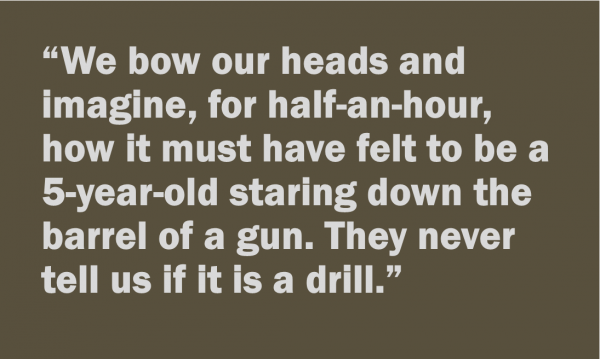 But those weren’t the answers I was really looking for. I didn’t want a death count. I wanted an estimate of the number of years of life lost. I wanted a numerical answer to how many times over the next 40 years their parents would stare into the smiling eyes of their 5-year-old’s school photo and try to imagine them with acne or facial hair or wedding dresses. I wanted a hypothesis at the number of prescriptions filled out for PTSD from the other students. I didn’t want to know the weapon. I wanted to know how he had come across it. I wanted to know how their lockdown drill had failed as naively as a duck-and-cover method from the atomic bomb.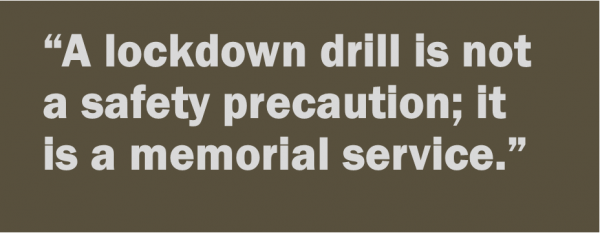
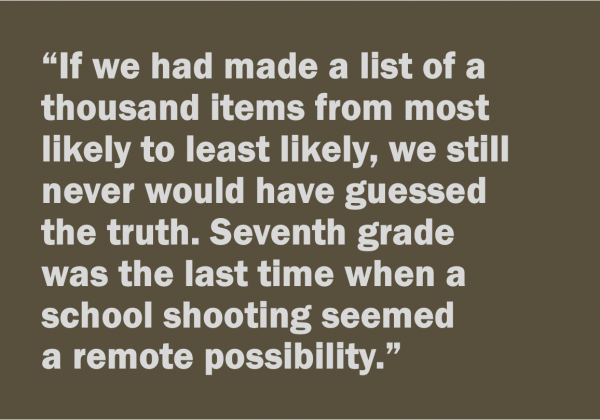 I am a girl who is going to be a teacher. Teachers don’t take an oath to protect and serve, yet they are the front lines in a battle that America is losing. There isn’t a single teacher – or student – in America who hasn’t wondered what they would do in a school shooting. I’d be willing to bet that most of the teachers, administrators, and security guards around the country have come to the same grim conclusion: that there is a unspoken clause in their job description.
 But why girls?
 Confidence, we’ve heard, comes from execution. Early results from
 While pay equity details that a woman should be paid the same as a man when doing equal amount of work in the same job, the gender wage gap differs. It describes the measured statistical difference in income between men and women. In Connecticut, the wage gap results in full time working women losing collectively $15 billion (Connecticut Women and the Wage Gap 2017).
 Sometimes these complaints are reinforced with evidence of adults’ lack of basic knowledge. For instance, after the national political conventions in 2016, just 37 percent of Americans
 A donor, for example, may want to ensure that people in our community do not go hungry. Rather than trying to figure out how to get meals to hungry people on their own, the donor gives money to a local food pantry that has programs to feed the hungry. In that way, the food pantry connects the donor to the outcome he or she is seeking.