PERSPECTIVE: Government Algorithms and the Public’s Right to Know
/by Mitchell W. Pearlman In many respects, computers have made life easier. But they have also made life quite a bit more complicated. For example, before the computer age most government documents were on paper. Today, people not only need access to government information on computer media and in computer-readable formats, they need access to the computer programs and systems government uses to make policy and other important decisions. Yale Law Professor Jack Balkin calls this “algorithmic transparency.”
An algorithm is the step-by-step procedure by which a task is performed. People use simple algorithms in their lives every day, such as for adding numbers or sorting books. On the other hand, algorithms used in computers are often highly complex. They require sophisticated logic and advanced mathematical modeling in the design and functionality of the applications in which they are embedded. Because of this, algorithms are considered intellectual property and deemed trade secrets by most private enterprises and many government agencies that create and use them.
Governments now gather almost incomprehensible amounts of information, organize them into vast databases, and make and implement important decisions using the algorithms they create or purchase. Governments use computer algorithms in making tax policy and budget decisions; they use them in forecasting various transportation and infrastructure needs; and they use them in analyzing public health and environmental issues and formulating policy based on these analyses. Of course, if the data used are less than complete or accurate, or if the algorithms themselves are based on flawed reasoning or assumptions, then government policies and decisions based on them will likewise be flawed. Such errors can lead not only to unsound decisions, but they also can lead to an enormous waste of public resources and even to a significant loss of life.
In Connecticut, as elsewhere, various government agencies forecast income and expenditures to help guide lawmakers in constructing state budgets. Each of these offices has access to the same data sets. But the assumptions programmed into their algorithms can differ significantly, leading to different outcomes in determining whether a budget will or will not be in balance. The 2018 state budget was out-of-balance by several hundred million dollars just weeks after it was enacted. How did this happen? Was it because the data was faulty? Or was it because the algorithms, and the assumptions built into them, were wrong?
The first shots in the battle for algorithmic transparency have already been fired. Recently the New York City Council passed an algorithmic accountability bill, which establishes a task force to study, and within 18 months of passage report, how city agencies use algorithms to make decisions. The bill was enacted in the wake of a racially biased algorithm used to assess risk factors of criminal defendants. The algorithm’s source code was confidential until a federal judge ordered it to be disclosed and the bias subsequently identified.
Trade secrets and confidential commercial information – which are exempt from public disclosure under current Freedom of Information laws – often represent a significant financial investment by those enterprises and organizations that create or own them. On the other hand, computer algorithms are now – and increasingly will be – vital components in government policy and other decision making. To prevent significant errors or miscalculations in the future, many government algorithms need to be transparent so they can be publicly vetted before policy decisions are made or legislation becomes law.
 Thus, proprietary rights face an important competing value when they would prevent the disclosure of information about which there is a legitimate and important public interest. The notion of an informed and knowledgeable electorate is one of the cornerstones of our country’s democratic tradition. To paraphrase the Connecticut Supreme Court in another context, trade secrets and confidential commercial information must give way when balanced against the publication of matters of public interest, in order to ensure the “uninhibited, robust and wide-open discussion of legitimate public issues.”
So in this case, as in others before it, the balance of competing interests must be resolved in favor of algorithmic transparency to the greatest extent possible. This is not to say that government need not provide some measure of just compensation if it discloses secret or confidential proprietary information. But the bottom line is that algorithmic transparency is essential to the continuance of our democratic system of governance.
___________________________
Mitchell Pearlman is the former executive director of the Connecticut Freedom of Information Commission. He currently teaches law in the Journalism Department of the University of Connecticut at Storrs. Rogers Epstein, MIT class of 2019, also contributed to this article. The article is abstracted from a “White Paper” published by the Connecticut Foundation for Open Government (CFOG), which can be found in its entirety at www.ctfog.org.
PERSPECTIVE columns from contributing writers appear each weekend on Connecticut by the Numbers.
 aven’t tested their own DNA. An adoptee who tests could find “Cousin Suzie” (who got a DNA test as a Christmas present), who in turns calls the birth mother before she even knows the adoptee is looking for her. This is much less private than an adoptee directly contacting her known birth mother who is named in the original birth certificate, as would be the case if HB 5408 becomes law.


 therefore are not necessary to fulfill the requirements of Section 2. The last time the immigration question was asked in a decennial census was in 1950.
 Enter the Benefit Corporation (known as B Corp). There are two types of B Corps. One is a certification through B Lab, an NGO that codified the structure. The other is a type of business incorporation, and is obtained by application through the Secretary of the State. Both give legal protection to leaders who consider the interests of all stakeholders - not just shareholders or a board of directors - when making business decisions.
 Our work is crucial to the stability of our state’s finances, securing federal funding, and ensuring state agency compliance. The work we do on whistleblower cases, in conjunction with the Attorney General, provides all citizens the opportunity to expose waste, fraud and corruption without threat of retaliation.
 However, when it came to their personal finances, 88 percent of those surveyed said they wish they started to save for their overall financial goals much sooner.
 It is impossible to assess the AT&T / Time Warner merger without taking into consideration the impact that the Trump Administration FCC’s proposed net neutrality rollback would have. AT&T is the third-largest broadband provider in the United States, with 15.7 million subscribers. And they own DirecTV, by far the largest satellite television provider, with over 20 million subscribers. If the Trump Administration is successful in fully implementing its net neutrality repeal, but is unsuccessful in blocking the AT&T / Time Warner merger, it would create a nightmare scenario for consumers.
 Opportunity: Talent
  Making the Connection
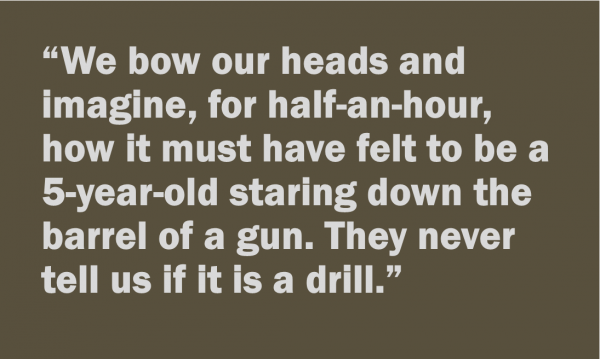 But those weren’t the answers I was really looking for. I didn’t want a death count. I wanted an estimate of the number of years of life lost. I wanted a numerical answer to how many times over the next 40 years their parents would stare into the smiling eyes of their 5-year-old’s school photo and try to imagine them with acne or facial hair or wedding dresses. I wanted a hypothesis at the number of prescriptions filled out for PTSD from the other students. I didn’t want to know the weapon. I wanted to know how he had come across it. I wanted to know how their lockdown drill had failed as naively as a duck-and-cover method from the atomic bomb.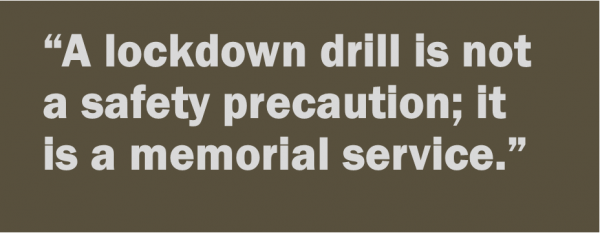
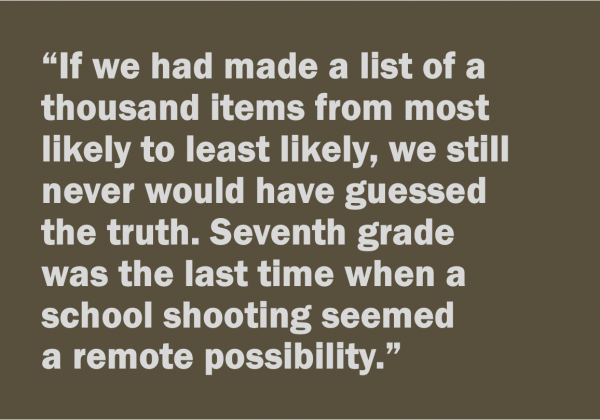 I am a girl who is going to be a teacher. Teachers don’t take an oath to protect and serve, yet they are the front lines in a battle that America is losing. There isn’t a single teacher – or student – in America who hasn’t wondered what they would do in a school shooting. I’d be willing to bet that most of the teachers, administrators, and security guards around the country have come to the same grim conclusion: that there is a unspoken clause in their job description.