PERSPECTIVE – Nonprofit Board Members: Take Off Your “Stupid Hats”
/by Jack Horak The National Association of Nonprofit Organizations and Executives (NANOE) is a relatively new and modest organization, but that hasn’t stopped it from challenging nonprofit sector dogma at the most fundamental level. A case in point is its suggestion that the “volunteer governing board” model should be upgraded to a “paid board” model.
As NANOE sees it, nonprofits adopting this practice would have a line item for “directors fees” in both their budget and their fund-raising literature – and they would do this proudly to let the world know that they are so committed to the mission that they have raised the money necessary to attract and retain the best talent available to fill seats on their governing boards.
The objective is not simply to start paying current volunteers to attend board meetings, but to induce very talented people to join the board where they will be expected to do real work in return for the money. After all, nonprofits pay their management team in exchange for work, so why not follow the same protocol with board members?
This is a sweeping reversal of sector orthodoxy — which presupposes that directors donate both their time and their money to the organizations they serve. Consequently, it’s no surprise that some of the more prominent sector voices were quick to dismiss NANOE’s message as it was rolled out. See, for example, the March 30, 2017 Chronicle of Philanthropy (New Nonprofit Puts Money over Mission and Ethics) and the April 18, 2017 Nonprofit Quarterly (NANOE’s Approach to Nonprofit Leadership: An Insult to your Intelligence).
The negative reaction is understandable to some extent. NANOE’s paradigm turns conventional wisdom on its head so criticism in defense of the status quo is expected. However, after nearly 40 years as a legal and business advisor in the sector, I respectfully disagree with NANOE’s critics. I suggest that if they take their analysis to a deeper and broader level they will find considerable insight in NANOE’s suggestion, and perhaps conclude, as I have, that the paid professional board model may be the optimal choice for some, but not all, organizations.
Here’s why.
We start with a fundamental question — what is a board of directors – and answer it with some history. The concept (and law) of what we commonly refer to as “charity” emerged in medieval England as part of the law of trusts. A charitable trust is an organization governed by a board trustees who hold and manage assets in their names for the benefit of a charitable purpose.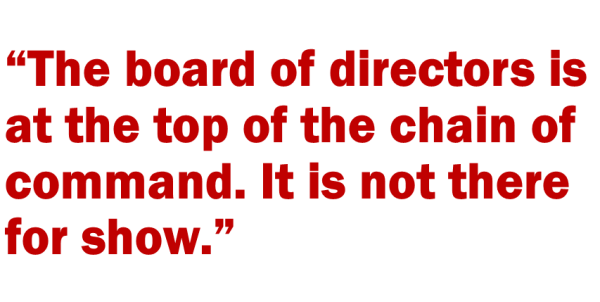
The trust form was predominant for centuries. While it still works well for organizations with activities limited to grant making, it is poorly suited for operating organizations which have service contracts, payrolls, real estate, borrowed money, licensure requirements, and much more. Consequently, as the sector grew and modernized in the middle of the last century, the trust form was pushed aside in favor of the corporate form because corporations have a bifurcated governance structure specifically designed for operating activities.
Corporations have both a board of directors (our topic), and a group of officers who comprise management (such as the CEO or CFO). Corporate law vests all power and authority of the organization in the board, which then delegates power and responsibility to management to conduct operations, but with the board overseeing management’s performance. In other words, the board of directors is at the top of the chain of command. It is not there for show.
Second, operating a nonprofit has become amazingly complicated over the last fifty years. The complexity has fallen on the backs of management, which must deal daily with everything from public expectations, to the morass of state and federal regulation which touches upon everything from HR policy and plans, credentialing, licensing, financial reporting and other challenges that are simply part of the modern turf. Management cannot take this on without board members rolling up their sleeves and doing some real work. Talented CEOs have told me how they long for a strong board to back them up -while expressing their frustration with the common fare offered by “volunteer board recruitment” efforts that don’t always deliver what is needed.
 Finally, there is the “Stupid Hat Syndrome.” I first heard this expression from a successful businessman, famously generous with both his money and his volunteer board service. He coined the phrase to express his frustration after years of observing “some of the smartest and most successful business people he knew join a nonprofit board and immediately put on their Stupid Hat.” In other words, they habitually checked their immense brain power and experience at the door. The Stupid Hat metaphor may be hard edged, but the phenomenon is real and all too commonplace in the sector. It’s the 800-pound gorilla in the corner, and it’s as true as the truism that in general “you get what you pay for.”
In contrast, when you pay someone, even a modest amount, you demonstrate respect for what they have to offer; and in return you can comfortably tell them that they are expected to do real work -show up at meetings, read the circulated minutes and financial reports before the meetings, ask informed questions and offer ideas, chair important committees, have calls and meetings with management between meetings to discuss how things are going, and more as necessary. Paying someone for their service is a commercial exchange of value, not an expense. The brain power, experience and work of talented directors who keep their smart hat on at board meetings is worth the money.
I’ll close by saying that there is a lot more to this question than space permits, and by noting that modern nonprofit corporation law is very flexible and allows for use of committees, advisory boards, and other structures that would keep an organization tightly bound to its community while giving this alternative model a chance in appropriate cases —indeed, NANOE’s New Guidelines for Nonprofits may revealed what could be the wave of the future and we should be willing to give it a chance.
_________________________________
Jack Horak joined The Alliance for Non-Profit Growth and Opportunity (TANGO) in 2016 after a 36-year legal career at the Hartford office of the law firm Reid and Riege, P.C. He was a member of the firm’s Business Law Practice, where he created the firm’s Nonprofit Organization Practice Group. He was the principal author of the Reid and Riege Nonprofit Organization Report, a quarterly publication distributed throughout the United States; and also regularly published articles and editorials on legal and policy issues in Philanthropy Magazine, The Hartford Courant, Connecticut Law Tribune, and the Hartford Business Journal, where he writes a regular editorial column entitled “Rule of Law.” This column first appeared in InsideCharity and the TANGO newsletter.
 Several years ago, town leaders in Litchfield County implemented a program to share heavy equipment. Ten towns in the area benefit from this program, the Litchfield Hills Public Works Equipment Cooperative, which allows the towns to share major equipment for road maintenance. Two street sweepers and one catch basin cleaner were purchased through the program, which was made possible by a $700,000 grant the council received from the state’s Regional Performance Incentive Program.
 After a lot of hard work in recruitment and creating lesson plans, we had our first meeting in September of 2017. We were both excited and anxious that this day had finally arrived and that our hard work had paid off.
 One student wrote on the before side of the poster that they feared “we might not be able to get along.” However, after our lesson they wrote on the after side of the poster that now they know “we are so similar and can be close friends.” It was truly inspiring to see how much new knowledge they acquired regarding the similarities between the two religions in just one short hour. The kids were so excited to learn this material and fascinated by the common ground.
 I sit before you now as someone past 70 wondering why you - strangers to me, members of this Public Health Committee as well as your colleagues in the CT General Assembly - get to decide what my end of life is going to be like. This is very real … and gets more real every day for me and thousands of other people in Connecticut.
 Instead of seeing the similarities that lie within these differences, and appreciating the uniqueness of culture, and finding ways to share our blessings… our nation has pushed them away. They have become a "them", divided from our population out of fear of these differences and blindness to the multitudes of commonalities. If you could talk to Reyna about her dream of being a doctor and how much she loves learning new words, if you could talk to Munir about his favorite songs and how he tells jokes to make friends… then you would see the similarities we share, and yet how many differences they face. However, do not be mistaken, this doesn't stop them.
 If you could see them the way I see them, as hard-working individuals that will do anything to provide for their family (like many of us would do), as welcoming neighbors who will open their doors to anyone...and as people. Not Mexicans, not drug-traffickers, not prostitutes, not foreigners, not aliens, not "them"...humans, people, children. These 11.6 million US citizens have names, stories, hopes, and families. The 303, 916 people who were apprehended at the Mexican border in 2017 have names, stories, hopes, and families. As do we.
 In the Connecticut State Colleges and Universities (CSCU) system, unstable housing - or the lack of housing altogether – is a barrier to academic success and stability for many students. Faculty, counselors and deans report that students are living in cars and “couch surfing” at friends’ or relatives’ homes while, at the same time, they are trying to attend college because they know that education is their path to a better future. During Town Hall meetings across the state during the 2016-17 academic year, CSCU President Ojakian was approached by many students who said that they were homeless and needed additional support.
 Of those schools reporting more than 30 individuals surveyed, the schools with the largest percentages of students experiencing a housing crisis are as follows: 38% at Gateway Community College with 42 students surveyed; 21% at Middlesex with 71 students surveyed; 26% at Eastern CT State University with 117 students surveyed; 19% at Housatonic with 320 students surveyed; 14% at Manchester Community College with 290 students surveyed; 13% at Three Rivers Community College with 164 surveys completed; 10% at Northwestern CCC with 88 completed surveys;11% at Asnuntuck with 81 surveys completed; 9% at Naugatuck Valley Community College with 243 completed surveys; 13% at Norwalk Community College with 72 surveys completed, and 38 surveys completed at Tunxis Community College with a 13% rate of housing instability and homelessness.
 ppression.
 “These inventions of prudence cannot be less requisite in the distribution of the supreme powers of the State.”
 In its 2018 Salary Guide for Accounting and Finance Professionals, Robert Half, a global staffing firm specializing in accounting and finance professionals, reports “There’s high demand for top talent in public accounting due to a severe shortage of skilled candidates…” Their “In-Demand Certifications” list puts “CPA” at the top.
 Why is this so important?