Editorial Cartoon by Bob Englehart
/
Connecticut is ranked second in the nation in the number of millionaires per capita. Only Maryland has more. But with Connecticut’s precarious financial situation amidst what has been described as a “new economic reality,” any drop in the plethora of extremely wealthy residents can almost instantly have far-reaching consequences, officials say. In Connecticut, as well as California, Maryland and New Jersey, the top 1 percent pay a third or more of total income taxes, The New York Times reported this month. “There's an outmigration trend. It's real,'' Sullivan recently told The Hartford Courant, describing the departure of wealthy residents from Connecticut.
But Connecticut is not sitting idly by. The state is trying to keep its wealthy residents right here in the Land of Steady Habits.
Connecticut, the Times reported, now tracks the quarterly estimated payments of 100 of its top earners. State Revenue Services Commissioner Kevin B Sullivan told Inside Wealth columnist and CNBC wealth editor Robert Frank that about five or six of the highest earners could have a "measurable impact on the revenue stream."
By way of example, Sullivan said that when one of the state's rich hedge fund executives planned to move his family and company to a lower-tax state, state officials met with him and persuaded him to leave some of his work force in Connecticut, the Times reported. "We knew we were going to lose him," Sullivan said, "but we wanted to keep some of the higher-paying jobs."
 He added, “We advised him that there are ways to be close to family and friends in Connecticut on occasion that are perfectly legal. We're trying to send a more welcoming message to the high earners as a group." Homeowners who spend more than 183 days in the state are considered residents for tax purposes.
The top 10 states in millionaires per capita, after Maryland and Connecticut, are Hawaii, New Jersey, Alaska, Massachusetts, New Hampshire, Virginia, Delaware and the District of Columbia, according to Phoenix Marketing International’s Global Wealth Monitor.
Earlier this year, the Courant reported that one of three Connecticut residents with an 11-figure net worth, according to the latest Forbes magazine list of the  wealthiest individuals, had relocated from Greenwich to Florida, the second individual in that tax bracket to do so recently. The exits, the Courant reported, “leave Connecticut with 13 billionaires, including Ray Dalio ($15.6 billion) and Steven Cohen ($12.7 billion), both hedge fund owners who live in Greenwich.” Eight of those 13 state residents list Greenwich as their home address, according to Forbes.
Connecticut is not alone in keeping a watchful eye on its billionaires. New York is now more closely monitoring wealthy taxpayers who have homes in New York but claim Florida as their tax residence. And New Jersey is collecting data on all of the taxpayers who make more than $1 million to forecast their tax payments more accurately, the Times reported.
As is true in a number of states with wealthy residents, including New York, New Jersey and California, even as some of the state's wealthiest residents head to warmer climates and more favorable tax structures, the number of millionaires in the state grows.
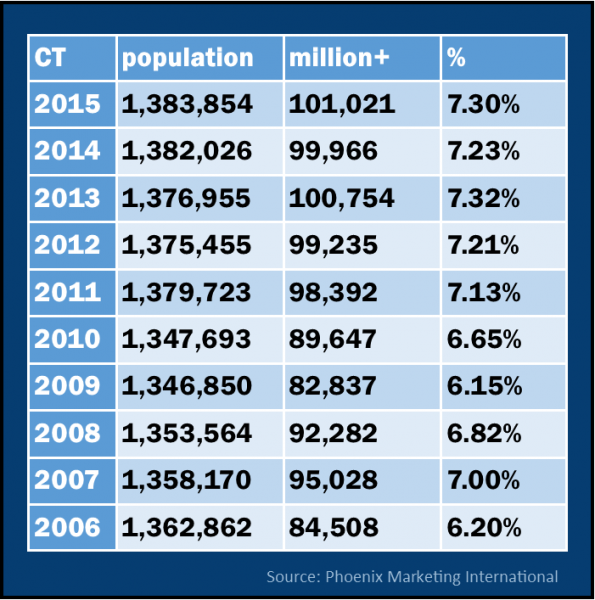
Just three years ago, in 2013, the number of millionaires in Connecticut topped 100,000 for the first time. In 2015, it exceeded 101,000. That compares with just over 84,000 in 2006. Millionaires made up 6.2 percent of state residents that year, compared with 7.3 percent in 2015, based on data from Phoenix Marketing International.
A local theater helping to re-energize downtown Fairfield and a New London developer and property manager who took it upon himself to improve a neighborhood by offering attractive housing that is also affordable are just two of the initiatives being recognized with a 2016 Award of Excellence from the Connecticut Main Street Center (CMSC). In total, five recipients have been selected to receive the prestigious awards, including organizations and initiatives from Fairfield, Farmington, Mansfield, New London and Waterbury.
Also being recognized with awards are a public outreach effort in Farmington that resulted in hundreds of residents voicing their opinion on plans for a new gateway into the town; a holiday window display competition that draws shoppers back to downtown Waterbury while garnering extra press and marketing for the businesses; and a new Town Square in Storrs Center, built around the unique needs of the space and the people that use it.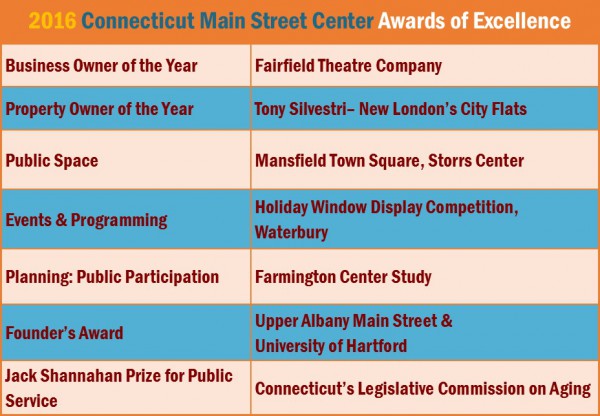
This year's awards will be presented on June 6th at E.O. Smith High School in downtown Storrs. CMSC’s mission is to be the catalyst that ignites Connecticut's Main Streets as the cornerstone of thriving communities. CMSC is dedicated to community and economic development within the context of historic preservation, and is committed to bringing Connecticut's commercial districts back to life socially and economically.
In addition to the competitive Awards of Excellence, where CMSC members submit applications that are reviewed by a jury of industry-related professionals and CMSC staff, CMSC also named Upper Albany Main Street (a CMSC member community) and the University of Hartford to receive the Founder's Award for their long and fruitful partnership - a relationship that has not only helped improve the appearance of the Avenue, but empowered many of the small business merchants in the neighborhood as well.
In addition, the Jack Shannahan Prize for Public Service was awarded to the Legislative Commission on Aging in recognition of their Livable Communities initiative. This initiative aims to create thriving places for residents to grow up and grow older, notably by helping prepare Connecticut for the challenges presented by a rapidly increasing aging demographic through education, awareness and advocacy.
"This year's crop of winners is really special, because they demonstrate how important incorporating the voice of the people is in the final success of a project," said CMSC President & CEO John Simone. "In Farmington, Fairfield and Mansfield especially, each one either specifically asked - or was smart enough to observe - what people wanted in the space, and made changes accordingly. As a result, there is greater support and usage of their public spaces and private businesses, meaning more people on Main Street and more money for the town coffers."
The June 6 awards ceremony will be followed by interactive experiences in the new Storrs Center. Activities will include guided tours of the downtown development, a collaboration with the Ballard Institute and Museum of Puppetry, time for dinner and exploration among the Center's many shops and restaurants, and a closing concert featuring the Funky Dawgz Brass Band.
Created in 2003 to recognize outstanding projects, individuals and partnerships in community efforts to bring traditional downtowns and neighborhood commercial districts back to life, socially and economically, the Awards of Excellence are presented annually at CMSC's Awards Gala. The evening’s welcome Reception Sponsor is United Illuminating and awards are presented with support from Webster Bank and Eversource Energy.
Despite ranking 37th in professional opportunities for women and 12th in child care, Connecticut has been ranked as the third best state for working moms on the strength of a number one ranking in “work-life balance," according to a new analysis from the financial website WalletHub.
With Mother’s Day just days away, the WalletHub analysis revealed 2016’s Best & Worst States for Working Moms.
The top five states were Vermont, Minnesota, Connecticut, North Dakota and Massachusetts. Vermont also ranked first in child care, and was the top-ranked state (after D.C.) in professional opportunities. At the bottom of the list, considered the worst states for working moms, were Alaska, Louisiana, South Carolina, Alabama and Nevada.
The website also noted that “women still earn only $0.79 for every dollar that men make and have far less upward mobility, as evidenced by the fact that only 4 percent of S&P 500 companies’ chief executives are female.”
WalletHub’s analysts compared the attractiveness of each of the 50 states and the District of Columbia to a working mother, using 13 key metrics such as median women’s salary, female unemployment rate and day-care quality.
Connecticut’s ranking across the categories included in the survey ranked from second in parental leave policy to 24th in the ratio of female to male executives. The state’s rankings by category, in the WalletHub analysis:
 The Child Care metrics included Day-Care Quality, Child-Care Costs, Access to Pediatric Services, and WalletHub’s “Best School Systems” Ranking. The Professional Opportunities category included Gender Pay Gap, Ratio of Female Executives to Male Executives, Median Women’s Salary, Percentage of Families in Poverty, Female Unemployment Rate, and Gender-Representation Gap in Different Economic Sectors. The Work-Life Balance category included Parental Leave Policy, Length of the Average Woman’s Work Week, and Women’s Average Commute Time.
Data used to create these rankings, according to WalletHub, were collected from the U.S. Census Bureau, Bureau of Labor Statistics, Child Care Aware® of America, Equal Employment Opportunity Commission, Council for Community and Economic Research, National Partnership for Women & Families and WalletHub research.
Experts agree that there is a deep connection between social-emotional development and literacy in children’s early school success including achieving reading proficiency in the early grades – and it turns out that the benefits of effectively making those connections sooner rather than later are significant, and can endure for a lifetime.
A new report from the Child Health and Development Institute of Connecticut (CHDI), “Connecting Social and Emotional Health and Literacy: Critical for Early School Success,” explores the interplay between young children's social-emotional development and early literacy and language skills, and “elevates awareness of the connections between these essential competencies,” according to CHDI and the report’s researchers.
The detailed 36-page report provides examples of linking strategies and outlines recommendations with the goal of accelerating actions by states and communities to advance children's readiness for school and successful educational achievement.
“Early cognitive and social-emotional skills are interactive and woven together - like strands of a rope,” notes Ann Rosewater, lead author of the report and co-leader of the Connecticut Peer Learning Pilot on Social-Emotional Development and Early Literacy. “The strategies and tools in this report will help communities implement approaches to align children’s literacy and social emotional health.”
The report urges a series of coordinated state actions to advance the linkage and integration of supports for children’s social-emotional health and learning:
 The recommendations are drawn from the experiences of nine communities in Connecticut that explored researched-based strategies over the past year, to link supports for social-emotional and literacy skills. The effort was part of the Connecticut Peer Learning Pilot on Social-Emotional Development and Early Literacy, developed and led by the Campaign for Grade-Level Reading, in partnership with the National Center for Children in Poverty and with support from the Irving Harris Foundation and others.
Participating community teams represented Campaign for Grade-Level Reading and William Caspar Graustein Memorial Fund Discovery Initiative coalitions from Bridgeport, Colchester, Danbury, Enfield, Norwalk, Torrington, Vernon, West Hartford, and Winchester. Their involvement, according to the report, “catalyzed notable progress in most participating communities, building on significant efforts their collaboratives had undertaken before engaging in the initiative.” The communities “found reinforcement, inspiration and impetus to pursue as vigorously as their circumstances allowed strategies that recognized and promoted the relationship between children’s social-emotional health and literacy and language skills,” the report concluded.
In addition to urging state action, based on these experiences the report highlighted steps that can be taken at the community level to promote school success by reflecting the understanding that literacy and social-emotional development build on and reinforce each other.
Promising strategies used by communities include the following:
 The report indicates that “Far too many children are at a disadvantage in their development because they lack the language and literacy competencies they need to enter kindergarten, significantly hobbling their success in reading proficiently by the end of third grade. Disparities begin as early as infancy and become more pronounced in the toddler years, with children from families below 200 percent of poverty scoring lower than children from higher income families on measures of cognitive development.”
The report goes on to state that “At kindergarten entry age, only 48 percent of poor children are ready for school, compared to 75 percent of children from families with moderate or high income.”
The Child Health and Development Institute of Connecticut (CHDI), a subsidiary of the Children’s Fund of Connecticut, is a not-for-profit organization established to promote and maximize the healthy physical, behavioral, emotional, cognitive and social development of children throughout Connecticut. CHDI works to ensure that children in Connecticut, particularly those who are disadvantaged, will have access to and make use of a comprehensive, effective, community-based health and mental health care system.
Parental support for enactment of laws and policies to protect youth from weight-based bullying is “present, consistent, and strong,” according to a new study by the Rudd Center for Food Policy and Obesity at the University of Connecticut.
All 50 states currently have anti-bullying laws, but only three states – New York, Maine and New Hampshire - include body weight as a characteristic that places youth at risk of being bullied.
Many school districts have anti-bullying policies, yet body weight is often overlooked, stating that “evidence from students, parents and teachers indicates that weight-based bullying is one of the most prevalent forms of peer harassment towards youth in the school setting.”
The study found that support for including weight-based bullying in anti-bullying laws has grown during the past two years, stressing that “the omission of body weight in existing policies has important implications for youth who face weight-based bullying.”
 “Parental voices can be influential in mobilizing advocacy efforts, and enacting policy change affecting children’s health,” said Rebecca Puhl, a study author, professor in UConn’s Department of Human Development and Family Studies, and deputy director of the Rudd Center.
The study findings, published in the journal Pediatric Obesity, can inform policy discussions about remedies for weight-based bullying among youth as increasing national attention is being paid to this issue. The study indicated that “parental support is an influential catalyst motivating political will for policy decisions affecting youth, but has received limited research attention.”
Specific findings of the study include:
“As a next step, it will be important to communicate with policy makers and school officials to identify interest and feasibility of viable policy initiatives,” said Puhl, “and to examine potential avenues for enacting change through law.” Puhl told CT by the Numbers that Connecticut’s law includes “physical appearance” but not body weight. There is, therefore, room to strengthen the state law, she pointed out, because physical appearance is a broad category that can include everything from clothing style to hair color, and body weight could easily slip through the cracks if it is not specifically enumerated.
The study involved online questionnaires of diverse national samples of parents in 2014 and 2015, totaling 1,804 parents over the two years. The research was funded by a donation from Rudd Foundation and a grant from the Robert Wood Johnson Foundation.
The study co-authors include Young Suh and Xun Li of the UConn Rudd Center. The Rudd Center for Food Policy & Obesity is a non-profit research and public policy organization devoted to promoting solutions to childhood obesity, poor diet, and weight bias through research and policy.
by Kim Sirois Pita Have you noticed the dynamics of your work environment changing right before your eyes? Our technology-connected youth are swooping in with their infinite wisdom and scooping up the jobs once occupied by our elders. We are in the midst of a true generational shift stemming from the reality of the graying of America.
This shift has brought five generations together into the workforce for the first time spanning from our aspiring teens to our active seniors. As these generations naturally converge, it becomes even more necessary to understand the vast differences among them, and how each can share essential knowledge.
Gloria Steinem, an 81-year-old pioneer of the feminist movement, said it best: “We need to remember across generations there is as much to learn as there is to teach.”
Take for example The Intern movie featuring Anne Hathaway and Robert DeNiro. The 2015 movie cleverly unveils work style differences between boomers and millennials by putting 20-something Hathaway in charge of 60-something DeNiro at her thriving Internet company.
While waiting for an assignment from the “boss lady,” he reads the morning paper from his brown leather attaché case. Hathaway barely notices him as she pedals her retro bicycle through the swanky open-space office, doing business from a blue tooth apparatus stuck to her ear.
 Hathaway’s character is a smart, savvy young businesswoman, who doesn’t want to face overwhelming feelings of stress and unease. But she is being forced to recognize her lack of business management experience by her company’s Board of Directors. When Hathaway finally realizes DeNiro’s value, she opens herself up to learning from him, and even yields to his advice on major business decisions.
Learning, most definitely, is a two-way street. When you change your attitude and free your mind to take it all in and refrain from the “know it all” attitude, an amazing behavioral shift and transfer of knowledge begins to occur between people of all ages.
While teaching a generational marketing class at Capital Community College, I remember an adult student commenting about the younger generations who seemed to look down on the older generations in her office. She used the word “aloof” to describe how the young professionals felt about the baby boomers.
By the end of the class, this student realized that perhaps she and her coworkers never fully embraced the talents of the younger generation, and perhaps they were being a bit dismissive of what they could contribute. Thanking me for opening her eyes, she went back to the state office with a new outlook — one where learning across generations should be embraced rather than dismissed.
Younger generations are entering the workforce with far greater expectations than their older counterparts. They are highly educated, information hounds with 24-hours access to knowledge. An afternoon at the library has since been replaced with a 15-minute Google search from anywhere, at any time — and they have harnessed the power of this.
The term “paying your dues” is no longer relevant in our changing workforce. Instead it is more about the skills and talents you can bring to the job. Sure, this will cause resentment among many, but it is the new reality that, ultimately, needs to be accepted to maintain a happy and cohesive workplace environment.
And not only do employees need to play nice in the sandbox during the work day, company leaders needs to understand and address the communication and work style differences across generations. They need to encourage collaboration and knowledge swapping between generations.
Gen X (age 34 to 45) and Millennials (age 18 to 33) tend to communicate in sound bytes using email, social media and mobile, while the older generations (Silent and G.I.) prefer lengthy detailed explanations. Baby Boomers (age 46 to 64) fall somewhere in the middle — they want details, but they are often time-challenged to absorb too much, often balancing work, home, kids, volunteer commitments and elderly parents.
While companies are trying to adapt to varying preferences among the generations, immediate change is not always possible. Company leaders need to balance what will work best for the business and its evolving employee population.
_____________________________________
Kim Pita is founder of Pita Peaces and former managing principal of The Pita Group. She is a transformational brand leader who works with industry pioneers and family owned businesses in transition. She takes them from a place of chaos and uncertainty to harmony and prominence. Kim serves as chair of CBIA’s Small Business Advisory Council and vice chair of the Mental Health Connecticut Board of Directors.
PERSPECTIVE commentaries by contributing writers appear each Sunday on Connecticut by the Numbers.
LAST WEEK: Progress Made on Regional Cooperation
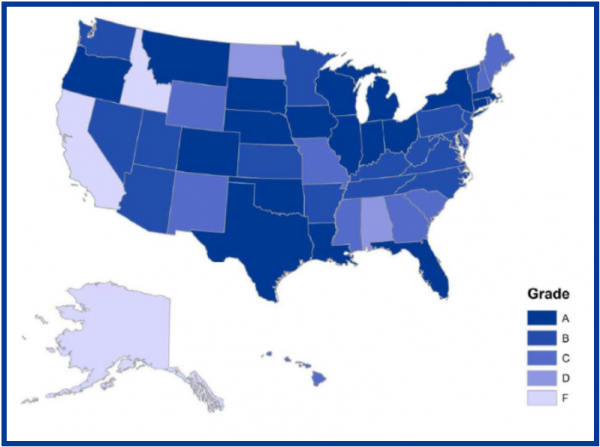
Connecticut is one of five states providing state residents with the most comprehensive online access to government spending data, according to an analysis by the U.S. Public Interest Research Group (USPIRG). Nationwide, government spending transparency is improving, but many states still lag far behind, according to “Following the Money 2016: How the 50 States Rate in Providing Online Access to Government Spending Data,” the sixth annual report by the organization’s Education Fund. Some states have improved their spending transparency web portals significantly, earning perfect scores in this year’s report, while others are still barely achieving the minimum standards.
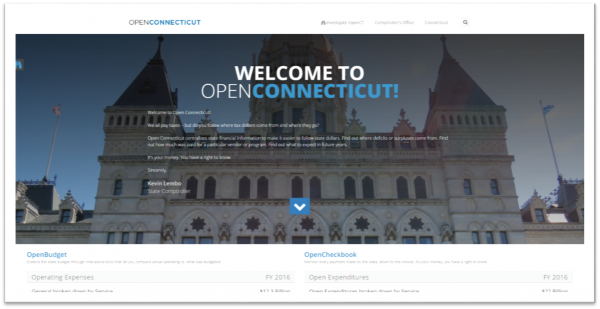 Based on an inventory of the content and ease-of-use of states' transparency websites, the report assigns each state a grade of “A+” to “F.” The leading states with the most comprehensive transparency websites are Ohio, Michigan, Indiana, Oregon, and Connecticut, with each receiving an A+ grade.
“This A+ is great news – and comes at an important time as Connecticut navigates new fiscal challenges and prickly public policy debates. Facts and truth – not shadowy special interests – should be driving our discussions here at the capitol. The only way to ensure an honest discussion about our financial future is to open government and deliver the truth to the public," said State Comptroller Kevin Lembo. "We are doing everything we can to deliver state financial information in bigger and better ways each year. With a few keystrokes, all of us can find out where state money is going and where it came from. Most recently we have been working to extend that transparency to our quasi-public agencies, as well as towns and cities across the state. We are grateful that ConnPIRG recognized our efforts – and promise that we will treat this grade as a starting point, not a finish line, in making Connecticut the most open and accountable state in the country.”
The Comptroller’s Office website providing state government financial data is www.osc.ct.gov/openCT
The report indicates the cost to maintain the website at $18,000, with start-up costs from existing budgetary resources. Among the state programs cited as providing easily accessible data to the public are the Enterprise Zone and Urban Jobs Tax Credit, Film and Digital Media Tax Credits, Jobs Creation Tax Credit, Manufacturing Assistance Act, and Small Business Express programs.
Connecticut’s most significant improvements include the addition of a page that details what data is excluded from the site, allowing citizens to better understand the universe of information the state is providing, according to the state Comptroller's Office. The state also added more information about the projected and actual public benefits of some of its largest subsidy programs. The state could continue to improve its transparency efforts by expanding its site to include spending information from municipalities and more local government bodies, the report noted.
USPIRG officials point out that states that have created or improved their online transparency have typically done so with little upfront cost. Top-flight transparency web portals can save money for taxpayers, while also restoring public confidence in government and preventing misspending and pay-to-play contracts.
“Citizens deserve to be able to follow their tax dollars, from the most minor state expenditures to the most major development subsidies,” said Michelle Surka, program associate with U.S. Public Interest Research Group Education Fund. “This year, it’s clear that several states made a commitment to meeting the high national standards for spending transparency. Other states continue to lag behind, unable to overcome some of the barriers that prevent comprehensive spending disclosures.”
“States’ online spending transparency efforts are paying off in better informed citizens and a more efficient government,” said Elizabeth Ridlington, policy analyst with Frontier Group and co-author of the report. “Our research found that top-ranked states have been making steady improvements to their transparency websites over the years, giving citizens in most states unprecedented access to information on where their tax money goes.”
While many states cont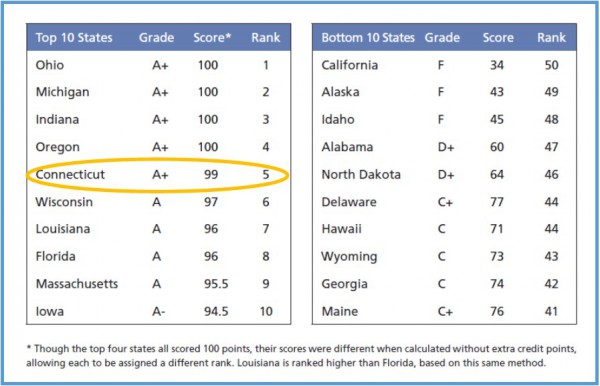 inue to improve, the states that most distinguished themselves as leaders in spending transparency are those that provide access to types of expenditures that otherwise receive little public scrutiny. Only 11 states- including Connecticut - provide checkbook-level information that includes the recipients of each of the state’s most important subsidy programs.
This year, most states have met basic standards for providing online access to information about state contracting and an increasing number provide information about economic development subsidies and off-budget agencies. Several states have made substantive upgrades to their transparency sites or added new features that give the public unprecedented ability to monitor how their government allocates resources. Of particular note, as highlighted in the report:
State spending transparency is a non-partisan issue, USPIRG stressed. The report compared transparency scores against party control of Governors’ offices and the state legislatures. For neither measure did higher levels of spending transparency correspond to Republican or Democratic control, according to the report.
It may not be widely recognized, but the Greater Hartford area has become a dynamic, participatory, collaborative regional ecosystem. And during National Workforce Development Week, which is celebrated nationally this week, that is an especially salient development.
What exactly does that mean? First, the definition: any time that partners within a region come together to solve problems, and meet regularly to answer new challenges, a regional ecosystem in is play. An “ecosystem” is defined as a system, or a group of interconnected elements, formed by the interaction of a community of organisms with their environment. A “Regional Ecosystem” is just that –specific to a geographic region. 
In North Central Connecticut, the regional ecosystem is helping business grow, and find the talent they need, and it is affecting the greater welfare of society, even in these extremely challenging times with budget deficits, and economic pressures that abound. So says Thomas Phillips, President and CEO of Capital Workforce Partners, among the drivers of progress underway across the 37-town region.
Regional ecosystems are like a chain of links, he explains, with each link playing a key role in holding the work together. “In workforce development – the regional ecosystem is comprised of strategic partnerships with industry, education, economic development, community organizations, labor and business-led workforce boards – leading programs that are nimble, flexible, adaptable and generating economic opportunity for business and job seekers.”
Among the leading examples of the local regional ecosystems - focusing on workforce development - which use a set of common goals and outcomes:
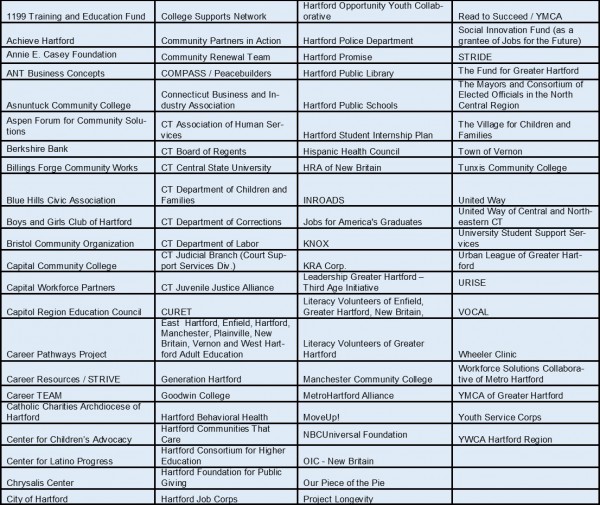
The organizations involved - scores of them - range from well-known names, such as Leadership Greater Hartford, Literacy volunteers, Capitol Region Education Council and the Hispanic Health Council, to those lesser known but just as vital.
“As ‘conveners,’ workforce development boards are often the ‘clasp’ of the chain, keeping all the links together, moving with changes in time,” says Phillips. “That means workforce development, economic development and education are responding collectively to work together toward sustainable jobs, talent creation and business growth.”
The number of organizations that collaborate continues to grow, with different organizations playing a lead role in select initiatives. But there is definitely strength in numbers, they point out.
At the national level, officials note, the U. S. Conference of Mayors (USCM), Workforce Development Council is spearheading an effort to help each region have better access to best practices in building strong regional ecosystems. The organizations is also working toward building more consistent communications and program focus that is designed to result in better outcomes.
That can best be accomplished region-by-region –addressing local area needs with locally based organizations.
Andrew McGough, Executive Director of the Portland, Oregon Workforce Development Board and Chair the USCM Workforce Development Committee, stresses that “Business-led local workforce boards lead the system through strategic partnerships with industry, education, community organizations, and labor, resulting in greater effectiveness and efficiency in serving businesses and job seekers in our communities.”
The Capital Workforce Partners website includes a list of participating community organizations.




















© 2025 Connecticut By The Numbers [TM] 557 Prospect Avenue - 1st Floor, West Hartford, CT 06105
Designed by RDK Design & Photography