Hartford’s Reputation As Excellent Host for National Gymnastics Brings Returns

If the three twenty-somethings enjoying  lunch and some brief down time outside at Trumbull Kitchen seemed familiar to passersby in downtown Hartford, it’s probably because they’ve been on national television a time or two.  And will be again. The casual lunch and conversation among three friends – competitors in the P&G Gymnastics Championships being held at the XL Center this weekend – are just one example of how hosting a major sporting event, in this case gymnastics, can boost the local economy and have reverberations that will continue to add value.

Californian Sam Mikulak, 23, who has won the men’s national title each of the past three years, remembers Hartford well.  His string of three consecutive all-around championships started here in 2013.  Fellow athletes Donathan Bailey, 25, of California and C.J. Maestas, 24, of New Mexico, have also competed in national championships held in Hartford.lunch

This weekend, the Capitol city is hosting not only the men’s championship for the third time in a decade (2010 and 2013 previously) but is also hosting the Secret U.S. Classic, a key tune-up for the nation’s top women gymnasts, with the Olympics just two months away and the U.S. teams to be chosen in the coming weeks.  It is the first time that Hartford has hosted major gymnastics events in an Olympic year, when public interest peaks.

The roster of past Olympic and international medalists competing in Hartford is lengthy – unprecedented in the view of some observers – and in many cases, Connecticut is part of their individual Olympic journeys.

2012 Olympic gold medalist Aly Raisman of Needham, Massachusetts recalls competing in Hartford in 2010, and says of her return, “I feel like I’m competing at home.”Aly

The Connecticut Convention and Sports Bureau (CTCSB) projects 1,425 hotel room nights, an estimated attendance approaching 30,000, a business sales impact of $1.5 million and $50,000 in local taxes generated.  But the impact goes beyond those numbers.

“It raises awareness of what we have in the state,” when people visit to enjoy the competition, or root for family or friends, points out Bob Murdock, Director of Sports Marketing at CTCSB.

Add to that the national network television coverage (NBC telecasts coverage on Sunday and NBC Sports Network also provides coverage), and the Hartford locale mentioned in news stories published worldwide and plentiful on social media, the exposure for the city and state is incalculable.  “It has lasting effects,” says Murdock, and “helps grow the brand of Connecticut.”
USA GymnasticsWhy does USA Gymnastics keep coming back?  “Everything runs smoothly,” suggests Mikulak, expressing a competitor’s viewpoint. “They trust us,” adds Murdock, noting that when Connecticut bids to attract future national caliber sporting events, the first question asked is “what else have you hosted.”

“The sports talk to each other,” Murdock explained.  They ask about community support, and the overall experience.  That USA Gymnastics has returned multiple times with its top national events speaks volumes.

Some up-and-coming hopefuls wouldn’t mind seeing the Hartford tradition continue awhile longer.

Among those competing at the Junior elite level is 14-year-old Riley McCusker of New Milford, the lone Connecticut resident at either the Senior or Junior level.photo

“I am so excited to be in Connecticut,” she says, seeking to advance her fledgling career at a major competition in her home state. Many of her friends and family will be on hand, including some that may be surprised when they see her on the XL Center floor and realize the full dimension of her steadily progressing gymnastics career.conv

McCusker recalls being at the XL Center as a spectator for a previous national championship, and being wowed by an extraordinary floor exercise she witnessed. This weekend, she may turn some heads herself as she continues to emphasize quality and consistency  as her track-record grows, although not quite looking ahead yet to Olympic possibilities in 2020.

Four years beyond her Olympic experience in London leading the U.S. team and earning individual and team gold medals, the just-turned-22 year-old Raisman says it “feels like forever ago.”  With a field of potential U.S. Olympians as deep as it ever has been all vying for one of only a handful of slots on the 2016 U.S. team, having the journey come through a familiar place – with nearly two dozen close friends and family coming to Hartford to join the many fans here to cheer her on - may offer a lift.

The competition itself certainly does so for the XL Center, Hartford and Connecticut.  Mikulak, as only a visitor could, sums it up succinctly:  “Hartford is a popular place.”


postscript

Aly Raisman of Needham, Mass. won the senior all-around title at the 2016 Secret U.S. Classic at the XL Center on Saturday, June 4.  Rachel Gowey of Urbandale, Iowa was second, and Alyssa Baumann of Plano, Texas finished third. Earlier in the day, Irina Alexeeva of Plano, Texas, captured the junior all-around title.  Connecticut’s Riley McCusker of New Milford finished 9th.  The 11,771 who attended the Secret U.S. Classic on Saturday evening were the largest one-day crowd USA Gymnastics has had for events held in Hartford. In 2010, the largest daily crowd was 11,325, and in 2013 the largest daily attendance was 10,233.


CT An Also-Ran Among States in Entrepreneurial Growth, Despite Some Gains

Connecticut ranks 13th among the nation’s 25 smaller states – and 36th overall - in the growth of entrepreneurship, according to a new study and state-by-state analysis by Kauffman Foundation.  A year ago, the state ranked 17th among the smaller states, slightly improving its ranking in the latest data.  The rate of start-up growth in Connecticut increased to 45.5 percent in the 2016 report, compared with 23.6 percent the previous year. The “share of scale-ups” also increased, from 1.29 percent in last year’s analyses to 1.33 percent this year.  Scale-ups measures the number of firms that started small but grew to employ fifty people or more by their tenth year of operation as a percentage of all employer firms ten years or younger.report

One metric that dropped slightly measured high-growth company density – the number of private businesses with a least $2 million in annual revenue reaching three years of 20 percent annual revenue growth normalized by total business population.  Connecticut moved from 55.1 a year ago to 48.8 in the 2016 report.  Both researchers and entrepreneurs have suggested density as a key indicator of vibrancy in entrepreneurial ecosystems, and there is high variation on this indicator across U.S. states, according to the report.

The Kauffman Index of Growth Entrepreneurship, released this week,  is an indicator of business growth in the United States, “integrating several high-quality sources of timely informastatstion into one composite indicator of entrepreneurial business growth.”

In rankings by industry, Connecticut ranked in the top five among the 25 smaller states in two five categories – 3rd in Business Products & Services and 3rd in Software.  The state was ranked outside the top five in high-growth companies in the IT Services, Advertising & Marketing and Health industries.

Overall, the Growth Entrepreneurship Index rose in 2016 in thirty-nine states in the last year, indicating a continued return of broad-based business growth, the report concluded.

  • Among the twenty-five largest states, the five states with the highest Growth Entrepreneurship Index were Virginia, Maryland, Arizona, Massachusetts, and Texas.
  • Among the twenty-five smallest states, the five states with the highest Growth Entrepreneurship Index were Utah, New Hampshire, Delaware, North Dakota, and Oklahoma. (Connecticut ranked 13th)

While most states experienced an increase in growth entrepreneurship activity, changes in state rankings— which measure relative yearly performance across states, as opposed to performance relative to a state’s own growth entrepreneurship rates in the previous year—were different. Twenty-three states ranked higher than they did last year, seven experienced no changes in rankings, and twenty ranked lower, the report pointed out.

"Growth entrepreneurship directly contributes to the economy through creating jobs, innovation and wealth," said Arnobio Morelix, senior research analyst at the Kauffman Foundation, which conducts the annual study.

Virginia took first place in growth entrepreneurship activity among the 25 largest states, followed by Maryland, Arizona, Massachusetts and Texas. Kauffman researchers said it is no coincidence that two of the top states include the highly entrepreneurial Washington, D.C., metro area. Among larger states, 12 ranked higher than they did last year, four experienced no change in rankings and nine ranked lower.

Among the 25 largest states, the five that experienced the biggest increase in rank from 2015 to 2016 were North Carolina (15 to 8), Alabama (13 to 9), Ohio (16 to 12), Tennessee (18 to 14) and Arizona (6 to 3).

The five large states that saw the greatest decrease in rank in 2016 were, with a tie for fifth place, New Jersey (8 to 20), Pennsylvania (10 to 16), Illinois (14 to 17), Wisconsin (20 to 23), Louisiana (4 to 6) and South Carolina (11 to 13).

Among the 25 smallest states, Utah led growth entrepreneurship activity, followed by New Hampshire, Delaware, North Dakota and Oklahoma. Eleven states ranked higher than they did last year, three experienced no change in rankings and 11 ranked lower.

The five small states that saw the biggest increase in rank were Mississippi (22 to 10), Wyoming (23 to 15), North Dakota (11 to 4), Nevada (15 to 8) and Connecticut (17 to 13).

Hartford Is Next Stop on the Road to Rio for Olympic Gymnastics Hopefuls

Gymnastics will once again take center stage in Hartford this weekend, as for the third time in a decade Connecticut’s Capitol City is the center of the gymnastics world – this time in an Olympic year, when public interest ramps up to peak levels. mikulakThe three-day event  begins on Friday at the downtown XL Center and features the two-day P&G Championships, the national championships for senior men’s gymnastics, and the Secret U.S. Classic, the final women’s qualifier for the P&G Women’s Gymnastics Championships.  The field for both events is nothing short of phenomenal.

The men’s 2016 P&G Championships will determine the men’s senior national champions and national team, as well as the men who will advance to the 2016 U.S. Olympic Team Trials for Men’s Gymnastics in St. Louis, June 23 and 25.

The Secret U.S. Classic, which has women competing on the junior and senior levels, serves as the last opportunity for female gymnasts to qualify for the P&G Women’s Championships in St. Louis (June 24 and 26), as well as a tune-up for many of the country’s top women leading into the national championships.

Led by three-time World all-around champion Simone Biles of Spring, Texas, eight gymnasts who have won World Championships or Olympic gold medals, including athletes who helped Team USA win the World team titles in 2011, 2014 and 2015 and the team gold medal at the 2012 Olympic Games, are expected to compete.

The 2016 Men’s P&G Gymnastics Championships begin on Friday, and will feature a field of 11 men who have combined fogymnas logosr 39 U.S. titles and 12 world championships medals. 2012 Olympian and three-time U.S. champion Sam Mikulak of Newport Coast, Calif., is pursuing his fourth consecutive U.S. all-around title.  Including Mikulak, four members of the 2012 U.S. Men’s Olympic Team are slated to compete in Hartford this weekend.
The competition will determine both the men’s senior national champions and national team, as well as the athletes who will advance to the U.S. Olympic Team Trials on June 23-25 in St. Louis. From there, five men will be chosen to represent Team USA at the Rio de Janeiro 2016 Olympic Games.

For those interested in looking well beyond this year’s Olympics, The Hopes Championships, which features young, aspiring female gymnasts (ages 10-13) , is held in conjunction with the Secret U.S. Classic and is scheduled for June 3 at 2:30 p.m.  Throughout the weekend, fans in attendance will have opportunities to visit the Kellogg’s Nutrition Zone and learn about International Gymnastics Camp.

The XL Center has hosted the USA Gymnastics national championships twice: in 2010 and 2013.  Both were important events building toward Olympic years, and Olympians competed both times, but neither was in an actual Olympic year. The Summer Olympics are scheduled for Aug. 5-21, 2016 in Rio de Janeiro, Brazil.

“When we left [Hartford] last time, I said, 'We'll look for a way to come back,' USA Gymnastics President and CEO Steve Penny said on a conference call when the events were awarded to Hartford in late 2014. "The density of our community is so great in that northeast part of the country. We knew we would have a good following for men's and women's gymnastics.”

The gymnastics events will garner national sports media coverage, including a live telecast on NBC on Sunday afternoon, and taped coverage on NBC Sports Network on Sunday night.  Some events will also be streamed live online.

Connectilogo-Travelers-Championship-Golfcut will be back in the sports spotlight later this summer, with the Travelers Championship PGA Tour event, traditionally held in June, pushed back to August, due to the Summer Olympics.  The run-up to that event, perennially a big draw for fans in Connecticut and New England, begins when defending champion Bubba Watson is interviewed during the MetroHartford Alliance’s Rising Star Breakfast on June 20.  The tournament will be August 1-7 at TPC River Highlands in Cromwell, with the final round telecast by CBS Sports.

site-logo-ctoJust weeks later, New Haven will be hosting the Connecticut Open, formerly the Pilot Pen, tennis tournament August 19-27. Connecticut Open presented by United Technologies features world-class women’s tennis players, highlighted by three-time champion and World No. 6 Petra Kvitova and Americans Madison Keys and Sloane Stephens. The event at the Connecticut Tennis Center at Yale will also be telecast nationally.  ESPN2 will broadcast the women’s semifinals (Friday, August 26) and finals (Sunday, August 27). Early round matches can also be seen on ESPN3.

Photos above: Three-time U.S. champion Sam Mikulak; Juniors competitor Riley McCusker of New Milford.


Next Digital Citizenship Summit will be at Twitter Headquarters, One Year After Hartford Area Launch

What a difference a year makes.  The Digital Citizenship Summit, launched last year in Greater Hartford at the University of Saint Joseph, will be hosted at Twitter headquarters in San Francisco on October 28 this year, as the launch event for U.S. Media Literacy Week at the social media giant’s global headquarters. The Digital Citizenship Summit, described as the only global network of summits and projects focused on the safe, savvy & ethical use of social media and tech, was developed locally and has quickly grown internationally, with sessions taking root across the globe. digcitsum

A major gathering of organizations, industry, parenting experts, students, and more, will bring together new, well-known, and unexpected voices from a wide variety of backgrounds for a fast-paced and energetic mix of presentations, panels, videos, and awards at Twitter headquarters this fall.

The day will be live-streamed to a large global audience, and seeks to broaden the appeal and accessibility to digital citizenship and media literacy. "Digital Citizenship" has been defined by Dr. Mike Ribble, author of Digital Citizenship in Schools, as "the norms of appropriate, responsible behavior with regard to technology use."

The Digital Citizenship Summit will serve as the kick-off event for Media Literacy Week (October 31-November 4) led by the National Association for Media Literacy (NAMLE). Media literacy “is the ability to access, analyze, evaluate, communicate and create using all forms of media,” and an area of heightened relevance so close to the presidential election.logo mix

“We are thrilled to be partnering with the Digital Citizenship Summit and Twitter on this event,” says Michelle Ciulla Lipkin, Executive Director of NAMLE. “We are excited about bringing thought leaders in digital citizenship and media literacy together. There is so much to be done to ensure a media literate world and exploring digital citizenship is a great way to get the conversation going.”

“Society has adopted new social media platforms and technologies before we have collectively had the chance to determine what constitutes safe, savvy, and ethical behavior,” says Digital Citizenship Summit co-founder David Ryan Polgar of West Hartford.

“There are multiple stakeholders who desire an active role in the process, including students, educators, parents, administrators, media specialists, and organizational leaders. All of these groups have crucial insight, and the Digital Citizenship Summit was setup to bring these voices together to solve current issues regarding social media and tech use,” Polgar said.

The issues, according to Polgar, are endless. “Some major areas of concern include how smartphones should or shouldn’t be used in the classroom, finding ways to improve civility online, adjusting to an Internet that never forgets our posts, and being able to determine the veracity of what we read online.”Polgar, Curran

By bringing together a broad range of experts, organizations, and interested parties, the Digital Citizenship Summit on October 28th aims to take a multi-stakeholder participatory approach to solving some of the vexing issues regarding social media and tech use.

Partnering organizations include the National Association for Media Literacy Education (NAMLE), Common Sense Media, Family Online Safety Institute (FOSI), #iCANHELP, ConnectSafely, iKeepSafe, and Trend Micro’s Internet Safety for Kids & Families.

The inaugural Digital Citizenship Summit in the United Kingdom was held earlier this year and another is already being planned in that nation, and plans are now being developed for similar initiatives in St. Louis as well as Ireland and Australia later this year.  A Summit was held in Wisconsin last month.

“We are thrilled to have the involvement of so many prominent organizations,” says co-founder Dr. Marialice B.F.X. Curran. “By collaborating on this event we can expose a wide audience with some incredible resources that can be used at home or in the classroom.” “At the same time,” chimes in her co-founder David Ryan Polgar, “the open and collaborative nature will bring forward new voices that can influence this important conversation around social media and tech use.”

“We want people impacted by tech and social media to feel empowered,” Curran continues. “Instead of being reactive, we want people to be active participants in the digital future. We want people to be the digital change.”

Media Literacy Week (#MediaLitWk) is designed to bring attention and visibility to media literacy education in the United States. Inspired by Canada’s Media Literacy Week, the National Association for Media Literacy Education is leading the efforts to create a media literacy week in the United States to showcase the work of amazing media literacy educators and organizations around the country. The mission of Media Literacy Week is to highlight the power of media literacy education and its essential role in education today.

The Digital Citizenship Summit is a global network of summits and projects focused on the safe, savvy, and ethical use of technology and social media. They are dedicated to creating a new culture in which everyone—particularly the next generation of digital natives, educators and parents—has a voice, and feels empowered to use it. The Digital Citizenship Summit brings diverse groups together to connect in person, join the conversation and take an active role in creating positive digital change on both a local and global level.

The first Digital Citizenship Summit was held on October 3, 2015 at the University of Saint Joseph in Connecticut. It drew over 220 educators, students, parents, administrators, organizations, and members of industry, and trended #1 in the nation (#digcitsummit).

CT’s Has Nation’s Third Lowest Rate of People Killed by Police; National Data Reveals Glaring Disparities Among States, Cities

Between January 2013 and April 2016, the rate of individuals killed by police in Connecticut was the third lowest in the nation, according to the website mappingpoliceviolence.org  The website indicates that during that period, there were 20 people killed by police in the state, for a rate of 5.60, based on the state’s population.  The only states with lower rates were New York, at 5.26, and Rhode Island, at 3.80. stat 1 The highest rates were in New Mexico (31.5), D.C. (28.25), Oklahoma (24.52), Arizona (23.31), Nevada (21.85) and Wyoming (21.29).

Key findings highlighted on the website include:

  • 28 percent of U.S. police killings between Jan 2013 - Apr 2016 were committed by police departments of the 100 largest U.S. cities.
  • Black people were 39 percent of people killed by these 100 police departments despite being only 21 percent of the population in their jurisdictions.
  • In only 3 of the 100 largest city police departments was there no one killed between January 2013 and April 2016 (Buffalo, Irvine, and Plano), according to the website.
  • The majority (51%) of unarmed people killed by the 100 largest city police departments were Black. These police departments killed unarmed Black people at a rate 4 times higher than unarmed White people, the data indicated.
  • Rates of violent crime in cities did not make it any more or less likely for police departments to kill people. For example, Buffalo and Newark police departments had low rates of police violence despite high crime rates while Spokane and Bakersfield had relatively low crime rates and high rates of police violence, the website points out.

The site is designed to “help hold state policy-makers accountable for police violence,” and highlight “how police violence disproportionately impacts black people in many states.”  It offers a number of mapping tools to allow users to review and contrast data, and also offers a database of gathered information.

compareLooking at the rate at which Blacks were killed by police during the period January 2013 – April 2016, Connecticut was among the lowest, at 8.3, which reflects three deaths.  In New Hampshire, Vermont, North Dakota, Maine, Idaho and South Dakota, largely reflecting the population in those states, there were no deaths of African Americans, according to the data.


In 2015, among the 100 largest police departments, there were 14 police departments in which 100 percent of the individuals killed were Black (St Louis, Atlanta, Kansas City, Cleveland, Baltimore, Washington D.C., Raleigh, Milwaukee, Detroit, Philadelphia and Charlotte) and five departments in which all of those killed were White.  Connecticut’s largest cities were not included in the list.

The research indicated that “while some have blamed violent crime for being responsible for police violence in some communities, data shows that high levels of violent crime in cities did not appear to make it any more or less likely for police departments to kill people.”

The report defines a “police killing” as “a case where a person dies as a result of being chased, beaten, arrested, restrained, shot, pepper sprayed, tasered, or otherwise harmed by police officers, whether on-duty or off-duty, intentional or accidental.”

The website Mapping Police Violence is a “research collaborative collecting comprehensive data on police killings nationwide to quantify the impact of police violence in communities,” as described by the website.  The research team indicates that “the data represented on this site is the most comprehensive accounting of people killed by police since 2013.”


stat 3,4

PERSPECTIVE: Face Your Fears – and the Editorial Board

by Paul Steinmetz Even those of us who love our jobs dread some tasks that we can’t avoid. For many politicians, it’s the interview with the local newspaper’s editorial board. I imagine a lot of candidates will relive the scene many times: You sit across a conference room table from a handful of people, some of whom you have grown to loathe, and others you may not know. The editorial board is usually made up of the editorial page editor, the editor, maybe the publisher, and a reporter or two.CT perspective

If you are an incumbent, the editorial page editor likely has written something biting and cruel about you in the past several months. You only talk to the editor when you call to complain about the editorial page editor. You may see the reporter frequently; he or she has repeatedly told you that the reporters have nothing to do with the editorials, and don’t know their content until they’re published. You aren’t positive that’s the truth. Nevertheless, you have convinced yourself this is a duty you must take on. If the newspaper endorses you, it might persuade some voters in your favor.

As the editor of a daily community paper, I sat on the editorial board for many election cycles. Unbeknownst to those running for office, I never prepared as well as I promised myself I would. And often they were stilted interviews because in the interest of fairness, we asked each candidate running for the same office the exact same questions, when it would have been much more interesting to get them talking on a personal level.

q1For example, one year a third-party candidate ran for mayor. He also hosted a local cable talk show and a couple of years earlier, in a rant against the newspaper and me, he had urged viewers to dump their household garbage at the foot of my driveway. No one did, and I decided finally not to torture him.
And torture is what it seemed to be for most of the politicians who came to see us. The most experienced wore a weary air or were angry and combative. John Rowland, when he was Connecticut’s governor, hated our editorials and our editorial page editor and he usually complained throughout the interview. (We usually endorsed him.)

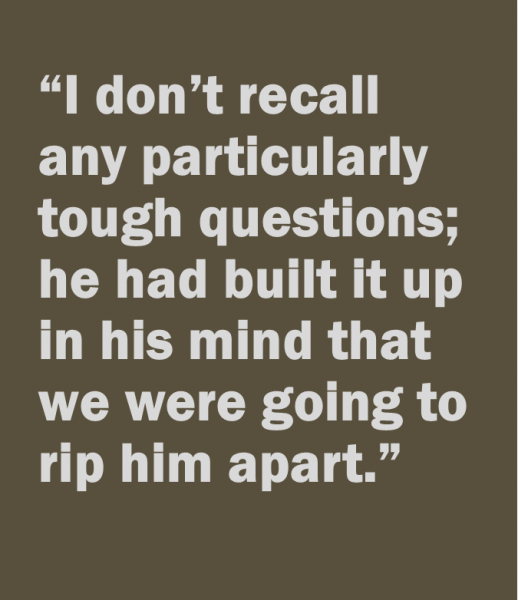
One gentleman running for a seat as a state representative had no political experience and seemed terrified. He stammered, started to answer one way and then changed direction, and practically squeaked by the end of the session. I don’t recall any particularly tough questions; he had built it up in his mind that we were going to rip him apart, or ask him something he didn’t know. Admittedly, the editorial page editor was a little scary. She always did her homework and knew the issues. Her editorials routinely skewered politicians.

For the most part, journalists understand that they must see many sides of an issue, and their personal feelings are not to enter the equation. I know that sounds naïve to those outside the newsroom, but in my experience it was true. And the politicians who did best understood what we were trying to do and what, for the most part, they could expect.q2

After I left the paper a friend of mine who was running for re-election asked me to help him prepare for his upcoming editorial board interview. I suggested some of the issues the editors might bring up and some of the positions he had taken in the past couple of years that he would be criticized for. Then I pointed out he was not going to get the endorsement. He was a Republican and fairly conservative. The editor was unabashedly liberal. My friend’s opponent was a minority – and gay. “He’s their dream candidate,” I said. “They can’t pass this up.”

He laughed, sat back and acknowledged I was right. Later he said it was the most fun he had ever had at an editorial board interview.

When you admit that some parts of the job just aren’t as fun as others – but they still must be tackled – it is easier to address them with courage and even a sense of humor.

________________________________

Paul Steinmetz is director of Public Affairs & Community Relations at Western Connecticut State University. As the founder of Writing Associates, he consults on writing and media issues for businesses and individuals.

PERSPECTIVE commentaries by contributing writers appear each Sunday on Connecticut by the Numbers.

LAST WEEK: Successful Succession Planning for Nonprofits

Most CT Residents Concerned About Loss of Jobs, Access, Care in Aetna-Humana Merger, Poll Shows; Missouri Decision Points to Adverse Impact

The State of Missouri raised a red flag today, waving it directly into the headwind that is the pending merger between health care giants Aetna and Humana.  Missouri’s action came just as a public poll was released in Connecticut by consumer advocates opposing the merger which indicated a general lack of public awareness about the merger plan and substantial concern about potential job losses and adverse health care affordability and choices here if the merger goes forward. The Missouri Insurance Department issued an order banning Aetna and Humana from selling certain types of insurance in the state if the companies’ planned $37 billion merger comes to fruition. The order states that Aetna and Humana should “cease and desist from doing business” throughout Missouri with respect to individual and small group insurance and the group Medicare Advantage market if Aetna’s acquisition of Humana is completed.aetna humana

In Connecticut, the Connecticut Campaign for Consumer Choice coalition released results of a recent poll which found that most Connecticut voters “didn’t know that the five major national health insurance companies – UnitedHealth, Anthem, Cigna, Aetna, and Humana - are attempting to merge down to three companies from five. The new research found that only 27 percent of respondents were aware of the plans.Picture8

After they were given more information about the consequences of the mergers among the five national health insurance providers (Aetna-Humana and CIGNA-Anthem), 71 percent of Connecticut voters were opposed to State Insurance Commissioner Katherine Wade approving the mergers in Connecticut.

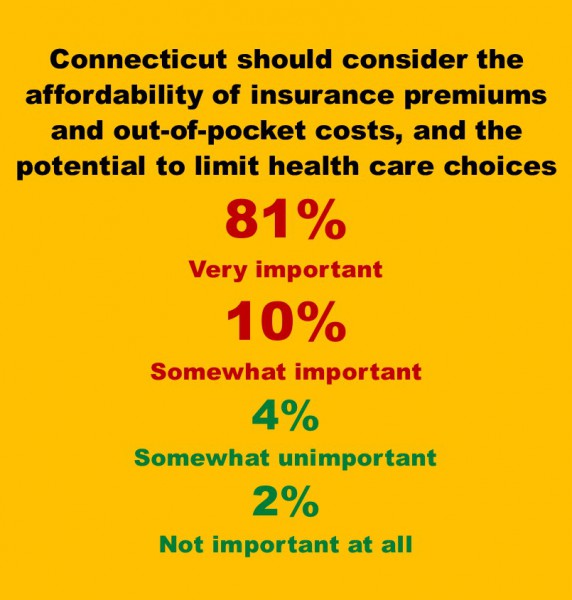
Nine in ten state voters (91 percent) think that it’s either very or somewhat important that Commissioner Wade “considers the impact of these mergers on the affordability of insurance premiums and out-of-pocket costs, and their potential to limit health care choices, in her decision making process.” And those surveyed were overwhelmingly concerned that the proposed mergers will lead to job losses in Connecticut.stat1

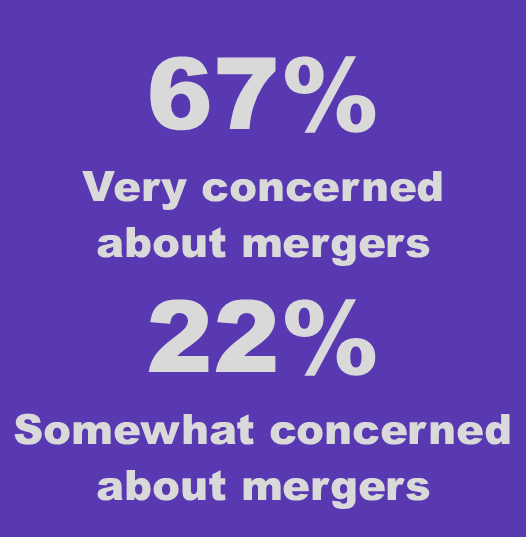
The Connecticut survey, conducted earlier this month by Public Policy Polling, found that 89 percent of Connecticut voters are either very or somewhat concerned that the proposed mergers will lead to job losses in Connecticut. Additionally, 89 percent of those polled believe it’s either very or somewhat important that the impact of these mergers on job losses in Connecticut be considered by state regulators.

Missouri is the first state regulator to release findings against the proposed deal, announced last year, published reports indicated. The deal is being reviewed by the U.S. Department of Justice, as well as state regulators and antitrust authorities, who are also reviewing competitor Anthem’s plan to buy Cigna Corp. Aetna has filed for regulatory approval in the 20 states where Humana is domiciled and of those, 15 have approved the deal thus far, including Connecticut.  Because of Humana's limited footprint in Connecticut, the review was more form than substance.  The Cigna-Anthem merger, however, is to receive a much fuller review, according to state insurance officials, as Cigna is a state-domiciled company.

Regarding Aetna-Humana, the Missouri Insurance Department “found that in its current, unmodified, form – as to a few specified lines of insurance – that the proposed acquisition would violate the competitive standard set forth in Missouri law, meaning that as to those lines the acquisition would substantially lessen competition in this state.”

The Missouri Insurance Department stressed that the decision “is not a final order. The statute provides that Aetna and Humana may submit a plan to remedy the anticompetitive effect of the merger as to those specified lines.”  If that step is taken, the department “would evaluate the plan and may modify or vacate” the order issued today banning the merged company from certain lines of insurance in the state.

"The Missouri order does not impede the Department of Justice approval process," Aetna said in a statement. "We're disappointed, but expect to have a constructive dialogue with the state to address their concerns."

Picture7In addition to the public poll, Connecticut Campaign for Consumer Choice – a coalition that includes the Universal Health Care Foundation, Connecticut Citizen Action Group and Connecticut State Medical Society -  released a letter to Commissioner Wade signed by 17 state legislators calling for multiple public hearings on the merger, intervenor status for interested consumer advocates, and a study that would “analyze the potential impact on cost, access, and the Connecticut economy, including jobs” and warning that if the merger is approved, “the resulting mega-insurer will cover 64 percent of covered lives in Connecticut, with an even greater concentration in some regions of our state.”

The Missouri decision comes following a public hearing held on May 16.  In testimony provided as part of the public record, Consumers Council of Missouri expressed “profound concern,” warning that the merger would result in a “significant reduction in competition (that) will most certainly result in increased cost to consumers,” adding that “the results will be catastrophic and we will have no power to undo it.”

The Missouri Hospital Association, in offering a detailed 21-page analysis, indicated that “Consolidation will affect the ability of hospitals and other health care providers to bargain competitively for contracts containing appropriate fees for medical services. In turn, such providers are less able to invest in the resources to maintain and improve the quality of care. An anticompetitive suppression of healthcare payments will suppress innovation, to the detriment of consumers.”

State Residents Pessimistic About State Economy, Upbeat About Personal Finances, Survey Finds

The state’s budget crisis, and months of fiscal wrangling at the State Capitol, appears to have taken a toll on the economic outlook of Connecticut residents.  Despite growing optimism about their personal financial situation, state residents are increasingly pessimistic about the state’s finances and employment prospects, and are preparing to do some personal belt-tightening as a result. In the latest InformCT Consumer Confidence Survey, for the first quarter of 2016, the percentage who believe that the Connecticut economy is improving has dropped 10 points from the first quarter of 2015 to the first quarter this year, from just over one-third (34%) of state residents to just  under one-quarter (24%).CTConsumConfSurveyLOGO

A year ago, when asked about current business conditions in Connecticut versus six months prior, 29 percent said conditions were better and only 22 percent said they were worse.  That break-down has now flipped, with 22 percent stating “better” and 29 percent saying business conditions are worse.

A majority of respondents (56%) said they intend to make some (41%), or significant (15%), cuts to their personal budget, as a result of budget cuts at the state level.  Only four in ten say that state cuts will have no effect “on me personally.”  Asked what the state should do to best remedy the budget shortfall, six in ten (59%) urged the state to reduce spending while four in ten (43%) suggested raising taxes on the top 1% of income households.

chart 1The quarterly survey is released by InformCT, a public-private partnership that provides independent, non-partisan research, analysis, and public outreach to help create fact-based dialogue and action in Connecticut.  Administered by researchers from the Connecticut Economic Resource Center, Inc. (CERC) and Smith & Company, the analysis is based on the responses of residents across Connecticut and addresses key economic issues, providing a glimpse of the public’s views.

Regarding the employment picture, state residents increasingly believe that although there are jobs available, but 6 in 10 believe there are “not enough.”  And 42 percent are concerned that either their job, or their spouse’s job, is in jeopardy - up from 33 percent in the previous quarter, and the highest level the quarterly survey has seen in the past year.

When it comes to their own finances, state residents are markedly more upbeat.  One-third (32%) say they are better off than 6 months ago (up from 24% in the previous quarterly survey) and 44 percent believe they will be better off six months from now than they are today, a jump of 10 points from last quarter.  More than 8 in 10 residents (83%) say that from a personal financial standpoint, they will be much better off, somewhat better off, or about the same, six months from now.infographic 1

State residents continue to be persistent in their view that Connecticut is a good place to live and raise a family, with 48 percent expressing that view, and only 29 percent disagreeing – a number that hasn’t budged much during the past year.  Yet, the percentage of respondents who say they are likely to move out of the state in the next five years has increased to its highest level in five quarters, to 43 percent, after hovering between 32 percent and 39 percent with that view in the four quarterly surveys of 2015.

Perhaps driven by economic necessity, the public’s view of regionalism – long an anathema in Connecticut – indicates receptivity.  Four in ten now believe that services such as public safety, public health, libraries, education and animal control “could effectively be delivered regionally.”  And 52 percent believe that the best way to grow the economy is to invest in local schools, transportation choices and walkable areas, versus 48 percent who view recruiting companies to the area as the best way to grow the economy.

PERSPECTIVE: Successful Succession Planning for Nonprofits

by Tom Wood The retirement party, it’s a familiar sight; we’ve all been to our fair share. Once you get past the cake, balloons, and bittersweet nostalgia you have to face the fact that you just lost a valued member of your management team. This is when many nonprofit organizations begin to address their succession planning. Even if it is only unspoken, there is a general consciousness that a retirement is coming, but when it comes to resignations there is usually a lack of any advanced noticed.

The effects of sudden turnover resonate strongest for nonprofit entities. For one, employees are driven by the mission and therefore tend to stay for a long time making them unwritten resources. In addition, everyone wears more than one hat so multiple aspects of the organization are affected. A few unplanned departures can have a great impact on multiple facets of the organization resulting in lost institutional knowledge. It also takes more time to replace a position as the skill set for many nonprofit organizations is program specific, which limits the pool of potential candidates.CT perspective

So when is the best time to start thinking about succession planning? Like everything else in life, an ounce of prevention is worth a pound of cure. As cliché as it sounds, the key is to address succession planning before it ever becomes an issue. A process should be developed to identify and monitor management positions that are at risk. From there, you can take three simple steps to mitigate succession related issues: 1) update your procedures manual annually, 2) cross train staff, and 3) develop from within.

Every nonprofit has a handful of individuals who have been around forever. They are the ones who know everything. The first step to proper succession planning is to document what they do. It sounds simple, but how often does your organization update its employee handbook or procedures manual? Make sure that the manual is reviewed by the person actually performing the duties. Having a current procedures manual will make sure that institutional knowledge isn’t lost.

q1Once your procedures are up to date, start cross training your staff. Not only will it be helpful in the event of unforeseen turnover, but it is an important internal control. Cross training is a temporary solution, but it can buy you time to find the perfect candidate.


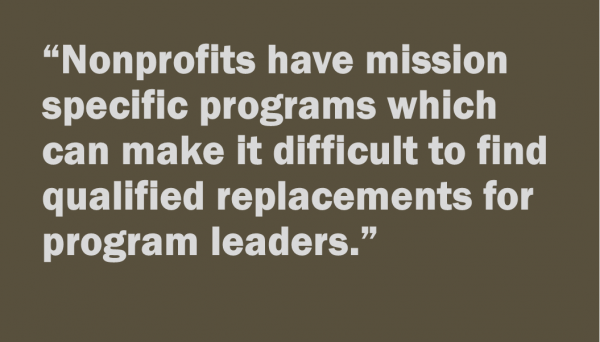
Nonprofits have mission specific programs which can make it difficult to find qualified replacements for program leaders. Often times, very specific job requirements including years of experience and advanced degrees limit the candidate pool. Now, you could hire an expensive headhunter who might come up with a handful of so-so replacements, but there is another option, albeit more long-term: hire from within. Identify potential leaders within your organization and then create a long term development plan. Unlike outside recruits, internal hires already understand the organization, fit in with the culture, and are passionate about the mission.

Senior management isn’t the only group that can benefit from succession planning. A healthy nonprofit is usually the result of an involved board of directors; a strong board takes time to develop and needs to be maintained. Typically, most nonprofit boards have a nominating or governance committee which are charged with finding and vetting future directors. Term limits and classes will keep the board fresh and prevent all the responsibility falling on a few individuals.

So the next time your nonprofit has a retirement party, enjoy a piece of cake and don’t worry because you’ll be ready.

____________________________________

Tom Wood is an audit manager with Whittlesey & Hadley, P.C.  He specializes in audits of nonprofit organizations.  Whittlesey & Hadley, P.C. is a leading, regional provider of accounting, financial, business and technology consulting services, headquartered in Hartford, with offices in Hamden, CT and Holyoke, MA.  

PERSPECTIVE commentaries by contributing writers appear each Sunday on Connecticut by the Numbers.

 LAST WEEK: Driven by Discovery