Fast Forward Past Fiscal Crisis: CT Developing Goals for the Year 2041

New goals approved in the waning hours of the state legislative session focus not on the impending deficit in the next two years, but what Connecticut should look like a quarter-century from now. Fast forwarding to the future, the newly approved legislation establishes a “Connecticut 500 Project” to develop a plan to, within 25 years:

  • Increase private sector jobs by 500,000;
  • Increase Connecticut’s population by 500,000;
  • Increase by 500 the number of start-up companies organized around Connecticut-developed intellectual property;
  • Increase by 500 the number of students graduating from each state college and university;
  • Achieve a national ranking within the top five for economic growth, public education, quality of life, and private sector employee salary;
  • Maintain Connecticut’s position within the top five for productivity, higher education, and income per capita.

500“This is an effort to reassert Connecticut as one of the strongest economies in the nation and in the world,” State Representative William Tong recently told WNPR. He's co-chair of the state’s Commission on Economic Competitiveness, and said the Connecticut 500 Project comes directly out of the work of the commission.  The commission will continue to flesh out the Connecticut 500 Project, and look to hire a private consultant to take the plan forward, WNPR reported.

Tong added that the project is modeled after similar efforts in states like New York, Minnesota, and Ohio, and one of its centerpieces will likely be to move away from Connecticut’s traditional suburban strategy, focusing instead on building population and business vitality in its urban cores.

Some of the groundwork begins sooner, and comes with a price tag.

The state Department of Economic and Community Development (DECD) is required to establish a Talent Advisory Committee to assess shortages in the software development and other technology workforces, and develop pilot programs to correct such shortages.  And the Committee would develop knowledge enterprise zones around colleges and universities with the same benefits accorded entities in enterprise zones.

Details are still to be worked out as to how such an initiative would unfold, and the precise role of the state’s public and private institutions.  The committee would design a pilot program to recruit developers and train state residents over the next 10 years, according to the legislation.

The department’s First Five financial assistance program to encourage business expansion and job creation, is also expanded, as a means of hitting the lofty goals within the next two-and-a-half decades. first

The initiative, which began just a few years ago with five companies and has expanded almost every year since, providing loans and grants to Connecticut businesses as an incentive to remain in the state either despite, or because of, the steadily increasing state deficit driven in part by declining tax revenues.  The First Five program is increased once again under the bill to 20 projects from 15.

When it began in 2012, the companies identified to receive state funds were CIGNA, ESPN, NBC Sports, Alexion Pharmaceuticals, and CareCentrix.  Subsequent participating companies benefitting from the program include Deloitte, Bridgewater, Charter Communications, Sustainable Building Systems, Navigators, Synchrony Financial and PitneyBowes.

Earlier this spring, DECD Commissioner Catherine Smith told the legislature that over the last three years the program has provided $256 million to thirteen different companies. Smith stated that the companies have “committed to retain more than 13,500 jobs and to create between 2,600 and 5,264 jobs” and urged the program’s expansion and extended deadline (into 2019), which was ultimately granted.

Most recently, the state provided $22 million in loans and grants to the world’s biggest hedge fund, Bridgewater Associates, to stay in Connecticut – a decision that instantly received both praise and criticism, from Democrats and Republicans alike.

More Rapes Reported at UConn Than Other Colleges in U.S.; New Study Finds Attitudes Toward Women Key In Higher Rates of Sexual Assault By College Athletes

Whether the number is interpreted as reflecting growing confidence in university adjudication systems, or a growing problem, there were 43 rapes reported at the University of Connecticut in 2014.  Nearly 100 colleges and universities had at least 10 reports of rape on their main campuses, according to federal campus safety data for that year, with UConn and Brown University in Rhode Island  tied for the highest annual total — 43 each. The release of the data comes as:

  • a new study suggests an alarming frequency of students – especially college athletes - coercing a partner into sex, and
  • the sentencing in California of a student athlete to a six month jail term for sex-related crimes, a sentence widely criticized for its brevity.

An on-line survey of 379 college men found that more than half of athletes and a more than 38 percent of non-athletes admitted to coercing a partner into sex.  Researchers surveyed male college students from one large, public, Division I university in the Southeast and asked about a list of sexually coercive behaviors — including threatening partners into oral or anal sex — almost all of which met the legal definition of rape.

The study was published in the journal Violence Against Women last week, with the researchers analysis showing “significant differences between the responses of athletes and non-athletes.”

The UConn data was announced last fall; the comparison with other universities was made public this week.  In an editorial, the UConn Daily Campus, the student newspaper, said “If students made targets of sexual abuse and harassment feel they can come forward and at least somewhat trust their university’s administration to appropriately address their situations, that speaks volumes on the progress the school is making as a bureaucracy and, most paramount, as a culture.”student

UConn spokeswoman Stephanie Reitz said the university “works very hard to cultivate a culture of forthrightness so this traditionally under-reported crime can be addressed and our students receive appropriate services and support.”

During the 2012-13 school year, UConn disclosed 13 reported rapes. That number increased to 18 the next year and to 43 last school year.  The number of reports of dating violence increased from eight in 2013-14 to 26 the following year, and the number of reports of stalking more than quadrupled, from 6 to 30.

New stories indicated that the highest number of reports occurred at Brown: 43; UConn: 43; Dartmouth College: 42; Wesleyan University: 37; and University of Virginia: 35. Yale had 13 reported rapes; Trinity had 12; SCSU had 9; Connecticut College had 8; Quinnipiac had 5; Fairfield had 4; University of New Haven had 4; University of Saint Joseph had 3; University of Bridgeport had 3; and WCSU, ECSU, CCSU and University of Hartford all had 1, according to published reports.

In April, UConn officials released the results of a survey designed to measure the problem of sexual violence on campus, and it indicated that students there feel safe, FOX61 reported. About 1,500 of 6,000 students responded to the anonymous survey, and 82 percent said they felt safe. Of the respondents, 5.5 percent said they'd been sexually asscourtaulted.

UConn was pointedly criticized two years ago from a group of students who alleged their complaints of sexual assault were not handled properly. The university later paid $1.3 million to settle the lawsuit filed by those students and made numerous changes to improve how students are treated when they come forward.  At the time, UConn was one of 67 higher education institutions under review by the Education Department’s Office for Civil Rights due to its handling of sexual assault cases.violence_against_woman_cover

Last week a former Stanford swimmer was sentenced to six months in jail and three years of probation for sexually assaulting a woman outside a fraternity party in 2015. The sentence, far more lenient than what prosecutors sought, provoked public outrage and drew renewed attention to an issue that in recent years has brought controversy and concern on campuses nationwide, including UConn.

The athletes included in the study were mostly those who play recreational, not intercollegiate, sports.  “What we see in this study speaks to a larger issue than just the high-profile and sensational reports we hear about,” Sarah Desmarais, an associate professor of psychology at North Carolina State University and the study’s co-author, told the publication. “There are some attitudes and beliefs prevalent among all kinds of male athletes that seem to be leading to high levels of sexually coercive behavior.”

For this study, the researchers surveyed online 379 male undergraduates: 191 non-athletes, 29 intercollegiate athletes and 159 recreational athletes. The study was conducted by researchers at NC State, the University of South Florida, Northern Arizona University and Emory University.

“We found that 54.3 percent of the intercollegiate and recreational athletes and 37.9 percent of non-athletes had engaged in sexually coercive behaviors – almost all of which met the legal definition of rape,” Desmarais said, in a published report on the NC State website.  “As high as these numbers are, they may actually under-represent the rates of sexual coercion, since the study relied on self-reported behavior,” Desmarais said.

The Washington Post and the Kaiser Family Foundation published in June 2015 a national poll that found one in five women who attended a residential college during a four-year span said they had been sexually assaulted. Those findings have been reinforced by surveys at several prominent research universities, the Post reported.

National Recognition for Charter Oak, Quinnipiac, Fairfield As State Stand-outs

Charter Oak State College, Connecticut’s public online college, has been ranked #2 of 100 colleges scored in the recently compiled Best College for Returning Adults. The national rank was awarded by College Factual and reported on the Forbes.com website. “We are very proud of this ranking. It speaks to the flexibility of and demand for our online workforce relevant programs, such as our new Master of Science in Organizational Effectiveness and Leadership, and the intense and successful focus on our mission of helping adults complete college degrees,” said Ed Klonoski, President, Charter Oak State College.

College Factual’s rankings specifically address “non-traditional students who actually make up the majority of degree-seekers” and include the following categories: students returning to college after dropping out or transferring; working adults seeking flexible options; students seeking distance learning options; and professional who want to utilize life experience to earn college credit.

Of Charter Oak, the website indicated “about 80% of the public school’s students are part-timers, and its online courses in liberal arts studies are among its most popular for returning adults.”  Factors deemed as “high importance” by College Factual were accreditation and early career salary boost.

Founded in 1973, Charter Oak State College is Connecticut’s only public online college, offering associate and bachelor’s degree completion programs in high-demand fields including Health Information Management, Health Care Administration, Cyber Security and Business Administration.

school logosAnother Connecticut school has received national recognition, as Military Times ranked the School of Business at Quinnipiac University as the best business school for veterans in Connecticut and the 24th best in the nation, according to its Best for Vets: Business Schools 2016 rankings.

The organization, made up of Army Times, Navy Times, Air Force Times and Marine Corps Times, focused on culture and curriculum that cater to military veterans when conducting and scoring the fourth annual Best for Vets: Business Schools survey, a highly respected analysis of a graduate business school's complete offerings for veterans. As with all of the Best for Vets rankings, Best for Vets: Business Schools is an editorially independent news project that evaluates the many factors that make an institution a good fit for military veterans.

"Veterans have told us they were attracted to a business degree because it wouldn't tie them down to a certain industry," said Amanda Miller, editor of Best for Vets. "The survey lets us recognize the graduate business schools with close military connections that truly take vets' success to heart."Forbes

Matthew O'Connor, dean of the School of Business, said, "The School of Business is proud to be selected as a 2016 Best for Vets Business School by the Military Times. As an AACSB-accredited business school, we offer a wide variety of high-quality business programs and student services”

He added, “Our excellent internship program and enviable track record for helping graduates secure full-time employment is particularly attractive to veterans. Quinnipiac is proud of the service of military personnel and veterans and celebrates the contributions they make to our University."

The rankings were published in full in the issues of Army Times, Navy Times, Air Force Times and Marine Corps Times and online.

Quinnipiac University also recently announced that the Hamden-based university will be adding a School of Engineering in the fall, breaking off from what has been the School of Business and Engineering, which offered engineering courses to students during the past four years.  The School of Engineering becomes that university’s ninth school leading to a bachelor of science degrees. It will of offer engineering degrees in civil, industrial, mechanical, software engineering and computer science.

Dr. Justin Kile has been appointed the founding dean of the new school after previously serving as Quinnipiac’s associate dean of engineering since 2013. He will guide the school through the Accreditation Board for Engineering and Technology’s yearlong approval process.

Regarding business schools in the state, Bloomberg recently concuded a study of the best U.S. undergraduate business schools, ranking Fairfield No. 1 in Connecticut with an overall national ranking of 43rd.The school jumped 15 spots from last year's rankings.

The other Connecticut business schools on the list were University of Connecticut, ranked 72nd; Quinnipiac University, 91st; Sacred Heart University, 92nd; University of Hartford, 101st; and the U.S. Coast Guard Academy, ranked at number 104. The elements that contributed to the rankings included an employer survey, student survey, starting salaries of graduates and internships available as part of the curriculum.

Another distinction for Fairfield University: the school is among nine universities nationwide to receive accreditation from the International Dyslexia Association (IDA) and its affiliate, the Center for Effective Reading Instruction, for having met the standards outlined in IDA’s Knowledge and Practice Standards for Teachers of Reading.dyslexia

The Certificate of Advanced Study (6th year), Reading and Language Development program in GSEAP received the designation.

The IDA Standards provide a framework for course content in university and other teacher preparation programs, offering research-supported documentation of what teachers ought to know and be able to demonstrate when teaching dyslexic students.  The standards also apply to the teaching of other struggling readers or the general student population.

The goal of the standards initiative is to promote consistent and high-quality teacher preparation to improve outcomes for those who struggle with written language. Fairfield’s Sixth Year Professional Certificate in Reading and Language Development is open to those who have received their master’s in education degree.

"We are very excited about this national recognition from IDA. Elementary teachers and even Reading Specialists are not prepared with the tools and training to diagnose and intervene with children with dyslexia; this program addresses that," said Robert Hannafin, Phd., Dean of GSEAP. "We are committed to helping all students read and particularly struggling readers."

Nine in Ten CT Residents Have a Usual Source of Care, But 3 in 10 Haven’t Seen Doctor in Past Year

A new federal report finds that all but 10.1 percent of Connecticut residents had a usual source of medical care during 2014 – tied for the sixth lowest percentage among the states.  The same report found great variation among states but, on average, 17.3 percent of Americans lacked a usual source of care. Vermont led the country with only 2.8 percent of residents reporting they do not have a regular care site, according to data compiled by the Centers for Disease Control and Prevention’s National Center for Health Statistics, followed by Delaware at 6.8 percent.CT stats

Even in Connecticut there remains room for improvement as nearly 3 in 10 – 29.6 percent - of Connecticut residents had not seen or talked to a general doctor during the last year, slightly better than the national average. Vermont also led the country in that statistic, with 84 percent having seen or spoken with a physician during the previous year.

The percentage of adults without a usual place of medical care ranged from 2.8 percent in Vermont to 26.7 percent in Nevada.  The percentage of adults who did not have a general doctor visit in the past 12 months ranged from 15.9 percent in Vermont to nearly have the state’s population - 48.1 percent - in Montana.

The federal data indicated that nine states (Nevada, Idaho, Texas, Oregon, Wyoming, Kentucky, Arizona, Alaska, and Florida) had a higher percentage of adults without a usual place of medical care compared with the national average (17.3%).box-2a

Conversely, Vermont, Delaware (6.8%), Massachusetts (7.5%), Wisconsin (9.5%), Hawaii (10%), Connecticut (10.1%), Rhode Island (10.1%), New Hampshire (11.6%), North Dakota (11.9%), South Dakota, New York, Alabama, Iowa, Maine, and Pennsylvania had a lower percentage of adults without a usual place of medical care compared with the national average.

Eleven states (Montana, South Dakota, Alaska, Nevada, New Mexico, South Carolina, Idaho, Nebraska, Texas, Florida, and California) had a higher percentage of adults who had not seen or talked to a general doctor in the past 12 months compared with the national average (34.0%).  Vermont, Delaware, Virginia, Pennsylvania, Michigan, Wisconsin, New Hampshire, Oklahoma, and Ohio had a lower percentage of adults who had not seen or talked to a general doctor in the past 12 months compared with the national average.

Connecticut, at 29.6 percent, ranked just outside the top 10 states in the second quartile, but just below the national average.map states

Also of note, the study found little impact on these metrics of states’ decisions to expand Medicaid or create a state-based health insurance exchange. The federal analysis concluded that “continued state-specific monitoring will be helpful in identifying and tracking state and regional disparities in health care utilization over time.”

The National Health Interview Survey is a multipurpose health survey conducted continuously throughout the year by the National Center for Health Statistics (NCHS). Interviews are conducted in person in respondents’ homes, but follow-ups to complete interviews may be conducted over the telephone. The federal report was authored by Lindsey I. Black and Jeannine S. Schiller, with the National Center for Health Statistics, Division of Health Interview Statistics.

PERSPECTIVE: Do Community College Students Go Begging?

by Endia DeCordova A professor at Manchester Community College noticed that a student – typically a regular class attendee – had stopped coming. Efforts to contact the student ultimately revealed that she had given up on many of her goals, including her education, because of depression. Having her electricity turned off because she couldn’t afford the bill was the last straw.CT perspective

A staff member at the college was approached by a student who asked to borrow a dollar for the vending machine. He had to remain on campus all day -- through an evening course -- and couldn’t afford to buy anything from the cafeteria.

One more anecdote involves a student who dropped out because of an inability to scrape up bus fare. That student relied on public transportation to get everywhere, including to class.

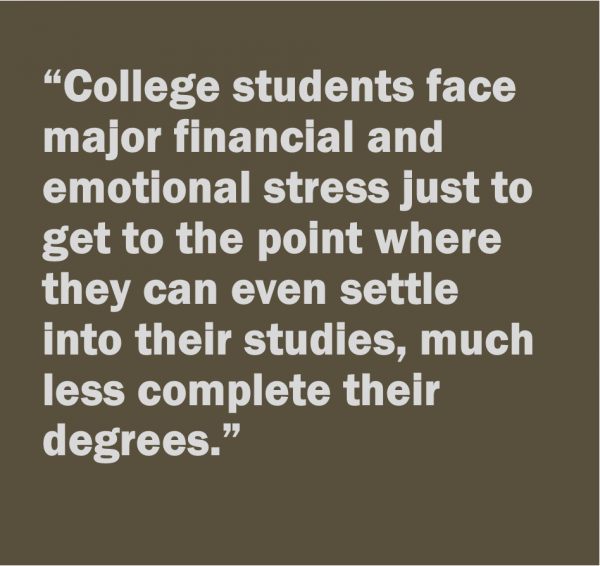
q1These are true stories. The names are omitted and details smoothed over for obvious reasons. But they really happened this spring at MCC.  The image of the college student – not a care in the world – partying and protesting, cramming just in time to pass an exam, and simply marking time until graduation has never really been accurate. It is certainly far from the truth today. College students face major financial and emotional stress just to get to the point where they can even settle into their studies, much less complete their degrees.
In fact, the story of the borrowed candy-bar dollar is especially heartbreaking as it makes clear how much of a hurdle food-insecurity is for an increasing number of college students. A February 2016 article in The Chronicle of Higher Education, “Students Shouldn’t Have to Choose Between Books and Food,” highlights the disturbing data on hunger among college students. According to a 2015 study by the Wisconsin HOPE Lab, 20 percent of community-college students were going hungry. Another, by City University of New York, found that 39 percent of its students were similarly at risk.

This underscores a major issue for college students nationally. How is it that higher ed creates poverty among people who are clearly working to improve their lives?

Rising costs of tuition, fees and books are easy to point to. At MCC, people are struggling to pay for higher education and after they enroll, often can’t follow through. For the spring 2016 term, nearly 900 students who applied to MCC paid their application fee but did not enroll. Another nearly 500 students enrolled but couldn’t complete their payments and were forced to drop out for lack of financial resources. Of those, many struggled to buy books or other class materials.

But the real issue is running just below the surface. Common sense tells us all that if you can’t afford to pay for something that is essentially a luxury – or a privilege, as many still view a college degree – you don’t buy it.

For many MCC students, not going to college is not an option. Their education is key to transformation – in many cases, moving them from zero hope to a promising future and a life of contributing to their families and their communities.

Yet as they forge ahead, they go begging for the basics. As the students above tragically did, they too often give up short of their goals. At the same time, public funds in Connecticut for higher ed are dropping.q2

This is why MCC is working through its foundation to develop a retention and completion grant program. Like many community colleges nationwide, we are determined to support students who have delayed starting college or “stopped out” of college because of short-term financial distress.

We ask students to assume some of the risk connected with the funding so they remain vested in their futures, but these grants (not loans) are designed to help them pay for the books -- or the bus pass, the electricity, the food they need -- to keep going and to graduate or transfer.

A college education today is a necessity. No one should have to beg.

__________________

Endia DeCordova is Dean of Institutional Advancement and Community Engagement for Manchester Community College.


PERSPECTIVE commentaries by contributing writers appear each Sunday on Connecticut by the Numbers.

LAST WEEK: Face Your Fears - and the Editorial Board

Hartford’s Reputation As Excellent Host for National Gymnastics Brings Returns

If the three twenty-somethings enjoying  lunch and some brief down time outside at Trumbull Kitchen seemed familiar to passersby in downtown Hartford, it’s probably because they’ve been on national television a time or two.  And will be again. The casual lunch and conversation among three friends – competitors in the P&G Gymnastics Championships being held at the XL Center this weekend – are just one example of how hosting a major sporting event, in this case gymnastics, can boost the local economy and have reverberations that will continue to add value.

Californian Sam Mikulak, 23, who has won the men’s national title each of the past three years, remembers Hartford well.  His string of three consecutive all-around championships started here in 2013.  Fellow athletes Donathan Bailey, 25, of California and C.J. Maestas, 24, of New Mexico, have also competed in national championships held in Hartford.lunch

This weekend, the Capitol city is hosting not only the men’s championship for the third time in a decade (2010 and 2013 previously) but is also hosting the Secret U.S. Classic, a key tune-up for the nation’s top women gymnasts, with the Olympics just two months away and the U.S. teams to be chosen in the coming weeks.  It is the first time that Hartford has hosted major gymnastics events in an Olympic year, when public interest peaks.

The roster of past Olympic and international medalists competing in Hartford is lengthy – unprecedented in the view of some observers – and in many cases, Connecticut is part of their individual Olympic journeys.

2012 Olympic gold medalist Aly Raisman of Needham, Massachusetts recalls competing in Hartford in 2010, and says of her return, “I feel like I’m competing at home.”Aly

The Connecticut Convention and Sports Bureau (CTCSB) projects 1,425 hotel room nights, an estimated attendance approaching 30,000, a business sales impact of $1.5 million and $50,000 in local taxes generated.  But the impact goes beyond those numbers.

“It raises awareness of what we have in the state,” when people visit to enjoy the competition, or root for family or friends, points out Bob Murdock, Director of Sports Marketing at CTCSB.

Add to that the national network television coverage (NBC telecasts coverage on Sunday and NBC Sports Network also provides coverage), and the Hartford locale mentioned in news stories published worldwide and plentiful on social media, the exposure for the city and state is incalculable.  “It has lasting effects,” says Murdock, and “helps grow the brand of Connecticut.”

USA GymnasticsWhy does USA Gymnastics keep coming back?  “Everything runs smoothly,” suggests Mikulak, expressing a competitor’s viewpoint. “They trust us,” adds Murdock, noting that when Connecticut bids to attract future national caliber sporting events, the first question asked is “what else have you hosted.”

“The sports talk to each other,” Murdock explained.  They ask about community support, and the overall experience.  That USA Gymnastics has returned multiple times with its top national events speaks volumes.

Some up-and-coming hopefuls wouldn’t mind seeing the Hartford tradition continue awhile longer.

Among those competing at the Junior elite level is 14-year-old Riley McCusker of New Milford, the lone Connecticut resident at either the Senior or Junior level.photo

“I am so excited to be in Connecticut,” she says, seeking to advance her fledgling career at a major competition in her home state. Many of her friends and family will be on hand, including some that may be surprised when they see her on the XL Center floor and realize the full dimension of her steadily progressing gymnastics career.conv

McCusker recalls being at the XL Center as a spectator for a previous national championship, and being wowed by an extraordinary floor exercise she witnessed. This weekend, she may turn some heads herself as she continues to emphasize quality and consistency  as her track-record grows, although not quite looking ahead yet to Olympic possibilities in 2020.

Four years beyond her Olympic experience in London leading the U.S. team and earning individual and team gold medals, the just-turned-22 year-old Raisman says it “feels like forever ago.”  With a field of potential U.S. Olympians as deep as it ever has been all vying for one of only a handful of slots on the 2016 U.S. team, having the journey come through a familiar place – with nearly two dozen close friends and family coming to Hartford to join the many fans here to cheer her on - may offer a lift.

The competition itself certainly does so for the XL Center, Hartford and Connecticut.  Mikulak, as only a visitor could, sums it up succinctly:  “Hartford is a popular place.”


postscript

Aly Raisman of Needham, Mass. won the senior all-around title at the 2016 Secret U.S. Classic at the XL Center on Saturday, June 4.  Rachel Gowey of Urbandale, Iowa was second, and Alyssa Baumann of Plano, Texas finished third. Earlier in the day, Irina Alexeeva of Plano, Texas, captured the junior all-around title.  Connecticut’s Riley McCusker of New Milford finished 9th.  The 11,771 who attended the Secret U.S. Classic on Saturday evening were the largest one-day crowd USA Gymnastics has had for events held in Hartford. In 2010, the largest daily crowd was 11,325, and in 2013 the largest daily attendance was 10,233.


CT An Also-Ran Among States in Entrepreneurial Growth, Despite Some Gains

Connecticut ranks 13th among the nation’s 25 smaller states – and 36th overall - in the growth of entrepreneurship, according to a new study and state-by-state analysis by Kauffman Foundation.  A year ago, the state ranked 17th among the smaller states, slightly improving its ranking in the latest data.  The rate of start-up growth in Connecticut increased to 45.5 percent in the 2016 report, compared with 23.6 percent the previous year. The “share of scale-ups” also increased, from 1.29 percent in last year’s analyses to 1.33 percent this year.  Scale-ups measures the number of firms that started small but grew to employ fifty people or more by their tenth year of operation as a percentage of all employer firms ten years or younger.report

One metric that dropped slightly measured high-growth company density – the number of private businesses with a least $2 million in annual revenue reaching three years of 20 percent annual revenue growth normalized by total business population.  Connecticut moved from 55.1 a year ago to 48.8 in the 2016 report.  Both researchers and entrepreneurs have suggested density as a key indicator of vibrancy in entrepreneurial ecosystems, and there is high variation on this indicator across U.S. states, according to the report.

The Kauffman Index of Growth Entrepreneurship, released this week,  is an indicator of business growth in the United States, “integrating several high-quality sources of timely informastatstion into one composite indicator of entrepreneurial business growth.”

In rankings by industry, Connecticut ranked in the top five among the 25 smaller states in two five categories – 3rd in Business Products & Services and 3rd in Software.  The state was ranked outside the top five in high-growth companies in the IT Services, Advertising & Marketing and Health industries.

Overall, the Growth Entrepreneurship Index rose in 2016 in thirty-nine states in the last year, indicating a continued return of broad-based business growth, the report concluded.

  • Among the twenty-five largest states, the five states with the highest Growth Entrepreneurship Index were Virginia, Maryland, Arizona, Massachusetts, and Texas.
  • Among the twenty-five smallest states, the five states with the highest Growth Entrepreneurship Index were Utah, New Hampshire, Delaware, North Dakota, and Oklahoma. (Connecticut ranked 13th)

While most states experienced an increase in growth entrepreneurship activity, changes in state rankings— which measure relative yearly performance across states, as opposed to performance relative to a state’s own growth entrepreneurship rates in the previous year—were different. Twenty-three states ranked higher than they did last year, seven experienced no changes in rankings, and twenty ranked lower, the report pointed out.

"Growth entrepreneurship directly contributes to the economy through creating jobs, innovation and wealth," said Arnobio Morelix, senior research analyst at the Kauffman Foundation, which conducts the annual study.

Virginia took first place in growth entrepreneurship activity among the 25 largest states, followed by Maryland, Arizona, Massachusetts and Texas. Kauffman researchers said it is no coincidence that two of the top states include the highly entrepreneurial Washington, D.C., metro area. Among larger states, 12 ranked higher than they did last year, four experienced no change in rankings and nine ranked lower.

Among the 25 largest states, the five that experienced the biggest increase in rank from 2015 to 2016 were North Carolina (15 to 8), Alabama (13 to 9), Ohio (16 to 12), Tennessee (18 to 14) and Arizona (6 to 3).

The five large states that saw the greatest decrease in rank in 2016 were, with a tie for fifth place, New Jersey (8 to 20), Pennsylvania (10 to 16), Illinois (14 to 17), Wisconsin (20 to 23), Louisiana (4 to 6) and South Carolina (11 to 13).

Among the 25 smallest states, Utah led growth entrepreneurship activity, followed by New Hampshire, Delaware, North Dakota and Oklahoma. Eleven states ranked higher than they did last year, three experienced no change in rankings and 11 ranked lower.

The five small states that saw the biggest increase in rank were Mississippi (22 to 10), Wyoming (23 to 15), North Dakota (11 to 4), Nevada (15 to 8) and Connecticut (17 to 13).

Hartford Is Next Stop on the Road to Rio for Olympic Gymnastics Hopefuls

Gymnastics will once again take center stage in Hartford this weekend, as for the third time in a decade Connecticut’s Capitol City is the center of the gymnastics world – this time in an Olympic year, when public interest ramps up to peak levels. mikulakThe three-day event  begins on Friday at the downtown XL Center and features the two-day P&G Championships, the national championships for senior men’s gymnastics, and the Secret U.S. Classic, the final women’s qualifier for the P&G Women’s Gymnastics Championships.  The field for both events is nothing short of phenomenal.

The men’s 2016 P&G Championships will determine the men’s senior national champions and national team, as well as the men who will advance to the 2016 U.S. Olympic Team Trials for Men’s Gymnastics in St. Louis, June 23 and 25.

The Secret U.S. Classic, which has women competing on the junior and senior levels, serves as the last opportunity for female gymnasts to qualify for the P&G Women’s Championships in St. Louis (June 24 and 26), as well as a tune-up for many of the country’s top women leading into the national championships.

Led by three-time World all-around champion Simone Biles of Spring, Texas, eight gymnasts who have won World Championships or Olympic gold medals, including athletes who helped Team USA win the World team titles in 2011, 2014 and 2015 and the team gold medal at the 2012 Olympic Games, are expected to compete.

The 2016 Men’s P&G Gymnastics Championships begin on Friday, and will feature a field of 11 men who have combined fogymnas logosr 39 U.S. titles and 12 world championships medals. 2012 Olympian and three-time U.S. champion Sam Mikulak of Newport Coast, Calif., is pursuing his fourth consecutive U.S. all-around title.  Including Mikulak, four members of the 2012 U.S. Men’s Olympic Team are slated to compete in Hartford this weekend.
The competition will determine both the men’s senior national champions and national team, as well as the athletes who will advance to the U.S. Olympic Team Trials on June 23-25 in St. Louis. From there, five men will be chosen to represent Team USA at the Rio de Janeiro 2016 Olympic Games.

For those interested in looking well beyond this year’s Olympics, The Hopes Championships, which features young, aspiring female gymnasts (ages 10-13) , is held in conjunction with the Secret U.S. Classic and is scheduled for June 3 at 2:30 p.m.  Throughout the weekend, fans in attendance will have opportunities to visit the Kellogg’s Nutrition Zone and learn about International Gymnastics Camp.

The XL Center has hosted the USA Gymnastics national championships twice: in 2010 and 2013.  Both were important events building toward Olympic years, and Olympians competed both times, but neither was in an actual Olympic year. The Summer Olympics are scheduled for Aug. 5-21, 2016 in Rio de Janeiro, Brazil.

“When we left [Hartford] last time, I said, 'We'll look for a way to come back,' USA Gymnastics President and CEO Steve Penny said on a conference call when the events were awarded to Hartford in late 2014. "The density of our community is so great in that northeast part of the country. We knew we would have a good following for men's and women's gymnastics.”

The gymnastics events will garner national sports media coverage, including a live telecast on NBC on Sunday afternoon, and taped coverage on NBC Sports Network on Sunday night.  Some events will also be streamed live online.

Connectilogo-Travelers-Championship-Golfcut will be back in the sports spotlight later this summer, with the Travelers Championship PGA Tour event, traditionally held in June, pushed back to August, due to the Summer Olympics.  The run-up to that event, perennially a big draw for fans in Connecticut and New England, begins when defending champion Bubba Watson is interviewed during the MetroHartford Alliance’s Rising Star Breakfast on June 20.  The tournament will be August 1-7 at TPC River Highlands in Cromwell, with the final round telecast by CBS Sports.

site-logo-ctoJust weeks later, New Haven will be hosting the Connecticut Open, formerly the Pilot Pen, tennis tournament August 19-27. Connecticut Open presented by United Technologies features world-class women’s tennis players, highlighted by three-time champion and World No. 6 Petra Kvitova and Americans Madison Keys and Sloane Stephens. The event at the Connecticut Tennis Center at Yale will also be telecast nationally.  ESPN2 will broadcast the women’s semifinals (Friday, August 26) and finals (Sunday, August 27). Early round matches can also be seen on ESPN3.

Photos above: Three-time U.S. champion Sam Mikulak; Juniors competitor Riley McCusker of New Milford.


Next Digital Citizenship Summit will be at Twitter Headquarters, One Year After Hartford Area Launch

What a difference a year makes.  The Digital Citizenship Summit, launched last year in Greater Hartford at the University of Saint Joseph, will be hosted at Twitter headquarters in San Francisco on October 28 this year, as the launch event for U.S. Media Literacy Week at the social media giant’s global headquarters. The Digital Citizenship Summit, described as the only global network of summits and projects focused on the safe, savvy & ethical use of social media and tech, was developed locally and has quickly grown internationally, with sessions taking root across the globe. digcitsum

A major gathering of organizations, industry, parenting experts, students, and more, will bring together new, well-known, and unexpected voices from a wide variety of backgrounds for a fast-paced and energetic mix of presentations, panels, videos, and awards at Twitter headquarters this fall.

The day will be live-streamed to a large global audience, and seeks to broaden the appeal and accessibility to digital citizenship and media literacy. "Digital Citizenship" has been defined by Dr. Mike Ribble, author of Digital Citizenship in Schools, as "the norms of appropriate, responsible behavior with regard to technology use."

The Digital Citizenship Summit will serve as the kick-off event for Media Literacy Week (October 31-November 4) led by the National Association for Media Literacy (NAMLE). Media literacy “is the ability to access, analyze, evaluate, communicate and create using all forms of media,” and an area of heightened relevance so close to the presidential election.logo mix

“We are thrilled to be partnering with the Digital Citizenship Summit and Twitter on this event,” says Michelle Ciulla Lipkin, Executive Director of NAMLE. “We are excited about bringing thought leaders in digital citizenship and media literacy together. There is so much to be done to ensure a media literate world and exploring digital citizenship is a great way to get the conversation going.”

“Society has adopted new social media platforms and technologies before we have collectively had the chance to determine what constitutes safe, savvy, and ethical behavior,” says Digital Citizenship Summit co-founder David Ryan Polgar of West Hartford.

“There are multiple stakeholders who desire an active role in the process, including students, educators, parents, administrators, media specialists, and organizational leaders. All of these groups have crucial insight, and the Digital Citizenship Summit was setup to bring these voices together to solve current issues regarding social media and tech use,” Polgar said.

The issues, according to Polgar, are endless. “Some major areas of concern include how smartphones should or shouldn’t be used in the classroom, finding ways to improve civility online, adjusting to an Internet that never forgets our posts, and being able to determine the veracity of what we read online.”Polgar, Curran

By bringing together a broad range of experts, organizations, and interested parties, the Digital Citizenship Summit on October 28th aims to take a multi-stakeholder participatory approach to solving some of the vexing issues regarding social media and tech use.

Partnering organizations include the National Association for Media Literacy Education (NAMLE), Common Sense Media, Family Online Safety Institute (FOSI), #iCANHELP, ConnectSafely, iKeepSafe, and Trend Micro’s Internet Safety for Kids & Families.

The inaugural Digital Citizenship Summit in the United Kingdom was held earlier this year and another is already being planned in that nation, and plans are now being developed for similar initiatives in St. Louis as well as Ireland and Australia later this year.  A Summit was held in Wisconsin last month.

“We are thrilled to have the involvement of so many prominent organizations,” says co-founder Dr. Marialice B.F.X. Curran. “By collaborating on this event we can expose a wide audience with some incredible resources that can be used at home or in the classroom.” “At the same time,” chimes in her co-founder David Ryan Polgar, “the open and collaborative nature will bring forward new voices that can influence this important conversation around social media and tech use.”

“We want people impacted by tech and social media to feel empowered,” Curran continues. “Instead of being reactive, we want people to be active participants in the digital future. We want people to be the digital change.”

Media Literacy Week (#MediaLitWk) is designed to bring attention and visibility to media literacy education in the United States. Inspired by Canada’s Media Literacy Week, the National Association for Media Literacy Education is leading the efforts to create a media literacy week in the United States to showcase the work of amazing media literacy educators and organizations around the country. The mission of Media Literacy Week is to highlight the power of media literacy education and its essential role in education today.

The Digital Citizenship Summit is a global network of summits and projects focused on the safe, savvy, and ethical use of technology and social media. They are dedicated to creating a new culture in which everyone—particularly the next generation of digital natives, educators and parents—has a voice, and feels empowered to use it. The Digital Citizenship Summit brings diverse groups together to connect in person, join the conversation and take an active role in creating positive digital change on both a local and global level.

The first Digital Citizenship Summit was held on October 3, 2015 at the University of Saint Joseph in Connecticut. It drew over 220 educators, students, parents, administrators, organizations, and members of industry, and trended #1 in the nation (#digcitsummit).