Migration Patterns Show Some Pluses as Population Numbers Decline

Connecticut's total population has declined over the past 3 years.  In fact, in 2016 Connecticut's total population fell below 2010 levels. New England and our neighboring states have also experienced an increase in people leaving. However, Connecticut has fallen the most post-recession, according to an analysis by the Connecticut Data Collaborative. International migration has helped, the data shows, but not enough to offset domestic out-migration.  Average international in-migration has grown 29% post-recession compared to pre-recession, but in terms of overall net migration, the state has seen an increased loss starting from 2012.

The state gains prime working age adults and children and also attracts well-educated international migrants, according to the analysis, and Connecticut loses the smallest percent of graduate degree holders. By income, the largest flows are at the lowest income levels (though largely due to age of earners), though the state is experiencing a slight loss of its highest income earners (incomes of $5 million or more).

Among the factors contribution to the population decline:

  • Post-recession, Connecticut has about 14% fewer births each year compared to pre-recession averages. Increased deaths are also slightly contributing to Connecticut's overall population decline.
  • Average domestic out-migration has increased by 55% post-recession compared to pre-recession, a difference of about 9,200 people.

Young adults move at a higher rate than the rest of the population (larger flows both in and out of Connecticut), and the state is losing young adults on net (18-29 year olds), but gaining working age adults (30-49 year olds), the Data Collaborative analysis shows.

Historically, Connecticut experienced population losses to other regions of the U.S. This is also true of New England in general. However, the recent declines in Connecticut's total population are primarily driven by increasing rates of net domestic out-migration and to a smaller degree a declining birth rate. But there are positive trends.

The state gains prime working age adults and children. Connecticut also attracts well-educated international migrants, and loses the smallest percent of graduate degree holders.  By income, the largest flows are at the lowest income levels (though largely due to age of earners), though the state is experiencing a slight loss of its highest income earners (incomes of $5 million or more).

Connecticut's domestic migration trends are now more like New York and New Jersey.  However domestic out-migration has more than doubled in Connecticut while New York and New Jersey are better than pre-recession, the researchers found.


More Daughters Mean More Venture Capital Investment, More Success, Study Shows

As the growing number of Connecticut start-up firms seek to attract venture capital funds to propel their growth, a newly published study may suggest some surprising influences on the investment decisions – and ultimately the success of venture capital investments. A National Bureau of Economic Research (NBER) working paper by Paul A. Gompers and Sophie Q. Wang from Harvard University says that gender diversity may boost performance of venture capital firms.  But it is not the gender diversity of the start-up firms leaders, or the gender diversity of the venture capitalists, who tend to predominantly be white males.

It is the gender diversity of the children of venture capitalists that appears to make the difference.

The paper, “And the Children Shall Lead: Gender Diversity and Performance in Venture Capital,” is based on a study of a dataset of gender of venture capital partners’ children. It finds that partners with more daughters than sons were more likely to hire female partners. But that’s not all.

The study also finds that having more girl children had a positive effect on deal and fund performance of these partners.  The authors indicate that the effects concentrate overwhelmingly on the daughters of senior partners than junior partners.

“Taken together, our findings have profound implications on how the capital markets could function better with improved diversity,” they say in the paper’s abstract.

Venture capital firms are typically deep-pocketed, small companies that bet on startup success by investing millions in exchange for an ownership interest and hopes of high returns.  Published reports indicate that according to the study, firms that increased their gender diversity by hiring more women saw their deal success rate increase by nearly 3 percent. Their profitability, as measured by internal rates of return, rose by more than 3 percent.

Venture capital in Connecticut is available from a range of private and quasi-public sources, including Connecticut Innovations.

The 62-page paper was posted last week; Paul Gompers is Professor of Business Administration and Director of research for the Harvard Business School Finance Unit.  Sophie Q. Wang is a PhD student in the Department of Economics at Harvard University. They based their results on some 12,000 venture-capital investments made between 1990 and 2016, primarily by U.S.-based firms.  They also studied personal information obtained from some 1,400 investing partners.

The NBER is a private, non-profit, non-partisan organization dedicated to conducting economic research and to disseminating research findings among academics, public policy makers, and business professionals.

PERSPECTIVE: 10 Reasons Your Performance Appraisal Might Be Useless

by Karen Hinds Are your performance appraisals useless? If you are a manager, end of year can often make you feel like a Christmas Grinch. You feel rushed, stressed, and even dread as you try to summarize an entire year of highs and lows on an employee’s performance appraisal. Invariably, someone will feel like they received a lump of coal after reading what they hoped would be a good review.

For employees, it’s a source of anxiety and even anger as they anticipate the results of their performance appraisals. Why do we tolerate this annual drain on productivity and morale? There are simple fixes, if done throughout the year, to make this process relevant and valuable to an employee’s growth. Here are 10 reasons why your current process might be of little or no value.

  1. Emphasis is on the mistakes and the past.

Unfortunately, there are managers who view the appraisal process as an opportunity to only recap everything an employee has gotten wrong throughout the year. This is incredibly demotivating and hampers morale as well as trust in that relationship. Focusing on the past leaves no room for forward thinking and growth, which is the intent of an appraisal.

  1. Appraisal is full of surprises.

An employee should not be surprised by what is written on their appraisal if the manager has done a great job communicating throughout the year. If surprises exist, it is an indication the manager/employee relationship is damaged and ineffective. Errors are inevitable, but the manager should immediately identify the error and help to design a plan of action that helps the employee correct the mistake and keep growing. When an employee does well, it also should be immediately acknowledged, documented, and celebrated.

  1. No regular check-in.

Many performance appraisals only see the light of day when it’s time to write a new one for the upcoming year. If this is how your team operates, it is a complete waste of time. The appraisal should be a living, breathing document used as a roadmap throughout the year. Monthly and quarterly reviews with adjustments will increase the probability of the employee meeting and even exceeding the expectations set.

  1. One-way conversations.

If an employee is simply sitting and listening to the manager during a performance appraisal or given a report to read, it is a sure sign the process is deeply flawed. This should be a two-way conversation where the employee and manager are both engaged. The manager and employee should be reviewing progress, examining the best way going forward, celebrating milestones, and setting new goals together.  As mentioned earlier, it’s an ongoing conversation, not an end-of-year marathon to talk and fill out paperwork.

  1. No preparation for advancement.

An effective manager should know their primary job is to provide the environment where each employee can reach their peak performance and then move on, whether a vertical or lateral move.  Even when the organization is flat, advancement can still be made by varying projects and learning new roles and skills sets.

  1. Setting goals that are not S.M.A.R.T.

Effective evaluation of an employee’s progress depends on the quality of the goals set. All goals must be measurable and adhere to the S.M.A.R.T standards of being Specific, Measurable, Attainable, Realistic, and Time-specific.

  1. Manager’s unconscious bias.

Managers are not perfect and even the best-intentioned manager has unconscious bias. The bias could be based on an employee’s personal style, preferences, gender, age, accomplishments, race, ethnicity, etc. It’s also not unusual for managers to carry a chip on their shoulder caused by an incident going back months. When these behaviors are present, a successful appraisal is impossible.

  1. Avoiding negative feedback.

Some managers cower at the thought of having to deliver negative feedback, especially to employees who may have a reputation of being difficult. They might tiptoe around the real issues and deliver a weak appraisal with no value by only highlighting what worked well.

  1. Confusing performance and attitude.

Some employees are great talkers, enthusiastic, and friendly around the office but are poor performers. There are also employees who are exceptional performers but lack the social skills or choose not to be overly enthusiastic because that’s their personality style. They may also consciously choose to be less engaged socially due to the work environment. Managers need to be clear on what they are measuring: Is it performance or attitude?

  1. Manager was never trained.

No one was born with excellent managerial skills, and even if you have managed people for many years, it is not an indication you are a competent manager or you know how to execute an effective performance evaluation. Companies should hold educational sessions to teach managers how to review an employee’s performance in a fair manner and set them up for future success.

_________________________________

Karen Hinds is president and CEO of Workplace Success Group, a Connecticut-based strategic talent development company. She has delivered talks about how to properly develop emerging leaders to companies, associations and organizations throughout the Greater Hartford region. She has presented “Bounce-Back Power: Everyday Strategies to Develop Resilience” as part of the University of Hartford’s Entrepreneurial Center professional development series. 

Good News, Bad News in State Health-Related Data, Analysis Finds

Connecticut is 11th best among states in the number of people who had no trouble finding a doctor in 2015, according to State Health Compare. The top 10 states were Minnesota, Kansas, Vermont, Utah, North Dakota, Montana, Maine, Nebraska, Hawaii and Tennessee.  That's the good news. But Connecticut is also 17th worst among states in the percent of residents with high medical cost burdens, at 23.1 percent. Utah has the highest percentage at 27.5 percent; Maryland the lowest at 15.3 percent, among the 50 states.

According to the data, 70.7 percent of state residents had a general doctor or provider visit during the year, a lower percentage than the national average of 73 percent, and ranking the state 38th in the nation.  The data also reveal that Connecticut is 19th lowest among states in the percent of state budget devoted to Medicaid, and 28th lowest in state public health spending per person.

Nearly one in ten Connecticut residents (9.1 percent) spent the night in a hospital during the year, 15th highest in the nation.

Created by SHADAC, State Health Compare is a new online comparison tool with state-level estimates across 46 measures of health and health care from six federal agency sources. SHADAC is a multidisciplinary health policy research center with a focus on state health policy, supported by the Robert Wood Johnson Foundation and affiliated with the Health Policy and Management Division of the School of Public Health at the University of Minnesota.

Categories in the database include health insurance coverage, cost of care, health behaviors, outcomes, access, utilization, quality of care, public health, and social and economic factors. Metrics include costs of potentially preventable hospitalizations, percent of residents who needed but did not get care due to cost, chronic disease prevalence, weight assessment in schools, and adult cancer screening rates.

Data for most measures is available for multiple years, allowing trend analysis. Within most of the 46 measures, the tool allows visitors to dive deeper into the data by subpopulations such as by age, race/ethnicity, and education level. The tool provides a map, state rank and trend display for each metric. The data can be downloaded and exported.

The data was recently featured in CT Health Notes, a biweekly informational newsletter of the Connecticut Health Policy Project. It includes research summaries, news, event notices, policy proposals and other issues important to Connecticut’s health policy.

Start-up Entrepreneurial Activity Boosts CT's Ranking from 22 to 18 Among Nation's 25 Smaller States

In a state-by-state analysis of start-up business activities, Connecticut moved from ranking 22nd among the smallest 25 states a year ago to 18th this year – the largest forward progress of any of the nation’s 25 smallest states.  Vermont also moved up four positions, from 13th to 9th.  And Kansas advanced three positions, from 18th to 15th. This year among the 25 smaller states, Nevada was top in startup activity, followed by Oklahoma, Wyoming, Montana, and Idaho. Among smaller states, eleven ranked higher than they did last year, five experienced no changes in rankings, and another nine ranked lower.

The analysis was included in the 2017 Kauffman Index Startup Activity State Report, issued this month by the Ewing Marion Kauffman Foundation, based in Kansas City.

Among the twenty-five largest states, the five states with the highest startup activity in the 2017 Index were California, Texas, Florida, Arizona, and Colorado. Seventeen out of the twenty-five largest states had higher levels of startup activity in 2017 compared to last year.  Among the twenty-five largest states, the four that experienced the biggest increase in ranks in 2017 were Massachusetts, Tennessee, Washington, and Minnesota. The three that experienced the biggest negative shifts in rank in 2017 compared to 2016 were Louisiana, Maryland, and Virginia.

After two years of large increases, startup activity rose slightly in 2016, continuing an upward trend started in 2014, the report indicated. Only three years ago, the Startup Activity Index was at its lowest point in the last twenty years. Today it has gone up three years in a row, reaching close to the peak before the Great Recession drop, the report pointed out.

Among the twenty-five smallest states, the three that experienced the biggest increase in ranks in 2017 were Connecticut, Vermont, and Kansas. The three that experienced the biggest negative shifts in rank in 2017 compared to 2016 were Hawaii, Rhode Island, and Delaware.  In the twenty-five smallest states, the five states with the highest startup activity in the 2017 Index were Nevada, Oklahoma, Wyoming, Montana, and Idaho. Eleven smaller states had higher Startup Activity Index measures this year.

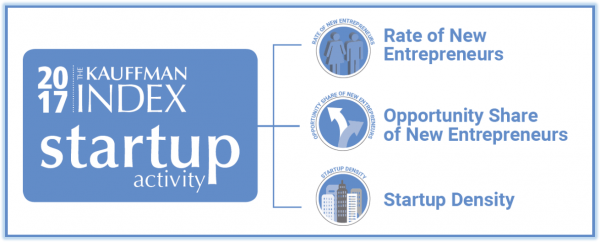
The Startup Activity Index is an index measure of a broad range of startup activity in the United States across national, state, and metropolitan-area levels. The Startup Activity Index captures startup activity along three dimensions:

  • The Rate of New Entrepreneurs in the economy— the percentage of adults becoming entrepreneurs in a given month.
  • The Opportunity Share of New Entrepreneurs—the percentage of new entrepreneurs driven primarily by “opportunity” as opposed to “necessity.”
  • Startup Density—the rate at which businesses with employees are created in the economy.

PERSPECTIVE: Lawsuits, Libel Laws and the Imperative to Protect Journalists

by Michelle Xiong On August 4, 1735, a lawyer stood in a crowded New York courthouse and proclaimed, “The question before you, gentlemen of the jury, is not of small or private concern. It is not the cause of one poor printer … It is the cause of liberty … the liberty both of exposing and opposing arbitrary power by speaking and writing the truth.” (Williams).

The man was Andrew Hamilton and he was defending John Peter Zenger from charges of seditious libel against the royal governor (Williams). The case would become a milestone in the development of the freedom of the press in America when the jury strayed from English common law and acquitted Zenger (Williams).

Over 200 years after the famous Zenger trial, Donald Trump’s campaign promise to “open up” libel laws is a selfish idea that would only open the doors again to the abuse of power. The press occupies a critical role in a democratic society. Current libel laws and interpretations of the First Amendment are designed to ensure government institutions and public officials can be held accountable.

Libel laws in the United States provide significant protection for the press because of the First Amendment. Distinct from European practices, “truth is an absolute defense against defamation” in the United States (“Substantial Truth”). This was formally enacted through legislation at the state and federal level after judges deadlocked over the issue in People v. Croswell (McGrath).

New York Times v. Sullivan was the landmark case that made it especially difficult for public officials to sue for damages (“New York Times Co. v. Sullivan”). The Supreme Court’s ruling established the need for actual malice which means the defendant published material with the “knowledge that it was false or with reckless disregard of whether it was false or not,” (“New York Times Co. v. Sullivan”).

While this standard may seem unfair to public officials, the high burden of proof required is fundamental to preventing the abuse of governmental power. Without strict libel laws, public officials can use lawsuits to suppress content that is critical of their behavior. Such was the case during the Civil Rights movement when southern state officials attacked news organizations that published unfavorable reports by bringing almost $300 million in libel actions against them (Schmitt).

What Donald Trump considers a ¨hit piece” may just be investigative reporting that dispute his actions and policies. Trump has a history of filing libel suits with 4,000 lawsuits over the last 30 years (Seager). Opening libel laws will allow Trump and other public officials the dangerous opportunity to intimidate political opposition and reduce government transparency.

Fortunately, Donald Trump’s threat to “open up” libel laws is easier said than done. Because libel laws are determined by individual states, Trump as president does not have the authority to alter libel laws directly (Ember). Trump would need to impose new limits on the First Amendment through an overturn of New York Times v. Sullivan by the Supreme Court or an amendment of the Constitution. According to Sandra S. Baron, former executive director of the Media Law Resource Center, both processes would be difficult and unlikely to happen successfully (Ember).

In the modern era of the Internet, the way people communicate and receive news is changing rapidly. However, concerns over “fake news” online should not detract from the fact that legitimate journalism must remain protected. To ensure that the government remains answerable to the people, prevailing libel laws should be preserved.

_______________________________

Michelle Xiong is in her junior year at Greenwich High School.  This essay was written for the Connecticut Foundation for Open Government annual essay contest for high school students, were it was selected to receive First Place recognition.


Ember, Sydney. “Can Libel Laws Be Changed Under Trump?” The New York Times, 13 Nov. 2016, www.nytimes.com/2016/11/14/business/media/can-libel-laws-be-changed-under-trump.html. Accessed 31 Mar. 2017.

McGrath, Paul. “People v. Croswell Andrew Hamilton and the Transformation of the Common Law of Libel.” The Historical Society of the New York Courts, 2011, www.nycourts.gov/history/programs-events/images/Judicial-Notice-07.pdf#page=6. Accessed 31 Mar. 2017.

“New York Times Co. v. Sullivan.” Cornell University Law School, Legal Information Institute, www.law.cornell.edu/supremecourt/text/376/254. Accessed 31 Mar. 2017.

Schmitt, Rick. “Window to the Past: New York Times Co. v. Sullivan.” District of Columbia Bar, Oct. 2014, www.dcbar.org/bar-resources/publications/washington-lawyer/articles/october-2014-nyt-sullivan.cfm. Accessed 31 Mar. 2017.

Seager, Susan E. “Donald J. Trump Is a Libel Bully But Also a Libel Loser.” Media Law Resource Center, www.medialaw.org/index.php?option=com_k2&view=item&id=3470. Accessed 31 Mar. 2017.

“Substantial Truth.” Digital Media Law Project, Berkman Center for Internet and Society, www.dmlp.org/legal-guide/substantial-truth. Accessed 31 Mar. 2017.

Williams, James A. “The Trial of John Peter Zenger in 1735.” Founders and Patriots of America, 1993, www.founderspatriots.org/articles/trial_zenger.php. Accessed 31 Mar. 2017.

Motorcycle Deaths in CT Projected to Remain Steady This Year and Next

The state Department of Transportation expects 47 motorcyclists to die in traffic accidents in this year and next.  According to a Department of Transportation report for Fiscal 2017, there was a fluctuating number of motorcyclist fatalities from 2010 to 2014, with a low of 37 in 2011 and a high of 57 in 2013.  Those numbers are expected to remain constant, department projections indicate. The report said the majority of motorcycle fatal and injury crashes occurred between the hours of noon and 8 p.m. and the crashes most commonly happened on Saturdays and Sundays.  Most fatal and injury crashes occurred in the summer months, and almost all motorcycle operators involved in crashes were male.

Cited most often as contributing factors were “driver lost control,” “driving too fast for conditions,” and “road condition/object in road.” In multiple vehicle crashes where the other driver was at fault, the major contributing factor in 47 percent of these crashes was failure to grant the right-of-way, the DOT report indicated. May is Motorcycle Safety Awareness Month.

Earlier this month, a Meriden man died in a motorcycle accident and another rider was injured in East Haven, and last week a Manchester man was seriously injured in a motorcycle crash in Manchester and an East Hartford man was killed in rural Washington.  Motorcycle accidents in April in Stonington, Coventry, and Middletown injured riders.  Earlier this year, state legislators discussed a bill proposing to reinstate Connecticut's motorcycle helmet law, which was repealed four decades ago. Currently, the law only requires riders under age 18 to wear helmets. That law was approved in 1989.  For adults driving or riding as a passenger, helmets are optional, as they have been since 1976.  After the February 10 public hearing, the bill has not moved forward.

Only about 42 percent of motorcyclists in Connecticut wear helmets, according to Neil Chaudhary, PhD, leader of a Trumbull team of premier investigators on behavioral traffic safety-related issues at Preusser Research Group, Inc.  In states where helmets are required, there is near 100 percent compliance, he recently told the Newtown Bee, adding professional driver training, offered throughout the state, can help riders to develop stronger defensive driving skills.

The Connecticut Transportation Safety Research Center reports the estimated loss to the state from motorcycle related injuries and death is $400 million. The group says helmet use reduced the risk of death by 37% and head injuries by 69%, FOX61 reported.

“Ultimately a motorcycle is more vulnerable because there is no protection like you have in a passenger vehicle. The only protection you have is what you put on yourself,” Dr Chaudhary told the local newspaper.

State Police set a goal in the report to train 5,000 motorcycle operators of all skill levels this year in an effort to reduce the number of deaths and injuries by reducing “operator error.”  The effort includes adopting a newly updated curriculum developed by the Motorcycle Safety Foundation for Department of Transportation's Connecticut Rider Education Program (CONREP). This new curriculum, according to the report, “will have a larger focus on rider responsibility and risk awareness.”  In addition, there will be a targeted media campaign, including promoting helmet use by all riders (not just those young riders currently covered under existing law), and “including motorcyclists in the planned emphasis on reducing impaired driving.”  The CONREP website, ride4ever.org provides updated information on education programs. 

The National Highway Transportation Safety Administration (NHTSA) reports that about 5,000 motorcycle operators and hundreds of motorcycle passengers lose their lives in accidents each year in the United States. These numbers account for about 13 percent of total traffic fatalities, even though motorcycles account for just three percent of all registered vehicles, the Newtown Bee reported.  In addition to the fatalities, about 100,000 operators and passengers are injured each year.

Matchmaker Event Seeks to Boost Local Small Businesses

Putting entrepreneurial, start-up and small businesses in the same place at the same time with business decision makers seeking suppliers, subcontractors and project partners is the concept that drives the CT Business Matchmaker, among Connecticut's largest events designed to bring together small, established businesses with “primes”—large and medium-sized companies, government agencies, educational institutions, and municipalities who are actively interested in increasing and diversifying their supplier lists. “The Matchmaker program is a premier event offering significant new opportunities for Connecticut-based small businesses,” said Fred Wergeles, director of the University of Hartford’s Entrepreneurial Center, which manages and hosts the event. “Bringing together large companies and agencies with small businesses in the fast-paced Matchmaker environment creates the spark for emerging relationships that will fuel the state’s economy. The Entrepreneurial Center provides pre-event training for both the large and small businesses to maximize the value of their participation in the program.”

The eighth annual event will be held on June 1, 7:00 AM to 2:30 PM on the university campus.  CT Business Matchmaker 2017 will offer an opportunity for small business owners to expand their contracting relationships. During the event, small businesses will present their products and services to potential customers in a series of ten- minute, one-on-one interviews with Primes. All Prime participants, including state and federal agencies, large corporations, municipalities, and educational institutions, come to the event with business needs they are seeking to fill.

“At Viking Construction, we are always looking for qualified subcontractors. We need to find the right company for the job in order to create a successful project, so relationships are very important to us. We know we’ll meet the quality we are seeking at CT Business Matchmaker,” said Michele Yeager, project administrator at Viking Construction.

“Through the CT Business Matchmaker, we accomplished our goal of reaching out to new subcontractors and providing economic opportunities to local businesses. They help get the small businesses ready for the opportunities we put out to bid,” said Michael Jefferson at the Metropolitan District (MDC). “I like to network with those agencies as well so I know what resources are available to support the success of our vendors. The MDC is committed to this process that helps build opportunities for small businesses.”

Wergeles also emphasized his organization’s effort to reach out to businesses run by women and minorities. “Through our Women’s Business Center, we also focus on recruiting women-owned and minority-owned businesses. These businesses traditionally receive fewer contracts, so we strive to provide more opportunities for them through this event.”

Additional organizing partners for CT Business Matchmaker include the University of Hartford’s Construction Institute, U.S. Small Business Administration, state Department of Administrative Services, CT Procurement Technical Assistance Program, state Commission on Human Rights and Opportunities, and the U.S. General Services Administration.

Participants include: Boston Scientific, Canberra Industries, Cianbro Corporation, City of Hartford, City of New Britain, Charter Oak Environmental Services, Inc., Colt's Manufacturing Company LLC, CT Airport Authority, Connecticut Lottery Corporation, CSCU, Dimeo Construction Company, Elbit Systems of America, Kollsman Inc., Enfield Enterprises Inc., Enterprise Builders, Inc., General Dynamics Electric Boat, Great Lakes Dredge & Dock Company, LLC, Greater Hartford Transit District, Harvard Pilgrim, Kaman Composite Structures, Manafort Brothers Incorporated, Methuen Construction Co., Inc., Pioneer Valley Transit Authority, Pitney Bowes, Sikorsky a Lockheed Martin Company, Skanska USA, Staples Business Advantage, Supervisor of Ship Building, The Hartford, The Metropolitan District, The Whiting-Turner Contracting Company, Triumph Integrated Systems, UCONN Health, UCONN Purchasing Dept., UConn Supplier Diversity Program, United States Navy, US Environmental Protection Agency, US General Services Administration – FAS, US General Services Administration – PBS, United Technology Aerospace Systems, Viking Construction, and Western CT State University.

Immigration Is Key to Connecticut's Economic Strength, Report Shows

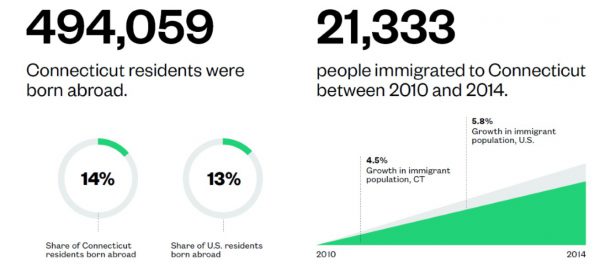
By 2014, Connecticut was home to almost half a million people who were born abroad.  In Connecticut, like the country as a whole, immigrants are currently punching far above their weight class as entrepreneurs, according to a report issued last year highlighting the impact of immigrants in the state. Foreign-born workers make up 21.3 percent of all entrepreneurs in the state, despite accounting for 13.7 percent of Connecticut’s population. Their firms generated $1.1 billion in business income in 2014, according to the report.

The report, “The Contributions of New Americans in Connecticut,” was prepared by the Partnership for a New American Economy, an organization that “brings together more than 500 Republican, Democratic and Independent mayors and business leaders who support sensible immigration reforms that will help create jobs for Americans.”

Immigrants are nothing new in Connecticut.  Even the Land of Steady Habits keeps changing.  In 1990, the state was already home to more than 279,000 immigrants, a group that made up 8.5 percent of Connecticut’s population overall. By 2010, the number of immigrants in this small state had grown to almost 473,000 people. By 2014, Connecticut was home to almost half a million people who were born abroad.

The report research also found:

  • Of the 18 Fortune 500 firms based in the state, 50 percent have at least one founder who was an immigrant or the child of an immigrant. For the country as a whole, the equivalent figure is 41.4 percent.
  • In Connecticut immigrants held $13.8 billion in spending power in 2014, defined in this brief as the net income available to a family after paying federal, state, and local taxes.
  • In Connecticut 69.8 percent of the foreign-born population is working aged, defined in the report as between the ages 25 and 64, while only 50.8 percent of the native-born population is. That 19 percentage point gap has major implications for the state’s workforce.
  • Foreign-born residents makeup more than one in three employees in the state’s computer systems design and related services industry. They also account for 32.2 percent of the state’s workers in medical equipment and supplies, contributing to Connecticut’s sizeable medical devices and supplies manufacturing industry, which generated more than $2.1 billion in sales in 2012.
  • Despite making up 13.7 percent of the state’s population, foreign-born Connecticut residents made up 23.8 percent of STEM workers in the state in 2014.

Research for the report also found that in 2016 nearly one in three physicians in Connecticut graduated from a foreign medical school, “a likely sign they were born elsewhere.”  Only six other U.S. states had a higher share of foreign-educated physicians. Immigrant healthcare practitioners also made up 15.3 percent of the state’s nurses in 2014, as well as 29.5 percent of those working as nursing, psychiatric, or home health aides. Both those figures were higher than the national average.

New Ventures Impress, Receive Funds to Advance Entrepreneurial Efforts

reSET, the Social Enterprise Trust (www.reSETCo.org), whose mission is advancing the social enterprise sector and supporting entrepreneurs of all stripes, revealed the winners of its 2017 Venture Showcase last night at The Mark Twain House and Museum to a sellout crowd of 200. The annual event recognizes the talented entrepreneurs and innovative businesses that have just graduated from reSET’s nationally recognized accelerator. 17 early stage enterprises graduated from the recent cohort, and last night, seven finalists competed for $30,000 in unrestricted funding.

The entrepreneurs pitched their business models to an audience of founders, investors, and community and corporate stakeholders. An esteemed panel of judges, including Tony Vengrove of Miles Finch Innovation, Michael Nicastro of Continuity, and Lalitha Shivaswamy of Helios Management Corporation, selected the ultimate winners.

Recipients of the competition’s three “reSET Impact Awards” are listed below, as is the winner of the “Tech Impact Award,” which was given by reSET’s Founding Partner and the evening’s Presenting Platinum Sponsor The Walker Group.

reSET Impact Awards:

$10,000 - Career Path  http://www.careerpathmobile.com

$6,000- Pelletric  http://www.pelletric.com

$4,000 - Phood  http://phoodsolutions.com

The Walker Group’s Tech Impact Award:

$10,000 - Phood http://phoodsolutions.com

Other finalists included:  Almasuite http://www.almasuite.com, Eureeka BI http://www.eureekabi.com, Optima Sports System http://optimasports.es,

and Sweetflexx http://sweetflexx.com/en.

The Showcase’s prize purse was made possible by a handful of reSET’s community partners: The Walker Group (Presenting Platinum Sponsor), The Hartford (Platinum Sponsor), Eversource (Gold Sponsor), AT&T (Gold Sponsor), Accounting Resources, Inc. (Silver Sponsor), Qualidigm (Silver Sponsor), CT by the Numbers (Silver Sponsor), and Aeton Law Partners (Silver Sponsor). The David Alan Hospitality Group and Capture provided in-kind services.

CareerPath is a platform that enables career planning teams to "effectively connect and communicate with students." Using a series of milestones, tasks, and events as drivers, CareerPath allows students to "tackle their career planning objectives in an organized and manageable way."

reSET also receives generous support from its Strategic Partners: The Walker Group, Connecticut Innovations, MetroHartford Alliance, and the Connecticut Department of Economic and Community Development.  reSET, the Social Enterprise Trust is a non-profit organization whose mission is to advance the social enterprise sector. Its strategic goals are threefold: to be the “go-to” place for impact entrepreneurs, to make Hartford the Impact City, and Connecticut the social enterprise state.  Since its inception, reSET has awarded more than a quarter of a million dollars to scaling ventures. Graduates of the organization’s accelerator have generated $4.4 million in revenue and have taken on $5.5 million in investment.

https://youtu.be/EAC6W3Dn_k8