

Museums Have Significant Impact on State, National Economy, Report Concludes
/Museums in Connecticut had a one-year total financial impact on Connecticut’s economy of $834 million, providing $556 million in income via wages and other income to state residents, generating $223.5 million in taxes (including $77.5 million in state and local taxes), and supporting just over 10,200 jobs – including 5,400 direct jobs, 1,877 indirect jobs and nearly 3,000 induced jobs.
The data was compiled as part of a national report, Museums as Economic Engines, compiled the Alliance of American Museums. The report indicates that nationwide, museums support 726,000 jobs in the United States, and directly employ 372,100 people, more than double that of the professional sports industry, according to the Bureau of Labor Statistics, the Alliance points out.
The study, conducted by Oxford Economics with the support of the Andrew W. Mellon Foundation, shows that for every $100 of economic activity created by museums, an additional $220 is created in other sectors of the US economy as a result of supply chain and employee expenditure impacts, according to the report. The data analyzed was from calendar year 2016, the most recent full year of data available.
These impacts mean that museums contribute approximately $50 billion to the US economy each year, a number that’s more than twice previous estimates, according to the Alliance. The report is also the first to show that US museums generate more than $12 billion per year in tax revenue to federal, state, and local governments.
 The report estimated that there are 372,100 museum workers employed in the US along with 3 million volunteers. It also indicated that 89 percent of Americans believe that museums provide important economic impacts back to their communities, according to a public opinion survey conducted in 2017.
Nationally, the museum field’s largest economic impact is on the leisure and hospitality industry (approximately $17 billion), but it also generates approximately $12 billion in the financial activities sector and approximately $3 billion each in the education/health services and manufacturing sectors.
The top 10 states driving this impact are geographically diverse and account for 57 percent of the gross value added to the national economy. States with the highest economic impact from the museum sector included California ($6.6 billion), New York ($5.4 billion), and Texas ($3.9 billion). However, those that rely most heavily on museums due to their relatively higher concentration, the report indicated, include the District of Columbia, Hawaii, Wyoming, and Alaska.
In breaking down the jobs impact of museums, direct impact refers to direct employment and spending by the industry’s business operations; indirect impact includes supply-chain effects, stemming from industry’s operations (e.g. legal services, utilities, etc.) and induced impact describes the impact resulting from employees spending their incomes in the economy.
The American Alliance of Museums (AAM), founded in 1906, now represents more than 35,000 professionals and volunteers, institutions, and corporate partners in the sector.

 Topping the national rankings were Falls Church, Virginia; Douglas County, Colorado; Broomfield County, Colorado; Los Alamos County, New Mexico; and Dukes County, Massachusetts.

 National Library Week is an annual celebration of the life-changing work of libraries, librarians and library workers. Libraries aren’t just places to borrow books or study, official explain, they’re also creative and engaging community centers where people can collaborate using new technologies and develop their skills and passions.
 On Thursday, April 12, 2018, at 11:00 a.m. Hartford Public Library will be one of six libraries working with USCIS to host Naturalization Ceremonies during National Library Week. Other sites hosting ceremonies during this week are: Danbury Public Library, Ferguson Library (Stamford), New Britain Public Library, Otis Library (Norwich), and Rockville Public Library (Vernon).

 l funds for libraries.

 Our work is crucial to the stability of our state’s finances, securing federal funding, and ensuring state agency compliance. The work we do on whistleblower cases, in conjunction with the Attorney General, provides all citizens the opportunity to expose waste, fraud and corruption without threat of retaliation.

 In comparing the average annual opioid-related death rates per 100,000 population in 2012-13, 2014-15, and 2016-17, the dramatic increases across communities statewide is quite evident. The data analysts point out that data are where deaths from 'any opioid' (meaning some type of opioid were found in the person) take place. Therefore, they explain, one would expect to see higher rates in places with large hospitals (hence high rates in cities). They add that one can also not discount that these places are also seeing higher rates among its residents.

 The Connecticut Data Collaborative has posted on its
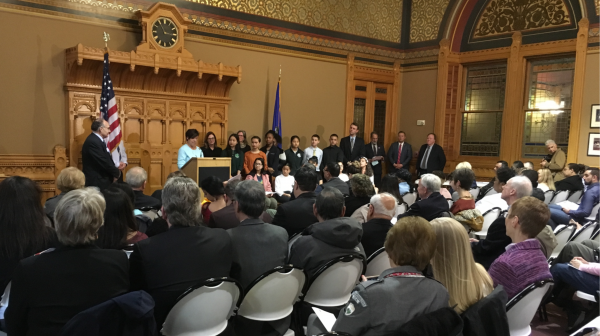
 Sixth-graders from the Interdistrict School for Arts and Communication in New London were recognized for their project, “Community Faces-Humanizing the Immigrant Label,” parts of which were on display at the Capitol. The second group was Teens4Citizenship, a Hartford Public Library and Hartford Public Schools collaborative program. As "Citizenship Guides," these high school immigrant students support family and community members on the path to Citizenship and upon turning 18 pursue their own citizenship.


 Bachelor's degree programs (13): Accelerated Nursing, Aging Studies, Climate Change Science, Elementary Education: Community Engaged Learning, Environmental Studies and Sustainability, Fine Woodworking and Furniture Design, Fisheries Biology, Health Care Studies, Information Technology International Affairs (dual major), Movement Science: Wilderness Leadership Concentration, Wildlife Biology, World Languages Education (K-12)
 However, when it came to their personal finances, 88 percent of those surveyed said they wish they started to save for their overall financial goals much sooner.

 Instead of honoring Christopher Columbus, the Indigenous Peoples’ Day recognizes Native Americans, who were the first inhabitants of the land that later became the United States of America. Advocates for the switch to Indigenous Peoples Day argue that Columbus did not “discover” America in 1492 but instead began the colonization of it.




















