The Green Book Has Hartford Debut - Documentary Tells Real Story of Guide to Freedom Through Segregated America

Little known by most people - regardless of race - until recently, the Green Book has recently exploded into the public consciousness. Described as "the essential travel guide for a segregated America," within just the past two days a popular movie by that name won the Academy Award for best picture, and a documentary relating the story of  real people and places that inspired the popular motion picture debuted on the Smithsonian Channel.

The documentary, "The Green Book: Guide to Freedom," was shown at a special preview at the Wadsworth Atheneum in Hartford, in a showing coordinated by the Amistad Center for Art and Culture, Comcast, and the Smithsonian Channel.  It marked the third year that Comcast has joined with the Amistad Center and Smithsonian Channel to bring a special presentation to Hartford during Black History month.

Nearly 100 people were on hand for the local premiere of the documentary, which was followed by a panel discussion including Kelli Herod, Vice President of Post Production at Smithsonian Channel, and Stacey Close, Associate Vice President for Equity and Diversity at Eastern Connecticut State University, moderated by Kara Sundlun of WFSB.  Amistad Center Executive Director & Curator at Large Wm. Frank Mitchell, Brad Palazzo, Comcast Director of Community Impact and Hartford Mayor Luke Bronin also spoke briefly, with Bronin saluting the "resiliance, ingenuity and determination" of those who traveled through dangerous times.
The documentary was produced by award-winning filmmaker Yoruba Richen.  It premieres this week on Smithsonian Channel, telling the story of the Green Book, launched in the 1930's by Victor Green, a black postal carrier from Harlem who created a volume that was "part travel guide and part survival guide."  It helped African-Americans navigate safe passage across a dangerously segregated nation, identifying towns, hotels, restaurants and businesses that would be hospitable to African-Americans, sometimes few and far between.

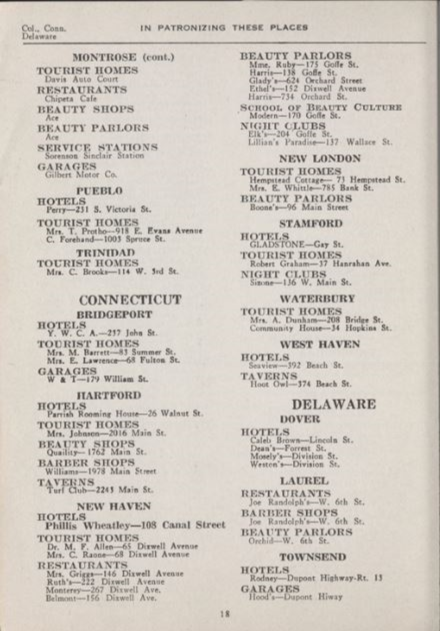
The challenges were not only in the South.  In fact, a page in the 1948 Green Book, lists locations in Connecticut - and the list does not fill the page.  The locations were in Bridgeport, Hartford, New Haven, New London, Stamford, Waterbury and West Haven.  Included are restaurants, hotels, tourist homes, beauty parlors, barber shops, and night clubs.  The 1967 edition also includes five Hartford locations, including one - the former Bond Hotel - that is still standing to this day.

"We are proud to tell the true story behind this remarkable guide and to shine new light on this disturbing yet important period in Amerian history," said David Royle, Smithsonian Channel's Chief Programming officer.

The documentary tells the story of the rise of the African American middle class in Detroit, and the iconic A.G. Gaston Motel in Birmingham, Alabama - a pivotal location in the civil rights movement. It also recalls that during its 1950s heyday, the Idlewild Resort in Michigan was a magnet for black culture and entertainment, with a booming nightlife featuring famous performers like Louis Armstrong, Sarah Vaughan and Dinah Washington.  In the Q&A in Hartford following the advance showing, one audience member recalled her family owning property at the Idlewild - a local connection that the panel did not expect, but was clearly pleased to learn.

"At Comcast NBC Universal diversity and inclusion is a fundamental part of our company culture and are crucial components to all of our efforts to create and deliver the best and boldest technology and entertainment for our customers," noted Palazzo. "The Green Book: Guide to Freedom screening is another way for us to bring diverse entertainment and story-telling locally to Hartford-area residents."  Comcast, with Connecticut offices in Berlin, has partnered with the Amistad on a number of initiatives over the years and "are proud to play a small role in helping them to tell their cultural story."

The Amistad Center for Art & Culture, located in the Wadsworth Atheneum, celebrates art and culture influenced by people of African descent through education, scholarship  and social experiences.

Victor Green looked forward to the day people wouldn't need the Green Book. In the 1949 edition he wrote,

There will be a day sometime in the near future when this guide will not have to be published. That is when we as a race will have equal opportunities and privileges in the United States. It will be a great day for us to suspend this publication for then we can go wherever we please, and without embarrassment. But until that time comes we shall continue to publish this information for your convenience each year.

The year the Civil Rights Act passed, in 1964, was the Green Book’s last.  As the panelists in Hartford noted, more than 50 years later, the struggle for equality continues.


Amidst Economic Recovery in New England, Poverty Rate Remains Highest in CT

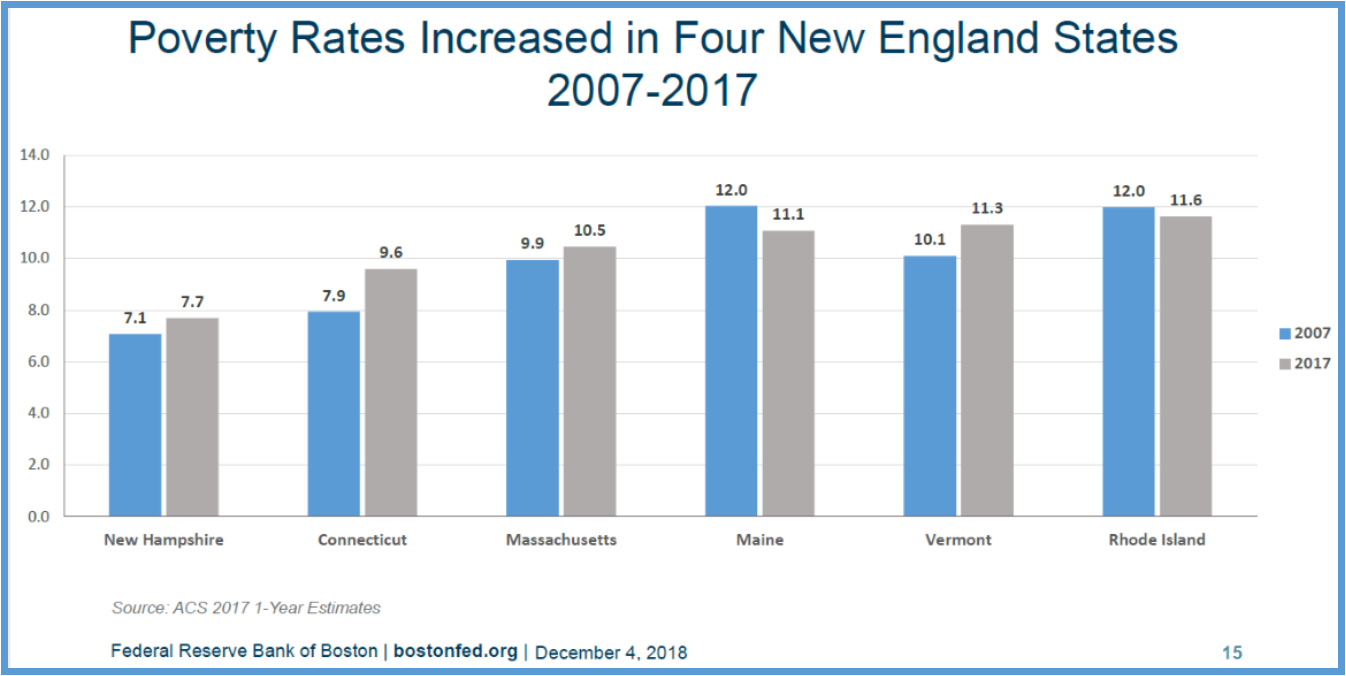
Between 2007 and 2017, the poverty rate increased more in Connecticut than any of the New England states.  According to data analyzed by the Federal Reserve Bank of Boston, Connecticut’s poverty rate increased from 7.9 percent to 9.6 percent, and increase of 1.7 percentage points, or about a 20 percent increase. Four of the six New England states saw increases: New Hampshire (.6%), Massachusetts (.6%), Vermont (1.2%) and Connecticut.  The other two New England states, Maine and Rhode Island, saw decreases, of .9 and .4 percent respectively.

The analysis found “a regional economic picture with some surprises and plenty of complexity,” the Boston Fed website points out.

It found that across New England, compared with 2007, fewer New Englanders are unemployed but the unemployed are more likely to be poor than in 2007, and those still out of work face diverse barriers to employment. New England’s unemployed are disproportionately young, non-white, and less educated, according to the data.

Among the other findings:

  • Long-term unemployment, defined as 27 weeks or longer, is down nationally since 2010, but less so in New England.
  • Among 25-54 year olds, the male employment rate is down since 2007, while the female employment rate has gone up.
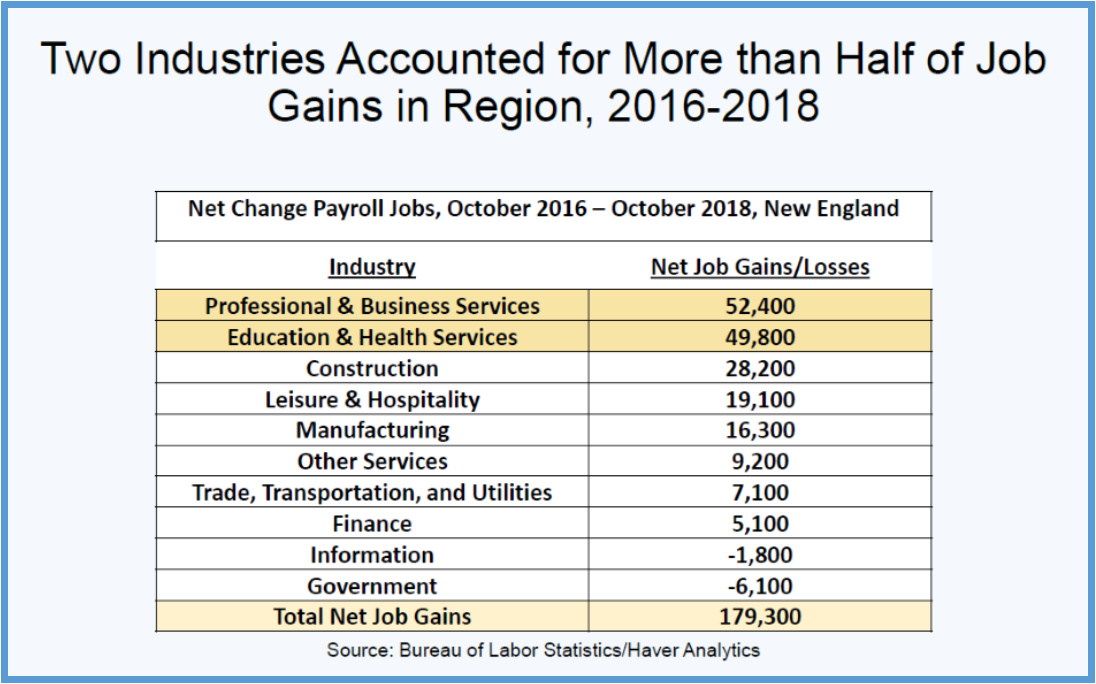
  • Two industries accounted for more than half of job gains in the region between 2016 and 2018: Professional & Business Services and Education & Health Services.  Among the other categories, Construction, Leisure & Hospitality and Manufacturing saw the largest gains.

Although poverty rates declined in all New England states between 2014 and 2017, as of 2017 four out of the six states exhibit higher poverty rates than they did in 2007. Among the region’s unemployed workers, the poverty rate as of 2017 is higher than it was in 2007, and it’s also higher than it was in 2010, after the recession had officially ended, the Boston Fed points out.

Mary Burke, a senior economist at the Federal Reserve Bank of Boston, views the delayed and incomplete recovery in poverty rates as both surprising and troubling, as it could indicate an erosion of the safety net.

CT is 24th in U.S., 2nd in New England in International Students; Numbers Rising

There were 15,278 international students enrolled at Connecticut collegiate institutions during the 2017-18 academic year, which represents an increase of 4 percent over the previous year and a 63 percent increase since 2012. In academic year 2017-18, Connecticut ranked second in New England and 24th in the U.S. in international student enrollment, according to the 2018 Open Doors report released by the nonprofit Institute of International Education (IIE) and the U.S. Department of State’s Bureau of Educational and Cultural Affairs (ECA).

Between AY 2012-13 and AY 2017-18, Yale University and the University of Connecticut took the top spots as the universities with the largest share of international students in Connecticut.

International students represent a big economic injection for New England, the report points out. In academic year 2017-18, international students contributed $39.4 billion to the overall U.S. economy, with $4.2 billion added to the New England economy alone. Between 2012 and 2018, international students contributed a total of $21.3 billion to the New England economy. Foreign students contributed an estimated $584 million to Connecticut’s economy in the past year, according to the report, which was highlighted recently by the New England Board of Higher Education.

The number of international students in New England has increased every year since 2012 and the region’s growth on this measure now outpaces the nation. In the 2017-18 academic year, the region enrolled 6.3 percent more international students than the previous academic year (AY).  This figure compares to a national increase of only 1.5 percent during the same period.

Both public and private nonprofit institutions in New England saw a 61 percent rise in the number of foreign students over a five-year period from AY 2012-13 to AY 2017-18, which is comparable to the national growth in the international student population over the same period.
International students have helped forestall a nationwide enrollment crisis. The total higher education population in the U.S. topped out in 2010 at about 21 million students and has been slowly declining since then. The decline in New England is especially acute. This has been countered to some extent by growth of the foreign student population, coupled with a rise in online enrollment, which together comprise almost a quarter of the nation’s students.

The data indicates that there were 9,350 international students enrolled in Connecticut colleges and universities in 2012; 14,711 in 2017 and 15,278 in 2018.  The number of international students increased from 2017 to 2018 in every New England state with the exception of New Hampshire, which saw a slight decrease.  Only Massachusetts has more international students than Connecticut, among the six New England states.

Craft Brewers Look to Continue CT Growth with Legislative Support

After two ill-fated legislative proposals that would have been detrimental to the state’s burgeoning craft brewery industry disintegrated within days amidst a public outcry, the Connecticut Brewers Guild is conveying its eagerness to work closely with state lawmakers.  Their aim: to help the booming industry create even more good-paying jobs, bolster local craft beer production, and to increase direct-to-consumer sales. “In 2012, when the Connecticut Brewers Guild was founded, there were around 12 craft breweries statewide,” said Phil Pappas, the executive director of the Connecticut Brewers Guild. “Now, our state’s booming craft brewery scene has more than 85 operational breweries with many more in the planning stages. These craft breweries -- all of which are independently owned -- employ over 4,600 people statewide, produce more than 166,000 barrels of locally brewed craft beer, and contribute to an overall economic impact of $746 million annually.”

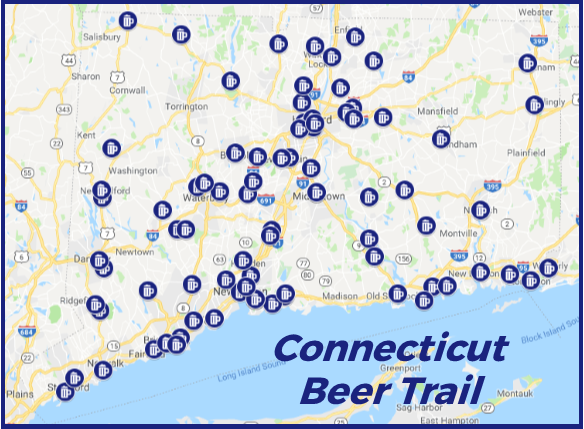
It is those numbers, and the degree of progress in recent years, that drive the conversation, although Pappas points out that although a lot of progress has been made, there is more work to be done to ensure the industry continues to grow and thrive statewide.  On doesn't need to look further than the map of the COnnecicut Beer Trail to see the impact of the industry all across the sate.

“Connecticut’s growing craft beer industry has been helped by state lawmakers providing a relatively healthy regulatory environment,” Pappas said.  “We thank state lawmakers for their support to date, and now more than ever -- in an increasingly competitive state-by-state landscape -- we need a renewed commitment to strengthen our industry, which is a bright spot in Connecticut’s economy.

“Moving forward,” he added, “we hope to work with state lawmakers and others to create even more local jobs, increase local craft beer production, and drive additional direct-to-consumer sales.”

In 2015, MarketWatch—a financial information website—ranked Hartford/New Haven as one of 10 cities that love craft beer the most. Other cities included Portland (Oregon), Cleveland and Washington, D.C. A year ago, Innovation Hartford reported that 2016 data indicated the craft beer industry in Connecticut contributed $718 million to the economy. That year there were 49 breweries that produced a combined 129,825 barrels of craft beer per year.  A year ago, there were 65 breweries operating throughout the state and another 49 breweries are either in the planning and construction phases or set to open shortly.

“We also look forward to working with representatives from the wholesaler, distributor, retailer, brewpub, and restaurant communities, to positively impact our state’s small businesses and economy both today and tomorrow,” Pappas said. “Our Connecticut Brewers Guild members strive every single day to produce the highest quality, best-tasting craft beer in the market. We consistently seek out ways to improve our product, utilize locally sourced ingredients, generate jobs, support local businesses while cultivating fun experiences for customers on-premise and off-premise.”

CT Start-Ups Receive Financial Assist to Spur Development

Six early-stage Connecticut companies now have additional funds to help fuel their growth, after participating in the Entrepreneur Innovation Awards (EIA) provided by CTNext, the state’s resource organization for entrepreneurial support. Following presentations from 10 finalists at the recent event, the judges awarded $10,000 grand prizes to the following Connecticut-based companies:

  • Payball (Norwalk): Developing an easier, digital way for amateur sport organizations to pay officials, event staff and coaches.
  • Peak Performance Leadership (Killingworth): Creating a variation on a rope protection system for military and first responders to increase product lifespan.
  • Raise Green (New Haven): Creating a crowdfunding portal to finance renewable energy and climate solution projects; developed by students at Yale.
  • YouCOMM (Farmington): Developing a patient-caregiver communication system that will replace antiquated call bell systems.

“At its core, Raise Green is a two-sided marketplace that provides people who want to build solar or other types of climate-solution projects with the tools they need to do that and to get it financed,” said Franz Hochstrasser, chief executive officer and co-founder of the start-up. 

According to the University of Connecticut Technology Incubation Program website, YouCOMM is a novel low-cost tablet based communication device to provide effective patient-caregiver communication. The device has 20 need buttons that allow patients to send specific needs to a nurse’s on-call phone.

Two additional companies also received recognition, and funds:

  • Lactation Innovations, a Canterbury company developing a non-invasive sensor that detects the volume of milk a baby ingests and provides feedback to the mother, won the $2,000 Crowd Favorite award.
  • Secure Election Systems of Westport, a startup developing an iPad-sized electronic absentee voting booth, took home the $2,000 Judges’ Favorite prize.

“The EIA Awards continue to showcase some of the most innovative and promising young companies across the state,” said Glendowlyn Thames, CTNext’s executive director. “We are looking forward to following the progress of the companies and wish all the competitors the best as they work to advance their ideas and visions.”

The six Connecticut companies were among 10 startups that presented their project ideas to a panel of judges for an opportunity to secure $10,000 awards to help support business growth.

Last fall, CTNext awarded $54,000 in grants to six Connecticut-based startups.  Receiving $10,000 were:

  • Actively AI – Creating an automated assistant for wellness businesses that handles customer experience and streamlines operations for staff
  • Dualflo – Creating a self-seal technology to eliminate the need for open surgery in cardiopulmonary bypass procedures
  • Encapsulate– Producing an effective chemotherapy solution with a fully automated tumor-on-a-chip pre-prescription analysis
  • Encaptiv– Developing a web-based presentation, sales and marketing software that integrates AI and machine learning
  • Kolb Consultants– Developing a process to manufacture “Ray-Board,” a kickboard with a new shape that distributes the body weight evenly when swimming

In addition, Kolb Consultants won the $2,000 crowd favorite award, while VigorSential took home the $2,000 award for judges’ favorite. VigorSential is developing and testing “MycoZaps,” a low-dose vaccine to control Mycoplasma bovis (M. bovis), a bacterium mainly affecting cattle that is resistant to common antibiotics.

CTNext’s goal is to build a more robust community of entrepreneurs and to accelerate startup growth by providing access to talent, space, industry expertise, services, skill development and capital to foster innovation and create jobs for people in Connecticut.

CTNext (www.ctnext.com) has more than 2,500 members in its network.

Connecticut Innovations Among Nation's Top Venture Capital Firms in Healthcare in 2018

Connecticut Innovations (CI) has landed on Forbes magazine’s list of the ten top venture capital firms making the most investments in healthcare start-ups during 2018.  With 20 deals done during the year, CI ranked at number seven. CI is Connecticut’s strategic venture capital arm and the state’s leading source of financing and ongoing support for innovative, growing companies. The two largest CI deals were with locally headquartered Arvinas, a $56 million investment, and Rallybio, a $37 million investment. 

Leading the way among venture capital firms in the U.S. were California-headquartered Alexandria Venture Investments (38 deals), Maryland-based New Enterprise Associates (28), Keiretsu Forum of California (27), OrbiMed, headquartered in New York (24), and ARCH Venture Partners (22) of Illinois.  Just ahead of CI was SV Health Investors, with 21 deals.  The venture capital firm is based in Massachusetts.

Nationally, startups in the sector have raised more money in 2018 than any previous year in the past decade.

Rallybio, based in Farmington at the University of Connecticut’s Technology Incubation Program, was co-founded in January 2018 by Martin Mackay, PhD, Stephen Uden MD, and Jeffrey Fryer, CPA, recognized leaders from the biopharma industry.  The company’s focus: identifying and accelerating the development of transformative breakthrough therapies for patients with severe and rare disorders.  They aim to develop innovative drug candidates against mechanisms that have strong biological rationales.  Rallybio’s focus is on antibodies, small molecules and engineered proteins.

Last month, the company was named by FierceBiotech as one of 2018’s Fierce 15 biotechnology companies, designating it as one of the most promising private biotechnology companies in the industry.

Arvinas, headquartered in New Haven, is a biopharmaceutical company dedicated to improving the lives of patients suffering from debilitating and life-threatening diseases through the discovery, development, and commercialization of therapies to degrade disease-causing proteins.

Building on groundbreaking research at Yale University by Craig Crews, Ph.D., Arvinas’ Founder and Chief Scientific Advisor, Arvinas has developed a broad technology platform “focused on high-value targets, with the potential to deliver safer, more potent treatment than small molecule inhibitors, and to address up to 80% of proteins that evade inhibition and are currently undruggable.”  Among the company’s Board members is Ted Kennedy, Jr., a health care policy and disability activist, regulatory attorney, and former Connecticut state senator.

Connecticut Innovations is located in Rocky Hill.

Rebranding of Connecticut's Cities Continues: Waterbury Up Next

The latest Connecticut community to go down the re-branding road is Waterbury.  The Prospect-based marketing firm WORX Group presented its marketing concepts this week to the city’s Board of Aldermen, according to reports in the Waterbury Republican-American. In December, the firm proposed two logos and sought public input, including at a series of focus groups last spring.  The underwhelming choices: The proposals were either a stylized “W” or a version of the city’s “brass horse.”  The horse is modeled after the statute atop the Carrie Welton Fountain by the city’s downtown Green. The proposed logo adds two leaves as wings, symbolizing the city’s rebirth. The “W” has an upward-tracking center, representing the city’s rising trajectory.

The lack of enthusiasm – and some outright criticism – for the initial options prompted a new approach, which led to the latest proposal, a stylized multi-colored W with the city’s name underneath, unveiled this week for the city leadership’s approval.

In recent years, Stamford, Norwalk and New Britain are among the Connecticut communities that have undertaken re-branding efforts, including rolling out new logos for the municipalities.   New Britain took steps to redesign the city’s Main Street bridge over Route 72 with architectural features promoting a beehive theme, as highlighted in the logo launched in 2017, and New Britain began to use the new logo and tagline on signs, letterhead, brochures and its website.

In Waterbury, the local marketing firm has been paid to $81,500 to develop marketing concepts and is proposing a $180,000, one-year, contract that would include a new website, social media, email marketing and other related initiatives. The website and social media campaign would include job openings, available properties, recreation opportunities, local eateries, upcoming events, health care resources, stories on city infrastructure projects and features stories on key city figures and business success stories, the newspaper reported.

The U.K.-based creative agency Canny, which chronicled city rebranding efforts around the world, has pointed out that “Creating a single brand for a city helps highlight its offerings and interactions, allowing it to appeal to both tourists and residents alike.”  The site also notes that “good city branding can make a place seem desirable, but bad city branding can have the opposite effect.”

CT is One of 8 States Launching Pilot Projects to Retain Workers with Disabilities

Eight states - including Connecticut - have launched projects aiming to provide opportunities for people who experience occupational or non-occupational injuries or illnesses to remain in and return to the workforce. After a competitive selection process, the U.S. Department of Labor’s Office of Disability Employment Policy in partnership with DOL’s Employment and Training Administration and the Social Security Administration awarded eight states with funding for RETAIN Demonstration Projects.

Connecticut’s request was $2.1 million. Phase one of the project will be in the Capitol Region; the intention is to then expand to other regions of the state in phase two.  Each state created a leadership team comprised of representatives from state health services, state workforce development, and other public and private stakeholders. The team will work to foster collaboration between health care providers and employers to assist injured or ill workers in remaining in the workforce.

Health care partner on the Connecticut pilot initiative is the University of Connecticut Health Center and the insurer is The Hartford.  The state Department of Labor’s Office of Workforce Competitiveness is leading the team, along with representatives of Capital Workforce Partners, The Hartford, UConn Health, the state Department of Rehabilitation Services, and the CT Business Leadership network.

In addition to Connecticut, the states of California, Kansas, Kentucky, Minnesota, Ohio, Vermont and Washington received awards. While each has the same mission, the projects are adaptable to specific state needs. The goal of RETAIN, or Retaining Employment and Talent after Injury/Illness Network, Demonstration Projects is to test the impact of early intervention strategies that improve stay-at-work/return-to-work outcomes, according to the U.S. Department of Labor, as reported by the Council of State Governments (CSG).

Stay-at-work/return-to-work initiatives provide timely and effective supports and services that allow employees to remain in the workforce and avoid long-term unemployment. Keeping people engaged in the workplace benefits all stakeholders including the employee, employer and state, officials point out.  States hope to reduce long-term work disability and the need for Social Security Disability Insurance through the projects.

The projects will be funded in two phases. The eight states mentioned above were funded for the 18-month Phase 1 pilot project. After Phase 1, a subset of the recipients will competitively apply for Phase 2 funding. Phase 2 will include a 30-month project implementation and a 12-month evaluation.

Providing supports and services for people who have acquired occupational or non-occupational injuries or illnesses strengthens their quality of life, allows businesses to prosper, and stimulates state economies, officials noted.