Child Care in Connecticut: Steady Progress, Ongoing Challenges
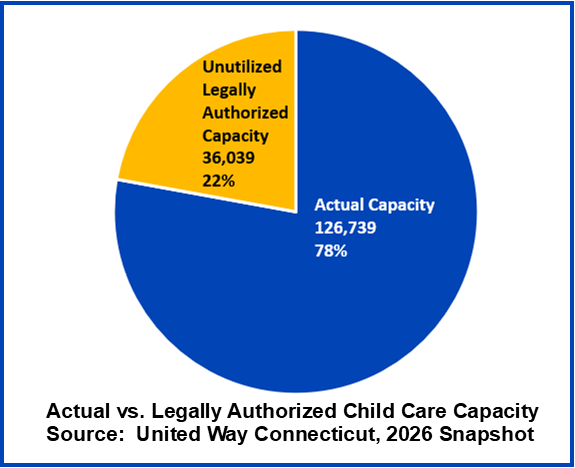
/Recent data from 211 Child Care in Connecticut shows that overall capacity in the state’s child care system remains largely stable, with much needed additions to infant/toddler and pre-school slots. At present, 78% of child care programs across the state are operating at their full, legally authorized capacity, and filling or nearly filling all of their child care slots, according to United Way Connecticut.
Providers offered this past year 78 percent of their legally authorized capacity – about level with 2025, but an increase of four percent over 2024. These increases in slots offered are largely due to:
1. Increased Funding: On July 1, 2025, the Connecticut Office of Early Childhood (OEC) launched Early Start CT, combining three previous state-funded programs into one program offering approximately 1,000 new state-funded child care slots. The Early Start CT slots are distributed among child care centers, licensed family homes and public schools to provide care primarily for children aged zero to five, making it easier for families to access high quality early care and education services throughout the state. The launch of the historic Early Childhood Education Endowment, a landmark, permanent savings account to stabilize and expand quality child care, allowed OEC to expand state-funded child care spaces, distribute grants to sustain capacity and increase payment rates for Early Start CT providers to help raise pay for child care staff.
2. New Entry Age for Kindergarten: Effective July 2024, children must turn five years old by September 1 to enter Kindergarten. The previous cutoff was January 1. This means potentially 33% more children remained in preschool compared to previous years, increasing demand for pre-K slots.

“The progress we’re seeing reflects the impact of Governor Lamont’s targeted investments in early childhood,” says Elena Trueworthy, Commissioner of the Connecticut Office of Early Childhood. “By increasing provider rates and expanding access, there were approximately 1,000 more subsidized slots for infants, toddlers and preschool-aged children, making access to affordable, high-quality child care within reach for more Connecticut families while strengthening the critical aspects of the state’s early childhood education system, including the workforce quality and child care business model.”
“The recent announcement of the additional investment of approximately $320 million into the Early Childhood Education Endowment represents Connecticut’s commitment to building an early childhood system that works for families, educators, providers and children,” she added/
“Today, United Way of Connecticut/211 Child Care is proud to release our 2026 point-in-time data through an interactive online map that allows our stakeholders to see a snapshot of estimated actual child care capacity, enrollment and open slots in their local communities,” noted Lisa Tepper Bates, President & CEO, United Way of Connecticut.
“The point-in-time data shows steady growth in the availability of child care programs over the past year, with increases in particular to infant and toddler slots, and a small decrease in school-age child care slots,” commented Sherri Sutera, Senior Vice President of Child Care Services, United Way of Connecticut.

There are still more than 36,000 legally authorized child care slots that are currently unavailable to families. 211 Child Care conducts an annual survey of child care providers to identify trends in the market. The child care programs not operating at full enrollment cite five main factors:
1. Affordability Challenge for Families. The cost of child care is not affordable for many working families. They may earn too much to qualify for a subsidy, but too little to pay market rates. Riverfront Children’s Center in Groton shares that “parents who are above income ($85,000 - $200,000) still say tuition is too expensive.” Programs say they struggle to fill private-pay seats, families withdraw children or fail to complete enrollment. Parents seek informal, unregulated care alternatives or leave the workforce to remain home with their children.[1]
2. Many Families Waiting for Care 4 Kids Subsidy. The Office of Early Childhood’s Care 4 Kids program helps the families of more than 22,000 Connecticut children pay for care. But additional eligible families currently face an average eight-month wait to secure a subsidy, frustrating parents and providers. "Many families who tour (our center) are interested in enrolling but are deterred by the almost year-long process to get off the waiting list for Care 4 Kids," says a child care center in Shelton. “The Care 4 Kids waitlist is hurting providers, families, children and the community as a whole,” says Wee Learn and Play Child Care Center in Torrington.

3. Public Preschool or Magnet Schools Offering Low-Cost Care. “School systems are now offering preschool/pre-K for three-year-olds at lower or no cost tuition," says a center in Prospect. Programs say they are losing three-to-five-year-olds to public school programs. Private-pay programs downsize, close classrooms or only use their centers to provide care before and after the regular school day. “Most of our slots are preschool/pre-K. There are seven public schools that offer programs,” says KLA Schools of Wallingford.
4. Staffing Shortage. Staffing constraints prevent programs from operating at full authorized capacity. Classrooms are only partially open; programs are waiting to hire before offering more slots and enrolling more children. Child care wages are not competitive compared to other sectors. An early learning center in Hartford shares, “We are down two Head Teachers which is preventing us from filling the classroom,” and a center in Storrs says, “Hiring qualified staff continues to be our biggest challenge.”
5. Programs Choosing to Operate at Lower Capacity. Programs report they may not operate at full authorized capacity to maintain quality as they seek to meet the individual needs of children. "We have kept numbers low in some of our classes due to the extreme needs of a few of our students. Their needs require more attention than we would be able to provide if we actually filled the classes to our legal capacity," says a child care center in Newtown.
“The good news is that over the past two years Connecticut has increased the supply of early care and education for children under five by 10,543 seats, a 13.7% increase,” said Merrill Gay, Executive Director of the Connecticut Early Childhood Alliance.
“The bad news is that many programs are facing real difficulty enrolling children. The eight-month waitlist for Care 4 Kids has had a substantial impact on families with infants and toddlers. There were 1,938 fewer children under age 3 receiving a Care 4 Kids child care subsidy in January 2026 than a year earlier. Family child care homes are experiencing the worst of it, serving almost a thousand fewer children than last year and are just 55% enrolled, raising real questions about their ongoing economic viability.“ he explained.
United Way of Connecticut/211 Child Care collected data for this report through surveys of child care providers from November 2025 through March 2026. Data Haven reviewed the methodology and associated calculations.