Connecticut is Nation's Third Best State for Working from Home, Analysis Shows
/With a large segment of the workforce working from home at least part of the time, the personal-finance company WalletHub has released its report on the Best States for Working from Home, illustrating where people can save the most money and be most comfortable while working remotely.
Connecticut ranked third among the 50 states and District of Columbia, across 12 key metrics. The data set ranges from the share of workers working from home to internet cost and cybersecurity. The study also considered factors like how large and how crowded homes are in each state.
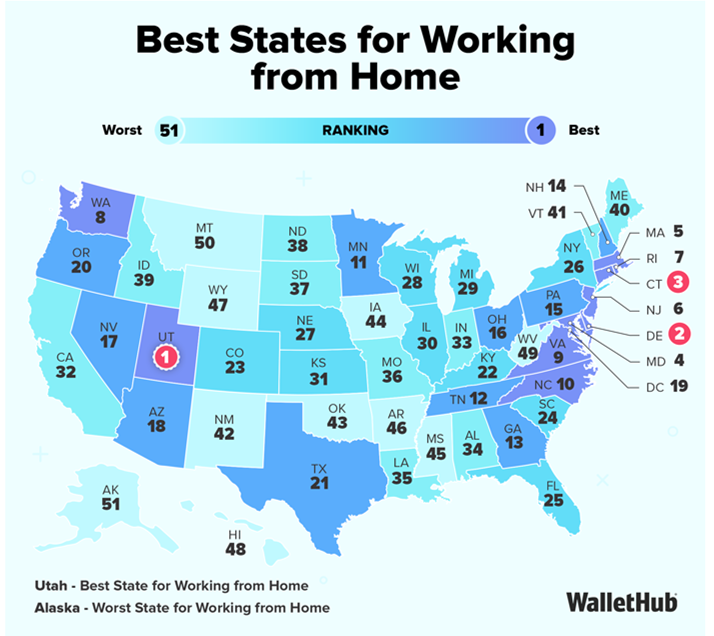
Among the various categories, Connecticut’s ranking ranged from 1st to 24th, resulting in the overall #3 finish:
24th – Share of Potential Telecommuters
21st – Average Home Square Footage
16th – Share of Population Working from Home
2nd – Households' Internet Access
1st – Internet Cost
Just ahead of Connecticut, Utah ranked first and Delaware ranked second. Rounding out the top 10 were Maryland, Massachusetts, New Jersey, Rhode Island, Washington State, Virginia and North Carolina.
WalletHub indicated that recent nationwide data indicates 12% of full-time employees work fully remote, while another 27% follow a hybrid schedule that splits time between home and the office.

“Working from home can save people a lot of money on transportation expenses, as well as make their work environment a lot more comfortable and their hours more flexible, commented WalletHub analyst Chip Lupo. “However, things like energy costs, internet speed, home sizes and how many people live together can greatly impact people’s savings and productivity. While work-from-home jobs can be done anywhere, certain states make the practice much better than others.”
The WalletHub analysis also notes that “Currently, 16% of Connecticut’s workforce does work from home, but nearly 96% of the workforce has the potential to telecommute, meaning that their jobs could be conducted remotely.”
Data used to create this ranking (collected as of March 9, 2026) include from the U.S. Census Bureau, Global Workplace Analytics, HighSpeedInternet.com, Internet Crime Complaint Center, Wakefield Research, U.S. Energy Information Administration, BroadbandNow, Allconnect, Realtor and Zillow.