Connecticut's Arts-Vibrancy Ranked Third in the Nation, Largest Leap Forward Among the States
/Southern Methodist University DataArts publishes a yearly index of the nation’s most arts-vibrant communities and ranks states by arts vibrancy. In 2025, Connecticut jumped to #3 in the state rankings from #21 a year ago, the largest advancement of any state. And communities throughout the state were ranked towards the top of the community rankings.
New Haven led the way, reaching the top ten nationally at number 7. Not too far behind was Bridgeport-Stamford-Danbury at number 15, Torrington at number 21, and Hartford-West Hartford-East Hartford at number 22, concluding a strong presence in the top 50.
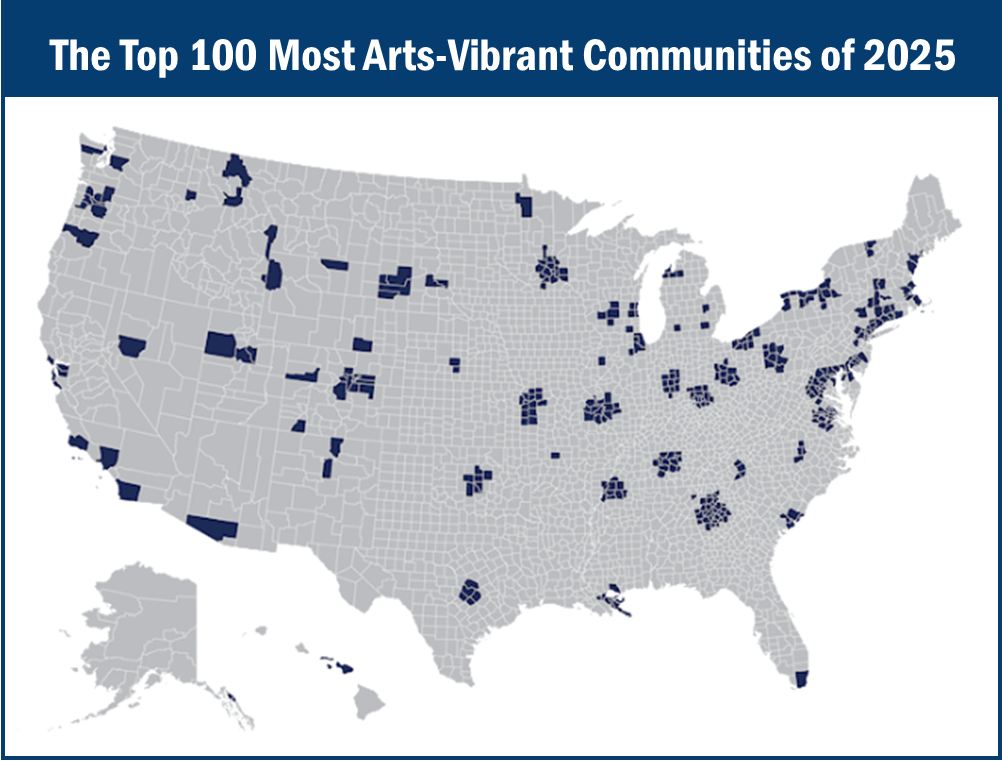
Waterbury-Shelton was ranked number 72, and Norwich-New London-Willimantic was ranked number 77, capping Connecticut’s communities earning a slot in the top 100.
On the state level, the leaders in arts vibrancy were New York (for the third consecutive year) and New Jersey, just ahead of Connecticut. Rounding out the top 10 were Massachusetts, Minnesota, Illinois, Maryland, California, Pennsylvania and Oregon. Among the other New England states, Rhode Island was #17, Vermont #19, Maine #23,and New Hampshire #42.
Using what officials describe as “a rigorous, data-driven methodology,” they measure vibrancy through indicators of arts supply, demand, and public support, while adjusting for cost of living and population size. These rankings provide a snapshot of where creative ecosystems are strongest and reveal emerging patterns in how states support and sustain arts and culture.
The vibrancy assessment consists of rubrics covering aspects of supply, demand, and public support for arts and culture. Values are adjusted on a per capita basis and differences in cost of living are accounted for to level the playing field as much as possible, SMU officials explain.
The three key measures, as outlined by SMU DataArts officials:
First, we measure the arts as an end unto themselves—not as a tool for economic development or tourism, but as fundamental to community life. The index tracks three areas: arts providers, arts dollars, and government support. We focus on measures available for every community in the U.S., minimizing bias based on local data collection capacity and ensuring apples-to-apples comparisons.
Second, we use a per capita approach. This ensures that cultural vitality is not dictated by population size, but by genuine investment in and commitment to the arts, given the size of a community. For instance, a small mountain town like Jackson, Wyoming with its robust cultural infrastructure can rank alongside—or even above—major metropolitan areas.
Third, we adjust for cost of living. A dollar spent on arts in rural Montana stretches further than a dollar in Manhattan. Our methodology accounts for these economic realities, ensuring that communities aren’t penalized—or artificially boosted—simply by geography.
“Connecticut's rise to #3 in the rankings demonstrates how dynamic a state's creative ecosystem can be,” they point out.