State Leaders Underscore Commitment to Connecticut's Mental Health Parity Laws
/State Comptroller Sean Scanlon, Attorney General William Tong, Insurance Committee Chair Senator Jorge Cabrera, and Senator Matt Lesser have responded to a just-released Connecticut Insurance Department Report announcing that the five major insurance companies in Connecticut will be fined for violating the state’s mental health parity laws.
The 158-page report, issued this month, is the Connecticut Nonquantitative Treatment Limitation Annual Report, prepared by the Insurance Department for the state legislature’s Insurance and Real Estate Committee.
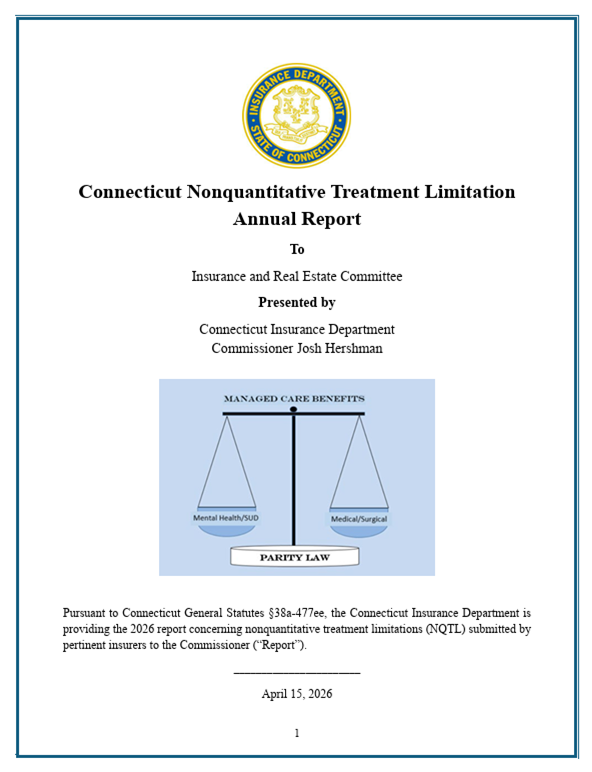
The data used by the Insurance Department, “limited to what was requested from and what was disclosed by the insurers, allows for a number of observations and leads to certain conclusions,” the report states. Submissions were received from five carriers: Aetna, Anthem, ConnectiCare, UnitedHealthcare, and Cigna.
Among the conclusions, the department’s data-gathering effort “revealed significant operational outcome disparities requiring robust evidence based- explanations and analyses of root causes that carriers failed to provide or that were provided in an insufficient or incomplete manner.”
In 2019, Senator Lesser and then-Representative Sean Scanlon led the passage of the Mental Health Parity Act, requiring that insurance companies not impose stricter limitations on mental health and substance use disorder benefits compared to those for medical and surgical benefits.
In 2025, Senator Cabrera worked to ensure the passage of regulations to enforce the Mental Health Parity Act, including publicly available scorecards for insurers based on their coverage of mental health services, as well as fines for those who violate the original law. Comptroller Scanlon and Attorney General Tong have continued to champion these initiatives, ensuring that all Connecticut residents have access to mental health treatment on their insurance plans.
"Diseases of the brain should never be covered differently by insurance than diseases of the body," said Comptroller Scanlon. "That's why, as a legislator, I worked to pass Connecticut's mental health parity law. It's why, as Comptroller, I worked to update that law and create real consequences for insurers that don't do the right thing. I'm glad to see that these companies will, for the first time, be held accountable for their violation of the law. And we will continue holding them accountable until no one in this state is discriminated against simply for seeking the mental health care they need and deserve."

The Insurance Department levied fines against Aetna, Cigna, ConnectiCare, UnitedHealthcare and Anthem, concluding that “A review of … data and information resulted in findings of violations against four health insurers for incomplete, insufficient, inaccurate or not updated network access measures regarding the new patient acceptance rate and patient wait times.” In addition, “several carriers provided insufficient information to address the operational outcome disparities that the department had identified. All five health insurers were found to have non-comparable and inadequate MH/SUD networks because of more stringent and limiting reimbursement rate structures demonstrated through disparate reimbursement rates, disparate out of network utilization rates, disparate new patient acceptance rates and disparate patient wait times.”
“The Connecticut Department of Insurance’s 2026 Mental Health Parity Report confirms what we have known for years: insurers are dropping the ball when it comes to covering mental health, despite their obligations under state and federal law. This report is important both because it identifies each insurer who is being evaluated and because the Department has fined five insurers, which it found to be out of compliance with parity laws. It represents a sea change in mental health parity enforcement in Connecticut,” said Attorney General Tong.

Tong added that he commends “Governor Lamont, Insurance Commissioner Hershman, legislators, patients, and mental health providers who have worked so hard to ensure that patients who pay dearly for insurance get real access to treatment for mental health conditions – just like they do for physical illness.”
"Mental health and substance abuse coverage is serious business,” said Senator Lesser. “In 2019, I wrote Connecticut's Mental Health Parity Law with then State Rep Sean Scanlon. Outrageously, insurance companies failed to follow the law. We amended the law last year to add fines and name names, and I am glad that Connecticut's Insurance Department is enforcing the law. Connecticut residents and businesses pay a fortune for health insurance. Insurance companies need to follow the law and provide the coverage people are paying for."
“In 2019, we had a good start. Senate Bill 10, passed last year, added monetary fines and ensured that we named names,” said Senator Cabrera, who as Senate Chair of the Insurance and Real Estate Committee oversaw passage of SB 10. “It was the right thing to do and, quite frankly, insurance companies should be ashamed of themselves for their actions. People are hurting. They need mental health care, and insurance companies are delaying and denying. Now we know who they are, and they are paying the price for their indifference.”
"For too long, people seeking mental health care in Connecticut have been navigating a system rigged against them. Finally, the days of insurers avoiding consequences for blocking access to care are ending,” said Christian Damiana of Mental Health Connecticut. “We're grateful to the General Assembly for enabling meaningful enforcement in 2025, and Governor Lamont and the Insurance Department for holding all five major insurers accountable for parity violations. We'll keep working for equal access to care for all residents.”